


If you only know the Lazio coast as a list of “best beaches near Rome,” it is easy to treat Sperlonga and Gaeta as simple day trips. After several nights actually sleeping on this stretch of shore, it became clear that the decision is less about ticking off beaches and more about where you base yourself, how close you sleep to the sand, and whether your car is a blessing or a burden. This is what I learned from staying near Sperlonga and Gaeta, and how to choose the right setup for your own Lazio coast escape.
Understanding the Lazio Coast Between Sperlonga and Gaeta
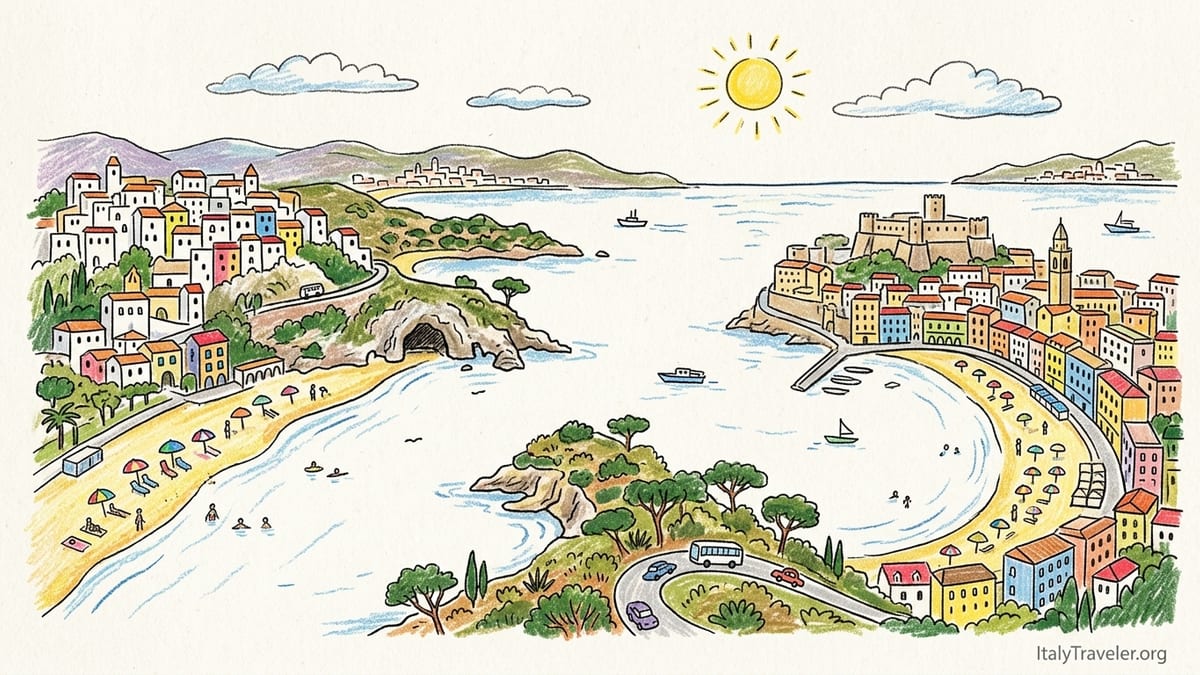
The coastline between Sperlonga and Gaeta sits roughly halfway between Rome and Naples, a series of sandy bays broken by rocky promontories and low headlands. Sperlonga itself is famous for its whitewashed medieval borgo on a hill and the archaeological remains of the Roman emperor Tiberius’s villa and grotto at the eastern end of the main beach. Inland, low hills covered in Mediterranean scrub frame what is officially promoted today as part of the Riviera di Ulisse landscape, emphasizing the link between these shores and classical mythology.
For a beach traveler, the relevant stretch is about 10 kilometers of coast that runs from Sperlonga’s long Ponente and Levante beaches out towards the Villa of Tiberius and then gradually on toward the rockier inlets on the road to Gaeta. Regional tourism materials describe this continuous band of sand and coves as a single seaside system with multiple access points, parking pockets and clusters of accommodations rather than one neatly bounded beach. That means you can sleep in an elevated historic center, at almost beach level, or in small roadside hotels and campgrounds set back from the water, all technically “Sperlonga.”
Gaeta, a little farther south, spreads around a peninsula that divides the Gulf of Gaeta into several distinct bays. Serapo Beach, directly south of the historic center, is the main urban strand, while smaller coves like Fontania and Ariana, and the longer Sant’Agostino beach, spread along the coastal road to Sperlonga. The municipality and local tourism boards list both fully equipped beach clubs and segments of free, public sand in each of these areas, with varying levels of parking, stair access and bar service.
From Rome, both towns are most commonly approached by train to Fondi-Sperlonga or Formia-Gaeta, followed by a short bus or taxi ride, or by car along the SS148 and Via Flacca. On a map, they look close enough to make an easy day trip. On the ground, especially in July and August, the choices you make about where to sleep and where to park will shape your trip at least as much as which Blue Flag beach you visit.
Sperlonga as a Base: Old Town vs Beach Level
Sperlonga is the more compact of the two towns and the one that most visitors describe as “looking like Greece” thanks to its cluster of white houses and alleys stacked over the sea. The historic center sits on a low promontory between two sandy bays. Streets inside the borgo are pedestrian, stepped and often steep. To get a sea view, you almost always accept some stairs, whether you are in a small guesthouse tucked into a lane or a larger hotel near the town’s higher terraces.
Many hotels and B&Bs in the old town are converted houses or small buildings with a handful of rooms. They trade on atmosphere and views rather than resort-style amenities. Breakfast often means a spread of pastries and coffee in a simple sala or terrace rather than a huge buffet. At night, you are within a few minutes’ walk of casual seafood trattorias, pizza places and gelato, and in high season you may hear conversation and music from the main piazzas until late. If you are sensitive to sound, look carefully at room descriptions and reviews before committing to a place directly on a square or main alley.
Down at beach level, on the flat land behind the sand, a different Sperlonga appears. Here the buildings are newer and lower, with more standard mid-range hotels, small family-run properties and some apartment complexes. Rooms are often larger, elevators are more common, and you can exit the lobby and reach a beach club entrance in just a few minutes on foot without climbing. Some properties include discounted access to a specific lido or maintain their own strip of umbrellas; others simply hand you towels and let you choose among neighboring clubs.
In practice, staying in the old town or at beach level is a trade-off between romance and logistics. Sleeping in the borgo delivers the whitewashed lanes and sea views that make Sperlonga so photogenic, but you will almost certainly be walking down and back up a hill to reach the sand, and your car, if you have one, will sit in a public or private lot below. Sleeping near the beach simplifies your days with children or elderly travelers, but the surroundings feel more like a generic seaside resort strip, and your evening stroll into the historic center may involve a ten to fifteen minute uphill walk or a short drive that circles to parking areas on the edge of the borgo.
Parking, Stairs and the Reality of Beach Access in Sperlonga
Parking is the practical bottleneck in Sperlonga. The streets inside the borgo are off limits to non-resident cars, and the public multi-storey lot at the edge of the old town has a reputation among recent visitors for narrow ramps and tight spaces. Additional pay-and-display lots sit near the waterfront and along the access roads to the beach. In peak season, local guides and recent reports describe day rates for central lots around the beach that can reach roughly 15 euro for a full day, with cheaper hourly rates in shoulder months.
If you arrive by car and stay overnight, many hotels at beach level and some guesthouses higher up maintain reserved spots in nearby lots or offer a limited number of private parking spaces for guests, sometimes free, sometimes at a daily surcharge. When comparing prices, it is worth asking explicitly whether parking is included in the room rate or must be reserved separately, because the difference can add up over several days. Those who arrive without a car often describe their stay as more relaxed, in part because they are not circling for a place in the afternoon heat.
Stairs are the second key factor. To move between the borgo and the beaches, you either walk downhill via stepped alleys and then along the seafront, or follow sloping side streets at the edge of town. The elevation change is not extreme, but in midsummer sun or carrying a beach bag and gear, it is noticeable. Staying near the beach largely removes this daily climb, while basing in the old town builds it into your routine. For travelers with limited mobility, beach-level accommodation or a stay in Gaeta near Serapo, which is mostly flat, often works better.
The beach clubs themselves vary. Some stretches have frequent private lidos with tight rows of umbrellas and orderly lockers, while others leave wider gaps of spiaggia libera. Prices in the Sperlonga area reported for the 2025 and 2026 summers suggest that a standard package of one umbrella and two sunbeds in a mid-row position can easily reach several tens of euros per day in July and August, with first rows closer to the sea costing an extra five to ten euros. Booking multiple days with the same lido or choosing June or September instead of peak August often brings better value.
Beach Clubs, Free Sand and Costs: What I Actually Paid
On days based in Sperlonga, paying for a lido rather than relying on the free sections usually made sense. At the main Ponente beach, I encountered several clubs charging in the region of 30 to 40 euro per day for an umbrella and two beds in mid-summer, with small variations depending on position. Second or third rows were significantly cheaper than the very front. Clubs with their own parking area requested an additional fee for non-guests, although some rolled a space into full-day packages on less busy weekdays.
For comparison, paying only for public parking and using the free beach would have saved money, but the savings shrank once you factored in the cost of shade, drinks and toilets. Public stretches have no fixed facility beyond any showers the municipality installs at the access points. On one day, the difference between a free stretch with supermarket picnic and a lido with bar, toilets and lifeguard worked out to about 15 to 20 euro, which felt justified on a hot afternoon when we wanted shade and easy swims.
In Gaeta, at Serapo Beach and the coves along the Via Flacca such as Ariana and Sant’Agostino, the structure is similar but slightly more spaced out. Official city information lists a mix of fully equipped clubs and public areas, with some lidos advertising free or included parking for day clients on their own websites. At one mid-range club near Ariana, a weekday umbrella and two beds package cost less than the Sperlonga high-season rate, and parking in the adjoining lot was free for those with a reservation at the lido. In exchange, there was a short walk down a paved path and a flight of stairs to reach the sand.
Breakfast and evening costs varied more by personal choice than location. In both towns, a simple beach bar breakfast of cappuccino and cornetto hovered in the low single digits per person, far cheaper than a hotel buffet surcharge. Dinners in the old centers, particularly Sperlonga’s hilltop lanes and Gaeta’s medieval quarter, climbed in price as soon as you chose fresh fish and a full bottle of local wine, but it was very possible to eat pizza al taglio or simple seafood pasta at moderate prices. Where you stay influences what you are tempted to order: a stroll past bustling taverns makes a sit-down meal more likely, while staying at beach level often leads to a simpler pattern of early aperitivo and occasional takeaway eaten on a balcony.
Sperlonga by Night vs Day Trip From Rome
Most day trippers from Rome reach Sperlonga by taking the regional train to Fondi-Sperlonga, then the shuttle bus toward the town and walking to the beach. In shoulder season, this works smoothly. On summer weekends, the intimacy that makes Sperlonga so appealing as a base can become a liability when crowds are funneled through the same few streets and parking lots. Basing in Rome and arriving only for the central hours of the day means you spend your time in the most crowded, hottest window, and are back on the train before the town’s evening personality comes out.
Staying overnight instead changes the rhythm. In the morning, before the first buses arrive, the sand is almost empty and the sea still. Walking down from the borgo, you may share the promenade mostly with joggers and local dog walkers. At night, once day visitors have left, restaurants in the old town and along the small harbor feel more local, and traffic on the coastal road drops. You still hear scooters and conversations, but the sense of being in a village rather than a busy beach club circuit returns.
From a cost perspective, a single long day trip can be cheaper than a night or two of accommodation, particularly if you stick to free beach areas and bring your own food. However, once you add parking or multiple lido days on top of train and bus tickets, a short Sperlonga stay starts to make sense if you value swimming at quiet times. An overnight in a simple guesthouse just off the main lanes, even without sea view, allowed more flexible beach hours and made the Villa of Tiberius visit feel like a stroll rather than a logistical challenge squeezed between train times.
The main downside of staying overnight is that you begin to share Sperlonga’s infrastructure constraints. Waste collection trucks, deliveries and early morning bar set-up noise filter through the narrow alleys. If your room faces a popular staircase or small piazza, late-evening voices echo more than in a modern coastal hotel. Choosing a room on an upper level, away from the busiest lanes, and accepting a five-minute extra walk often improves sleep significantly.
Gaeta as a Base: Serapo, Medieval Quarter and Outlying Coves
Gaeta, while still very much a seaside resort, feels more like a working town than a pure holiday village. It occupies a peninsula that creates a natural harbor on one side and opens to Serapo Beach on the other. The town extends over several neighborhoods, from the medieval quarter clustered around the castle and churches, to 20th-century streets lined with apartments and small hotels closer to the main beach. This spread means you can stay on the waterfront, in a historic lane, or slightly inland and still reach the sea on foot.
Serapo Beach itself is a long city strand backed by a road with hotels, small villas and apartment buildings. Some hotels sit directly across from the sand and partner with nearby lidos for discounted umbrella packages. Others, including classic family-run properties slightly back from the water, emphasize their gardens or rooftop terraces over direct beach frontage but remain only a few minutes’ walk from lido entrances. In this part of Gaeta, the topography is fairly flat, so stairs are limited to short flights over dunes or down to particular coves.
Parking in Gaeta is more dispersed but still needs attention. The municipality lists multiple car parks in town, including areas near Serapo and in the city center. Some are small street-level lots, others are marked bays along the promenade. Many are paid, at least in high season or during daytime hours, with free or cheaper parking further from the waterfront. Several beach clubs outside the center, particularly around Ariana, advertise their own free parking for guests, which can be a significant advantage if you are using Gaeta as a base to explore different bays by car.
At night, Gaeta offers a broader spread of dining and bar options than Sperlonga simply because it is larger. In the medieval upper town you find trattorias under stone arches and wine bars tucked into alleys, while down near the waterfront promenade there are modern cafes and gelaterie that stay open late in summer. Sleep quality depends heavily on where you stay. Rooms overlooking busy streets or the promenade can be noisy until after midnight, especially on weekends, while hotels in slightly elevated residential pockets or facing internal courtyards are noticeably quieter.
Car or No Car: How Useful Was It in Each Town
Whether your car feels like freedom or a headache on this part of the Lazio coast depends on how you plan to use your base. In Sperlonga, the car mostly stayed parked. Once checked into a hotel near the beach or a guesthouse in the old town, daily life played out on foot. Walking to the Villa of Tiberius archaeological area from the center along the sand took roughly forty minutes at a gentle pace. Alternatively, a short drive along the coastal road delivered you to the museum car park, but since the parking area is limited and summer demand high, visiting on a weekday morning while based in town was calmer than arriving as an outside day tripper.
Using Sperlonga as a hub for inland excursions or for hopping between nearby beaches is theoretically attractive but practically awkward, because leaving and re-parking can cost both time and money. Each re-entry to the tight public lots or search for street parking risks losing the relatively convenient spot you already secured. Several travelers consider leaving the car at a larger inland lot or even arriving without one, relying instead on buses and walking while in Sperlonga itself, only renting a vehicle for a separate segment of their trip focused on wider exploration.
In Gaeta, the car was more actively useful. Without its own train station, Gaeta depends on buses or taxis to connect with Formia’s rail hub, and public transport along the coast between the different beaches is workable but limited. Having a car made day trips to the smaller coves and out-of-town lidos, including those with their own guest parking, far more convenient. It also opened up inland villages and hilltop viewpoints beyond the reach of casual walkers.
The trade-off is that parking enforcement in Gaeta is taken seriously, with clear colored zones and time limits marked on signs. Where beach clubs did not provide parking, using municipal spaces near popular spots like Serapo or the medieval quarter required careful reading of hours and payment rules. Travelers who wanted nothing more than to sit on the sand outside their hotel and stroll to dinner would do well to choose accommodation within a short walk of Serapo and to leave the car parked in a permitted zone or hotel lot for most of their stay.
Balancing Sea Views, Sleep Quality and Services
In both Sperlonga and Gaeta, chasing a sea view room can mean giving up some sleep quality. In Sperlonga’s old town, rooms with balconies over popular stairways or squares give postcard-ready photos at sunset but also pick up every conversation and clatter of footsteps below. Choosing a room facing inward to a small courtyard, or on a side alley slightly back from the main spine of the borgo, reduced noise significantly in my experience while still keeping the whitewashed charm just outside the door.
At beach level in Sperlonga, hotels that sit directly on the promenade may experience traffic noise in the early evening and morning, as delivery vans and scooters use the same tight roads that serve as seafront walks. A second-row property behind them or one shielded by a small garden can feel noticeably quieter. If your main priority is easy access to the sand and you are willing to walk ten minutes uphill for dinner views, this is an excellent compromise, particularly with children, strollers or older relatives.
In Gaeta, the calculus is similar. Rooms overlooking Serapo or the waterfront marina offer wide sea vistas but also pick up beach bar music, summer events and the ambient hum of a larger town. Some of the most comfortable nights came in hotels set slightly off the waterfront, with side views of the sea but front windows opening to quieter side streets. These properties often had their own small parking court or reserved spaces, further reducing stress.
Breakfast quality varied less by town than by individual property. Some hotels presented generous buffets with savory and sweet options, while many smaller B&Bs offered a simpler spread in line with Italian breakfast habits. Because both Sperlonga and Gaeta have numerous bars and pastry shops, it was always possible to step out and improvise breakfast for a few euros per person, and in Gaeta in particular, stopping at a bar for coffee became a way to feel part of daily life as locals paused on their way to work.
The Takeaway
If your main goal is to enjoy a classic whitewashed hill town with long sandy beaches, and you are content to live on foot for a few days, Sperlonga makes the more focused base. Staying in the old town immerses you in the lanes and views that attract photographers, at the cost of stairs and daily walks down to the beach. Staying at beach level makes life easier with children and reduces the vertical effort, though at the price of a more generic resort atmosphere. Either way, you can visit the Villa of Tiberius, explore the archaeological museum and enjoy the 10 kilometers of coast around town without relying heavily on your car.
If you prefer a slightly larger town with more varied dining, a spread of beaches from urban to wild, and you plan to use your car to explore several bays, Gaeta is the better base. Sleeping near Serapo means you can leave the car parked for much of your stay, dipping into medieval lanes and beach bars on foot. Choosing accommodation nearer the outlying coves such as Ariana or Sant’Agostino suits travelers who want more space and are willing to drive into town for evening strolls.
Comparing overnight stays with day trips from Rome, the key difference lies in rhythm, not in any single beach. A day trip compresses your experience into the busiest hours and makes every connection and parking stop feel like a deadline. A two or three night stay, whether in Sperlonga or Gaeta, allows you to swim early and late, wander historic streets after the crowds have gone, and treat the cost of a lido umbrella or parking fee as part of a wider seaside pause rather than a rushed expense. On this part of the Lazio coast, that shift in tempo is often what turns a hot outing into a genuinely restorative break.
FAQ
Q1. Is it better to stay in Sperlonga’s old town or near the beach?
Staying in the old town gives more atmosphere and views but involves daily stair and hill climbs to reach the sand and parking. Staying at beach level is far more convenient for swimming and for families, though the setting feels more like a modern resort strip than a historic village.
Q2. Do I need a car to enjoy Sperlonga and Gaeta?
No, but it changes what you can do. In Sperlonga, a car is almost unnecessary once you arrive, as most activities are walkable. In Gaeta, a car is more useful for reaching different coves and for connecting with Formia’s train station, though it adds parking and traffic considerations.
Q3. How expensive are beach clubs compared to free beaches?
On the Lazio coast around Sperlonga and Gaeta, a summer day with an umbrella and two sunbeds in a beach club can cost several tens of euros, sometimes more for front rows or high-season weekends. Free beaches cost nothing but offer little shade or services, so you may still spend on food, drinks and portable shade.
Q4. Is parking really a problem in Sperlonga?
Yes, particularly in July and August and on weekends. Public lots fill quickly and daily rates in central areas can be high. Many visitors find it easier to leave the car parked for the duration of their stay or to arrive by train and bus instead of driving right into town.
Q5. Which town is better for travelers with limited mobility?
Gaeta, especially near Serapo Beach, offers flatter terrain and easier beach access than Sperlonga’s stepped hilltop streets. In Sperlonga, choosing accommodation at beach level rather than in the borgo can reduce the number of stairs, but there will still be some slopes and uneven surfaces.
Q6. Can I visit the Villa of Tiberius easily if I stay in Sperlonga?
Yes. From the center of Sperlonga the Villa of Tiberius archaeological complex and museum are within a walk along the beach or a short drive along the coastal road. Staying in town makes it easier to choose a quieter time of day for the visit, avoiding the hottest midday hours.
Q7. Is Gaeta too big to feel like a seaside getaway?
Gaeta is larger and more lived-in than Sperlonga but still very much a coastal resort, with a main beach at Serapo and smaller coves along the peninsula. If you stay near the sea and historic quarters, it feels like a beach town with extra dining and service options rather than a generic city.
Q8. How many nights should I plan on the Lazio coast?
Two to three nights works well for most travelers, allowing a full day on the beach, time to explore the historic quarters, and a visit to the Villa of Tiberius if you base in Sperlonga. Longer stays suit those who want to explore multiple bays, nearby inland villages or simply slow down.
Q9. Are evenings noisy in these towns in summer?
In high season, both Sperlonga and Gaeta are lively in the evenings, with restaurants and bars open late. Rooms facing main squares, stairways or the waterfront can pick up noise, so lighter sleepers often prefer accommodation on quieter side streets or slightly back from the promenades.
Q10. If I only have time for one town, should I pick Sperlonga or Gaeta?
If you want a small, photogenic whitewashed village with a strong holiday feel, choose Sperlonga. If you prefer a slightly larger town with more varied beaches, restaurants and practical services, and you are likely to use a car, Gaeta is usually the better fit.