


Viterbo markets itself as the “City of the Popes,” but what really lured me north from Rome was hot water. The countryside around this medieval city in northern Lazio is riddled with geothermal springs, feeding everything from polished spa complexes to rough concrete basins steaming by the roadside. I spent a full day moving between a paid spa at Terme dei Papi and the free pools at Piscine Carletti, paying attention not to vague wellness promises but to the very concrete details that actually make or break a thermal day: queues, lockers, changing rooms, water temperature, food, crowds and the things I was annoyed I had not packed.
Arriving in Viterbo’s Thermal Belt
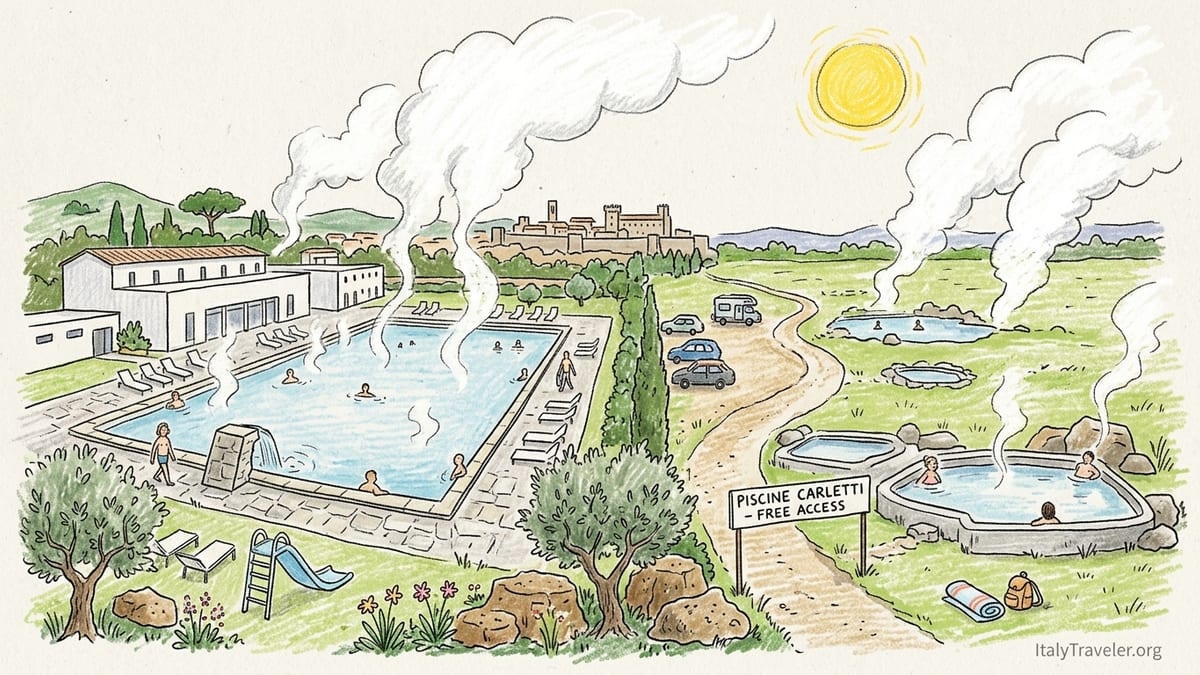
I based myself in Viterbo’s walled historic center, about 90 minutes north of Rome by car or regional train and bus. The city sits in the middle of one of Italy’s most active lowland geothermal zones, and you are reminded of this long before you see any spa reception. Driving along Strada Bagni toward Terme dei Papi, plumes of steam rise from fields and ditches, and the sulfur smell creeps into the car as you pass signposts for Il Bagnaccio, Bulicame and Piscine Carletti.
By mid-morning I was pulling into the large parking area in front of Terme dei Papi, a long white building set at the foot of low green hills. The spa’s monumental outdoor pool is its calling card, and it stays open all year. According to the official information, the thermal center opens daily from 9:00 to 19:00, with the big pool open the same hours on most days and extended night opening on Saturdays, when bathing continues until 1:00. Tuesdays are reserved for routine maintenance, so the monumental pool is closed then even though the rest of the center may still operate.
I chose a weekday in early autumn specifically to avoid weekend crowds and the peak summer heat. Even so, there was a steady stream of cars and tour buses in the lot by 10:00. Most visitors seemed to be Italian couples and groups of friends rather than international tourists. The atmosphere was relaxed but purposeful: people were clearly here to soak for several hours, not just to snap a few photos and leave.
Booking, Tickets and First Impressions at Terme dei Papi
One difference between a commercial spa and a free spring in Viterbo shows up even before you touch the water: you now need to think about reservations. Terme dei Papi sells tickets both on site and online, and the official policy strongly recommends booking ahead, especially at weekends and on holidays, because admissions are capped. Online tickets must be prepaid and guarantee entry up to the capacity limit. Once the daily quota is sold, there may still be a small allocation for walk-ins at the front desk, but you cannot count on it.
Prices are fairly transparent. At the time of my visit, a weekday all-day ticket for the monumental pool cost about 18 euros, with a three-hour option at 12 euros. On holidays and the days immediately before them, those prices rise to roughly 25 euros for the full day and 18 euros for three hours. There is a child rate for ages roughly 2 to 11 at around 8 euros, and a separate 20 euro ticket for the Saturday night session from 21:00 to 1:00. Seasonal surcharges apply around Christmas and New Year, when special pricing can push the adult day ticket to around 30 euros and the three-hour ticket above 20. These figures can change, but they give a realistic baseline for planning a Tuscia spa day budget.
Inside the lobby, the process is closer to a swimming pool than a luxury resort. At the main reception, I paid for a weekday all-day admission, then was directed to a second counter to collect a plastic wristband and choose a locker. The staff were brisk but patient in explaining how the timing worked. If you choose the three-hour option your countdown starts when you pass through the electronic turnstiles into the pool area and stops when you exit them. Overstaying, even by a few minutes, automatically adds a surcharge of around 10 euros per person, which is something to keep in mind if you tend to linger in hot water.
Changing Rooms, Lockers and What I Wished I Had Packed
The changing area at Terme dei Papi feels more functional than glamorous, but it is one of the main advantages of paying for a commercial spa over going straight to an open-air pool like Carletti. Along a long corridor there are separate male and female changing rooms with rows of lockers, showers and toilets. The lockers are large enough to swallow a daypack or medium-sized backpack, and they are included in the entrance price. The wristband they hand you at check-in is programmed to your specific locker: you tap it against the sensor to lock and unlock, so there is no fiddly key to keep track of in the water.
I found the overall cleanliness solid. The floors in the changing room are wet and a bit mineral stained, but I saw staff doing regular mopping runs and emptying bins. The showers are basic, with warm water and simple mixers, and the water pressure was adequate. Soap is not always provided by default at every shower station, so packing your own travel-size body wash or a small bar is useful if you care about rinsing off properly after standing in sulfur water.
In hindsight, my packing list could have been better. I had a standard swimsuit and a microfiber towel, which are the minimum essentials, but I really missed a pair of rubber or plastic pool slides. Flip-flops technically work, yet the combination of wet tiles and sulfur residue makes the surfaces surprisingly slippery. Closed-heel slides or sandals with some grip feel much safer. I also wished I had brought an old swimsuit rather than a favorite one, because sulfur water and the dissolved minerals can discolor fabrics over time. Finally, a lightweight robe or poncho towel would have made trips between the pool and the bar area far more comfortable on a breezy day.
The Monumental Pool: Water, Heat and Hours of Soaking
Stepping out of the building onto the pool deck, the first thing that hits you is the sheer scale of the monumental pool. The official description puts it at around 2,000 square meters, a wide expanse of steaming, pale blue water framed by stone edges and low, misty hills beyond. On a cool morning in Tuscia, the air above the surface is thick with vapor, and the far end of the pool disappears in fog.
The water in the main pool at Terme dei Papi is hyperthermal, which in practical terms means it feels genuinely hot as you step in, especially if you have just come from the cooler air outside. Different sources report slightly different figures, but it sits in the low 40s Celsius at the points where it flows in, cooling as it circulates and mixes. I found that certain corners and areas around the small waterfalls felt much hotter, while spots closer to the pool edges or farther from the inflows were closer to a very warm bath. That variety allowed people to self-select zones that matched their own tolerance.
I ended up spending about three hours in and out of the water without noticing time pass. Because this is a pool designed for soaking rather than lane swimming, the pace is unhurried. Many people leaned against the underwater benches along the sides, half-submerged up to their shoulders. Others waded slowly through the center, letting the mineral-rich water lap at their arms and neck. There are a few water jets and cascade features where people queue for a few minutes of pounding water on their shoulders, but Terme dei Papi is more about immersion than gadgets.
The pool deck has a mix of stone and non-slip surfaces, and on my visit it was clean, with only a light natural patina from the water. The slight film of minerals on the bottom surprised some first-time visitors, but it is a normal side effect of geothermal pools in this region. From certain angles you can see the fine silt swirling around your feet when you move. Between long soaking sessions, I would get out, wrap myself in a towel, and sit on the loungers around the edge. In autumn there were always spare loungers, though in high summer these can fill up quickly, so arriving earlier in the day is wise if you want a spot.
Food, Drinks and Practical Rules Inside the Spa
Another clear difference between a commercial spa and a free spring near Viterbo is how food and drink are handled. At Terme dei Papi, outside food is not permitted inside the main thermal complex. The spa provides its own bar, cafeteria and a more formal restaurant. This policy is clearly signposted, and bags are subject to a quick visual check at the entrance. It is not the place for picnic coolers or homemade sandwiches.
During my visit I opted for the self-service cafeteria just off the indoor corridor. The offer was recognisably Italian: simple pasta dishes, grilled vegetables, salads, panini and cakes. Prices were higher than a basic trattoria in town but not outlandish for a captive spa setting, and the turnover of diners kept the food reasonably fresh. I appreciated being able to leave the pool area, eat at a proper table, and then return to the water without needing to fully check out or change back into street clothes.
For drinks, the bar serves coffee, soft drinks, aperitifs and bottled water. The atmosphere around the bar is social but not rowdy; most people seemed to be locals on a day off or guests staying at affiliated hotels. Alcohol is allowed in moderation, but staff keep an eye on anyone who looks unsteady getting back into the hot water. Inside the spa, standard rules apply: swimwear is mandatory, long hair must be tied up or contained, and glass containers are not allowed on the pool deck. Lifeguards and attendants walk regular circuits to enforce these basics and answer questions.
Free Springs: My Evening at Piscine Carletti
After a full day at Terme dei Papi, I wanted to see the other side of Viterbo’s thermal culture. A short drive along the same Strada Terme brings you to Piscine Carletti, a cluster of free, open-air basins just a couple of kilometers from the city. There is no gatehouse, no ticket and no reception. Instead, there is an unpaved parking area near the road and a network of paths leading to steaming pools in a flat field.
The basic facts matter for planning. Piscine Carletti sits on public land and is officially described by regional tourism bodies as having free access. That means there is no entrance fee and no fixed opening or closing hours. In practice, people soak here at all times of day and night, with late evening and very early morning particularly atmospheric as the steam catches the low light. Some information boards and independent guides note that the site is suitable for low-impact overnight bivouac from roughly dusk to dawn, and camper vans often park nearby. At the same time, local news reports have highlighted ongoing issues with degraded access tracks, potholes between the main road and the parking area and occasional littering.
Arriving in the late afternoon, the scene could not have been more different from Terme dei Papi. There was no guardrail between the pools and the surrounding fields, and the basins themselves were relatively simple concrete and natural rock structures of varying sizes and depths. The nearer pools, where the thermal water surged in hottest, were almost too hot for me to enter fully at first, especially after a full day of soaking. As you move away from the source, the water cools, and some basins under scattered trees felt more like warm baths.
There are no changing rooms at Carletti. Most visitors either arrived in their swimsuits under loose clothing or used a towel as a makeshift curtain against the wind. There are no lockers; valuables either stayed locked in cars or in small dry bags within arm’s reach on the pool edge. There are no formal showers, though some people used bottles of freshwater they had brought from home to rinse off their skin before heading back to the car. In short, every convenience that was built into my day at Terme dei Papi suddenly became my own responsibility.
Cleanliness, Crowds and Comfort: Paid Spa vs Free Pools
Experiencing both a paid spa and a free site in the same day makes the trade-offs very clear. In terms of cleanliness, Terme dei Papi has the edge simply because it controls access and employs staff to maintain the facilities. The changing rooms, toilets and showers are cleaned on rotation, and the monumental pool is closed weekly for maintenance and deeper cleaning. Even so, it is not a sterile environment. Mineral deposits form naturally, and the sulfur smell clings to hair and fabrics.
At Piscine Carletti the maintenance model is different. The water is constantly flowing and draining, which does help to keep the pools themselves relatively clear, but the surrounding area relies heavily on visitor behavior and occasional municipal interventions. When I visited, some basins were pleasantly clean, and others had stray plastic bottles or cigarette ends around the edges. The parking area was uneven and rutted. Signage from local authorities urges visitors to respect the environment and use the scattered bins, but the reality of a completely free, unsupervised site is that standards vary from day to day.
Crowd levels also feel different. At Terme dei Papi, entry limits and timed tickets flatten out the peaks. On my weekday visit the monumental pool was busy but never felt dangerously crowded. People spread naturally around the perimeter and into the central zone, with room to float without bumping constantly into strangers. On peak weekends and during holiday periods, the pool can feel much fuller, but the cap on admissions still keeps it within safe capacity.
At Carletti, crowding is governed only by word of mouth, weather and the season. On a cool shoulder-season evening the mix was relaxed: local families, backpackers and a few camper vans lined up along the dirt track. Friends chatted, some people soaked quietly alone, and the lack of artificial lighting beyond car headlights and a few portable lanterns made the scene feel semi-wild. On other nights, especially in high season, online reviews suggest it can get much busier and noisier, with late-night social gatherings that may not appeal to every traveler.
Other Springs Around Viterbo and When to Go
Terme dei Papi and Piscine Carletti are not the only options in Viterbo’s thermal belt, but they illustrate the two poles of the experience: polished commercial spa and unstructured free pools. Somewhere in the middle sits Il Bagnaccio, a partially managed thermal park with an access fee, changing facilities and on-site staff, which attracts both locals and visitors following the Via Francigena pilgrimage trail. Other historic springs such as Bulicame have had periods of partial closure or restricted access in recent years for environmental and safety reasons, so it is worth checking the most recent local information before planning a visit specifically around them.
Seasonally, the sweetest time to enjoy this area is from late September through early May. In midsummer, central Italy can be hot enough that sitting in a 40 degree pool under a blazing sun loses its appeal quickly, and you need to think more carefully about hydration and sunburn. In the cooler months, by contrast, stepping from cold air into steaming water feels indulgent in a very straightforward way. My own spa day in early autumn offered the best of both worlds: a crisp morning and evening with mist over the pools, and a warm, sunny afternoon for drying out on a lounger.
Another factor to consider is the day of the week. Because the monumental pool at Terme dei Papi closes for maintenance on Tuesdays, that is the one day you cannot count on a full spa experience there, although the rest of the facility may still offer treatments and smaller pools. Weekends, especially Saturdays with the late-night opening, are popular with both locals and visitors from Rome; weekday mornings tend to be quieter, with a demographic skewed toward retirees and people on midweek breaks.
What I Learned and What I Would Do Differently Next Time
Looking back at my Tuscia spa day, the strongest impression is how complementary the paid spa and the free springs felt rather than how they competed. Terme dei Papi gave structure: hot showers, proper changing rooms, lockers, a cafeteria where I could eat a real meal and the psychological comfort of lifeguards and clear rules. It was easy to relax there for long stretches without worrying about where to put my wallet or how to rinse off sulfur water before getting back into a rental car.
Piscine Carletti, on the other hand, gave me a sense of the raw geothermal landscape that made Viterbo a thermal destination in the first place. Sitting in a shallow pool carved out of tufa rock, looking out over dark fields with only the lights of distant farmhouses and the occasional train, felt nothing like being in a managed spa complex. It was less about amenities and more about sharing an old local habit with whoever happened to show up that evening.
Next time, I would pack a slightly different kit. For Terme dei Papi, I would bring secure pool slides, a light bathrobe or poncho towel, a spare swimsuit I do not mind staining, a waterproof pouch for my phone and a simple plastic bag for a wet towel. For Carletti, I would add a headlamp or small torch for navigating in the dark, two liters of drinking water, a thermos with something warm, a compact camp chair to avoid sitting on damp ground and a garbage bag to carry out my own trash and, if needed, a bit of someone else’s.
Most importantly, I would allow more time. A single day is enough to experience both sides of Viterbo’s thermal belt, but stretching that to a long weekend would let you add a medieval-city wander and perhaps a trip to nearby Bolsena Lake, which many locals combine with winter thermal soaks as a kind of seasonal rhythm.
The Takeaway
If you travel to Viterbo with glossy brochure images of luxury wellness in mind, Terme dei Papi will give you a solid, concrete version of that vision. You get a vast hot pool, managed facilities, clear entry rules, somewhere to shower and a place to sit with a plate of pasta between soaks. It is not the kind of designer spa where everything smells of eucalyptus and the loungers are velvet, but it is reliable, warm and open most days of the year.
If you arrive curious about how people in this part of Lazio actually use the hot water that bubbles up from beneath their fields, then you owe it to yourself to visit at least one free spring, whether that is Piscine Carletti or another legal site nearby. You will trade changing rooms and security cameras for starry skies, improvised benches and the mild unpredictability that comes with any unsupervised public place.
My own Tuscia spa day convinced me that the real strength of Viterbo as a thermal destination is this mix. The city offers both a commercial wellness product and a more spontaneous, do-it-yourself way of entering the same aquifers that once attracted popes and pilgrims. As long as you arrive prepared, respect the rules where they exist and the landscape where they do not, you can have a very real, very warm day in the water without needing any grand promises about what it will do for your health.
FAQ
Q1. Do I need to book Terme dei Papi in advance or can I just show up?
For weekdays outside holidays you can often buy tickets on site, but the spa limits admissions and strongly recommends online booking, especially for weekends, holidays and Saturday night openings. Advance purchase guarantees your slot up to the facility’s maximum capacity, while walk-in tickets are sold only if there is remaining space.
Q2. How much does it cost to spend a day at Terme dei Papi?
Recent official price lists show a weekday all-day ticket for the monumental pool at around 18 euros, with a three-hour option at about 12 euros. On holidays and the days immediately before them, the all-day price rises to roughly 25 euros and the three-hour ticket to about 18 euros. There is a child rate and occasional seasonal surcharges, such as higher prices over the Christmas and New Year period.
Q3. What should I bring for a spa day at Terme dei Papi?
At minimum bring a swimsuit, towel and pool-safe footwear. In practice, a pair of sturdy rubber slides or sandals, a light robe or poncho towel, a waterproof pouch for your phone and a plastic bag for wet items make the day more comfortable. If you have long hair, bring a hair tie or cap, and consider using an older swimsuit, as sulfur water can slowly affect colors.
Q4. Are there age restrictions or family facilities at Terme dei Papi?
Families with children do use the monumental pool, and there is a reduced child ticket for younger visitors. Very young children may be subject to specific rules or limitations around hot water use, which the staff can explain at check-in. For adults, there is no upper age limit, and weekdays often see many local retirees spending several hours soaking.
Q5. Is Piscine Carletti really free and open 24 hours a day?
Piscine Carletti is on public land with free access, and there is currently no entrance fee or official closing time. People commonly soak there at all hours, including late at night and at sunrise. However, because it is unsupervised and conditions can change due to weather or municipal works, it is wise to check recent local information and exercise common sense about personal safety after dark.
Q6. Are there any facilities at the free pools like Piscine Carletti?
Facilities at Carletti are minimal. You can expect an unpaved parking area, informal paths and the basins themselves, but no staffed changing rooms, lockers or staffed showers. Information boards and a few bins may be present, yet you should plan to arrive already wearing your swimsuit, keep valuables secure in your vehicle and bring your own drinking water and basic supplies.
Q7. How hot is the water at Viterbo’s springs?
The geothermal springs around Viterbo are among central Italy’s hotter ones. At Terme dei Papi the water feeding the monumental pool is hyperthermal, with source temperatures reported in the low 40s Celsius, cooling slightly as it circulates. At free sites like Carletti, pools nearest the source can feel extremely hot, while those farther away are comfortably warm. Sensitive bathers may prefer to start in the cooler basins.
Q8. What is the best season to visit the thermal baths around Viterbo?
The most comfortable season for long soaks is from autumn through spring, roughly October to April, when cooler air makes the contrast with hot water pleasant. Summer visits are possible, especially in the evenings, but daytime temperatures can make prolonged soaking uncomfortable and increase the risk of sunburn and dehydration.
Q9. Is it safe to visit free springs like Piscine Carletti alone?
Many people do visit Carletti alone, particularly during daylight, and I personally felt at ease in the late afternoon and early evening when other bathers were around. However, free, unsupervised sites always involve some degree of risk, particularly at night or in very isolated conditions. If you are traveling solo, consider visiting during busier times, keeping valuables out of sight and trusting your instincts about when to leave.
Q10. Can I combine a visit to Terme dei Papi with other sights in Viterbo in one day?
Yes. With careful planning you can spend several hours at Terme dei Papi and still explore part of Viterbo’s medieval center, including the Papal Palace and the walled quarters. One common pattern is to book a morning or early afternoon slot at the spa, return to town for a walk and an early dinner, and then, if you still have the energy, drive out to a free spring such as Piscine Carletti for an evening or night-time soak.