

When I first started planning side trips from Rome, I made the classic mistake of searching for “best day trip from Rome” and expecting the internet to hand me a single winner. After several visits built around Tivoli, the Castelli Romani and Viterbo’s Tuscia, I can confirm there is no single “best.” What there is instead are three very different escapes that suit different moods, time frames and traveler types. I have walked the length of Hadrian’s Villa in Tivoli, eaten long Sunday lunches in Castelli Romani towns, and sunk into hot thermal water outside Viterbo. Drawing on those firsthand days, and updated practical details, this is how the three Lazio escapes really compare when you have to choose.
How I Actually Traveled Each Area
Across several Rome stays, I visited each of these areas in different ways. Tivoli was my pure day trip from Rome: out in the morning, back in the evening, with a deliberate focus on Villa Adriana (Hadrian’s Villa) and Villa d’Este. The rhythm was classic sightseeing. I took a regional train from Roma Tiburtina to Tivoli in about 40 minutes, then a local bus and a fair bit of walking between the two UNESCO villa complexes. It felt like a compact, culture heavy excursion that still ended with gelato in Tivoli’s historic center before the train back.
The Castelli Romani came later, when I wanted a slower day where lunch, wine and lake views mattered more than museum tickets. One trip I went by train to Frascati for a vineyard visit and a stroll between noble villas overlooking the city. Another time I rode a bus to Castel Gandolfo above Lake Albano, then on to Ariccia for a porchetta feast in a traditional fraschetta tavern. On both days, I spent more time sitting at tables than queuing for anything.
Tuscia, around Viterbo, demands more of a road trip mindset. I rented a car from Rome and based myself for two nights near Viterbo’s medieval center. From there I drove to Civita di Bagnoregio, soaked at the Terme dei Papi complex outside Viterbo, and threaded through smaller Tuscia towns. It was the only one of the three that felt like a mini journey instead of a single destination. The distances are longer, but the payoff is that the crowds thin out quickly compared with Tivoli.
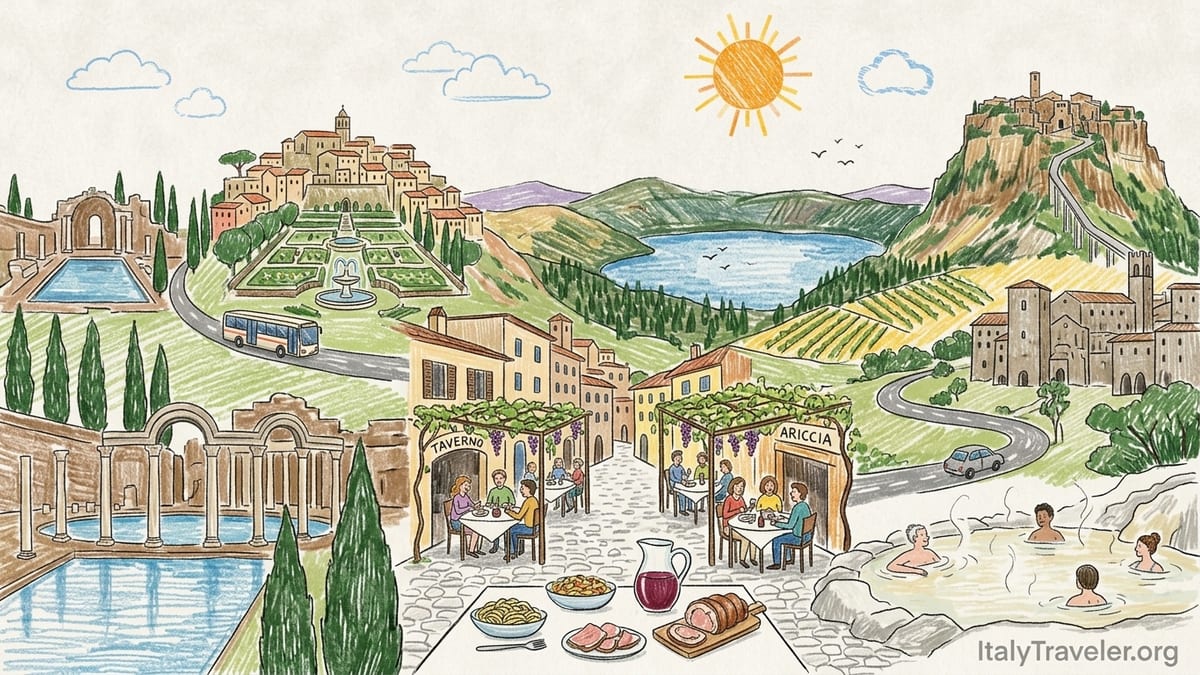
These different ways of traveling shaped how each place worked for me, and they mirror how many visitors actually experience them today: Tivoli as a concentrated UNESCO double, the Castelli Romani as Rome’s dining room in the hills, and Tuscia as a broader, quieter drive through Etruscan and medieval landscapes.
Tivoli: Concentrated UNESCO and Archaeological Immersion
If your priority is major historic sites in a tight radius, Tivoli is the clearest choice. Hadrian’s Villa alone can fill half a day. Officially known as Villa Adriana, this vast imperial retreat spreads across about 40 hectares of visitable ruins east of Rome. Walking through its pools, baths and courtyards, what struck me was the scale: you do not just look at a single palace; you wander between separate complexes linked by pathways that once served an underground service network. It feels closer to exploring a small city than a villa.
On one visit I entered early in the morning, when the light was still low and the tour groups had not yet arrived. I remember rounding a corner into the Canopus area, where the long reflecting pool lined with columns catches the sky. For ten minutes it was almost silent except for birds, and it was the most transporting archaeological moment of that trip. By late morning, especially in peak season, the atmosphere was busier and more structured, but the site is big enough that you can still find quiet stretches.
Back in Tivoli proper, Villa d’Este provides a very different experience. The villa itself is Renaissance rather than Roman, but the real draw is the terraced garden filled with fountains and water theatrics. The villa is currently part of Italy’s “Villae” system together with Hadrian’s Villa, and recent cultural programs have included garden themed exhibitions that underline why UNESCO considers it a masterpiece of Italian garden design. I vividly recall climbing from terrace to terrace while the roar of the Organ Fountain grew louder, then watching jets of water choreograph themselves in the afternoon sun. After Rome’s dense traffic, being surrounded by water, cypresses and stone felt almost unreal.
For most travelers, Tivoli works best as a single day with a clear archaeological focus: Villa Adriana in the morning, Villa d’Este in the afternoon, with a coffee or simple lunch in between in Tivoli’s compact historic center. You can add a third stop at Villa Gregoriana, the ravine park with trails and waterfalls, but that makes for a long, physical day. The main decision is not whether Tivoli is worth it, but how much walking under the sun you want in one go.
Castelli Romani: Food, Wine, Lakes and Slow Town Life
Where Tivoli gives you two headline sites, the Castelli Romani offer atmosphere. This group of hill towns, built on the slopes and caldera of the ancient volcanic complex southeast of Rome, has become shorthand among Romans for fresh air, hearty food and weekend lunches that stretch into the afternoon. The area includes Frascati, Ariccia, Castel Gandolfo, Nemi and several others, connected by winding roads over the Alban Hills and protected within the Parco Regionale dei Castelli Romani.
My days here have rarely followed a tight schedule. In Frascati, I walked out from the station directly into streets lined with wine shops and small bars offering glasses of Frascati DOC white and simple plates of pecorino and cold cuts. One afternoon I joined a short vineyard visit on the slopes above town. The owner poured a young Frascati Superiore while pointing down at the haze above Rome on the horizon, a reminder that we were still less than an hour away. That mix of countryside and proximity is the area’s biggest advantage.
Ariccia gave me one of my most vivid food memories near Rome. I arrived around lunch and crossed the monumental bridge into town, passing under the façade of Palazzo Chigi. A couple of streets later, the atmosphere changed completely: strings of fraschette, the traditional taverns of Ariccia, were spilling onto the pavement with wooden tables. I sat down under low arches hung with prosciutti, ordered house Frascati in a jug, plates of porchetta di Ariccia piled with herb scented slices of pork, and a succession of simple dishes from rigatoni all’amatriciana to grilled vegetables. That lunch cost less than a mid range meal in central Rome and felt richer in character.
On another trip I focused on the lakes. Castel Gandolfo, the Pope’s historic summer residence, sits above the dark oval of Lake Albano, with a lakeside promenade below that fills with Romans renting pedal boats and kayaks on summer weekends. Nemi looks down over its own smaller, intensely blue crater lake, famous in season for tiny strawberries that end up in tarts and liqueurs. Neither town has a single must see site that matches Villa d’Este, but together they build an image of volcanic lakes, wine terraces and bar tables under vines that is hard to forget.
Tuscia and Viterbo: Medieval Towns, Civita and Thermal Water
North of Rome, Viterbo and the broader Tuscia region feel like a different Lazio entirely. Where Tivoli is about imperial and Renaissance villas and the Castelli Romani about volcanic hills and food traditions, Tuscia is shaped by Etruscan roots, medieval streets and widespread thermal springs. The distances are greater, and public transport thinner, but the sense of being in a quieter, less internationally known corner of Italy is correspondingly stronger.
I used Viterbo as a base for two nights, not because the city has a single blockbuster sight, but because its medieval core rewards unhurried wandering. In the San Pellegrino quarter, stone houses are linked by archways and external staircases. In the evening, small restaurants and wine bars fill with locals rather than day trippers. Prices felt notably lower than in Rome; a proper dinner with a carafe of local Lazio red cost what I would normally pay for a simple trattoria main course in the capital.
One morning I drove out to Civita di Bagnoregio, the “dying town” perched on a plateau of tufa rock and reached only via a narrow pedestrian bridge. The final approach on foot is part of the experience. After buying the entry ticket at the info point near the start of the bridge, I climbed steadily, with the wind rising as the plateau narrowed. Inside Civita, lanes twist between stone houses and viewpoints drop away over the eroded valleys that are slowly eating into the cliffs. It is busier than it used to be, especially at weekends, but the physical effort of the approach keeps it from feeling like a theme park.
The other pole of a Tuscia trip for me has always been water. Outside Viterbo, Terme dei Papi is a large spa complex where a broad outdoor pool fills with naturally warm, mineral rich water. On my last visit, I arrived in the late afternoon, paid for a day spa package at the reception, and walked out into the steam. The surface of the pool rippled in the evening light, and limestone deposits along the edges gave everything a pale, textured look. It is very much a structured facility rather than a wild hot spring, but the combination of genuine thermal water and views to the hills feels luxurious after time in city streets.
Stringing these together, Tuscia worked best as a two or three day circuit: Viterbo as a hub for sleeping and dinner, Civita for an intense half day, thermal baths for another half day, and other smaller towns and archaeological sites for those who want to go deeper. It did not feel like a quick grab and go day trip in the way Tivoli did, but that was part of its appeal.
Transport Difficulty and Whether You Need a Hotel
Transport logistics are often what separate a satisfying side trip from a stressful one, and the three areas differ sharply here. Tivoli is the simplest. Regular regional trains connect Rome and Tivoli in around 40 minutes, and intercity buses run from Rome’s eastern bus hubs to Tivoli town and on toward the Villa Adriana area. Once you understand that Hadrian’s Villa lies several kilometres outside Tivoli’s historic center, not next door to Villa d’Este, the puzzle pieces fall into place. You will still need a local bus or short taxi ride between them, but you do not have to rent a car or change trains multiple times.
Because Tivoli is so close, most visitors do not need to stay overnight. I only booked a Tivoli guesthouse on one trip when I wanted to see Villa d’Este lit in the evening and walk the town after day trippers had left. The vast majority of travelers I met were commuting from Rome and back in a single day. That makes Tivoli a good choice if you are short on time or do not want to deal with check in and luggage between bases.
The Castelli Romani sit closer in distance, around 20 to 30 kilometres southeast of Rome, but the transport web is more fragmented once you arrive. Individual towns such as Frascati or Castel Gandolfo are easy by regional train from Rome, and several others connect by buses that climb through the Alban Hills. The challenge appears when you want to hop between towns in a single day. On the day I combined Castel Gandolfo and Ariccia, I accepted that there would be some waiting for buses or, at times, using a short taxi hop to avoid spending half my day studying timetables. For many people, a private driver or small group tour simplifies the experience, especially if you plan to drink wine.
Viterbo’s Tuscia is the area where I would most strongly recommend a hotel night and a car. There are regional trains from Rome to Viterbo, but they are slower and less frequent than the Tivoli line, and once you are in Viterbo, public transport to places like Civita di Bagnoregio or the countryside thermal spots is limited. On my first Tuscia trip I tried to rely on buses and quickly felt hemmed in by schedules and early last departures. On the second, with a rental car and a two night stay, the mood changed completely. I could watch the sunset from Civita without anxiously checking bus apps and fit a full unhurried soak at the thermal pools into the day.
Expense, Walking and Crowds on the Ground
In terms of costs, Tivoli sits in the middle. Individual tickets for Villa Adriana and Villa d’Este are priced as major state run sites, so a full day taking in both will cost more in entrance fees than a casual day in the Castelli Romani but less than a structured thermal spa package in Tuscia. In town, snacks, coffee and simple lunches are slightly cheaper than Rome’s historic center but not dramatically so. Where costs can creep up is in small things like taxis between villas if you tire of waiting for buses, or organized day tours from Rome that bundle transport, entry and a guide into a single price.
Physically, Tivoli days can be demanding, especially in warmer months. Hadrian’s Villa involves extensive walking over uneven ground with limited shade. Villa d’Este, though compact, is structured as a vertical garden, which means repeated climbs and descents on stone steps. When I combined the two on a July day, I was grateful for a long mid afternoon break in a café near Piazza Trento, both to cool down and to give my knees a rest. If mobility or heat are concerns, Tivoli is still manageable, but you will want to pace yourself and perhaps choose just one villa.
The Castelli Romani are gentler on both wallet and legs. You can easily spend most of a day sitting: on the train, at a café in Frascati, in a fraschetta in Ariccia, on a lakeside terrace at Castel Gandolfo or Nemi. Walks here are mostly short and pleasant rather than strenuous, though the streets can be steep in hilltop towns. My most active day was one where I walked from Frascati’s center up to a viewpoint among the Ville Tuscolane and then down again for a long lunch. The bulk of my spending here goes to food and wine rather than tickets. A generous lunch with house Frascati, antipasti, a pasta course and shared meat in a traditional tavern has consistently come in lower than similar meals in Rome.
Tuscia varies. Strolling Viterbo’s medieval lanes is easy and almost entirely flat. The thermal pools at Terme dei Papi are designed for relaxation, with paved edges and controlled access. Civita di Bagnoregio is the exception: the approach bridge climbs steadily, and inside you will find slopes and stairs on stone paving. On a sunny day, the walk up feels long because there is little shade. That climb, and the area’s relative remoteness, keep crowds at a more manageable level than Tivoli. On my last visit to Civita in shoulder season, there was a steady flow of visitors crossing the bridge, but once inside I could still find quiet corners. By contrast, the approach to Villa d’Este on a weekend in peak season felt like slipping into a moving stream of day trippers.
Landscape, Atmosphere and How Much Time Each Deserves
The landscapes around the three areas form very different backdrops to your days. Tivoli sits at the edge of the Tiburtine hills, looking back toward Rome and out over the Aniene valley. From terraces at Villa d’Este you see tiled roofs falling away to the valley, framed by cypresses and distant industrial structures that remind you this is still part of the modern Lazio plain. The contrast between the ordered, formal gardens and the looser countryside beyond is part of the villa’s theatrical effect. At Hadrian’s Villa, long rectangular pools, brick ruins and earth tones dominate, with glimpses of surrounding fields through arches and colonnades.
The Castelli Romani are shaped by their volcanic origin. The Alban Hills rise abruptly from the plain, and their crater holds dark crater lakes fed by ancient rain and groundwater. Driving or riding buses here, I would catch sudden views of Lake Albano or Lake Nemi opening under the road, ringed by steep wooded slopes. Vineyards climb the sunnier flanks, and you often see vines just beyond the last houses of a town. This gives the area a very specific sense of place. When you sip a glass of Frascati on a terrace in Frascati itself, you can physically see the vineyards across the valley that produced it.
Tuscia around Viterbo feels more open and rural. Here the land undulates in broader hills and plateaus cut by ravines, where soft tufa stone erodes into sharp ridges and gullies. Civita di Bagnoregio perches atop one such plateau, its setting so precarious that landslides have slowly eaten away parts of the town over centuries. Elsewhere, fields, small forests and low stone farmhouses dominate, broken up by clusters of medieval towers in towns like Viterbo and Montefiascone. The presence of geothermal activity and hot springs is more subtle in the landscape than the Castelli lakes, but when you smell sulfur on the air near some pools or see steam rising on a cool evening at Terme dei Papi, you feel it.
In terms of time, Tivoli can be powerfully experienced in one day, especially if you focus on the two main villas. A second day would only be necessary if you want a slower rhythm, to add Villa Gregoriana or to return at night. The Castelli Romani can be done as a single day focused on one or two towns, but they reward repeat visits. On my third Rome trip I spent one day just in Nemi and Genzano, wandering between viewpoints and tasting strawberry pastries, and it felt fresh despite having been to Frascati and Castel Gandolfo before.
Tuscia deserves the most time relative to distance. I would struggle to recommend Civita di Bagnoregio and Viterbo as a single rushed day from Rome unless you are very constrained. Even two days, with one full day sandwiched between travel days, will feel short if you add thermal baths. For my ideal itinerary, Tuscia gets at least two nights, Tivoli one or two day trips depending on your interest in archaeology, and the Castelli Romani one or two days sprinkled across a longer Rome stay when you crave air, views and food experiences.
Which Lazio Escape Fits Which Traveler?
Choosing between these three is less about ranking them and more about matching them to your energy, interests and available days. Tivoli worked best for me on a history focused trip when I had the mental space for another set of UNESCO heavyweights after the Colosseum and the Vatican. If you love Roman history, architecture and large scale archaeological sites, and you are comfortable with a fairly structured day of moving between ticketed attractions, Tivoli is easy to recommend. It is also the most straightforward choice if you have only one spare day and do not want to rent a car.
The Castelli Romani, by contrast, suited the trips when I had already seen the main sights and wanted to feel, simply, what life is like just outside Rome. They are ideal for food orientated travelers, wine fans who want to taste Frascati and other local whites close to their vineyards, and anyone who likes the idea of a day where the main event is a long lunch. The presence of crater lakes and views back toward Rome adds a scenic layer, but the real memory is more likely to be a plate of porchetta in Ariccia or a terrace table in Frascati than a specific monument.
Tuscia, finally, is the choice for those who enjoy driving trips, medieval towns and thermal water. If the idea of leaving Rome for several days, staying in a smaller city like Viterbo, and building a loop that includes Civita di Bagnoregio, hot springs and countryside appeals to you, then Tuscia will probably feel like the most rewarding of the three. It is less about single headline sights and more about the accumulation of villages, landscapes and experiences that still feel largely Italian rather than international in character.
My own pattern across multiple trips has been to start with Tivoli on an early visit to Rome, add a Castelli Romani day once I have a feel for the city and its food, and then dedicate a later, longer stay to Tuscia with a rental car. That sequence is not a universal prescription, but it reflects how the areas build on each other: from intense UNESCO villas, to relaxed vineyard and lake days, to an extended medieval and thermal landscape.
The Takeaway
After walking the ruins of Hadrian’s Villa, lingering over wine in Castelli Romani taverns and watching steam rise from thermal pools near Viterbo, I find it impossible to declare a single winner among Tivoli, the Castelli Romani and Tuscia. Each Lazio escape is anchored by something different: monumental archaeological and garden complexes in Tivoli, volcanic hills and food traditions in the Castelli Romani, and a mix of medieval towns, Civita’s dramatic perch and thermal springs in Tuscia.
If your spare time in Rome amounts to just one day, Tivoli offers the most concentrated and straightforward payoff. You will return having touched two UNESCO level sites that can hold their own against the capital’s attractions. If you have the luxury of multiple days and want to feel Rome’s hinterland more than its history, then a Castelli Romani day, possibly with a driver so no one has to worry about wine tastings, becomes deeply appealing. For those ready to step further out, both in distance and mentality, Tuscia around Viterbo rewards a small road trip with nights spent under medieval towers rather than city domes.
The best answer to “which Lazio escape worked best” for me is that each did, on different trips, because I let their character dictate the kind of day I planned. If you match Tivoli, the Castelli Romani and Tuscia to what you most need from your time out of Rome, you are less likely to compare them against each other and more likely to remember each for the specific light, tastes and textures it gave you.
FAQ
Q1. Is Tivoli, the Castelli Romani or Tuscia better for a first trip to Rome?
For a first short trip, Tivoli usually works best because it delivers two major, well organized UNESCO sites in a simple day trip. The Castelli Romani and Tuscia are excellent additions on longer or repeat visits when you have more time for slower days.
Q2. Can I visit Hadrian’s Villa and Villa d’Este in Tivoli in one day without a tour?
Yes. Many travelers take a regional train or bus to Tivoli, visit Hadrian’s Villa in the morning and Villa d’Este in the afternoon, using local buses or taxis between the two. It makes for a full day of walking but is very doable without an organized tour if you are comfortable with basic Italian transport.
Q3. Do I need to rent a car to enjoy the Castelli Romani?
No, but a car or private driver makes it easier to string several towns together in one day. Frascati and Castel Gandolfo are comfortably reached by train from Rome, and you can enjoy a rewarding day focusing on just one or two towns using regional trains and local buses.
Q4. How many nights should I spend in Viterbo’s Tuscia region?
If you want to see Viterbo, visit Civita di Bagnoregio and enjoy at least one proper thermal bath session, two nights are a good minimum. That gives you a full central day without travel, and you can add a third night if you want to explore more small towns or Etruscan sites.
Q5. Which area is best if I am traveling on a tight budget?
The Castelli Romani and Viterbo’s Tuscia often feel lighter on the wallet than central Rome, especially for dining and accommodation. Tivoli’s main costs are the villa tickets and any tours or taxis you add. A day in the Castelli Romani can be very affordable if you focus spending on one generous lunch and use trains or buses.
Q6. Where will I find the best food and wine experiences?
The Castelli Romani are the most food and wine centered choice, with Frascati’s white wines, Ariccia’s porchetta and lakeside meals at Castel Gandolfo or Nemi. Tuscia offers satisfying, often less expensive meals with local wines in Viterbo and surrounding towns. Tivoli has good places to eat, but the main focus there is sightseeing rather than culinary exploration.
Q7. Which option is easiest if I have limited mobility?
None of the three are completely flat or step free, but a gentle day in the Castelli Romani, focused on one town like Frascati or Castel Gandolfo with short walks and plenty of café time, is often easiest. Tivoli’s main sites involve more steps and uneven ground, and Civita di Bagnoregio in Tuscia requires a sustained uphill walk across the bridge to reach the town.
Q8. Are thermal baths in Tuscia suitable for children and families?
Large spa complexes near Viterbo, such as the best known thermal pools, usually welcome families and offer shallow areas where children can enjoy the warm water under supervision. It is worth checking current rules and age policies for specific pools before you go, as some treatments and quieter areas may have minimum age limits.
Q9. Can I combine Tivoli and the Castelli Romani in a single day from Rome?
It is technically possible but rarely enjoyable. Each area easily fills a day on its own, and adding travel between them would mostly increase time on trains and buses. For a more relaxed experience, give Tivoli and the Castelli Romani separate days, even if those days are not consecutive.
Q10. Which Lazio escape is least crowded in peak season?
Tuscia around Viterbo is generally the quietest, especially once you step away from the busiest hours at Civita di Bagnoregio. Tivoli can feel crowded around Villa d’Este and Hadrian’s Villa in summer, and the most popular Castelli Romani towns are lively on sunny weekends, though you can usually escape to quieter streets within a few minutes’ walk.