


After more than a dozen trips to Rome, I finally dedicated a full week to doing what I had always rushed: proper day trips across Lazio. I wanted to see which excursions genuinely deserved a full day and when it was smarter to pay for a guided tour rather than piece together regional trains and buses myself. The result was a mixed bag of early alarms, calm country lunches, missed connections narrowly avoided and a few routes where I was very glad there was a coach driver worrying about traffic instead of me.
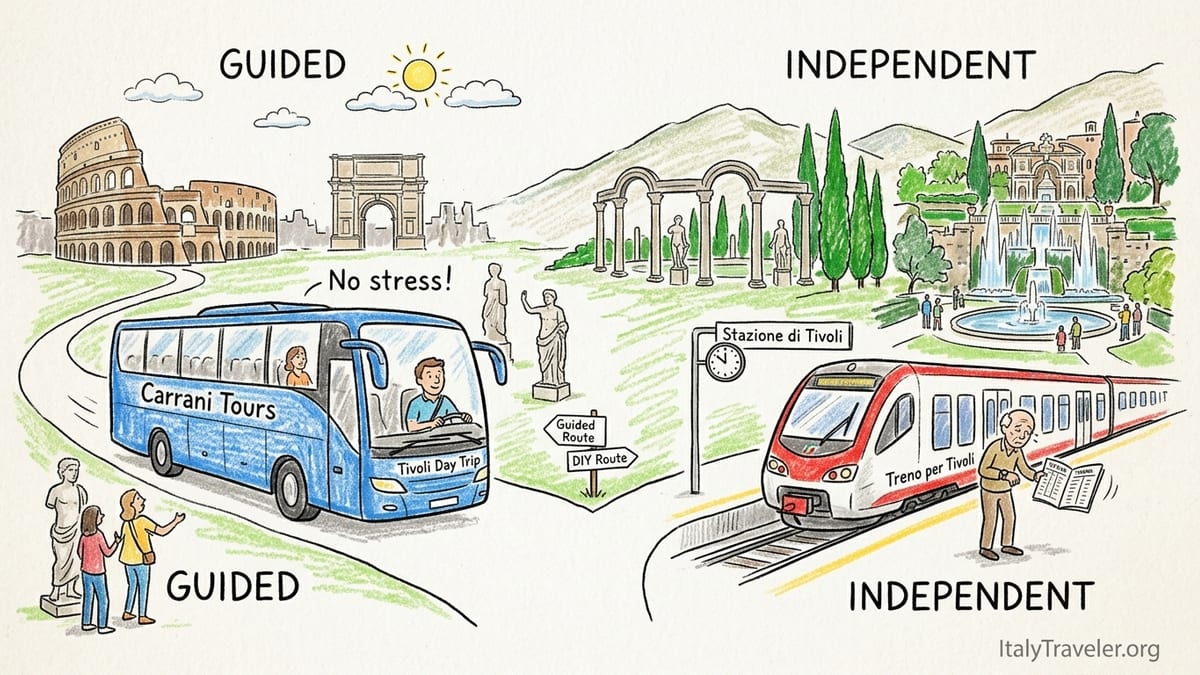
Tivoli: When a Guided Tour Really Earns Its Keep
I tested Tivoli twice on the same trip from Rome: once on a fully guided coach excursion that combined Hadrian’s Villa and Villa d’Este, and once as a do-it-yourself regional train outing. Both days started early, but the feel of the day and how rushed the return felt were surprisingly different.
On the guided day, I was picked up near Termini around 7:30 in the morning by a coach run through a major operator that works with Carrani Tours. The bus eased out of Rome in about 30 minutes, and we rolled into the parking area for Hadrian’s Villa a little after 9. Including hotel pickup shuttles and a brief stop, total travel time each way was just under 1 hour 15 minutes. Tickets for both Hadrian’s Villa and Villa d’Este were already handled, and the guide had our group inside within ten minutes of arrival, which mattered on a weekend when the ticket line was already snaking toward the parking lot.
We spent roughly two hours at Hadrian’s Villa, with a guide walking us past the Canopus, the Maritime Theater and the thermal baths. It was not an in-depth academic tour, but the commentary filled in details that would have been easy to miss, such as how the emperor used certain pools as semi-private spaces. After a short 15 minute ride into Tivoli town, we had just under an hour of free time for lunch. The guide steered those who wanted a sit-down meal toward simple trattorie on Via della Missione, where a plate of pasta and a glass of wine ran around 15 to 20 euro. I opted instead for a quick pizza al taglio close to the main square to maximize time inside Villa d’Este.
At Villa d’Este we had about an hour of guided touring and another 45 minutes of free time. That translated to just under two and a half hours total among the frescoed halls and the garden terraces. It was enough to walk the main cascades, stop at the Oval Fountain, linger at the Hundred Fountains and still catch a coffee at the cafe. We left Tivoli around 16:30 and were back inside Rome shortly after 17:30. The return did not feel rushed, largely because nobody was watching a train schedule. I simply closed my eyes as the coach rejoined the autostrada and was dropped back near my hotel.
Two days later I tried the independent version. I left my apartment near Termini at 8:00, bought a same-day regional ticket to Tivoli from the Trenitalia machines and caught a departure around 8:30. Recent timetables show that the run between Roma Tiburtina or Termini and Tivoli is about 45 to 55 minutes, and my train was in that range, arriving just after 9:20. The fare was under 4 euro each way, dramatically cheaper than a tour coach seat that can run over 130 euro including entry tickets. From Tivoli station it was a 15 to 20 minute walk through town to Villa d’Este, which forced me to decide on my order of visits.
I chose to start in town at Villa d’Este, entering around 10:00 and staying almost two hours. Without a guide, I lingered longer at individual fountains and sat on the lower terraces watching gardeners rebuild a small channel. After a quick sandwich from a bar just off the main pedestrian street for about 7 euro, I caught the local bus toward Hadrian’s Villa. Here, things got a bit messy. Buses from Tivoli to the archaeological site are not particularly frequent. I waited almost 25 minutes in the sun, then rode 15 minutes out to the site. By the time I bought my ticket at the gate, it was already mid afternoon.
Hadrian’s Villa is extensive, and walking its gravel paths adds up. In two and a half hours I covered the central clusters but skipped some of the outer ruins that I had seen on the guided tour. With the last trains back to Rome in mind, I took a late afternoon bus back to Tivoli town with another 20 minute wait. I reached Tivoli station just in time for a regional train around 18:30 and stepped off at Termini close to 19:20. The whole day felt more tiring, and I spent more energy thinking about timetables.
Looking back, Tivoli genuinely warrants a full day because Hadrian’s Villa and Villa d’Este together make a remarkably rich pairing. If you are comfortable with Italian regional trains and a bit of bus uncertainty, going independently is much cheaper and gives you more flexibility for long photography stops and slow garden wandering. If you want stress-free logistics for two major sites in one go or you are visiting on a tight schedule in peak season, the guided coach, with pre-booked entrances and clear timing, earns its price. It solved the only real headache on the DIY day: synchronizing buses and trains without cutting short time among the ruins or in the gardens.
Civita di Bagnoregio: A Spectacular Day That Punishes Poor Planning
Civita di Bagnoregio had been on my list for years, mostly because of the photos of its narrow pedestrian bridge rising out of badland cliffs. I had heard that getting there from Rome without a car could be fussy, and after doing it myself, I would not recommend going without double-checking train and bus times and allowing generous margins.
I left my apartment near Termini at 7:15 and aimed for an early train to Orvieto, one of the usual launch points for Civita. The intercity and regional services to Orvieto take about 1 hour to 1 hour 20 minutes, and my morning run came in just over the hour mark. I had reserved a seat on a mid-morning regional that cost around 12 euro one way. On arrival at Orvieto station, I crossed the underpass to the Cotral bus stop to find a small knot of people waiting for the bus toward Bagnoregio.
There is no direct train to Civita di Bagnoregio. The standard sequence is train to Orvieto or Viterbo, Cotral bus to Bagnoregio and then either a local shuttle, taxi or a 25 to 30 minute walk to the beginning of the pedestrian bridge. Recent local guidance suggests allowing ample time for the bus connection, because departures can be spaced out and delays are possible. On my day, the bus arrived roughly on time around 10:30 and took just under an hour through hill towns and countryside. I paid the driver a few euro in cash and watched Orvieto’s cliff recede in the bus mirror.
In Bagnoregio the bus drops you near the modern town. From there I followed small signs uphill through residential streets to the belvedere. It is another 15 to 20 minutes on foot before you see Civita itself perched on its eroding plateau. Buying the entrance ticket to the village took only a few minutes at the kiosk by the viewpoint. After that came the climb. The pedestrian bridge is long and steep, especially under a midday sun, and the final approach into the town gate will get your lungs working. By the time I crossed into Civita it was close to noon. Door to gate, the journey from central Rome had taken just over four hours.
I stayed inside Civita and around the surrounding viewpoints for almost three hours. That gave me time to walk most of the narrow lanes, detour along the lower paths above the calanchi gorges and settle in for a proper lunch. A trattoria tucked into a small piazza served a plate of umbrichelli with porcini and a carafe of house white for around 20 euro. Service was not fast, but that pace suited the setting. I could easily imagine staying overnight, yet as a day tripper I still had to keep one eye on the bus timetable pinned to a pole back in Bagnoregio.
I left Civita around 15:00, walked back across the bridge and through Bagnoregio town, and reached the bus stop with 20 minutes to spare before the scheduled mid-afternoon Cotral back to Orvieto station. From there, a regional train around 17:00 got me into Rome between 18:30 and 19:00. The return felt compressed. A missed bus or a delayed train would have meant arriving back late in the evening. There is no problem in daylight in spring or summer, but in shoulder seasons the thought of navigating quiet streets and rural bus stops after dark is not appealing.
After that experience, I compared notes with travelers who had gone on organized day tours by minivan from Rome. Those tours typically leave central Rome around 7:30, drive directly to Bagnoregio with one coffee stop, and include the village entrance ticket. They usually combine Civita with a wine tasting or a stop at nearby Lake Bolsena. The price is considerably higher than the DIY route, but the benefit is obvious: you do not have to worry about thin bus timetables and train connections. Given how eroded the plateau is and how much time you want to spend simply staring at the landscape, Civita is a case where I would consider a guided excursion if I were traveling in shoulder season, with short daylight, or if I were not comfortable reading Italian bus schedules. For budget-focused travelers in spring or summer who like planning, going independently is feasible, but it is not a casual outing you decide on over breakfast.
Ninfa and Sermoneta: Beautiful, Controlled and Best Done with a Car or Tour
The Garden of Ninfa is one of the most controlled day trips from Rome that I have ever attempted. It sits roughly 70 kilometers southeast of Rome, near the town of Norma, and opens only on specific days with strictly timed, pre-booked visits from March through November. The official calendar for the 2026 season runs from late March to early November, with entry possible only via advance reservations for specific time slots. You cannot simply show up and stroll in.
When I planned my day, I first checked the official booking site to pick a Saturday in late April and secured a mid-morning slot around 11:30. Tickets could only be bought online, and the confirmation email made it very clear that arrivals outside the selected time were not guaranteed entry. I decided to rent a small car for the day from a local agency near Termini rather than trust the combination of regional trains, buses and taxis. With the car, I left central Rome around 8:30 and joined the motorway toward Latina.
The drive took a bit under 1 hour 30 minutes with light traffic, and the last stretch wound through fields and past the town of Norma before dropping down to the dedicated parking area. On opening days there is a large free lot for cars near the entrance. I arrived with about 40 minutes to spare. Even with that margin, I felt the constraint of the fixed slot. The staff gathered our group at the gate and checked tickets against a list. Visits to Ninfa are always guided, and you stay with the group for about 60 to 75 minutes, following a set path past the ruined village walls, over stone bridges and alongside channels and ponds.
The visit itself is magical. Yet the rigidity of the system changes the feel of the day. You cannot linger wherever you like for more than a minute or two, because the guide is moving the group along to accommodate the next time slot. You cannot picnic inside, and you are escorted out directly after the visit. Photography is allowed within reason, but again you are fitting your photos into the group pace. Because of that, I planned the rest of my day around lunch and a slow afternoon in nearby Sermoneta rather than expecting Ninfa alone to fill a full day.
From the garden parking lot, Sermoneta is about 20 minutes by car up into the hills. The town sits on a ridge with views over the Pontine plain. I parked just below the centro storico and walked uphill on cobbled streets to the main piazza in about ten minutes. By then it was almost 14:00. Many restaurants were preparing to close after lunch, but I found a small place serving a fixed menu of local dishes for around 25 euro, including a plate of cavatelli with sausage and a glass of red from nearby producers. Walking off lunch in Sermoneta’s lanes and around the exterior of the Caetani Castle took about an hour and a half. The castle itself has its own guided tours on set schedules, so you need to coordinate those times too if you want to go inside.
Could you do Ninfa and Sermoneta without renting a car or going on an organized tour? It is possible in theory. On some days there are regional trains from Rome to Latina or Norma, and from there local buses or taxis up toward Ninfa and Sermoneta. However, the connection between train times, irregular local buses and the strict garden entry slots leaves very little room for delays. In practice, unless you are deeply comfortable with Italian regional transit and can read current timetables, Ninfa and Sermoneta are destinations where either a rental car or a small-group tour genuinely simplifies the logistics. On my day, the car added around 60 euro including fuel and tolls, but the ability to leave Rome after rush hour, arrive at the garden with time to spare and linger in Sermoneta without glancing at a bus stop timetable made the outing feel relaxed rather than stressful.
Castelli Romani: Easy Trains, Slow Lunches and DIY Comfort
The Castelli Romani towns southeast of Rome, especially Frascati and Castel Gandolfo, turned out to be the easiest independent day trips of the entire week. Here, local trains from Termini and even commuter services from other stations do most of the work. You do not need a car and, unless you want a very structured food or wine experience, a guided tour feels unnecessary.
On my Castelli day I set a later alarm and left my apartment around 9:00. I walked to Termini, bought a regional ticket to Frascati for just a few euro and caught a departure just after 9:30. The ride is short, around 30 minutes, and by 10:00 I was standing outside Frascati station. From there it is a ten minute uphill walk into the historic center, with the Baroque facade of Villa Aldobrandini rising above town. My plan was simple: a slow coffee in the square, a stroll to the viewpoints over Rome, and then a move to Castel Gandolfo in time for lunch by the lake.
Frascati itself absorbed nearly two hours between walking, stopping for espresso and a pastry, browsing a small market and enjoying the views. There was no guide and no fixed schedule, just a general sense that I wanted to reach Castel Gandolfo by early afternoon. To get there, I walked back down to the station, caught a short train hop to a junction and then another train toward Castel Gandolfo. Including a small wait between trains, the total travel time between the two towns was about 40 minutes. The station at Castel Gandolfo is below the historic center, so there is another ten minute uphill walk into town.
By 13:30 I was sitting on a terrace overlooking Lake Albano with a plate of grilled lake fish and a glass of white wine. Lunch here was a bit pricier than up in Frascati, but still around 25 to 30 euro for a full meal with wine and coffee. The combination of warm lake breezes, scattered boats below and the dome of the collegiate church behind me made it feel far removed from Rome, even though the return journey would take less than an hour. After lunch I walked a good section of the ridge, visited the papal palace courtyard and then dropped down closer to the water for a short lakeside stroll.
The relaxed nature of the Castelli Romani loop meant that I did not once check a tour schedule or feel rushed to make a bus. Mid-afternoon, around 17:00, I retraced my steps to the station and caught an early evening train back toward Termini. The ride took about 45 minutes with one change, and I was back in Rome in plenty of time for dinner. Here, paying for a guided coach excursion would add structure but not necessarily value. The joy of this particular day was wandering at my own pace, with plenty of flexibility to extend lunch or linger at viewpoints. The trains are frequent enough, and walking distances short enough, that independent travel felt completely natural.
Bracciano and the Lakes: A Flexible Day Best Done on Your Own
Compared with Tivoli and Civita, Bracciano and its volcanic lake northwest of Rome were a pleasant logistical surprise. A direct regional train from Rome’s main stations to Bracciano takes around an hour, and once you step off the train, the castle towers are already visible above town. I made this trip without a guide or tour, and at no point did I miss having one.
I left Rome around 9:15, catching a regional train that would reach Bracciano just after 10:15. Tickets were in the same low single-digit euro range as other Lazio regional routes. The train rolled through suburban stations, then fields and woodland, before gliding into Bracciano’s small station. From there it was a straightforward 10 minute walk uphill into the centro storico and the entrance to Castello Orsini-Odescalchi. I arrived around 10:30 and bought a ticket at the counter. The castle can be visited either self-guided or on a scheduled tour depending on the day and language.
I opted for the self-guided route, which took me through courtyards, furnished halls and ramparts in about 90 minutes at a moderate pace. Informational panels in English filled in the missing details. The walking is mostly indoors and along stone staircases, so comfortable shoes help but you do not need the stamina of, say, the Civita bridge climb. By midday I emerged onto the castle terraces to take in the first real views of Lake Bracciano glittering in the distance. Lunch was at a small trattoria a few streets away, where a plate of cacio e pepe and a glass of house red came to just under 18 euro.
The second half of the day unfolded down by the lake. A 20 to 25 minute walk from town leads to the water’s edge, where a small promenade and several cafes line the shore. It is also common to hop one of the local buses down from the center to the lakeside if you prefer not to walk the distance. I spent a quiet two hours reading by the water, with occasional swims in the warmer months. Boat rentals, if they are available on your day, add another layer of activity.
By late afternoon I felt completely unrushed. I wandered back to the station through side streets, stopping for gelato, and caught a regional train back to Rome around 18:00. The return leg took about an hour again, and the carriage was filled with commuters heading home. At no point did a tour feel necessary. Unless you are particularly anxious about regional trains, Bracciano is a textbook example of a Lazio day trip where independent travel is both cheaper and more pleasant. A tour could add a structured castle tour and included transport, but it would also fix your schedule in a way that might cut short lake time or force a midday return.
Viterbo and the Tuscia Towns: Slow Trains, Real Payoff
Of all the trips I took, Viterbo and the surrounding Tuscia region came closest to blurring the line between a day trip and a short break. The city itself, with its medieval quarter and thermal baths, deserves at least one long, unhurried day. Nearby villages and Etruscan sites could easily fill another. I chose to focus on Viterbo proper for a single long day and to test the regional train that links Rome with the Tuscia capital.
I left my accommodation near Flaminio early, around 7:45, and walked to the Roma Nord station. The regional line connecting Rome with Civita Castellana and Viterbo runs from here and counts as part of the extended metro system in its urban section. Suburban trains that run all the way to Viterbo take roughly two and a half hours end to end. My morning train left just after 8:15 and pulled into Viterbo late in the morning. The fare was modest, roughly in line with other Lazio regional routes, and the carriages were mostly filled with commuters and students at first before thinning out deeper into the countryside.
From the station it was a 15 minute walk into the San Pellegrino district, one of the best preserved medieval quarters in Italy. Over the next three hours I walked stone lanes, climbed staircases to overhanging loggias and visited the Papal Palace complex. Lunch in a small osteria was slow and satisfying: a plate of local chickpea soup, grilled meats and a carafe of wine for around 25 euro. Here, time works differently than in Rome. Service was unhurried, and nobody seemed concerned that I was taking up a table well past 14:00.
In the afternoon I had a choice: hop a local bus or taxi to the nearby Terme dei Papi thermal complex or simply continue exploring the city on foot. Because my return train options were thin and I did not want to risk a complex connection back to Rome, I chose to remain in town and explore additional churches and small squares instead. This is where an organized excursion might have added value by bundling both Viterbo and a nearby Etruscan necropolis or thermal stop with guaranteed transport. With a tour, you are controlled by the group pace but relieved of monitoring a two and a half hour regional ride in both directions.
I left the center slightly before 17:00, walked back to the station and boarded the early evening train back toward Rome. The ride felt long after a full walking day, and the carriage grew cold and quiet as the sun went down. I stepped off the train in Rome after 19:30. It was a full 12 hour day from door to door, of which around five hours were spent in transit. Yet Viterbo still felt worth it because of the depth of its historic core. If you have more days available, staying one night in the Tuscia region would be more comfortable, but for determined day trippers, it is a rewarding stretch.
The Takeaway
After a week of early trains, rented cars, tour coaches and long walks, a pattern emerged. Some Lazio destinations repay the control and savings of independent travel, while others practically demand the simplicity of a guided excursion or a rental car.
Tivoli can go either way. If you want to preserve your energy and guarantee time at both Hadrian’s Villa and Villa d’Este without juggling local buses, a coach tour from Rome genuinely solves a real transport puzzle. If you are confident with regional trains and comfortable waiting for local buses, you can cut costs dramatically and still enjoy a full day split between ruins and gardens. Civita di Bagnoregio, by contrast, feels designed to punish poor planning. The combination of an intercity train, rural bus and long pedestrian approach means that a missed connection or late departure can eat deeply into your time in the village. Here, a guided small-group tour or at least very careful scheduling is worth considering, especially outside high summer.
Ninfa and Sermoneta are all about fixed times and controlled access. With strictly limited opening days and only guided, reserved visits inside the garden, the margin for error using public transport is thin. In this case, either renting a car or booking a tour that includes both Ninfa and Sermoneta is not a luxury, it is a practical choice that makes the day relaxing. The Castelli Romani towns and Bracciano sit at the opposite end of the spectrum. Frequent regional trains, short walks and compact centers make them ideal for DIY day trips where the main goal is a leisurely lunch and a view rather than a tight program of sites.
If there is a single rule that held true across all of these outings, it is that time at the principal attraction is what matters most. When a tour increased that time by smoothing over transport, it was worth the extra cost. When independent travel allowed more flexible and longer visits without serious stress, no guide was needed. Planning from Rome, think less in terms of how many towns you can technically string together in a day, and more about how you want the middle hours to feel once you finally step off the train, across the bridge or through the garden gate.
FAQ
Q1. Is Tivoli better as a guided tour or an independent day trip from Rome?
For most travelers, both options work. A guided tour simplifies transport between Hadrian’s Villa and Villa d’Este and includes tickets, while independent travel by regional train and local bus is significantly cheaper and offers more flexibility if you are comfortable with Italian public transport.
Q2. How much walking is involved in a day trip to Civita di Bagnoregio?
There is a substantial amount of walking, including a 15 to 20 minute walk from Bagnoregio town to the viewing area and a steep pedestrian bridge that can take another 10 to 15 minutes to cross. Inside Civita, narrow lanes and viewpoints add at least another hour on foot, so good shoes and reasonable fitness are important.
Q3. Do I need to book tickets in advance for the Garden of Ninfa?
Yes. Visits to the Garden of Ninfa are only possible on specified opening days between roughly March and November and always require advance online reservations for a fixed time slot. Tickets are not sold at the gate on a casual drop-in basis.
Q4. Can I reach Ninfa and Sermoneta by public transport from Rome?
It is technically possible by combining regional trains to towns like Latina or Norma with local buses or taxis, but the schedules do not always align well with Ninfa’s strict entry slots. For most visitors, renting a car or joining a tour that includes both Ninfa and Sermoneta is more practical and less stressful.
Q5. Is a car necessary for visiting the Castelli Romani towns?
No. Towns such as Frascati and Castel Gandolfo are well served by regional trains from Rome, and the main sights are within walking distance of the stations. A car can add flexibility for reaching smaller villages, but it is not required for a rewarding day in the main Castelli centers.
Q6. How long does it take to get from Rome to Bracciano by train?
Regional trains from Rome’s main stations to Bracciano generally take about one hour. From Bracciano station, it is about a 10 minute walk to the historic center and the castle, and around 20 to 25 minutes on foot down to the lakeshore.
Q7. Is one day in Viterbo enough, or should I stay overnight?
One long day from Rome gives you time for the medieval San Pellegrino district, the Papal Palace area and a relaxed lunch, but travel can take around two and a half hours each way by train. If you want to add nearby Etruscan sites or thermal baths, an overnight stay in the Tuscia region is more comfortable.
Q8. Are guided tours always more expensive than going independently?
Guided tours almost always cost more than a do-it-yourself combination of regional trains and local buses, sometimes by a wide margin. However, they may include entrance tickets, a guide and private transport that saves time and reduces stress, especially for places with complicated access such as Civita di Bagnoregio or Ninfa.
Q9. What time should I leave Rome for a full, relaxed day trip?
For most Lazio destinations, leaving Rome between 7:30 and 9:00 provides a comfortable balance. Earlier departures give more time on site at places like Tivoli, Civita or Viterbo, while a 9:00 start works well for closer spots such as the Castelli Romani or Bracciano.
Q10. How far in advance should I plan these Lazio day trips?
For flexible destinations served by frequent trains, such as the Castelli Romani or Bracciano, you can often plan just a day or two ahead. For controlled or complex sites like Ninfa, Civita di Bagnoregio or combined Tivoli tours, it is wise to check current schedules and book tickets at least one to two weeks in advance, especially in spring and autumn.