


I thought a day in Tivoli would be a gentle break from Rome. In reality, visiting Villa d’Este and Hadrian’s Villa in one shot turned into a highly logistical but very rewarding puzzle involving tickets, transport, heat, footwear and a few near-missed buses. This guide is based on that real visit, updated with current prices and hours checked directly on the official Villae site and local operators as of October 2026, so you can copy what worked, avoid what did not, and decide whether to visit independently or with a guided tour.
Understanding Tivoli’s Two Main Villas Before You Go
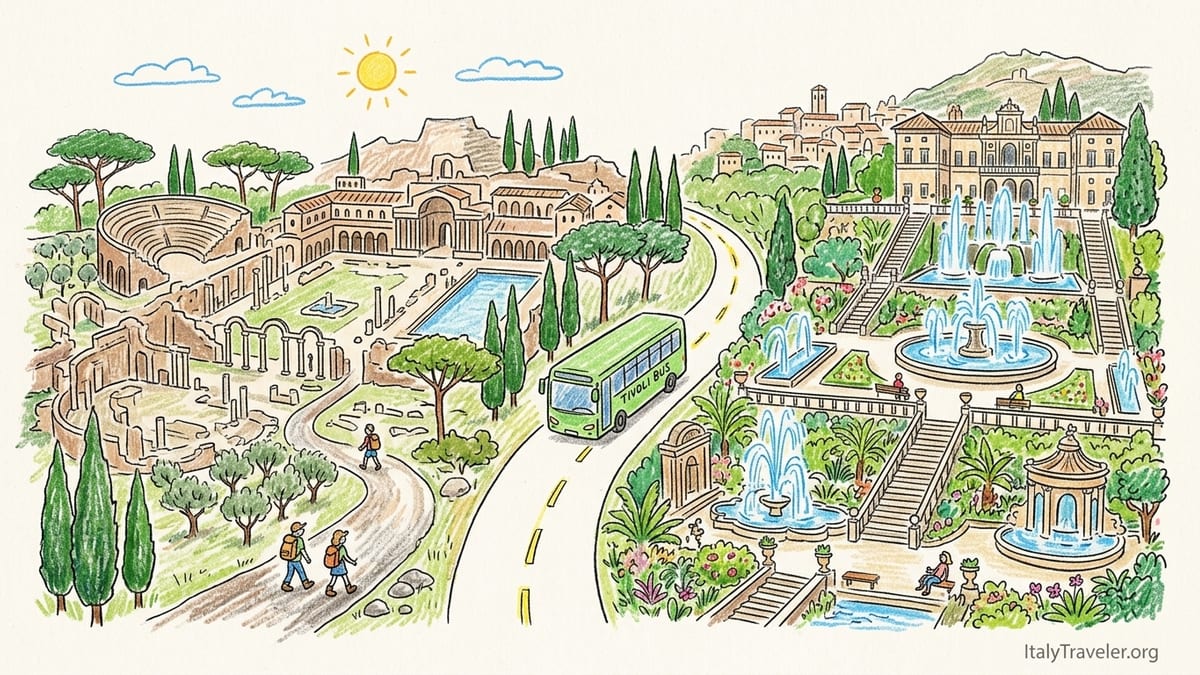
The first thing I learned is that “Tivoli” is not one compact complex. Villa d’Este and Hadrian’s Villa are two separate UNESCO World Heritage Sites roughly 6 kilometers apart. Villa d’Este sits in the historic center of Tivoli, just off Piazza Trento, while Hadrian’s Villa lies out in the countryside below town, near the modern suburb called Villa Adriana. You cannot simply walk between them in a few minutes. On my day trip it took a local bus ride of about 15 minutes plus a short walk at each end.
Both sites are managed together under the Italian state institution Le Villae, which means tickets and opening hours are coordinated. According to the official Villae information, the standard 2026 admission for each villa is 15 euros, or 30 euros for a combined ticket that also covers the Sanctuary of Hercules Victor and the Mensa Ponderaria, valid across consecutive days. The combined ticket is sold directly by Villae and is the main way independent visitors can save money if they want both major villas. This aligns closely with what I paid on site, though concession prices can vary by age and residency, so it is worth checking the Villae price page just before you travel.
Hadrian’s Villa is described on the official site as normally open every day apart from specified closure dates, and it explicitly warns that the archaeological routes involve paths and gradients that require suitable footwear. That description is not an exaggeration. My visit involved long stretches on uneven dirt, sections of loose gravel and some mild climbs to reach viewpoints across the vast ruins. Villa d’Este, by contrast, feels more compact in footprint, but its terraced Renaissance gardens are laced with steps and steep ramps that can be demanding in summer heat.
Because the two sites feel so different in atmosphere and layout, understanding this contrast in advance is important. If you picture one big museum with easy corridors, you will be surprised. What you are really planning is one half-day outdoor archaeological walk at Hadrian’s Villa and one half-day historic palace-plus-garden visit at Villa d’Este, connected by a small logistics exercise in the middle.
Current Opening Hours, Closures and Fountain Schedules
For a day like mine, getting the hours right is crucial. The Villae site states that Hadrian’s Villa is open every day, with seasonal closing times shifting through the year. In 2026 the pattern follows the typical Italian state-museum timetable, with opening from around 8:30 in the morning and last admission roughly one hour before closing. In winter that can mean last entry as early as mid-afternoon. Before finalizing my itinerary, I checked the Villae “Opening time and tickets” page again a few days before travel to confirm there were no special closure dates such as maintenance days or public holidays affecting either villa.
Villa d’Este also operates under specific access schedules. In 2026, standard opening is listed from approximately 8:30 or 8:45 in the morning, with closing time stretching into the early evening in high season and much earlier in winter, again with last admission set one hour before closing. Mondays are a special case. The official information notes that Villa d’Este may open later on Mondays, in some periods at 14:00 instead of early morning, to allow for maintenance. On my visit I deliberately avoided Monday for this reason, but if Monday is your only option, confirm the exact Monday opening time on the Villae site, because it can differ between seasons and during special exhibitions.
One question I had before going was whether the famous fountains at Villa d’Este always run. Locals in Tivoli confirmed and recent travelers have reported that winter maintenance or drought conditions can reduce or interrupt the water features, particularly around January and February. There have also been notices from the Ministry of Culture about specific days of free admission, such as the Republic Day free-entry event at Villa d’Este on 2 June 2026, which can increase crowds. Because these special days shift year by year, they need checking close to your travel dates. On my spring visit, all major fountains were operating by late morning, and the lower gardens were fully accessible.
At Hadrian’s Villa, there are no fountains in operation in the modern sense, but there are water basins and pools whose surfaces are strongly affected by light conditions. The site’s warning about gradients and walking conditions is matched by a practical reminder at the entrance: staff pointed to a schematic showing that some outer routes may close during heavy rain or extreme heat for safety or preservation reasons. That means a marginal weather forecast can change your route on the day, another reason to arrive early enough to adjust.
How I Bought Tickets and What I Would Do Differently
There are two broad ways to handle tickets in Tivoli. You can buy directly through the official Villae system or you can buy third-party tickets that may bundle transport or guiding. For my own trip I chose the official route. A few days before visiting, I used the Villae online booking system that is integrated with a platform used widely for Italian state museums. The interface allowed me to select a combined ticket for Hadrian’s Villa and Villa d’Este for 30 euros, plus a small online booking fee of just under 2 euros per person. The tickets were issued with a QR code that I kept both in email and as a PDF on my phone.
At Hadrian’s Villa, the QR code was scanned directly at the ticket office window. The staff then printed a small paper ticket that I needed to keep for Villa d’Este later that same day. At Villa d’Este in the afternoon, I showed the combined ticket at the separate ticket office in Piazza Trento, where staff validated it for entry without additional payment. The only minor friction was a short queue of about 10 minutes at the Villa d’Este ticket window as day trippers from Rome arrived at similar times.
Because I had already prebooked, I cannot report on same-day online availability, but I did compare lines with a couple who had not booked in advance. They paid on the spot with card at Hadrian’s Villa, and ticket availability was not an issue on a weekday in shoulder season. However, they mentioned that when they checked the booking site a week earlier, some time slots closer to midday were already marked “sold out” for Villa d’Este, likely because of group allocations. That is why my recommendation is to prebook through the official system at least several days ahead during spring and autumn weekends, and as early as you can if you are targeting a specific free-entry event or public holiday.
The other option I explored but did not ultimately use was buying tickets through a third-party platform that marketed itself under a Villa d’Este Tivoli domain but disclosed in the small print that it was an independent reseller. Its prices were noticeably higher, with “skip the line” combined entries listed at around 45 to 55 euros per person depending on date and cancellation terms. These tickets did not include a guide, only priority entry, which I decided did not justify a roughly 50 percent markup over the official combined ticket. The main advantage they offered was more flexible cancellation, which could appeal to travelers planning far in advance.
Getting There and Moving Between the Villas
On the transport side, I used the classic independent route from Rome. I took Metro line B to Ponte Mammolo, then a Cotral bus toward Tivoli via Prenestina. Cotral publishes current schedules, and there were buses roughly every 20 to 30 minutes at peak times when I checked. I boarded an 8:15 bus and arrived near the Hadrian’s Villa stop just after 9:00, with moderate morning traffic. The bus drops you on the main road; from there it is about 15 minutes’ walk to the entrance, gently uphill on a paved road with a short final stretch along the main gate driveway. There are a couple of small bars and a tabacchi near the bus stop that sell bus tickets and basic coffee and pastries.
For the stretch between Hadrian’s Villa and Villa d’Este, I used the local CAT bus. Routes 4 and 4X connect the archaeological site area with Tivoli’s historic center, stopping at Largo Nazioni Unite, from which Villa d’Este is about a five to ten minute walk through the old streets. I bought my CAT ticket in advance at the bar near the Hadrian’s Villa bus stop because conductors do not always sell tickets on board, and several recent visitors have reported getting stuck without a ticket for the return. The bus itself was modest and a little crowded around 13:00, but the ride took barely 15 minutes.
Some travelers choose the regional train from Rome Tiburtina station to Tivoli, then a CAT bus or taxi down to Hadrian’s Villa first, and finally a return by train from Tivoli in the evening. I compared both options and chose the bus in the morning because it dropped me closer to the villa and avoided an extra change. For the way back to Rome I actually took the regional train from Tivoli station around 18:30, which cost only a few euros and put me at Tiburtina within 45 minutes. This mix-and-match approach worked well because it avoided rush-hour traffic returning along the motorway.
If you prefer to remove transport from the equation, several tour companies in Rome sell full-day Tivoli excursions that include bus transfer, a guide, and entry to both sites. When I priced them up for my dates, costs ranged from around 110 to 150 euros per person for a group tour, including tickets, coach transport, and a licensed guide, with some private tours costing substantially more. Compared with my independent outlay of roughly 35 euros for combined tickets plus under 10 euros for all transport, you are paying mainly for simplicity and commentary. Whether that is worth it depends on how anxious you feel about the logistics described above.
Inside Hadrian’s Villa: Time, Terrain and Photography
I reached Hadrian’s Villa ticket office at about 9:15. There was no line, and after a quick bag check I entered the site at 9:20. From that moment until about 12:30, I walked almost continuously. The site is enormous, covering around 120 hectares in its original extent, and the accessible core still feels expansive. I followed the marked route past the Maritime Theatre, the Canopus, and the large baths, stopping often for photos and to read the bilingual information panels. I did not feel I had time to explore every side path, but I did visit all the main highlights and took a short break at the small café near the center for a coffee and bottle of water.
The terrain is exactly what the Villae note about gradients and surfaces suggests. I wore trail shoes with good grip and was very glad I did. Paths alternate between firm dirt, scattered stones, and occasional grassy stretches. A few short sections climb more steeply to reach panoramic viewpoints where you can see across the complex and towards the hills around Tivoli. In dry weather, dust can get into low-cut shoes; in wet weather the same paths could easily become muddy. I saw a handful of visitors in sandals or fashion trainers who were moving much more cautiously, especially on loose gravel near stair edges.
In late spring, shade was mixed. There are clusters of tall cypress and pine trees near some structures, and a few covered stretches around the theatre and baths, but large portions of the main route are exposed. I carried a wide-brimmed hat and a small folding umbrella that doubled as a personal shade in very open sections. Temperatures climbed well above 25 degrees Celsius by midday, and there are relatively few water fountains on site. The small café sold basic snacks and drinks, but I was glad I had arrived with a full one-liter bottle and refilled it when I could.
Photography at Hadrian’s Villa is rewarding but a little challenging in the bright midday sun. The reflective water of the Canopus pool easily blows out highlights if you shoot towards it around noon. My best images came earlier in the morning when the light was softer and side-lit the columns and tree trunks. A midrange zoom around 24 to 70 millimeters on a full-frame camera or a phone with both standard and telephoto lenses is ideal; there are many scenes where you want to compress arches and columns slightly rather than go ultra-wide. Tripods were not commonly used, and staff at the entrance reminded visitors that professional setups or commercial shooting require prior authorization.
Inside Villa d’Este: Heat, Fountains and Crowds
After lunch in Tivoli’s center, I entered Villa d’Este around 15:00. The ticket office on Piazza Trento had developed a short line by mid-afternoon, mostly small tour groups collecting group tickets and a few independent visitors buying same-day admission. With my combined ticket already in hand, I waited about 10 minutes, then passed through a security scan and reached the interior courtyard and palace rooms.
Villa d’Este is much more compact than Hadrian’s Villa, but its verticality makes it equally demanding in some ways. I spent about two hours inside, starting with a quick pass through the richly frescoed rooms of the palace and then descending steadily through the terraced gardens to the lower fountains. The famous Hundred Fountains alley, the Oval Fountain, and the Organ Fountain were all operating, and at set intervals the Organ Fountain played its water-powered music, drawing a small crowd each time. The combination of mist from the fountains and bright sunlight created very contrasty conditions for photography.
Footwear matters here as well. While the main paths are paved or cobbled, many staircases are slightly worn and can be slippery where overspray from the fountains keeps them damp. I saw more than one person in smooth-soled sandals with white knuckles on the railings. My same trail shoes from Hadrian’s Villa felt slightly overkill for the palace rooms but perfect for the terraces. Shade is better than at Hadrian’s Villa, thanks to mature trees and narrow terraces, but in high summer you still get intense heat pockets when the stone has baked all day. In shoulder season, afternoons are delightful, with dappled light under trees and long shadows across the fountains.
From a photography perspective, Villa d’Este favors the late afternoon. When I arrived around 15:00 in spring, the light still felt harsh on the upper terraces but softened as I descended. By about 16:30, the lower gardens were bathed in warm side light that made water jets sparkle without destroying detail in the stone. A phone camera is absolutely fine here, but if you have a dedicated camera, a wide lens around 16 to 24 millimeters can capture entire terraces, while a moderate zoom lets you isolate individual statues and water features. Tripods and large flashes were politely discouraged by staff, who asked one photographer to put away a large light stand.
Is Doing Both Villas in One Day Too Rushed?
Before my trip I read wildly different claims about whether both villas in one day was “too much.” After doing it myself, my conclusion is that it is very doable but not leisurely, and it suits a particular type of traveler. My timeline looked like this: departure from Rome around 8:15, arrival and entry to Hadrian’s Villa about 9:20, three hours on site until about 12:30, short walk and CAT bus into Tivoli by 13:00, a one-hour lunch near Piazza Trento, entry to Villa d’Este at 15:00, and departure back towards Rome around 17:30 to 18:00.
At Hadrian’s Villa, three hours felt like a decent but not exhaustive visit. I had time for the main complexes, repeated a couple of viewpoints, and sat quietly for a few minutes by the Canopus, but I did not attempt every peripheral path or read every inscription. Someone with a deep interest in Roman architecture could easily spend five or six hours there and still feel they were discovering new angles. At Villa d’Este, two hours was enough to see the interior rooms, descend through all the major terraces and fountains, sit for a few minutes on a bench, and take photographs without constantly checking the clock.
Where the day feels rushed is in the mental and physical transition. Shifting from the quiet sprawl of Hadrian’s Villa to the busy core of Tivoli, grabbing lunch, and then joining the afternoon crowds at Villa d’Este means you never quite stop moving. I walked well over 15,000 steps that day, much of it on uneven surfaces or stairs. If you are traveling with young children, anyone with mobility issues, or if you simply prefer a slow travel pace with more café time, you will likely appreciate splitting the villas across two days and using the combined ticket’s multi-day validity.
For reasonably fit travelers comfortable with city walking days, however, both villas in one day felt full but not punishing. The key is an early departure from Rome. I would not attempt both if you were only boarding your bus or train around midday. In that case, pick one villa, do it justice, and leave the other for a return trip.
Guided Tour vs Independent Visit: What I Actually Used
When planning my visit, I seriously considered booking a full-day guided tour from Rome that included bus transport and a licensed guide for both sites. Several respected operators listed group tours in 2026 that cost around 120 to 140 euros per person and bundled coach transfer, combined Villae tickets, and a guide who would walk guests through both villas. I read through their itineraries, which typically promised about two hours with the guide at each site plus some free time, and departure from central Rome around 8:30 with return by early evening.
In the end, I decided against a full tour and created a hybrid version instead. I visited Hadrian’s Villa entirely independently using the official information boards and a compact printed guidebook I had bought in Rome, then joined a prebooked small-group guided visit at Villa d’Este in the afternoon. That local guide charged 25 euros per person, paid in cash on arrival, for a 90-minute tour of the palace rooms and upper terraces, after which we could continue exploring alone.
For me, this split approach worked well. At Hadrian’s Villa, where distances are large and much of the appeal lies in wandering among ruins and imagining the former structures, I enjoyed setting my own pace and occasionally stepping away from the main paths. The on-site panels gave sufficient historical context for a general visitor, and a lot of the experience came from quiet observation rather than dense commentary. A guide here would be very valuable if you are academically interested in Roman history or archaeology, since they could explain building phases and imperial politics in more depth, but for a first-time casual visit I did not feel deprived without one.
At Villa d’Este, however, the guide made a clear difference. The dense layering of Renaissance patronage, hydraulic engineering, symbolism in the frescoes, and the story behind specific fountains such as the Organ Fountain or the Avenue of the Hundred Fountains came alive through her explanations. Walking through the palace without guidance earlier in the afternoon, I had noticed the beauty of the rooms but missed much of the narrative. With the guide, details like how water was channeled from the Aniene River, or why certain mythological figures appear together, suddenly made the place feel more than just a pretty garden. In that context, the extra 25 euros felt well justified.
My verdict is that travelers who enjoy independent sightseeing, are comfortable reading interpretive panels, and have done a little pre-reading about Roman and Renaissance history can absolutely visit both villas without a guide and still have a rich day. Those who like structured storytelling, or who may feel overwhelmed by ruins and frescoes without explanation, will benefit from at least one guided segment, with Villa d’Este being the place where a guide arguably adds the most value per euro.
Practical Tips on Footwear, Heat, Food and Photography
From a purely practical standpoint, the most important single decision you will make is footwear. The official Villae information about Hadrian’s Villa requiring suitable shoes is accurate. I would describe the minimum as supportive trainers or walking shoes with some tread. If you already own light hiking shoes or trail runners, wear those. Avoid smooth soles, high heels, and flimsy sandals. Even at Villa d’Este, where surfaces look more urban, those fountains generate slick patches, and the stairs can be tiring without good support.
Heat management comes a close second. Tivoli can be very hot from late May through early September. My strategy that worked well in late spring was an early start at Hadrian’s Villa to finish the more exposed, sprawling walk by early afternoon, then Villa d’Este later when more of the gardens are shaded. I carried a light cotton long-sleeve shirt, a hat, sunscreen, and a refillable bottle. There are limited drinking fountains at both sites, and the cafés, while welcome, are not as numerous as in a city center museum. In winter, by contrast, you may face the opposite problem of limited daylight and potentially reduced fountain activity at Villa d’Este, so checking seasonal notes on the Villae and Tivoli tourism sites before travel is worthwhile.
Food options are simple but adequate. Near Hadrian’s Villa, a couple of cafés and bars cluster around the Cotral bus stop and the approach road to the entrance. I had a coffee and cornetto there while waiting for the site to open, then a second quick snack at the on-site café around late morning. After the CAT bus up to Tivoli, I ate a relaxed one-hour lunch at a trattoria just off Piazza Trento, with several menus advertising fixed-price tourist lunches around 18 to 22 euros that included pasta, a main course, and water or house wine. With time pressure from the afternoon visit, I was grateful for clear, fast lunch options near Villa d’Este.
Finally, a note on photography etiquette. Both villas are popular with photographers, and it is easy to get carried away chasing the perfect shot. Staff at each site reminded visitors to avoid blocking narrow paths or stairways for long periods, especially when larger groups were passing. At Villa d’Este, I found the best compromise was to walk the gardens once fairly quickly, mentally noting angles and viewpoints, then do a second, slower loop focusing on a handful of compositions when paths were quieter. At Hadrian’s Villa, I paused more often early in the day when fewer people were around, then walked more continuously as midday coach groups arrived. Respecting other visitors’ sight lines and not leaning over barriers also keeps the experience pleasant for everyone.
FAQ
Q1. Can I visit both Hadrian’s Villa and Villa d’Este in one day from Rome?
Yes, it is entirely possible if you leave Rome by around 8:00 in the morning, budget about three hours at Hadrian’s Villa, two hours at Villa d’Este, and factor in transport time and a quick lunch. The day will feel full but manageable for reasonably fit travelers.
Q2. Is it worth buying the official combined ticket instead of separate tickets?
If you plan to visit both villas within the validity period, the official combined ticket, currently 30 euros for standard admission, saves money compared with buying two separate 15 euro tickets and also covers additional sites like the Sanctuary of Hercules Victor. It is the best-value option for most independent visitors.
Q3. Do I need to book tickets in advance, or can I just show up?
Outside of peak weekends and public holidays you can usually buy tickets on arrival without issues, especially at Hadrian’s Villa. However, online prebooking through the official Villae system is recommended in spring, autumn, and on special free-entry days to avoid sold-out time slots and small queues at Villa d’Este.
Q4. What is the easiest way to get to Tivoli without a tour?
The most straightforward independent route is Metro B to Ponte Mammolo in Rome, then a Cotral bus toward Tivoli. For Hadrian’s Villa you get off near the Villa Adriana stop, then walk about 15 minutes. For Villa d’Este and the return, many travelers switch to the regional train from Tivoli station back to Rome Tiburtina.
Q5. How much walking is involved at each villa?
Expect several kilometers of walking at Hadrian’s Villa, on uneven paths with some gradients, over roughly three hours if you see the main highlights. At Villa d’Este you will climb and descend multiple staircases and terraces over two hours, with many short but steep sections rather than long distances.
Q6. What kind of shoes and clothing should I wear?
Wear sturdy trainers or light hiking shoes with good grip, and avoid smooth-soled sandals or dress shoes. In warm months choose breathable clothing, a hat, and sunscreen, and in cooler seasons bring a light waterproof or extra layer since much of both visits is outdoors.
Q7. Are the sites suitable for visitors with limited mobility?
Both villas present challenges for visitors with mobility issues. Hadrian’s Villa has uneven paths and gradients, while Villa d’Este has many stairs and terraced levels. Some areas are accessible, but large parts will be difficult without strong mobility. Checking the latest accessibility notes on the Villae site and contacting them directly is advisable.
Q8. Is a guided tour necessary to enjoy the villas?
No, you can have a very rewarding visit using the official information panels and a good guidebook, especially at Hadrian’s Villa. However, a guide at Villa d’Este adds valuable context about the Renaissance history, symbolism, and hydraulic engineering, which many visitors find enhances the experience enough to justify the extra cost.
Q9. Can I take photos and videos freely inside the villas?
Personal photography is generally allowed at both sites, but large tripods, lighting equipment, and commercial shoots require prior permission. It is courteous to avoid blocking paths or stairways for long periods and to follow any instructions from staff about restricted areas or no-flash zones.
Q10. When is the best time of day to visit each villa for comfort and photos?
For comfort and photography, an early morning visit to Hadrian’s Villa avoids the strongest sun on its exposed paths and offers softer light on the ruins. Villa d’Este is lovely in the later afternoon, when its terraces get more shade and warm, angled light enhances the fountains and gardens.