


When I first moved to Rome, I treated Lazio as empty space on the map. Day trips meant Florence or Naples, not the hills and lakes that quietly ring the capital. That changed one sticky June when, half on a whim, I boarded a suburban train to Tivoli. I came back after dark with wet shoes, a phone full of fountains, and the unsettling feeling that the best parts of my Roman life might lie outside the city ring road. Over the next two years I kept testing that idea, trading cobblestones and Caravaggios for volcanic lakes, papal gardens, Etruscan tombs and ruined imperial villas. These are the places in Lazio that genuinely made me forget about Rome for a day, sometimes longer, and what I learned about seeing them without wasting time or patience.
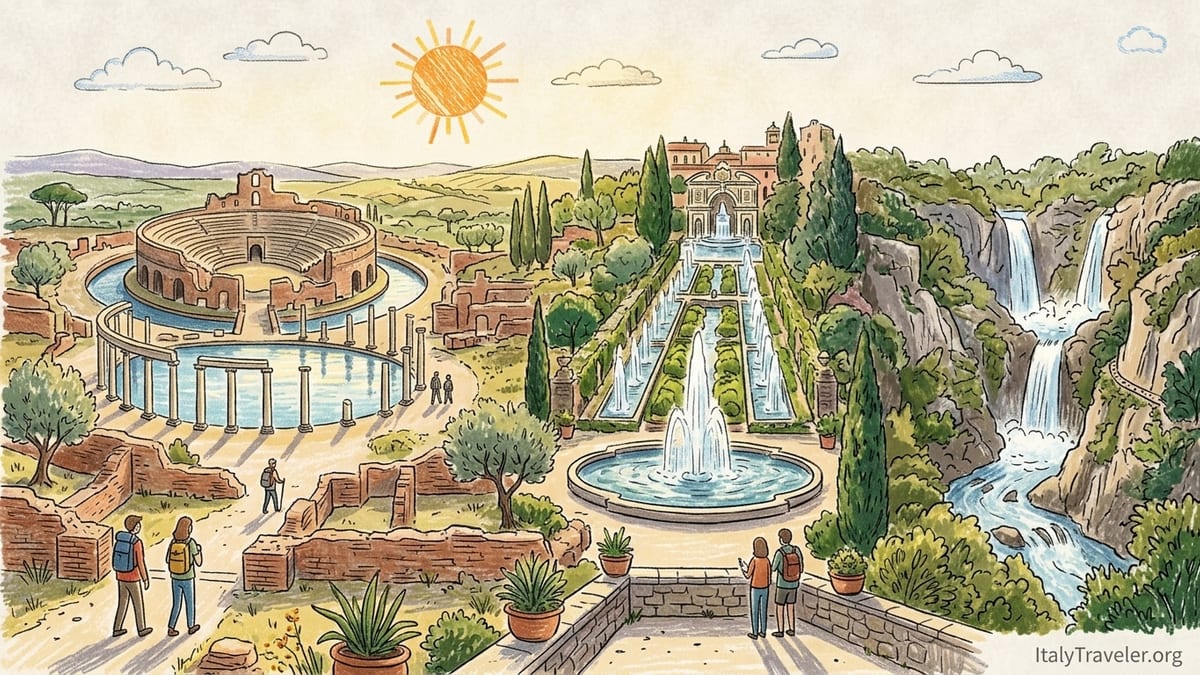
Tivoli: The Day I Realized Rome Was Not Enough
Tivoli is where my love affair with Lazio began, and if you only leave Rome once, this should be it. The town sits on a ridge above the Aniene River, about 35 minutes by regional train from Roma Tiburtina, and it delivers three completely different experiences within a few kilometres: the hillside waterfalls and gorge of Villa Gregoriana, the theatrical fountains of Villa d’Este, and the sprawling ruins of Hadrian’s Villa in the countryside. I have now done this triangle three times, in different seasons and combinations, and each visit confirmed the same thing. Tivoli is not a checklist of sights. It is a full, sensory day that needs planning, shoes you are not precious about, and more water than you think.
On my first trip I tried to squeeze everything into a rushed six-hour window and failed. The second time I gave Tivoli a full day from Rome and still wished I had a night there. What finally worked was arriving on an early train, starting with Hadrian’s Villa while it was still quiet, moving into town for a late lunch and Villa d’Este in the softer late-afternoon light, and saving Villa Gregoriana for a separate day. In practice, that meant leaving Rome around 8 am, getting back close to 9 pm, and walking more than 20 000 steps. None of it felt like a chore. Tivoli deserves that kind of energy because it offers something Rome increasingly struggles with: space, breeze, and an unhurried relationship with its past.
Crowds are the one thing that can sabotage Tivoli, but they are far more manageable than in the historic centre of Rome. Weekends from late spring through autumn bring tour buses, especially to Villa d’Este, and you will notice queues mid-morning. By contrast, my midweek April visit was remarkably calm. At Hadrian’s Villa I walked entire stretches of the Pecile colonnade without seeing another visitor. The lesson I took from multiple trips is simple. If your schedule allows, aim for a Tuesday to Thursday visit in shoulder season and buy combined or timed tickets in advance when they are available. Not because they sell out months ahead, but because it lets you walk straight past the people trying to open ticketing websites in patchy mobile signal outside the gates.
Hadrian’s Villa: A Ruined City That Ate My Morning
I had seen a hundred photographs of Hadrian’s Villa before I went, mostly of the elegant Canopus pool lined with broken columns. What those photos do not capture is the sheer scale and emptiness of the complex. This was not a country house but an imperial campus spread over more than a hundred hectares, and walking it feels closer to exploring an abandoned small town than ticking off a monument. On my first visit I thought two hours would be enough before lunch in Tivoli. I stayed nearly four and still skipped sections. That is the first practical point. If you care even a little about Roman history or atmospheric ruins, plan half a day here, not a quick stop on the way to something prettier.
Getting to Hadrian’s Villa without a tour is perfectly feasible. I have used both the Cotral buses that leave from the Ponte Mammolo metro station and the occasional direct coach included in organized day trips. The bus journey takes roughly 45 minutes in light traffic. What surprised me the first time was how uncrowded the site felt compared to central Rome. Even on a June Saturday, the queue at the ticket office was never more than ten people deep, and there were stretches where I could hear only crickets. Admission prices for 2026 day tickets are posted locally and by tour organisers; guides on my most recent trip quoted around 13 to 15 euros for a standard adult ticket, with reductions for EU residents and under‑25s. Because fees can change with temporary exhibitions, I check the official Lazio culture pages shortly before travelling rather than relying on older guidebooks.
Inside, the villa rewards visitors who are willing to wander without a rigid route. I followed the main path past the Pecile and its long reflecting pool, then veered off into the layered brickwork of the baths complex and the subterranean service tunnels. What made the visit worthwhile for me was the freedom to stand in the middle of the Maritime Theatre, surrounded by its circular moat, and imagine Hadrian walking the same ring when he wanted privacy. The signage is clear but not intrusive, and on my last visit there were a couple of small shaded kiosks selling water and snacks. They are not cheap. A small bottle of water cost more than at a supermarket in Rome. I still recommend bringing at least a litre per person and a hat, because shade is patchy and the stonework reflects heat well into the afternoon.
Hadrian’s Villa is also where I learned to calibrate my expectations about photography. From certain angles, especially around the Canopus, the ruins look exactly like the postcard images that first drew me in. In other spots the reality is harsher: fences, scaffolding, and areas of rough scrub that do not match the romantic paintings. This is not a problem if you accept that the villa is an active archaeological site, not a manicured garden. The upside is that you get long, quiet sightlines, especially in the morning, and if you walk a little beyond the main clusters you can still find corners without anyone in your frame at all.
Villa d’Este and Villa Gregoriana: Two Very Different Kinds of Water
After the dusty pale stone of Hadrian’s Villa, Villa d’Este hits you with green and sound. The 16th century palace sits right in Tivoli’s historic centre, a few minutes’ walk from the main square. From the street it looks surprisingly modest. Then you step out onto the terrace and realize that the real villa is vertical, a cascade of terraces, hedges and hydraulic miracles tumbling down the hillside. On my first visit I spent nearly an hour just on that upper level, moving slowly from balustrade to balustrade. The famous Hundred Fountains is not a metaphor. It is a long corridor of spouting faces, moss and stone that still runs cold water. Around it, larger features like the Oval Fountain send spray high into the air, turning backlit droplets into something that feels almost theatrical.
In 2026, Villa d’Este remains a headline attraction, and the ticket reflects that. When I visited in late spring, the full adult admission advertised at the gate was in the mid‑teens in euros, with reduced prices for youth and concessions. That is more than many regional sites but still less than a major Roman museum. For me it was worth every cent. I spent almost three hours inside on my most recent trip, much of it just sitting on shaded benches, listening to the water and watching families attempt group photos on the grand staircases. Late afternoon is the sweet spot. Group tours tend to visit earlier, and from about 4 pm the gardens thin out. The light also softens so that the carved details and cypresses photograph far better than under a midday sun that flattens everything.
By contrast, Villa Gregoriana feels wilder and more vertical. Managed by the FAI heritage trust, it drops from a park entrance near Tivoli’s centre down into a gorge carved by the Aniene River. Adult tickets are currently 10 euros, with discounted options for children, students and locals, and opening hours vary slightly by season but generally run from mid‑morning to late afternoon. I first went on a humid September day and underestimated how physical the paths would be. Within minutes I was on steep stone steps heading towards the so‑called Valley of Hell, with the sound of waterfalls growing louder and my mobile signal fading away.
What made Villa Gregoriana stand out for me was the way it compresses geology and history into one walk. You pass viewpoints over the Grand Waterfall, duck into dripping caves, and then round a bend to find yourself suddenly below the remains of Roman temples perched far above. I needed a solid two hours to follow the main loop at a comfortable pace, with frequent stops for photographs and to regain my breath. The paths are well signposted but can be muddy after rain, so this is not the place for sandals with smooth soles. Crowds were minimal on all my visits. Even on a May Sunday I never felt pushed along a path or jostling for space at viewpoints. If Villa d’Este is about spectacle and human control over water, Villa Gregoriana is about letting that water roar and grab back some territory.
Castel Gandolfo and Lake Albano: A Cooler Roman Summer
Castel Gandolfo sits on the rim of a volcanic crater south of Rome, looking down on deep blue Lake Albano, and it is the place that finally convinced me to leave the city on the hottest days of August. The regional train from Roma Termini to Castel Gandolfo station takes around 40 minutes, often for less than 3 euros one way when I booked at the station. From there it is a short uphill walk into the village. The air already feels cooler thanks to the altitude and the lake below, and the view that opens up when you step onto the main belvedere stopped me in my tracks the first time. Rome stretched faint and hazy on the horizon, and for once I felt entirely happy to have it behind me.
Two things make Castel Gandolfo special. The first is the water. Lidos along the lake shore offer sunbeds, pedal boats and kayaks. On my last summer visit I paid around 12 euros for a full‑day lounger and umbrella at a simple lakeside establishment, less than half what a comparable setup would cost at trendier beaches near Rome. There are also stretches of free shoreline where you can simply lay out a towel, although facilities are basic. I swam in the lake in July and September and found the water refreshingly cool but never shocking, even after a long lunch. Renting a pedal boat for an hour gave me the best perspective on the papal residence and the ring of forest above.
The second draw is the Vatican’s presence. The Papal Palace and the Barberini and Secret Gardens have been progressively opened to visitors in recent years, with several ticket types available through the Vatican Museums booking system. On my most recent trip in 2026, the posted full entry price for the Papal Palace and Secret Garden combination was 12 euros, with reduced tickets for students and children and a family tariff where additional children entered free after the first two paying ones. Tickets were sold directly at the palace ticket office in the village. I opted for a palace and gardens visit that lasted a little over two hours including a guided electric minibus tour through the Barberini Gardens. The experience surprised me by feeling far less formal than the Vatican Museums in Rome. There were no crushing crowds, photography was relaxed, and I had time to linger in the papal study looking out at the lake that once served as a summer escape for popes.
If there was one slight disappointment, it lay in the main village streets. Some parts of Castel Gandolfo’s historic centre felt more postcard‑driven than lived‑in, with menus overly focused on tourist staples. That said, I did find a small enoteca pouring local Frascati and Cesanese by the glass for around 5 euros, and a bakery where I grabbed slices of pizza bianca to eat on a bench overlooking the lake. In total, a day here deserved at least eight hours, between palace, gardens, swimming and slow wandering. Anything shorter would have felt rushed, especially considering the temptation to simply sit and stare at the water for long stretches.
Castelli Romani: Wine, Porchetta and Volcanic Hills
Castel Gandolfo is technically part of the Castelli Romani, a cluster of hill towns in the Alban Hills southeast of Rome. It took me a few trips to understand that this area is more than a single destination. Over time I threaded together Frascati, Ariccia, Nemi and Monte Cavo into a pattern that became my default escape when friends visited and wanted “something local” outside the city. The defining elements here are volcanic lakes, vineyards, abbeys and roasted meat.
My most vivid Castelli Romani memory is of a long Sunday lunch in Ariccia, famous for its porchetta. A local friend steered us away from the most aggressively advertised spots near the main square and into a simple fraschetta, the traditional taverns that serve cold cuts, cheeses and hearty pasta. We ordered wooden boards stacked with porchetta, pecorino and marinated vegetables, plus a jug of house red wine. The total per person, including a plate of amatriciana and coffee, came out under 25 euros. It was not refined dining. It was noisy, bright, and utterly satisfying. That afternoon taught me that the best Castelli Romani food experiences happen when you embrace the local rhythm. Arrive early or book on weekends, be ready to share a table, and do not expect fine‑tuned service. Do expect generous pours and a lot of laughter.
On another visit I joined a small‑group vineyard tour near Frascati. Many local wineries now coordinate tastings with transfers from Rome, usually costing between 50 and 80 euros per person depending on the number of wines and food pairings. The operation I chose had us walking through the vines with the owner, who explained how the volcanic soil shapes the crisp profile of Frascati DOC whites. We tasted three wines alongside local cheeses and a simple olive oil from their own groves. It was the kind of experience that looks generic on a brochure but felt oddly intimate in person, particularly when we ended up sitting on a low stone wall chatting about harvest dates and late frosts.
What surprised me about the Castelli Romani was how rarely I felt overcrowded. Frascati’s main piazza can fill up on summer evenings, and Nemi sees weekend motorcycle traffic, but outside a few pinch points the hills still feel like a Roman playground more than an international hotspot. If you plan your own route using regional trains and buses, factor in the time connections take. Moving between Frascati, Castel Gandolfo and other villages in a single day without a car can leave you sitting at quiet stations for longer than expected. In practice, I found it best to focus on one or two places per day and not try to conquer the whole ring of hills at once.
Lake Bracciano, Viterbo and Civita di Bagnoregio: Northern Lazio’s Slow Charm
When I needed a change from the southern hills, I turned my attention north. Lake Bracciano was the first revelation. A direct regional train from Rome to Bracciano takes around an hour, and from the station it is a short walk up into the town crowned by the Orsini‑Odescalchi Castle. I joined a guided tour of the castle’s interior, which cost a little over 10 euros, and spent almost ninety minutes moving through frescoed halls, armour displays and a loggia with sweeping lake views. Unlike some Italian castles that feel half‑empty, this one still holds an eclectic mix of furniture and paintings, which made it easier to imagine actual lives lived here.
Afterwards I wandered down to the lakefront at Anguillara Sabazia, a nearby village reachable by a short bus ride or boat when services are running. The water of Bracciano is clean enough to serve as part of Rome’s drinking supply, and motorboats are heavily restricted, so the surface stays unusually calm. I rented a paddleboard for an hour from a lakeside kiosk for around 15 euros and drifted along the shore, watching families picnic on the grass. Compared to coastal beaches near Rome, Bracciano felt lower key and more local, with simpler bars and more space between umbrellas. Crowds built up around mid‑afternoon on hot weekends but never to the point of shoulder‑to‑shoulder towels.
Further north, Viterbo and the Tuscia countryside gave me a glimpse of Lazio that often gets mistaken for Umbria or southern Tuscany. Viterbo’s medieval San Pellegrino quarter, with its stone towers and flowered balconies, is one of the rare old towns where the reality matched the photos almost perfectly. I spent a full day just wandering its alleys, ducking into churches and pausing at cafes where an espresso still cost around 1.50 euros at the counter. The town is large enough to support a university and thermal spa culture but small enough that you can cross the historic centre on foot in fifteen minutes. I based myself here for two nights and used local buses to reach nearby hilltop villages scattered with Etruscan tombs.
Civita di Bagnoregio, by contrast, was the place where I most clearly felt the tension between Instagram fame and lived reality. The town sits on a crumbling ridge accessible only by a pedestrian bridge, and entry requires a paid ticket collected at a booth on the far side. When I visited, the fee was a little under 10 euros, payable in cash or card, which goes towards maintaining access as the cliffs erode. Walking up in the early morning, with fog still pooled in the valleys, was magical. By late morning the bridge became a queue of people taking the same photograph. Inside the tiny village, the streets are undeniably photogenic, with stone houses, cats, and potted geraniums, but many doors now open onto souvenir shops, wine bars and small guesthouses. I spent about three hours including the walk in and out, which felt sufficient. It was worth seeing once, especially at off‑peak times, but it is one of the few Lazio spots where I would say the images circulating online slightly oversell the sense of untouched charm.
Ninfa and Sperlonga: Gardens and Sea on the Edge of Lazio
If Tivoli is Lazio’s theatrical side and Viterbo its medieval heart, Ninfa is its dream. The gardens of Ninfa sit on the ruins of a medieval town on the edge of the Pontine plain, and they are open to the public only on specific days, usually weekends and some holidays from spring to autumn. Because visitor numbers are controlled, you must book a timed entry slot in advance through the foundation that manages the site. When I went in May, the ticket cost around 15 euros and included a guided walk of about ninety minutes. Photography was allowed, but wandering freely outside the set routes was not.
Despite those constraints, Ninfa became one of the few places where I felt my own photos could never quite capture what I saw. Roses climbed over half‑collapsed walls, streams ran under stone bridges carpeted with moss, and rare trees cast unexpected shade. It felt less like a botanical garden and more like stumbling into a storybook where nature had politely reclaimed a village. Because groups are staggered, I rarely had other people in my frame. This is the pure antidote to places like Civita di Bagnoregio. The limited access keeps the atmosphere almost eerily calm. The downside is that you cannot linger indefinitely. Guides keep a gentle but clear eye on the clock, and after the loop you must leave. If you want to make a full day of it, combine Ninfa with nearby medieval towns like Sermoneta, whose hilltop castle and tight streets are easily worth another few hours.
For the sea, Lazio does not compete with the drama of the Amalfi Coast or Puglia, but Sperlonga is where I go when I need both clear water and a bit of history without leaving the region. The town is roughly halfway between Rome and Naples on the coast, reachable by train to Fondi‑Sperlonga and then a short bus ride. The upper town is a whitewashed tangle of alleys and archways that spill down towards long sandy beaches. On my first visit I paid about 18 euros for a sunbed and umbrella at a midrange lido in high summer, which felt fair given the cleanliness of the facilities and the warm shower included. Walking further along the sand, I found less formal stretches where you can simply lay out a towel with no fee.
The historical surprise here is the archaeological museum and grotto of Emperor Tiberius just outside town. The complex preserves fragments of large marble sculptures that once decorated a seaside villa and cave. Admission on my visit was under 10 euros and included the small museum and access to the grotto overlooking the sea. I spent an easy two hours here, partly to escape midday sun and partly because the setting makes it unusually simple to imagine the Roman elite at leisure. Compared to busy coastal sites in other regions, the crowds were reasonable even in August. Most beachgoers seem more focused on the water than the ruins, which works in your favour if you care about both.
The Takeaway
Looking back at my years based in Rome, the days that stand out clearest are not the ones I spent in front of the Trevi Fountain or the Colosseum. They are the days when I boarded a regional train with a simple plan and left the city behind. Tivoli’s trio of villas taught me how an imperial mind played with space, water and retirement. Castel Gandolfo and the Castelli Romani showed me how Romans actually escape their own city, into hills scented with porchetta and volcanic lakes. Bracciano, Viterbo, Civita and Ninfa revealed a Lazio that does not care whether outsiders notice, full of crumbling towers, garden dreams and quiet stations where the timetable still matters more than a selfie.
If there is one practical lesson that underpins all of these trips, it is this. Lazio rewards slowness and focus more than frantic box‑ticking. Most of the places that moved me most needed at least half a day, often a full one. Some, like Tivoli or Viterbo, are worth a night. Crowds are present but rarely unbearable if you choose your days and hours with a bit of care. And while a few spots look slightly better in photographs than in person, many more quietly exceed what the images suggest. Leave Rome for a day or two, or more if you can. The city will still be there when you get back. What waits beyond the ring road might change how you feel about it.
FAQ
Q1. Can I visit Hadrian’s Villa, Villa d’Este and Villa Gregoriana in one day from Rome?
It is physically possible, but in my experience it makes for a rushed and tiring day. I found that combining Hadrian’s Villa and Villa d’Este in one long day was just about manageable, but adding Villa Gregoriana left no time to actually enjoy the sites. If you only have one day, focus on Hadrian’s Villa in the morning and Villa d’Este in the late afternoon. If you have two days, give Villa Gregoriana its own half‑day or pair it with a relaxed wander through Tivoli’s historic centre.
Q2. How much time should I plan for a visit to Castel Gandolfo and Lake Albano?
On my trips, a satisfying visit took a full day of around eight hours. That allowed time for a tour of the Papal Palace and gardens, a long lakeside lunch, swimming or renting a small boat, and an unhurried stroll through the village. You can technically see the palace and look at the lake in half a day, but you lose the relaxed atmosphere that makes the trip worthwhile, especially in summer when the cooler air is part of the appeal.
Q3. Is it worth joining an organized tour for Tivoli or should I go independently?
Both options work. I have done Tivoli independently using regional trains and local buses, which kept costs lower and gave me flexibility. Organized tours, often priced from around 80 to 120 euros per person including transport and tickets, can save logistical hassle and sometimes use dedicated shuttles that link the villas more efficiently. If you are comfortable with Italian public transport and enjoy setting your own pace, independent travel is rewarding. If you prefer someone else to handle timings and connections, a reputable small‑group tour can be good value.
Q4. Are the Lazio lakes clean enough for swimming?
In my experience at Lakes Albano and Bracciano, the water was clear and felt clean. Bracciano, in particular, has restrictions on motorboats because it helps supply drinking water to Rome, which keeps the lake relatively unspoiled. I swam from both free beaches and paid lidos and did not notice litter problems in the water itself. As always, it is wise to check for any local advisories posted on the shore before swimming, especially after heavy rain.
Q5. How far in advance do I need to book tickets for Ninfa gardens?
The gardens of Ninfa have limited opening days and timed entries, and places can sell out, especially in spring and early summer. When I visited in May, weekend slots were fully booked several days in advance. As a rule of thumb, I would try to reserve at least a week ahead for popular dates, and even earlier if you have fixed travel plans. Outside peak periods some spaces may be available closer to the day, but I would not count on walking up without a booking.
Q6. Are these Lazio destinations suitable for travellers without a car?
Yes, with a bit of planning. I visited all the places described using trains, regional buses, occasional taxis and, in the case of organised vineyard visits, transfers included in the tour. Trains connect Rome with Tivoli, Castel Gandolfo, Frascati, Bracciano, Viterbo and Fondi‑Sperlonga. Local buses or short taxi rides usually cover the last stretch. The main trade‑off is time and flexibility. Without a car you must pay close attention to timetables and avoid the last departures of the day to reduce stress.
Q7. Which Lazio spot felt the most crowded and which the most peaceful?
Villa d’Este and Civita di Bagnoregio felt the most crowded on my visits, especially late mornings on weekends when tour groups arrived. Paths and viewpoints could get busy, and it sometimes took patience to find a quiet corner for photos. The most peaceful experiences were at Villa Gregoriana, particularly on an overcast weekday, and in the Ninfa gardens where timed entries and group limits kept numbers low. Parts of Lake Bracciano and Viterbo’s back streets also offered long stretches with very few other visitors.
Q8. How expensive are food and drink compared to central Rome?
Overall I found prices in these Lazio destinations equal to or slightly lower than in central Rome, especially away from the most touristy streets. In the Castelli Romani, substantial lunches with wine in simple fraschette cost around 20 to 25 euros per person. In Viterbo and Tivoli a cappuccino at the bar often cost under 2 euros and an espresso about 1.50. Lakeside and beach lidos charge more, but still tended to be cheaper than equivalent setups at fashionable seaside resorts in other regions.
Q9. Are there particular seasons that are best for visiting Lazio outside Rome?
My favourite times were late April to early June and late September to October. In these shoulder seasons the weather was warm enough for comfortable walking, gardens like Villa d’Este and Ninfa were lush, and crowds were moderate. High summer brought great swimming at lakes and sea but also stronger heat and more local visitors on weekends. Winter visits to towns like Viterbo and Tivoli were atmospheric and much quieter, though some gardens had reduced hours and shorter opening times.
Q10. If I only have two days free from Rome, which places should I prioritise?
If you have two days, I would use one full day for Tivoli, focusing on Hadrian’s Villa and Villa d’Este, and a second day for either Castel Gandolfo and the Castelli Romani or Lake Bracciano and its castle. That combination gives you a mix of imperial history, spectacular gardens and water, all reachable without a car. If you are more drawn to medieval towns and slower streets, swap one of the lake days for Viterbo and the Tuscia countryside instead.