


I thought I knew Lazio. For years, it was simply “the region around Rome” on maps and train timetables, a hazy backdrop to the Colosseum and the Vatican Museums. It was only when I finally forced myself to leave the ring road behind, rental car packed and Trenitalia app open, that I discovered how wildly wrong that impression was. What surprised me most was not just the beauty of places like Tivoli, the Castelli Romani, Tuscia, Bracciano, Sperlonga and Gaeta, but how utterly different they felt from one another, as if several small regions had been folded into one.
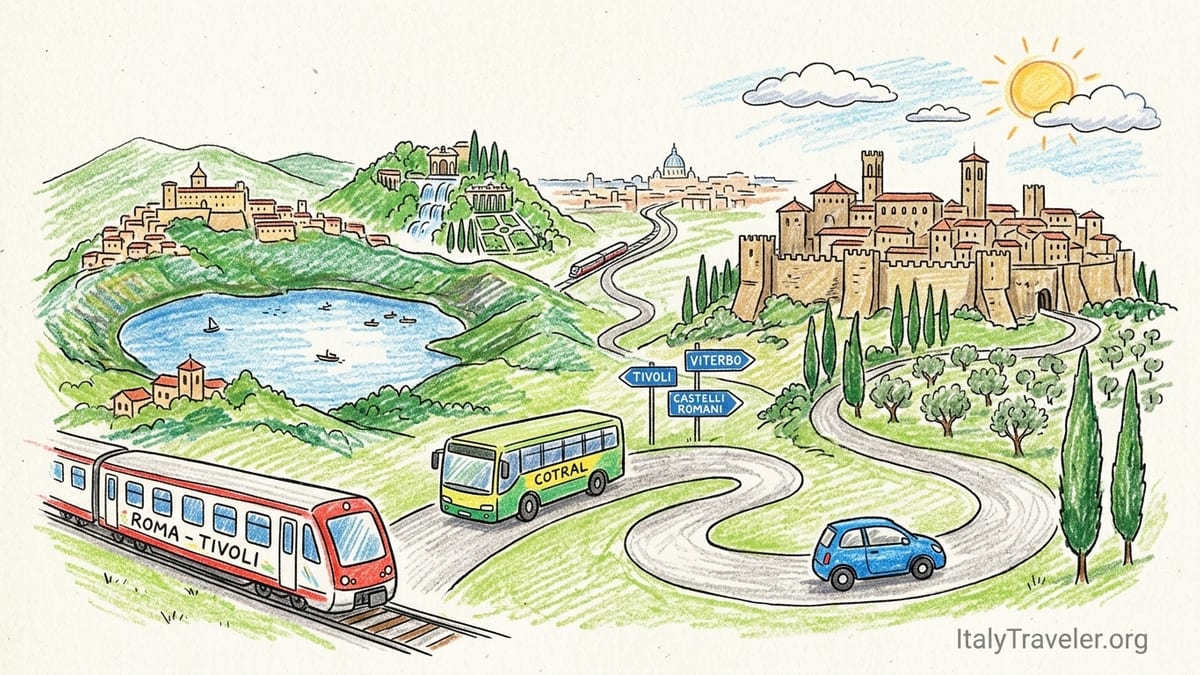
How I Based Myself and Got Around Lazio
On this trip I treated Rome as my launch pad rather than my destination. I based myself first in the San Giovanni district for easy access to Roma Termini and Roma Tiburtina, then moved to a small guesthouse in Trastevere for the second half when I relied more on trains heading west and south. This split base turned out to be practical: San Giovanni put me close to the A24 and A1 for picking up a rental car near Termini, while Trastevere station made it straightforward to reach the coast and the north without crossing the whole city each morning.
For transport, I deliberately mixed modes because different corners of Lazio reward different choices. For Tivoli and the Castelli Romani, I used regional trains and local buses so I could experience the commute that many locals actually do. The regional train from Roma Tiburtina to Tivoli, for example, took about 40 to 45 minutes door to door when I included the few minutes’ walk from Tivoli station up into the historic center. On other days, especially for Viterbo and the thermal baths at Terme dei Papi, I rented a compact car from an office near Termini. Driving the Cassia bis north out of Rome and then joining the Orte–Viterbo road made the run to Viterbo roughly 1 hour 30 minutes in daytime traffic, compared with close to two hours on the regional train with changes.
Parking and road conditions deserve a note because they influence where it makes sense to have a car. In hill towns like Viterbo and in lakeside Bracciano, the historic centers are wrapped in ZTLs, those limited-traffic zones that trigger automatic fines if you drive through the wrong archway. I left the car in signed public car parks just outside the walls, where daytime rates ran around a couple of euros per hour, and walked the final 10 to 15 minutes inside. Roads were generally well paved, even smaller provincial ones, but I quickly adjusted my driving style for tight bends and local habits such as last-second overtaking on the Appia and Flacca coastal roads.
Time-wise, the transfers shaped the itinerary more than any map suggested. A morning train from Termini to Fondi-Sperlonga station for the southern coast took about 1 hour 10 minutes on a regional service, then a 15 to 20 minute bus ride into Sperlonga itself. Reaching Gaeta in the same day involved another 30-minute bus along the coast. By contrast, a day built around Tivoli easily fit into a half-day window: leaving Rome around 08:30, I was walking into Villa d’Este by about 09:30. All of this made one thing clear: Lazio is not a single “day trip” in practical terms, but a patchwork of very different journeys.
Tivoli: Monumental Villas and a Different Pace from Rome
My first foray beyond central Rome was to Tivoli, about 30 kilometers east. I took a morning regional train from Roma Tiburtina, found a seat by the window and watched apartment blocks dissolve into olive groves as the line followed the old Tiburtina route. Forty minutes later I stepped off at Tivoli station, crossed the river and climbed through narrow streets that felt a world away from the capital’s gridlocked avenues.
In Tivoli, the rhythm of the day revolves around the villas. I started with Villa d’Este, the Renaissance masterpiece famous for its terraces and fountains. Current information from the official Villae site confirmed that the gardens open in the morning and run into the evening, with seasonal variations on exact times and last entry, so I aimed to arrive within the first hour of opening to avoid school groups. At the ticket office I paid a modest entry fee that, at the time of visiting, was clearly posted for adults, reduced categories and free EU youth. Once inside, it became obvious why Tivoli sits in its own mental category in Lazio: stepping out from frescoed rooms onto the terraces, I faced cascades, organ fountains and clipped hedges plunging down the hillside, with the haze of the Roman plain in the distance.
From a practical standpoint, I was struck by how compact Tivoli’s villa cluster is if you are prepared to walk. Villa d’Este lies right in town near Piazza Trento, about 10 to 15 minutes’ walk from the station uphill. Villa Gregoriana and the dramatic gorge of the Aniene are another short walk in the opposite direction, although seasonal closures in winter can limit access. Hadrian’s Villa, by contrast, sits a few kilometers out along the Tiburtina; here I followed current advice and took a local bus from near the train station, which took roughly 15 minutes once it left town traffic behind. Between buses and taxis waiting near the archaeological site entrance, it was easy to get back into Tivoli for a late lunch.
Eating in Tivoli underscored how different it felt from grabbing a quick panino around the Colosseum. I sat at a trattoria on Via delle Cascatelle and ordered a plate of fettuccine with porcini, a carafe of house red and a simple salad. The bill came to around 20 euros, and I watched local office workers on their lunch break rather than tour groups. That same afternoon, I still managed to catch a mid-afternoon train back to Rome, making Tivoli feel like an extended neighborhood of the capital even as its monumental villas belong to a separate Lazio of gardens and emperors.
Castelli Romani: Volcanic Lakes, Wine and Hillside Towns
A few days later I headed southeast into the Castelli Romani. Here, the landscape changes from the stone and tuff of Rome to a softer, greener world of extinct volcanic craters. I followed the advice of the official Castelli Romani tourism board and took a regional train from Roma Termini to Castel Gandolfo, a journey that took just under 40 minutes. The line winds past Ciampino and up into the Albani Hills before dropping you at a small station with views already opening out over Lake Albano.
From the station at Castel Gandolfo I walked uphill into the old papal town, a climb of about 10 to 15 minutes on a paved road. The reward was a sweeping view over the lake from the main piazza, framed by baroque facades and café terraces. Where Tivoli turned around Renaissance gardens and imperial ruins, Castelli Romani felt rooted in volcanic geology and food. The deep, almost circular basin of Lake Albano below me, with its wooded slopes and rowing lanes, reminded me that these lakes are the flooded craters of ancient volcanoes. That geology gives the area its distinctive wines, especially the whites from Frascati and the villages between Castel Gandolfo and Marino.
Getting between towns here required a bit more planning. The Visit Castelli Romani information highlighted integrated rail plus shuttle tickets, and I saw regional buses from operators like Cotral linking Marino, Albano, Ariccia and Genzano. In practice, I combined a train to Frascati with a local bus to Grottaferrata, where I visited the abbey, and then another bus across the ridge line to Nemi. Travel times were modest, usually 15 to 25 minutes between towns, but schedules thinned out at lunchtime and in the evening. When I switched to a rental car for a later day in the area, the freedom was obvious: I could loop down from Frascati through Monte Porzio Catone and out to the vineyards around Marino, stopping at a roadside fraschetta for roast porchetta and a glass of chilled Frascati Superiore for around 8 to 10 euros.
Driving here felt different from the high-speed ring roads around Rome. The roads between the Castelli towns are narrower, climbing and descending in a series of bends with sharp switchbacks and sudden viewpoints. Parking, however, was easier than I expected. Most towns have signed parking lots just outside the old centers, some free for the first hour with a dashboard disc and others pay-and-display with machines that accept coins or cards. In Nemi I left the car in a terraced lot and walked down into the main street overlooking the tiny lake below, where I bought a slice of the local strawberry tart the town is famous for. Looking across to the opposite crater wall, I realized that even within the same volcanic ring, each village had carved out its own identity in food, wine and views.
Viterbo and Tuscia: Medieval Stones and Thermal Water
Northwest of Rome, the feel of Lazio changes again in Tuscia, the historic area around Viterbo that once formed a powerful medieval state. I picked up a rental car in Rome and headed out on the Cassia bis towards Vetralla, before joining the Orte–Viterbo road that the Terme dei Papi thermal complex highlights on its official directions. The drive, mostly on modern expressways tracing ancient consular routes, took about one and a half hours with light traffic. The moment I saw Viterbo’s walls appear on the horizon, compact and honey-colored, I understood why this city is regularly described as one of the best-preserved medieval centers in Lazio.
Because the historic core of Viterbo is wrapped in a ZTL, I parked in a public car park outside Porta Romana and walked in, a 10-minute stroll past small shops and bars sliding their shutters up for the morning. Inside the walls, the San Pellegrino quarter felt centuries older than anything I had seen in Rome: narrow lanes with profferlo staircases jutting from facades, stone arches linking houses above ground level, and quiet piazzas where laundry flapped from wrought-iron balconies. I spent a morning wandering up to the Palazzo dei Papi and the loggia where popes once gave blessings, paid a few euros to visit the palace complex during posted opening hours, and listened to a guide explain how Viterbo hosted one of the longest papal conclaves in history.
The other draw in Tuscia, and where I really felt Lazio shift character again, was the thermal water. Just outside town, the Terme dei Papi complex takes advantage of natural hot springs that have been known since Etruscan times. According to the spa’s current information, the main thermal center is open daily through the year, generally from morning until early evening, with a monumental outdoor pool supplied by the sulfureous “Bullicame” spring. I drove from the city walls to the Terme exit in about 10 minutes, parked in the on-site lot included for spa users, and paid for a day pass that gave me access to the huge outdoor basin and changing facilities.
Soaking in the warm, slightly opaque water surrounded by low hills, I could not have felt further from the marble floors of the Vatican. The experience was closer to a wellness retreat than a cultural excursion. People lounged on deck chairs, read books and occasionally drifted to the on-site café and restaurant for snacks and simple dishes like salads, pasta and grilled vegetables. Prices were posted clearly for package treatments and entry, and the spa’s rules about swim caps and the prohibition on bringing outside food kept the atmosphere calm and ordered. That evening I drove back to Rome with skin pleasantly tired from the minerals, convinced that Tuscia is Lazio’s answer to a medieval and thermal countryside break rather than a simple extension of the city.
Bracciano and the Lakes: Water, Castles and Commuter Trains
If Tuscia feels medieval and geothermal, the area around Lake Bracciano offers yet another face of Lazio. On this leg I skipped the car and took a regional train from Roma Ostiense along the line documented by local mobility authorities as part of a “lake is near” initiative. The journey to Bracciano station took about one hour, following tracks that slowly left industrial Rome behind for fields and low forest. When the train curved around and the glint of water finally appeared, I understood why Romans consider Bracciano a summer and weekend escape.
From Bracciano station, the town rises in a compact hill crowned by the Orsini-Odescalchi castle. It was a steep but short 10-minute walk up cobbled streets to reach the historic center. I paused often, partly to catch my breath and partly to take in views over the lake that widened with each turn. The castle entrance posted visiting hours and ticket prices; guided tours ran at set times, and I joined a mid-morning slot that took around an hour to wind through furnished rooms and up to terraces with broad views. The guide explained how the lake is volcanic, like those in the Castelli Romani, and serves as a crucial freshwater reserve, which is why motorboats are restricted and the shoreline feels quieter than at many Italian lakes.
Getting down to the water from town involves another 20 to 25 minutes’ walk, partly on paved roads and partly along pedestrian paths. For visitors with reduced mobility, local buses and taxis offer a more comfortable link between station, castle and lakeshore, although services may thin in the afternoon outside summer weekends. On my visit, I picked up a simple lunch at a lakeside bar: a caprese sandwich, a bottle of water and a coffee for just under 10 euros, then watched sailing lessons and paddleboarders making slow progress across the calm surface. Compared with the packed trains heading to Ostia’s urban beaches, Bracciano felt like a small-scale resort stitched into daily commuter life.
The practical difference between Bracciano and Rome came home again when it was time to leave. Trains back to the city ran at roughly hourly intervals, with the latest services in the evening catering to commuters as much as visitors. I built in a buffer of half an hour in case of minor delays or platform changes, especially important if you need to make a connection in Rome. The combination of fresh water, medieval castle and easy rail access made Bracciano feel like its own micro-destination inside Lazio: neither coastal nor mountainous, but defined by its lake and the balance between tourism and everyday life.
The Southern Coast: Sperlonga and Gaeta as a Different Kind of Lazio
For all the variation I had already seen, nothing shifted my perception of Lazio’s diversity as sharply as heading south to the Tyrrhenian coast. Early one morning I boarded a regional train from Roma Termini bound for Fondi-Sperlonga. The journey took around 70 minutes, crossing flat countryside punctuated by hill towns on the horizon. Stepping off at the modest station, it was immediately clear that I was no longer in an easy, walkable day trip like Tivoli. The town of Sperlonga sits several kilometers away on the coast, reached by a bus that times its departures to meet the trains.
The bus ride to Sperlonga took about 15 to 20 minutes along the modern coastal road opened in the mid twentieth century, with occasional glimpses of the sea between trees and hotels. As we entered town, the atmosphere changed completely: whitewashed houses climbed a headland, laundry snapped in the sea breeze, and sandy beaches stretched in both directions. Trails of visitors headed down to stabilimenti, the managed beach clubs that rent umbrellas and loungers by the day, while others strolled the pedestrian alleys of the old town. This Lazio felt closer to the Amalfi Coast than to the Forum.
Practicalities on the coast had their own rhythm. At Sperlonga’s beach clubs, I saw posted prices for a day’s rental of two loungers and an umbrella that varied by row and season, rising in August when Roman holidaymakers arrive in force. For those on a tighter budget, stretches of free beach still exist between the private concessions, though they fill quickly on weekends. I split my day between a swim in the sea and a visit to the archaeological area around the grotto of Tiberius, where an on-site museum preserves sculptures found in the emperor’s seaside villa. Entry fees were modest, and the site’s posted hours allowed enough time to combine a cultural visit with a lazy afternoon on the sand before catching the bus back to the station.
Gaeta, slightly further south along the same coastline, required a different approach. On a separate day I took a regional train from Rome towards Formia-Gaeta, a roughly 75- to 90-minute ride depending on stops. From Formia station, local buses and taxis cover the short transfer into Gaeta proper. The town presented yet another flavor of Lazio: a mix of naval port, medieval quarter and beach promenade. I walked out along the seafront to Serapo beach, where the curve of sand backed by low cliffs and pine trees felt distinct from Sperlonga’s longer, flatter stretch. Lunch was a slice of tiella, the stuffed pie Gaeta is known for, bought from a bakery for a few euros.
Combining Sperlonga and Gaeta in a single day without a car would have been unrealistic. The train lines and bus connections do not align neatly, and current guides emphasize that a rental car is the only practical way to link multiple coastal towns on the same outing. When I finally did rent a small car in Rome and drive south along the SS148 Pontina and then the coastal Flacca road, the drive itself became part of the experience: stretches of reclaimed Pontine countryside gave way to rocky headlands and glimpses of sea, with frequent speed changes, tunnels and roundabouts. The coast here showed me a Lazio of summer apartments, seafood restaurants and evening passeggiata, radically unlike the villas of Tivoli or the alleys of Viterbo.
What Tied It All Together: Lazio as Many Places, Not One
By the time I returned my rental car in Rome and scrolled back through my notes, a pattern had emerged. Official regional material talks about Lazio as a land of lakes, historic villages, coast, nature, archaeology and wellness. After moving beyond central Rome, I realized that this is not marketing language but a literal description of very different places that happen to share a regional border. Tivoli revolves around monumental villas and terraced gardens cut into a hillside above the Aniene. The Castelli Romani orbit volcanic lakes and vineyards, their identity tasted in a glass of white wine or a slice of porchetta. Tuscia and Viterbo push you into a medieval cityscape of stone and into hot mineral water that steams in winter air. Bracciano centers on its volcanic lake and castle, folding leisure into daily commuting patterns. Sperlonga and Gaeta present a Lazio of sun lotion, tiella, and sand underfoot.
The logistics highlighted these differences as much as the landscapes did. In Tivoli and the Castelli Romani, trains and local buses were my main tools, with travel times under an hour from central Rome and walking distances manageable, though often steep. In Tuscia, the convenience of a car became clear the moment I tried to match train timetables to spa opening hours. Around Bracciano, the ease of a direct railway line into the lakeside town encouraged spontaneous day trips. Along the southern coast, the need to align train arrival times with infrequent buses or, alternatively, to drive and navigate parking near beaches, gave the whole experience a different, more independent feel.
Accommodation and meal stops changed flavor too. In Tivoli I stayed in a family-run guesthouse just off Piazza Plebiscito, where breakfast included homemade cakes and conversations about villa crowding patterns. In the Castelli Romani, my base was a small agriturismo outside Genzano with views across orchards and a dinner menu built around seasonal vegetables and local wine, with a set menu price that hovered around 30 euros per person. Viterbo offered a stone-built B&B in the San Pellegrino quarter, a short walk from evening aperitivo spots where a glass of local red and a plate of snacks rarely cost more than 7 or 8 euros. On the coast, I chose a simple room above a bar in Sperlonga, where the chief amenity was a balcony catching the sea breeze and the promise of fresh grilled fish in the trattoria downstairs.
What surprised me most was how quickly my mental map of Lazio changed from a fuzzy ring around Rome into a set of specific, grounded images: the echo of water in Tivoli’s fountains at opening time, the taste of cool Frascati wine above a volcanic lake, sulfur rising from a steaming pool outside Viterbo in winter, the outline of Bracciano’s castle against an evening sky, the feel of hot sand near Gaeta under my feet as the sun dropped behind the hills. Each of these belonged to Lazio, but none of them felt like the others. To understand the region, you have to move through it, mode by mode and town by town.
FAQ
Q1. Do I need a rental car to explore Lazio beyond Rome?
For Tivoli, the Castelli Romani and Bracciano, you can comfortably rely on regional trains and local buses, with journeys typically under an hour from central Rome. A rental car becomes more useful for Tuscia around Viterbo and for combining multiple coastal towns such as Sperlonga and Gaeta in a single trip, where public transport schedules are less aligned.
Q2. How long does it really take to visit Tivoli from Rome and back?
From Roma Tiburtina or Termini, regional trains to Tivoli take roughly 40 to 45 minutes, plus a 10- to 15-minute walk uphill to the historic center and Villa d’Este. Even with time inside at least one villa and a relaxed lunch, you can comfortably return to Rome by late afternoon or early evening on the same day.
Q3. Is Tivoli’s Villa d’Este open year-round and do I need to book ahead?
Villa d’Este is open most days of the year, with hours and last-entry times that vary seasonally and are published on the official Villae site and ticketing platforms. For quieter months, buying a ticket on arrival usually works; in busier spring and autumn weekends it is wise to check current conditions and consider advance purchase through the official channels to avoid queues.
Q4. What is the best way to reach the Castelli Romani from Rome without a car?
Direct regional trains run from Roma Termini to hubs like Castel Gandolfo and Frascati, generally in under 40 minutes. From there, local buses operated by regional companies connect to nearby hill towns such as Marino, Albano, Ariccia and Nemi. Integrated rail-plus-shuttle tickets are available on certain routes, and timetables are posted on local tourism and transport sites.
Q5. How do I get to Viterbo and Terme dei Papi, and what are the spa’s hours?
You can reach Viterbo by regional train from Rome, with journey times often close to two hours including changes, or by car in about 1 hour 30 minutes along the Cassia bis and Orte–Viterbo road. Terme dei Papi sits just outside Viterbo, has on-site parking, and, according to current information, opens daily through the year with continuous hours from morning to early evening; the exact schedule is published on the spa’s official site.
Q6. Are there any driving or parking restrictions I should know about in Lazio towns?
Many historic centers, including those in Viterbo, Tivoli and some Castelli Romani towns, are protected by limited-traffic zones marked by signs and cameras. Visitors should park in signed public lots outside the walls or old-town gates, where payment machines indicate hourly rates and maximum stays, and then walk into the center to avoid fines.
Q7. How do I reach Sperlonga and Gaeta from Rome using public transport?
For Sperlonga, take a regional train from Roma Termini to Fondi-Sperlonga station, which usually takes about 70 minutes, then transfer to the local bus that runs the 15- to 20-minute route into town and the beaches. For Gaeta, regional trains from Rome stop at Formia-Gaeta station, from which local buses or taxis cover the short distance into Gaeta and its waterfront areas.
Q8. Can I visit both Sperlonga and Gaeta in one day without a car?
Combining Sperlonga and Gaeta by public transport in a single day is challenging because they rely on different train stops and separate bus connections along the coast. Current regional guidance and recent traveler reports suggest that a rental car is the practical option if you want to link multiple coastal towns on the same outing from Rome.
Q9. Is Bracciano a good alternative to Rome’s urban beaches like Ostia?
Bracciano offers a very different experience from Ostia, centered on a volcanic freshwater lake and a medieval castle rather than a long urban seafront. The regional train from Rome to Bracciano takes about an hour, and from the station it is a short walk up to the castle and a longer but manageable stroll down to the lakeside, where swimming, sailing and lakeside cafés replace the more crowded city-beach atmosphere.
Q10. How many days should I plan to get a sense of Lazio’s diversity beyond Rome?
With three to four full days you can sample several sides of Lazio, for example a day in Tivoli, one in the Castelli Romani, one in Tuscia around Viterbo and the thermal baths, and one on the southern coast at Sperlonga or Gaeta. A week gives you time to slow down, stay overnight in at least one hill town or coastal village, and appreciate how different each part of the region feels from the others.