


Planning a trip to Lazio often starts and ends with Rome. The temptation is strong to book a single hotel near the Colosseum or Trastevere, buy a stack of train tickets and “day trip” your way across the region. I have done that. I have also done the opposite, renting cars, changing beds three times in a week and waking up in hill towns where the church bells, not scooters, are the alarm clock. The contrast between using Rome as a hub and actually sleeping elsewhere in Lazio is much sharper than it looks on the map, because this region’s best experiences are scattered across very different landscapes, micro‑climates and evening atmospheres.
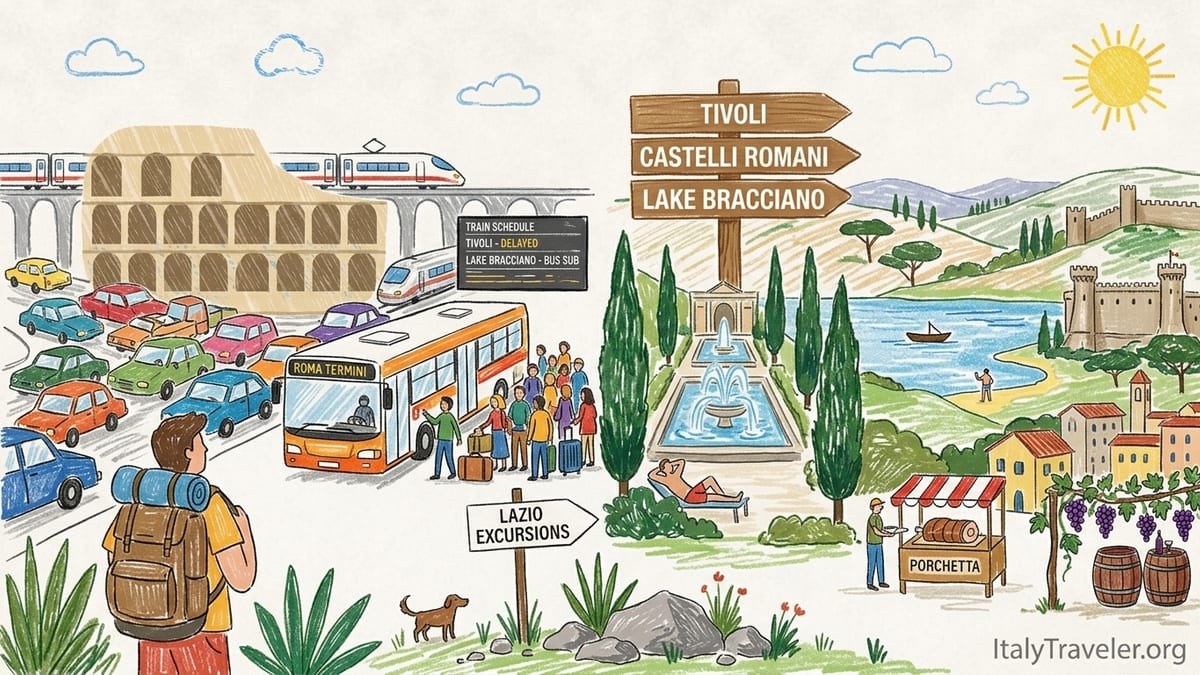
Rome as a Hub: Convenience vs Reality
On paper, Rome looks like the perfect base for everywhere in Lazio. You have two major train stations, Fiumicino and Ciampino airports, endless hotel options and car rental desks that stay open into the evening. From Roma Termini, trains to Tivoli can be as quick as about 40 minutes, and to Bracciano or Anguillara Sabazia on Lake Bracciano often around one hour with regional services. Regional buses reach Viterbo and the coastal towns around Sperlonga and Gaeta in a couple of hours. It is technically possible to see a lot without ever changing hotels.
In practice, you pay for that convenience with early alarms, late returns and a steady drip of small frictions. Rome’s morning traffic into and out of the city can be heavy, particularly on weekdays between about 7:30 and 9:30. If you pick up a rental car at Termini or near the Aurelian Walls and try to leave town at 8:30, your first hour can disappear before you reach the ring road. Parking near central sights is scarce and mostly restricted to residents, so you often end up in underground garages at roughly 20 to 35 euros per day, then walking or taking the metro back to your hotel.
Even when you rely on trains and buses, evenings in Rome shape your days. After a full outing to Tivoli or the coast, you return to Termini or Tiburtina, navigate the metro in rush hour and then look for dinner in a neighborhood that may be busy and loud. It is fun if you want a city buzz every night, but it can make a five day Lazio trip feel like one long city break punctuated by bus rides.
Where Rome as a hub still shines is for pure simplicity. If you only have three nights, are nervous about driving, or are traveling with a lot of luggage, a single hotel booking near Termini, the Monti neighborhood or Trastevere and two well chosen day trips gives you a taste of Lazio’s variety without the stress of packing and parking. But if you have five or seven nights and care as much about countryside evenings, lake swims or thermal baths as you do about monuments, shifting your base once or twice inside Lazio changes the feel of the trip completely.
Tivoli: Sleeping Next to the Villas
Tivoli is the obvious first alternative to staying in Rome. Villa d’Este, with its cascades and Renaissance terraces, and Hadrian’s Villa, sprawling in the countryside, both deserve more than the rushed hour that many bus tours allow. Official information from the Villa d’Este operator shows a clear effort to keep opening hours as long as staffing allows, with extended opening around holidays and spring events, which makes early or late visits especially attractive if you sleep nearby.([villae.cultura.gov.it](https://villae.cultura.gov.it/en/the-locations/villa-deste/?media_link=1&utm_source=openai))
Using Rome as a base, a typical day looks like this: you catch a morning regional train from Termini to Tivoli, walk or take a local bus up to Villa d’Este, visit for two or three hours, grab a quick lunch, maybe rush to Villa Gregoriana, and then face a late afternoon bus or taxi out to Hadrian’s Villa before returning to Rome in early evening. It is a satisfying day, but it also means you are in the most famous gardens during the busiest midday window, and you have one eye on train schedules instead of fountains.
Staying in Tivoli flips the script. When I overnighted a block from Piazza Garibaldi, I was able to walk into Villa d’Este not long after opening with only a handful of other visitors. A slow loop through the upper gardens, followed by an almost private moment at the Hundred Fountains, would have been impossible if I had been on a train. In summer, you can do the opposite: take a long afternoon break and then slip back in for the softer evening light when many day trippers are already lining up for buses back to Rome. If you self drive, you also avoid reentering Rome’s ring road at the evening peak.
Practicalities matter here. Parking on the upper plateau of Tivoli near the historic center is mostly paid blue‑line street parking and a couple of multi story garages. Midweek in shoulder seasons it is usually possible to find a spot within a ten minute walk of the villas without circling for half an hour. In high summer weekends, you may have to park lower down and climb, so if mobility is an issue, ask hotels about reserved spaces or small private lots. Restaurants are concentrated on and around the main streets near Piazza Trento and the lanes just below Villa d’Este. On a Wednesday in April, several trattorie were still busy at 9 p.m., but the vibe was local rather than touristy: families eating pizza al taglio on the steps, couples with gelato in the square. If your priority is villa time and a quieter evening atmosphere, two nights in Tivoli instead of two extra nights in Rome is one of the clearest trade offs that feels worth repacking for.
Castelli Romani: Food, Wine and Relaxed Evenings
To the southeast of Rome, the volcanic hills of the Castelli Romani are a completely different Lazio. Frascati, Castel Gandolfo, Ariccia, Genzano and a necklace of smaller towns sit among vineyards, chestnut woods and crater lakes. Official regional tourism describes the area as a landscape of DOC wines, specialty foods like porchetta di Ariccia and Lariano bread, and walking paths between lake viewpoints and monasteries.([visitlazio.com](https://www.visitlazio.com/en/the-castelli-romani-wine-road/?utm_source=openai))
Base yourself in Rome and this becomes another long day: an early train from Termini to Frascati, a wander through town, perhaps a taxi to Castel Gandolfo for lake views and the papal gardens, a late lunch in one of Ariccia’s traditional fraschette taverns and then a train or bus back to the city. You can absolutely do this, and if you keep your ambitions in check, it is a great introduction to the hills. But the most rewarding Castelli hours are in the evening, when Frascati’s main piazza fills with locals and wine bars, or when Castel Gandolfo’s terrace over the lake quiets down after day trippers head back to their coaches.
On a recent trip I stayed two nights at a small inn in Frascati’s historic center. I parked the car once in a covered municipal lot on the edge of town, paying a moderate day rate that worked out significantly cheaper than Rome’s central garages, and did the rest on foot. At 8 a.m., the cobbled streets around the cathedral were almost empty. By 10 a.m. the outdoor tables were filling with locals having cappuccino and cornetto, not yet surrounded by guided groups. Dinner meant walking five minutes to a fraschetta style osteria, sharing a plate of porchetta di Ariccia and local Frascati wine, then strolling home with a clear view of Rome’s glow on the horizon. That kind of gentle, food centered evening is difficult to replicate if you are always watching the clock for the last regional train back to Termini.
In terms of logistics, Castelli Romani is one of the easiest places in Lazio to base without a car. Trains from Roma Termini to Frascati can take under half an hour, and buses connect the hill towns to each other, although evening frequencies can thin out. If you do drive, the hills are outside Rome’s strict central ZTL zones, and traffic in and out of the area is calmer than in the capital, especially if you plan around rush hours. For a five day Lazio trip focused on food, wine and soft countryside, one night in Rome, two nights in Frascati or Castel Gandolfo, and then a couple of nights further north or on the coast gives you a very different rhythm compared with five straight nights under Rome’s streetlights.
Bracciano and the Lakes: Slower Days by the Water
West and slightly north of Rome, Lake Bracciano offers a cooler, breezier side of Lazio. Bracciano itself has a remarkably well preserved castle, Castello Orsini Odescalchi, rising above a medieval core, while lakeside villages such as Anguillara Sabazia line up beaches and small piers. Official information highlights how the lake and surrounding landscape are part of a protected regional park and are off limits to fuel powered boats, which keeps the water unusually clean and the atmosphere quieter than at many Italian lakes closer to big cities.([it.wikipedia.org](https://it.wikipedia.org/wiki/Lago_di_Bracciano?utm_source=openai))
If you stay in Rome and day trip to Bracciano, the usual pattern is an hour or so on a regional train, a castle visit, a quick lunch and perhaps an hour on the lakeshore before you head back for dinner in the city. It works, but the timetable and the last trains can loom large, especially for families who want an unhurried swim. Some visitors report finding simple paid parking close to the beach for just a couple of euros for several hours, particularly along the limited access lakeside road where a parking lot serves as a drop off point for the sand.([reddit.com](https://www.reddit.com/r/rome/comments/1v98u49/lake_bracciano_and_orsiniodescalchi_castle_the/?utm_source=openai))
Sleeping in Bracciano or Anguillara shifts the mood. With a car, it is easy to find small guesthouses on the hills above the lake that include on site parking. You can wander down to the water in the morning when it is still glassy and quiet, rent a lounger at a modestly priced lido or use one of the free beach stretches, and then linger over a long lakeside lunch without thinking about the journey home. Evenings tend to be relaxed: a handful of restaurants, a gelato on the square, the sound of conversation carrying from the lakeshore. Walking distances are manageable. From many central Bracciano hotels, it is ten to fifteen minutes on foot down to the water and a similar uphill walk back to the casteled old town.
Bracciano also works well as a low stress base if you combine self driving with public transport. You can arrive by train from Rome, pick up a rental car locally if arranged through a small agency, or simply rely on buses and walking while you are at the lake. Compared with parking and driving around Rome, negotiating a small hill town and lakeside roads feels straightforward. For a three day Lazio visit in hot weather, one night in Rome followed by two nights on Lake Bracciano can be more refreshing than trying to sandwich the lake into a single long day from the city.
Viterbo and Tuscia: Medieval Lanes and Thermal Baths
North of Rome and inland, the province often marketed as Tuscia offers a different face of Lazio again. Viterbo’s medieval walled center is one of the best preserved in central Italy, and just outside town you find an entire culture of hot springs and baths. Travelers now have a choice between free natural pools such as Bullicame and Bagnaccio and organized complexes like Terme dei Papi, whose monumental pool covers more than 2,000 square meters and is fed by mineral rich hyperthermal waters.([termedeipapi.it](https://termedeipapi.it/en/one-day-packages/?utm_source=openai))
From Rome, Viterbo is reachable by regional train or bus in around two hours. A day trip is possible, but by the time you walk from the station into the medieval quarter, explore the papal palace, have lunch and figure out transport to one of the baths, you are either rushing your soak or resigning yourself to a late return. The better experiences I have had in Tuscia all came when I stayed at least one night in or near Viterbo. That allowed me to visit the city walls in the late afternoon light, dine at a trattoria hidden behind the cathedral, and then spend a slow half day at the thermal pools rather than treating them as an add on.
Concrete numbers help when planning. Recent information from packages marketed around Terme dei Papi lists basic full day entrance to the monumental pool at roughly 18 euros on weekdays, rising to about 25 euros on weekends and holidays, with separate, higher priced packages if you add spa treatments or access to special grottos.([termedeipapi.it](https://termedeipapi.it/en/one-day-packages/?utm_source=openai)) Free or semi managed baths such as Bagnaccio may ask for a smaller contribution, often under 20 euros, which helps with upkeep and services.([en.wikipedia.org](https://en.wikipedia.org/wiki/Bagnaccio?utm_source=openai)) Sleeping locally also makes it easier to use local buses or short taxi rides from Viterbo’s stations to the baths, avoiding the hassle of driving wet and relaxed back into Rome’s traffic at night.
Parking around Viterbo’s walls is generally easier than circling Rome’s center. There are several large surface lots just outside the gates, where I have found spaces in early afternoon without more than a few minutes of searching, even on market days. Evening atmosphere is quietly lively: students from the local university and families stroll the pedestrian streets, cafés serve drinks until late, and restaurants are busy but rarely feel overwhelmed by tourism. For a seven day Lazio trip, basing three nights in Viterbo or the nearby countryside, combined with one or two nights in Rome and a couple of nights at the coast or lakes, creates a balanced loop that gives Tuscia the time it deserves.
Sperlonga and Gaeta: Coastal Contrast to the City
South of Rome, the Lazio coast offers bright, white washed Sperlonga and the more working harbor town of Gaeta. Both share wide sandy beaches and clear water that draw Romans on summer weekends. Driving from central Rome, you can expect a journey of around two to two and a half hours depending on traffic, with the final stretch often slowing as you approach beach parking areas and local ZTL zones. Municipal maps for Sperlonga clearly mark limited traffic areas and seasonal restrictions, which can change from day to day; when I last visited in peak season the central ZTL was active, meaning I had to leave the car in a paid lot a ten to fifteen minute walk from the old town and beach.([sperlongaturismo.it](https://www.sperlongaturismo.it/wp-content/uploads/2023/06/CARTINA_compressed.pdf?utm_source=openai))
As a day trip from Rome, Sperlonga can feel like a scramble: you leave early to beat traffic, arrive late morning, circle for a parking spot, rent a couple of sun loungers at a stabilimento for a few hours, grab a quick seafood lunch and then watch the clock for the drive back before dark. If a storm rolls in or the beach is more crowded and expensive than you hoped, there is little flexibility. The return into Rome often coincides with evening traffic, lengthening the journey and leaving you tired when you still need to find dinner near your hotel.
Staying in Sperlonga or Gaeta changes the calculus. Many small hotels and guesthouses either include a reserved space in a nearby parking area or have arrangements with private garages on the edge of town; it is important to confirm this when you book, since on street spaces in the center are often off limits or time limited. Once parked, you can walk almost everywhere: from upper Sperlonga’s white lanes down to the beach in about ten minutes, or along Gaeta’s waterfront from the harbor to the main town beaches in a quarter of an hour. Evenings are the payoff. Families stroll the lungomare with gelato, fish restaurants are busy until late, and night temperatures are gentler than inland in July and August.
If your Lazio trip is in warm weather and lasts at least five nights, one of the most satisfying patterns I have found is to start with two or three nights in Rome, then rent a car and spend two or three nights on the coast before returning the car closer to Naples or Rome depending on onward travel. The extra hotel change feels justified because you avoid repeating the long coastal drive twice in a single day and because your beach time becomes something more than an excursion bolted onto a city itinerary.
Is Moving Around Worth the Packing?
The question that underpins all of these choices is simple: does changing hotels save enough time and improve the experience enough to justify packing your suitcase again. After several trips focused on Lazio, my answer is that it depends on how many nights you have and what you value most in your evenings.
On a three day visit, the friction of packing and unpacking usually outweighs the gains. Rome works best as the single base, with perhaps one substantial day trip to Tivoli, Frascati or Lake Bracciano. You can pick a hotel within walking distance of Termini or on a direct bus line to your chosen excursion, avoid renting a car altogether and accept that evenings will be urban and lively rather than lakeside quiet.
At five days, the equation changes. If you care about food and countryside, moving once starts to make sense. One pattern that has worked well is three nights in Rome followed by two nights in Castelli Romani or on Lake Bracciano. You lose perhaps half a day to checking out and relocating by train or car, but you gain one full evening and morning in a smaller town where you can walk to dinner without crossing a ring road and wake up to church bells instead of traffic. If your focus is more on history and hot springs, three nights split between Rome and Viterbo achieves something similar, especially in cooler months when thermal baths are appealing.
With seven days, Lazio rewards a more regional approach. A loop of two nights in Rome, two in Viterbo or Tuscia, and three on the coast or in the hills shares out driving and rail time in manageable portions and gives each landscape its own mornings and evenings. You might, for example, have breakfast on a Viterbo terrace, soak in the Terme dei Papi monumental pool in the late morning, then drive an hour or so towards the coast and be walking a seafront promenade in time for sunset. The key is to avoid over splitting your stay. Two base changes in a week are plenty. More than that, and you risk spending as much time figuring out hotel parking policies and check in windows as you do enjoying the piazzas and lakes you came to see.
How I Would Allocate 3, 5 and 7 Days in Lazio
Rather than a rigid itinerary, it helps to think in terms of where you sleep and what kind of evenings you want. On a three day trip focused mainly on Rome’s sights with a taste of Lazio, I would stay all three nights in Rome itself, close to Termini or a metro line, and choose a single strong day trip: Tivoli for villa lovers, Frascati for food and wine, or Bracciano for water and castle views. That keeps transfers simple and minimizes time spent worrying about luggage or car hire.
On a five day trip, I would almost always divide my time between Rome and one regional base. If your priority is gardens and hill towns, three nights in Rome and two in Tivoli or Frascati work well, using the regional base to enjoy early or late access to villas and evening passeggiate that feel more local. If your emphasis is on relaxation, three nights in Rome followed by two nights in Viterbo gives you both a medieval city and a proper half or full day at the thermal baths, with time to dry off, nap and go out to dinner without having to think about a return journey.
For seven days, I would choose two non Rome bases and limit Rome to two or at most three nights, especially if I have visited the capital before. One satisfying option is two nights in Rome, two in Viterbo or another Tuscia town for medieval lanes and hot springs, and three on the coast in Sperlonga or Gaeta. Another is two nights in Rome, two around Lake Bracciano, and three in Castelli Romani, using the second week base for wine, porchetta and easy countryside walks. In each case, Rome becomes the gateway rather than the hub, and the bulk of your evenings are spent where parking is simpler, restaurant reservations less stressful and the night sky a little darker.
What makes this kind of regional planning work in Lazio is precisely that the attractions are not clustered around one obvious secondary city. Tuscia’s thermal culture feels completely different from the hills of Castelli Romani or the clean, boat free waters of Lake Bracciano, and the coast south of Rome has its own rhythm again. Using Rome as a hub flattens those differences into a sequence of long day trips. Sleeping in at least one of these landscapes lets the region’s variety seep into the quieter parts of your day, which is often where travel memories stick.
FAQ
Q1. Is it realistic to visit Tivoli’s main villas as a day trip from Rome?
Yes, it is realistic, especially if you focus on two sites. With an early regional train from Termini, you can comfortably see Villa d’Este and either Villa Gregoriana or Hadrian’s Villa in one day, but you will be moving at a steady pace and your visits may fall into the busiest midday hours. Staying overnight in Tivoli allows for quieter early morning or late afternoon visits and removes the pressure of catching the last train back.
Q2. Do I need a car to enjoy Castelli Romani, or can I rely on public transport?
You can enjoy Castelli Romani without a car by basing in Frascati or Castel Gandolfo and using regional trains from Roma Termini plus local buses or taxis between nearby towns. Trains to Frascati are frequent and take under half an hour, which makes it easy to arrive and depart. A car adds flexibility for smaller villages and vineyards, but it is not essential if you choose your base with rail in mind and accept that evening buses between hill towns can be limited.
Q3. How difficult is parking in smaller Lazio towns compared with Rome?
In most smaller towns such as Tivoli, Frascati, Bracciano and Viterbo, parking is noticeably easier and cheaper than in central Rome. You are more likely to find spaces in municipal surface lots or multi story garages within a ten to fifteen minute walk of the center, often for lower daily rates than city garages. You still need to watch for ZTL signs and blue lines that indicate paid parking, but you are unlikely to experience the prolonged circling that is common near Rome’s historic core.
Q4. Are Lazio’s thermal baths near Viterbo suitable as a quick stop on a driving day?
They can be, but they are far more rewarding if you allow at least a half day and ideally base nearby. Organized complexes such as Terme dei Papi sell full day and partial day access to their monumental pools at prices that make sense if you stay to soak, nap and repeat rather than rush through in an hour. Free or lower cost thermal areas near Viterbo also benefit from slow use, so if you are tight on time, consider planning a dedicated Viterbo night instead of squeezing a bath between long drives.
Q5. Is it worth staying overnight on Lake Bracciano instead of day tripping from Rome?
If you enjoy quiet water, castle views and unhurried meals, yes. An overnight stay in Bracciano or Anguillara Sabazia lets you swim or walk along the lake early and late in the day when it is calm and less busy, and it removes the need to coordinate lake time with regional train schedules. For a short three day trip you might keep Rome as your only base, but on a five or seven day visit, one or two nights at the lake offer a restorative counterpoint to the city.
Q6. How crowded are Sperlonga and Gaeta in summer, and does staying there help?
In July and August, both Sperlonga and Gaeta attract many day visitors from Rome and other parts of Lazio, which can lead to busy beaches and competition for parking by late morning. Staying in one of these towns helps significantly: you can walk to the beach, claim a spot earlier in the day, retreat to your room for a rest during the hottest hours and enjoy the evening passeggiata without fighting through outbound traffic. It also allows you to navigate local ZTL restrictions more calmly, often with hotel guidance on where to park.
Q7. For a five day Lazio trip, is it better to add Tuscia or the coast as a second base?
This depends on your interests and season. If you are traveling in cooler months or enjoy medieval towns and hot springs, Tuscia with a base in Viterbo is ideal, combining historic streets and thermal baths. In warmer months, the coast around Sperlonga or Gaeta offers swimming and sea air. In either case, splitting your time between Rome and one of these areas makes better use of your five days than commuting back and forth daily from the capital.
Q8. How walkable are towns like Tivoli, Frascati, Bracciano and Viterbo once I am parked?
All four are very walkable if you are comfortable with some hills and cobblestones. Historic centers are compact, with most sights, restaurants and main squares within a ten to fifteen minute walk of central parking areas or train stations. The trade off for quieter evenings and easier parking compared with Rome is that you may be walking uphill at least once a day, especially in places like Tivoli and Bracciano where the old town sits above the river or lake.
Q9. Will splitting my stay across multiple bases make my trip feel rushed?
It can, if you change hotels too often. The key in Lazio is to limit yourself to one or at most two bases beyond Rome in a seven day period. That way, you only pack and unpack a couple of times and spend the bulk of your days and evenings exploring, not moving. Thoughtful choices such as pairing Rome with just Viterbo, or Rome with just the coast, preserve a sense of ease while still giving you very different atmospheres.
Q10. If I only have three days in Lazio and want one countryside evening, where should I stay?
With only three days, a simple solution is to book two nights in Rome at the start for key city sights and then spend the final night in a close by town such as Frascati or Tivoli. Both are reachable by train in under an hour, offer a clear change of pace in the evening with local restaurants and calmer streets, and do not add much travel complexity when it is time to return to Rome or the airport the next day.