

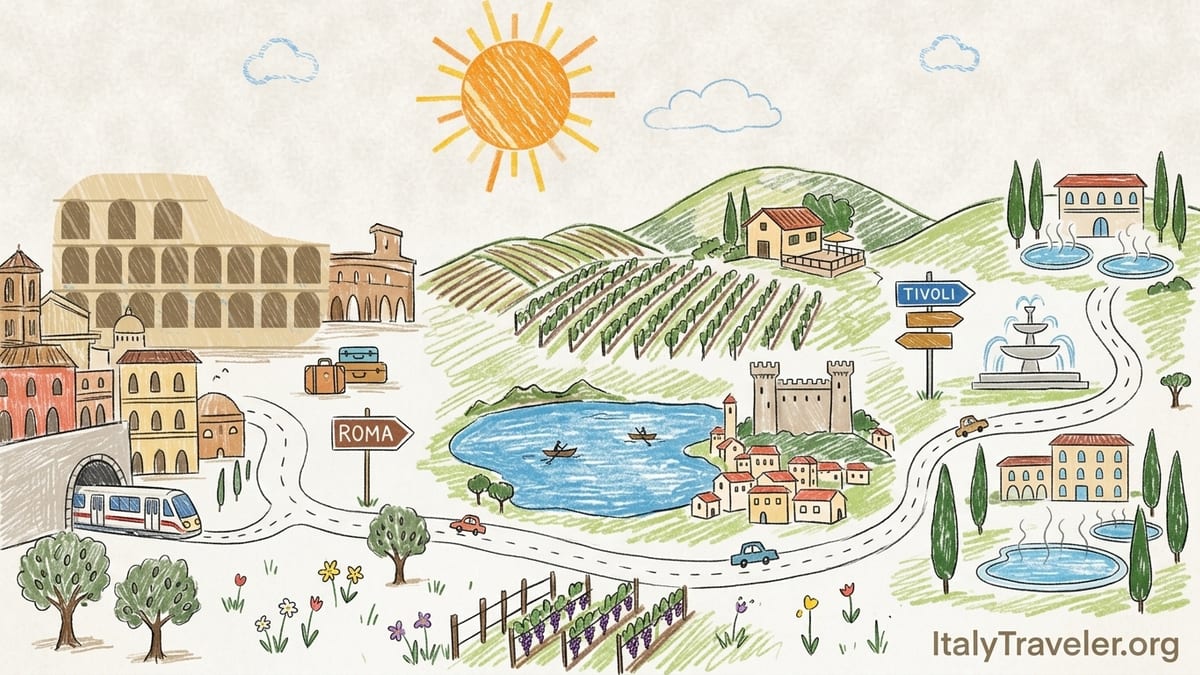
Sooner or later, every Rome traveler asks the same question: is it really worth giving up a central hotel near the Metro for a night or two in the Lazio countryside, on a lake, or by the sea? Around Rome, the answer can genuinely be yes, provided you choose a stay that feels like a destination in itself and still keeps logistics realistic. The region’s small hotels, agriturismi and spa resorts turn classic day trips like Tivoli, the Castelli Romani, Lake Bracciano, Viterbo’s hot springs and the Sperlonga coast into slow, atmospheric overnights rather than rushed box‑ticking from Termini.
Should You Sleep Outside Rome At All?
Before looking at specific hotels, it is worth being clear about what you give up when you move your base outside the city. In central Rome, you usually have quick access to at least one Metro line, the main train stations and a dense network of buses and trams. For most sightseeing focused purely on the Colosseum, Vatican Museums and Trastevere, this convenience is hard to beat. Moving your luggage on and off regional trains, planning last evening departures back from the countryside and negotiating rural buses all add friction, especially on a short trip.
However, Lazio’s hinterland is unusually rich. The Castelli Romani hill towns south east of Rome mix vineyards, volcanic lakes and historic villas recognized as a wine-producing zone since the 1990s, and they lie roughly 30 to 45 minutes from the capital by train or car. Tivoli holds two UNESCO‑listed villa complexes that together draw hundreds of thousands of visitors each year, arguably more than justify a single day. Lake Bracciano, the thermal area around Viterbo and the Sperlonga and Gaeta coast all offer settings that Rome simply cannot replicate, from views over crater lakes to sandy coves well beyond the city beaches.
The commercial question is therefore not only price but how much you value quiet evenings, outdoor space and a stronger sense of place. A night in a lakefront room where you can watch rowing boats at dawn, or a Castelli agriturismo where you can walk among vines and taste local white wine on site, will not appeal to every traveler. For those already planning a day trip out of Rome, though, choosing one or two overnights near their chosen excursion point can reduce commuting and increase actual relaxation time.
This guide focuses entirely on accommodations that give you a real reason to sleep outside Rome. Properties are organized by travel purpose rather than star rating, and each section notes whether a place is based on firsthand experience or on research from recent, verifiable information. Where possible, you will find practical details about rooms, beds, bathrooms, breakfast, noise, air‑conditioning, parking, restaurant options, views and how useful the location really is for a short trip.
Historic Stays in Tivoli for Villa‑Focused Trips
Tivoli is the classic day trip from Rome, yet it holds at least two sites that can easily fill a full day or more: Villa d’Este, with its dense network of fountains and Renaissance terraces, and Hadrian’s Villa, a huge second‑century complex on the plain below. Both are recognized as major state attractions, with Villa d’Este alone frequently counted among the ten most visited state sites in Italy. Staying overnight means you can visit one villa in the late afternoon and another the following morning, avoiding the most crowded midday windows and reducing travel fatigue.
B&B Al Catillo 1600 – Dimora storica Tivoli sits in the upper part of the historic center in a seventeenth‑century building a short walk from Villa d’Este’s entrance. Recent descriptions highlight large rooms with high ceilings, tiled or parquet floors and classic antique furniture rather than minimalist design. Bathrooms are modernized, with walk‑in showers, standard ceramic fixtures and good water pressure rather than spa features. Beds are typically standard European doubles with firm mattresses and cotton linens, and rooms facing inward to the courtyard are quieter than those on the narrow lanes, where voices and scooters can echo in the evening. Air‑conditioning is installed and important in summer, but the thick walls also keep rooms cooler. Breakfast is described as an Italian buffet with pastries, yogurt, fruit and coffee served in a vaulted room, and while there is no restaurant on site, the location is very useful, with several trattorie in under five minutes’ walk and public parking garages available on the edge of the center.
Another researched option that balances history with comfort is Palazzo Papa Gregorio XVI, housed in a historic palazzo close to Villa d’Este. Rooms here are reported to mix original architectural elements with contemporary bathrooms. Expect classic tile or stone underfoot, a proper desk, and windows opening to either internal courtyards or views over the rooftops. Sound insulation in old palaces is often imperfect, so light sleepers should prefer upper floors or courtyard rooms. Air‑conditioning is standard, as are private bathrooms with shower cabins and modern fittings. Breakfast tends toward a sweet Italian spread with some savory items. Parking is typically in public garages or lots below the historic center, so factor in a short uphill walk with luggage.
For travelers more focused on pools and road access than historic atmosphere, the Tivoli Terme area near the thermal baths offers modern hotels with easier parking and closer road links back to Rome. Properties such as Hotel Victoria Terme and several chain hotels in the area offer standard modern rooms with tile floors, blackout curtains, air‑conditioning and functional bathrooms. Many have on‑site spa facilities connected to the thermal complex, outdoor pools and plentiful parking. The trade‑off is that you will rely on buses or taxis to reach Villa d’Este and Hadrian’s Villa, and the immediate surroundings are more suburban than picturesque. For a tight villa‑centered itinerary, however, this can still be a logical base, particularly if you value a larger pool and clear driving routes back toward Rome or further into Lazio.
Wine and Countryside Hotels in the Castelli Romani
The Castelli Romani, a group of hill towns on the Alban Hills south east of Rome, have been the capital’s countryside escape for centuries. The area is recognized as a wine denomination that covers both white and red styles, and towns like Frascati, Grottaferrata and Marino mix vineyards, wooded slopes and traditional osterie. From Rome’s termini, regional trains reach Frascati in roughly half an hour, and local buses connect onward to other villages. For visitors deciding whether to sleep here, the strongest arguments are evening vineyard views, cooler temperatures and access to both Lake Albano and Lake Nemi without crossing the city again.
Tenuta Cusmano, an agriturismo and wine estate near Grottaferrata, offers precisely that countryside‑plus‑city balance. The property lies amid its own vineyards on a hillside, with a broad terrace reported to look over the Alban Hills, the estate’s vines and, on clear days, even as far as Rome and the distant sea. Rooms are more in line with a countryside residence than a sleek design hotel: expect terracotta floors, wooden furniture, beds with proper mattresses and cotton duvets, and private bathrooms equipped with showers and standard amenities. Air‑conditioning is available, but nighttime temperatures in the hills are often gentler than in central Rome. Breakfast typically includes local baked goods and fruit, and many guests comment on the pleasure of eating outside when the weather allows. Parking is on the estate grounds, which suits renters with a car, and the location works well for day drives to Castel Gandolfo, Nemi, Frascati and back to Rome for one or two city days.
Another researched country option within the broader Castelli area is Casal Montani, an agriturismo and wine resort located on gentle hills within the wider territory of the Roman countryside. The historic farmhouse sits along a small country road that turns to a short stretch of gravel before reaching the entrance. Rooms and suites are set in a medieval‑style casale surrounded by vines and centuries‑old olive trees. Descriptions emphasize historical character paired with basic comforts: beds with solid headboards and firm mattresses, exposed beams or stonework, and well‑kept bathrooms with showers. The property offers a bed and breakfast formula and showcases its own wines in a historic cellar that still incorporates a Roman‑era cistern. Because this is a rural setting, there is essentially no road noise beyond the approach lane, and parking is on site. You will need a car, but in exchange you gain evenings surrounded by fields and a sky that is noticeably darker than in Rome.
These wine‑country bases make the most sense if you are already curious about Castelli Romani villages, wine tasting or hiking in the wooded slopes of the regional park. For a first‑time visitor focused strictly on Rome’s city sights, commuting from Frascati or Grottaferrata every morning and evening will feel inefficient. For travelers planning a three to five night stay around Rome, however, splitting time between a central city hotel and two nights in the Castelli can be an effective way to add variety, slow down the pace and enjoy vineyard sunsets that feel like a different trip altogether.
Lake Bracciano and Trevignano: Waterfront Rooms Within Reach of Rome
North west of Rome lies Lake Bracciano, a clean volcanic lake bordered by villages such as Bracciano, Trevignano Romano and Anguillara Sabazia. Sailing, paddleboarding and swimming are popular in summer, and the lake also supplies water to Rome, so motorboat traffic is limited, keeping the surface quieter than many Italian lakes. These towns are accessible by regional train and bus from the capital, though driving remains the most flexible option if you want to move between villages.
In Trevignano Romano, Borgo Vista Lago (researched) presents a small, scattered boutique hotel concept integrated into the medieval village. The reception and some rooms occupy historic buildings just back from the waterfront promenade, and others are spread across the village lanes. Room descriptions highlight contemporary interiors with light colors, wooden or tile floors, and large beds, often larger than the basic Italian double, topped with modern linens. Bathrooms are updated, many with walk‑in showers, heated towel rails and quality fixtures. Because of the village layout, some rooms have partial lake views from balconies or windows, while others look onto narrow streets. Air‑conditioning is present and important in the summer months, though the lake moderates heat somewhat. Breakfast typically leans toward a buffet of pastries, cereals, yogurt, fruit and coffee served in a common area, with the lakefront bars and restaurants a short walk away. There is usually no on‑site parking garage, but the village offers public parking lots close to the center. Staying here works well if you want to wake up a short stroll from the water and take morning walks along the promenade before day trippers arrive.
On the opposite side of the lake, small lakeside hotels and guesthouses in Bracciano itself combine the water with the imposing Orsini‑Odescalchi Castle rising above town. Rooms in these family‑run places typically prioritize function over design: beds with standard mattresses, tiled floors easy to clean after a day at the lake, and bathrooms with compact shower cabins. Air‑conditioning is increasingly common, though older properties may rely more on ceiling fans and the lake breeze, which is worth verifying at booking if you travel in July or August. Road noise is rarely a serious issue away from the main lakeside road, but on weekends the promenade can be lively late into the evening, so lakefront rooms may hear bar chatter. For drivers, public parking lots are scattered below the town, while train travelers can reach Rome in roughly an hour from Bracciano station with regular regional services.
Opting for a night at Lake Bracciano makes practical sense if you already plan to visit the castle or spend part of a day on the water. Instead of rushing back to Rome, you can arrange paddleboard rentals or a sailing lesson in the afternoon, stay for lakeside aperitivo and dinner, and enjoy a quieter sunrise the next day before heading back to the city. For families, the space along the water and the possibility of swimming in summer are tangible advantages compared with a city hotel courtyard.
Spa Hotels and Thermal Escapes Around Viterbo
North of Rome, Viterbo and its surroundings form one of Italy’s notable thermal regions, with ancient springs such as Bullicame known since medieval times and even mentioned in historical literature. Today, several modern hotels incorporate thermal pools and wellness facilities, providing a different kind of break from Rome’s stone and traffic. Trains from Rome to Viterbo take around two hours depending on route, and driving is typically faster, which makes a one or two‑night spa stay realistic for those with a car or flexible schedule.
Hotel Salus Terme in Viterbo (researched) is a four‑star property built directly around thermal pools. The hotel layout centers on a large garden area with outdoor and indoor pools, some fed by thermal water, with loungers and parasols. Rooms are in a modern building with an elevator, tile or wood‑effect flooring and contemporary furnishings. Standard doubles usually have queen‑size beds with padded headboards, good mattresses and individual reading lights, and bathrooms are fitted with walk‑in showers or combined bath‑showers, modern ceramic basins and hairdryers. Air‑conditioning is individually controlled. Breakfast is typically a substantial buffet including both sweet and savory options, and the hotel restaurant serves lunch and dinner with set menus and local dishes, meaning you could spend a full day on site without needing a car. Parking is provided on the grounds, and because the property lies outside the city center, road noise is limited to nearby local roads rather than city traffic.
Other spa‑oriented hotels around Viterbo and nearby thermal zones combine lodgings with access to both private and public hot pools. Some are described as “medical hotels” that offer wellness programs staffed by doctors and therapists, reflecting Italy’s strong tradition of therapeutic spa stays. Rooms in such facilities are generally practical rather than characterful, often with tile floors, firm beds and accessible bathrooms with grab bars and step‑free showers. What you trade in old stone charm you gain in direct access to hot outdoor pools, saunas and treatment rooms. For travelers coming from central Rome, this can be an appealing way to pause between city segments of a longer trip through Lazio, especially in shoulder seasons when cooler evenings make hot pools more attractive.
From a logistical point of view, it seldom makes sense to shuttle daily between Viterbo and Rome. Instead, spa hotels in this area are best treated as a self‑contained one or two‑night escape in the middle or at the end of a Rome‑based itinerary. You can visit Viterbo’s historic center, with its medieval quarter and papal palace, during the cooler morning or evening hours and spend the rest of the time soaking in the thermal waters and making use of wellness facilities that are difficult to find in the capital itself.
Rural Agriturismi: When the Countryside Stay Is the Point
Beyond the more structured wine estates of the Castelli Romani, Lazio is dotted with agriturismi, working farms that offer rooms and meals based largely on their own production. The regional park authority for the Castelli Romani maintains lists of agriturismi within the protected area, and specialist booking platforms group options across Lazio’s countryside from the Alban Hills to areas near Orvieto and along the Via Francigena pilgrimage route. For travelers, the key advantage is immersion: staying in the middle of fields and vineyards, eating seasonal food grown on site and waking up to views that are purely rural.
Typical agriturismo rooms in Lazio are simple but comfortable. Expect tile or terracotta floors, wooden beams, double or twin beds with firm mattresses, and bathrooms that favor functional showers over bathtubs. Air‑conditioning is not universal in all rural properties, especially in old stone farmhouses that were historically cool, so it is important to check if you are visiting in high summer. Window screens are not always standard either, so rural realities such as insects need to be factored in. Breakfast tends to focus on homemade cakes, jams, local cheese and cured meats, accompanied by coffee and sometimes fresh eggs. Many agriturismi offer half‑board dinners prepared with farm produce, which reduces the need to drive narrow country roads at night.
In the Castelli Romani specifically, agriturismi such as Tenuta Santi Apostoli and other listed farms combine vineyards with hospitality. These places often sit among DOC wine rows, with tasting rooms carved out of old cellars. Rooms are usually in converted farm buildings, with rustic furniture, tile floors and modern private bathrooms. Because these properties are reached by narrow lanes away from major roads, night‑time noise is limited to farm sounds, insects and the occasional car of a guest arriving late. Parking is typically in open gravel areas on site. For travelers coming from Rome by car, staying at an agriturismo here means you can visit nearby towns such as Frascati, Castel Gandolfo, Nemi and Ariccia during the day, then return to drink local white or red wines without needing to drive further in the evening.
The trade‑off versus a central Rome hotel is sharp. You will not have a Metro stop at your doorstep or a choice of ten trattorie within five minutes. Instead, you get starrier skies, early quiet mornings and a direct connection to Lazio’s food culture. For some visitors this becomes the highlight of their time in the region, particularly if they have already visited Rome on a previous trip. For first‑timers, agriturismi work best as a one or two‑night interlude at the beginning or end of a trip, combined with a shorter city stay rather than replacing Rome entirely.
Coastal Stays Around Sperlonga and Gaeta
South of Rome, the coastline around Sperlonga and Gaeta offers sandy beaches, coves and clear water that many travelers consider more attractive than the city’s nearer beaches. The area lies roughly midway between Rome and Naples along the main rail and road routes, which makes it a logical pause on a longer itinerary or a beach break after heavy sightseeing. From Rome, trains take around one and a half hours to Formia‑Gaeta station, from which buses and taxis connect to Gaeta and Sperlonga, while drivers can reach the area in around two hours depending on traffic.
In Sperlonga, many small hotels cluster on or near the beach and in the whitewashed historic center on the hill above. Typical seaside hotels offer bright rooms with tiled floors, marine colors and balconies facing the sea or side streets. Beds are usually standard doubles, and bathrooms range from compact shower stalls to slightly larger rooms with bidets and good ventilation. Air‑conditioning is standard and essential in summer. Because these properties line the seafront road or sit just behind it, there can be some road noise from cars and scooters during peak season, though sea‑view rooms higher up usually mitigate this. Parking is a constant issue in Sperlonga: some hotels offer a limited number of private spaces or deals with nearby garages, while others rely on public paid parking lots, which can fill up on weekends. When comparing hotels, it is worth favoring those that clearly state they include reserved parking or a shuttle from a dedicated parking area.
Gaeta, slightly larger and more spread out, combines a medieval upper town with a long sandy beach area. Beachfront hotels and guesthouses along this strand often have direct or near‑direct access to the sand, with rooms furnished in a simple, bright style. Again, tile floors and compact but functional bathrooms are the norm, and many properties advertise air‑conditioning and sea‑view balconies as key features. Road noise is slightly more present here, since a road usually runs parallel to the beach, but once inside with balcony doors closed and air‑conditioning running, most guests find it acceptable. Parking can be easier than in Sperlonga, with some hotels owning their own lots or garages.
Choosing to sleep in Sperlonga or Gaeta instead of Rome is only sensible if beach time is a real priority on your trip. The advantage is obvious: you can swim early in the morning and again at sunset, which is far more pleasant than a rushed single swim on a day trip. Many travelers combine this coastal segment with Rome and Naples, using the same rail line, which also keeps transfers efficient. For a trip centered on Rome’s art and archaeology, however, staying here only makes sense as a closing chapter rather than as a base for commuting back and forth to the capital.
Does a Countryside or Lake Stay Really Beat Rome’s Convenience?
Putting all these options together, the decision comes down to how you travel and what you want from your time in Lazio. If you are visiting Rome for the first time with only three or four nights, staying entirely in the city is usually the right call. The time and mental energy saved by walking or taking a quick tram instead of timing regional trains and hauling luggage across cobbled squares matters more than a vineyard sunset you may hardly have time to enjoy.
Once your stay extends beyond four nights, or if you have already seen Rome on a previous visit, the equation changes. Swapping one or two city nights for a lakefront room in Trevignano Romano, a wine estate in the Castelli Romani, a thermal spa hotel near Viterbo or a historic palazzo in Tivoli can significantly change your sense of the region. You gain quieter nights, more outdoor space and direct contact with local landscapes that Romans themselves seek out on weekends. In Castelli Romani in particular, the combination of villages, vineyards, wooded volcanic slopes and Lake Albano and Lake Nemi offers a complete micro‑destination that remains close to the capital yet feels distinct from it.
From a commercial perspective, it is important to compare real prices and what they buy you. Outside peak August periods and major holidays, good countryside properties in Lazio can be competitively priced against midrange Rome hotels, and in some cases cheaper per night for larger rooms and included parking. On the other hand, transport costs to reach them and the need for a rental car can erase some savings. When planning, think in segments: one urban base for core Rome days, one countryside or coastal segment for a true change of pace, and clear transfer days between them rather than repeated commuting.
Finally, be honest about your tolerance for logistics. Booking a night in a Castelli Romani agriturismo might sound idyllic, but if you know that driving curving roads after a full day of sightseeing leaves you tense rather than relaxed, you are better off with an easy‑access hotel in Tivoli Terme or a lakeside village where buses and trains do some of the work. The best “outside Rome” stay is one where the room, bathroom, breakfast, noise levels and location all contribute to real rest, so that you return to the capital refreshed rather than more tired than when you left.
The Takeaway
Lazio’s best hotels outside central Rome are not simply cheaper beds beyond the ring road. They are places that make the surrounding landscape part of your trip, whether that landscape is the stepped fountains of Villa d’Este, rows of Castelli Romani vines, the surface of Lake Bracciano, steaming thermal pools near Viterbo or the sandy crescents around Sperlonga and Gaeta.
Choosing one of these stays is most rewarding when you give it at least a full afternoon and morning, not just a late‑night arrival before another early transfer. Castelli Romani stands out as a particularly effective choice because its mix of villages, vineyards, woodland and crater lakes offers a balanced rural experience without losing sight of Rome on the horizon. Historic Tivoli stays suit villa enthusiasts, lake hotels favor relaxed walkers and water sports, spa resorts serve those craving rest, agriturismi highlight food and farming culture, and coastal hotels are for travelers who only truly switch off with sand underfoot.
If your time in Rome is very short and you are anxious about transport, there is no shame in staying central and treating these places as day trips. If you can afford a little more time and are willing to trade a Metro stop for vineyards, fountains or a seafront promenade, then an overnight outside the city can turn a standard Rome itinerary into a more complete Lazio journey.
FAQ
Q1. Is it realistic to visit Rome by day and sleep in the Castelli Romani every night?
It is possible but rarely efficient. Trains from Rome to Frascati are relatively quick, yet repeated regional journeys plus walks to and from stations add time and friction. Castelli Romani works best as a one or two night segment of a longer trip, not as a daily commuting base.
Q2. If I only have one night outside Rome, should I prioritize Tivoli, the Castelli Romani or the coast?
For villa and garden enthusiasts, Tivoli is the logical single choice. For food, wine and varied landscapes close to Rome, choose the Castelli Romani. For swimming and beach time, pick Sperlonga or Gaeta, which are better if you can allow two nights to justify the transfer.
Q3. Do countryside agriturismi in Lazio usually have air‑conditioning?
Some do, especially newer or renovated properties, but old stone farmhouses have historically relied on thick walls rather than modern systems. If you are traveling in July or August, it is important to check for air‑conditioning and, if relevant, window screens before booking.
Q4. How difficult is parking at Lake Bracciano and Trevignano Romano hotels?
Many small hotels and guesthouses rely on public parking lots near the lake or at the edge of the village, sometimes supplemented by a few private spaces. In busy summer weekends, spaces can fill, so it is worth choosing accommodation that clearly indicates dedicated parking or provides clear guidance on where to leave your car.
Q5. Are spa hotels around Viterbo suitable for families with children?
Some thermal hotels welcome children and have pools where families can relax together, while others focus more on quiet wellness stays for adults and may restrict access to certain pools or spa areas. It is essential to check each property’s policies on age limits and pool use before booking with children.
Q6. Can I reach Sperlonga or Gaeta easily without renting a car?
Yes. From Rome you can take a regional train to Formia‑Gaeta and continue by bus or taxi to both Sperlonga and Gaeta. Travel times are longer than a straightforward drive, but many travelers use this route successfully for beach stays without renting a car.
Q7. Is staying by Lake Bracciano a good idea in winter?
Lake Bracciano remains atmospheric in winter and can be very quiet, with misty mornings and peaceful promenades. However, many water‑activity providers and some lakefront restaurants reduce hours or close in the low season, so a winter stay is better suited to travelers who enjoy walks, castle visits and quiet evenings rather than swimming or boating.
Q8. How many nights should I plan in the Castelli Romani to make it worthwhile?
Two nights is an effective minimum. This allows one full day for exploring villages such as Frascati, Castel Gandolfo and Nemi, tasting local wines and enjoying vineyard views without feeling rushed, plus the arrival and departure days to manage transfers more calmly.
Q9. Are historic palazzi and B&Bs in Tivoli accessible for travelers with mobility issues?
Many historic buildings in Tivoli’s old town have steps, narrow staircases and uneven pavements around them, and not all have elevators. Travelers with limited mobility should look for accommodations that explicitly state step‑free access or consider hotels in Tivoli Terme or the lower town, where buildings and streets are generally more accessible.
Q10. Will I save money by staying outside Rome instead of in the city?
Room rates in the countryside, at the lake or on the coast can be competitive with midrange Rome hotels, especially outside peak holidays, and may include extras like parking or larger rooms. However, transport costs to reach these areas and possible car rental expenses can offset savings, so the choice should be based more on the type of experience you want than on price alone.