


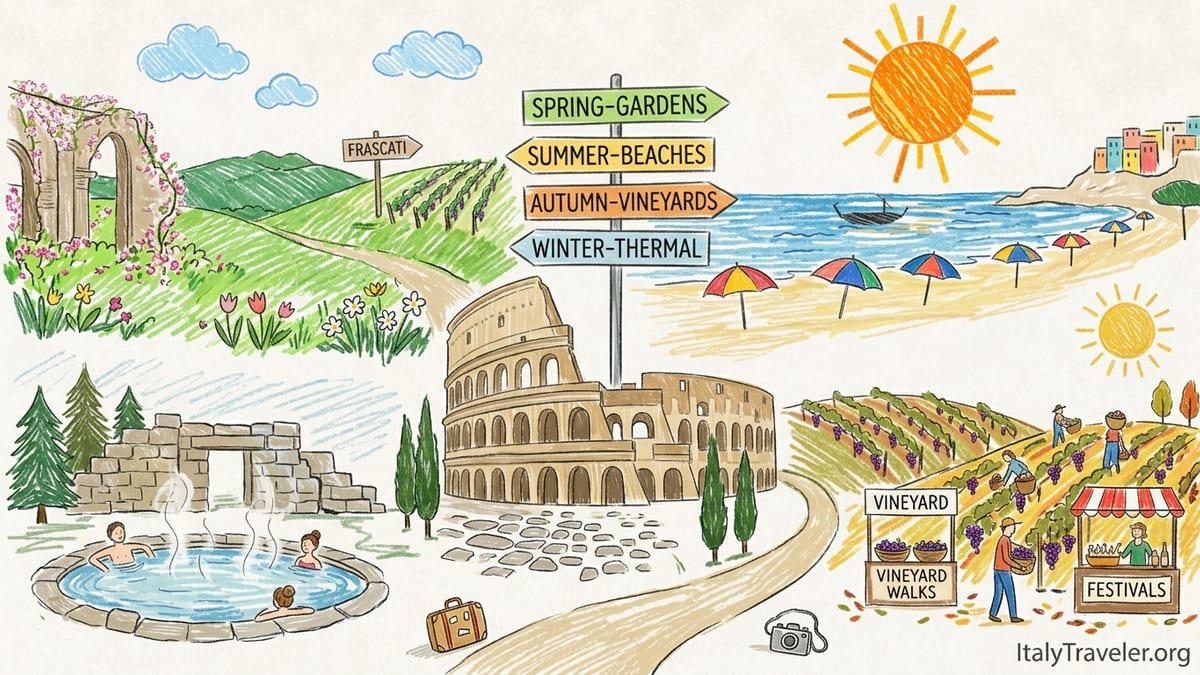
Choosing when to visit Lazio is not just a question of “good weather.” It decides whether you walk the Roman Forum in 38 degree heat, drift through the Giardino di Ninfa at golden-hour closing, or soak in Viterbo’s steaming thermal pools while vineyards outside are turning red and gold. Over several trips in different seasons, I have learned that Lazio behaves almost like three different regions: coastal, urban and archaeological, and inland hills and thermal country. Each responds very differently to the same calendar months, and getting the timing right changes the entire character of a trip.
How Lazio’s Seasons Really Feel On the Ground
On paper, Rome’s climate looks simple. Spring and autumn are described as “pleasant,” with averages in the low to mid 20s Celsius, while July and August often climb above 30 degrees. Long term climate data confirms that rain concentrates in the cooler months, while late spring through early autumn is relatively dry. In reality, walking those streets or standing on sun-baked stone tells a much more nuanced story, especially as heatwaves have become more frequent in recent years.
In Rome itself, spring days in late March and April have greeted me with that mix of cool mornings and shirt-sleeve afternoons that numbers do not quite capture: leaving a jacket on at the Colosseum entrance queue at 9 am, then carrying it by 11 as the sun reflects off travertine. By early June, the same sites feel distinctly hotter. The urban heat effect means that even when official forecasts show around 30 degrees, standing on the Palatine Hill or in the open areas of the Forum can feel several degrees warmer, with very little shade. Travelers regularly describe late July and August days pushing into the mid to high 30s, which matches the pattern of recent heatwaves affecting central Italy.
Along the Tyrrhenian coast, from Sperlonga down to Gaeta and back up toward Sabaudia, the sea moderates some of that intensity. On a July afternoon there, I could still feel a breeze that is absent among Rome’s alleyways. Inland, in the hill towns and vineyard belts around Frascati, Piglio or in the Sabine hills, evenings cool down more quickly, and by late September you may need a light sweater for an outdoor trattoria table, even if days remain warm enough for vineyard walks and terrace lunches.
These microclimates mean that “best time to visit Lazio” is not a single date range. Instead, it is a series of decisions: which Lazio are you coming for, and how much heat, crowding and darkness are you prepared to accept to get the experiences you want.
Spring in Lazio: Gardens, Green Hills and Unpredictable Skies
Spring is where Lazio most clearly rewards those who tolerate a bit of weather uncertainty in exchange for lower heat and vivid landscapes. By late March and April, countryside around the Castelli Romani and the Pontine plain below Sermoneta turns lush. On one April visit to Frascati, vineyard slopes were a bright, almost luminescent green, with vines just leafing out and clear views back toward Rome’s distant skyline. Daytime temperatures hovered in the high teens to low 20s Celsius, cool enough for comfortable hikes but warm in direct sun.
This is the prime time for gardens and historic landscapes. The Giardino di Ninfa, near Cisterna di Latina, is the clearest example of how timing becomes a central travel decision rather than a footnote. Ninfa is not a walk-up daily attraction. Its 2026 season is set to run on selected weekends and public holidays from March into November, with a published calendar from the Roffredo Caetani Foundation. The first opening dates in 2026 are scheduled for the weekend of 21 and 22 March, then continue as specific open days rather than continuous operation. There are also certain evenings in the warmer months when extended hours align with sunset light. Planning a Lazio spring itinerary around one of these weekends is essential if Ninfa is a priority.
Visiting Ninfa in late April on a designated opening, I entered on a timed ticket mid morning. The air still held a cool edge, perhaps 15 to 17 degrees in the shade, but sun on the blossom-heavy trees quickly made it feel warmer. Rain in the days before the visit had left the ground soft but not muddy; flowers and new foliage were intensely fresh, and the river that runs through the ruins looked higher and livelier than in late summer photographs. Crowds were noticeable at the gate at the start of each entry slot, yet once inside, the combination of controlled numbers and the size of the garden allowed long, quiet stretches with only birdsong and running water.
Elsewhere in Lazio, spring strikes a similar balance. In Rome, late April into May offers long daylight without oppressive heat. Sunrise around this period edges earlier each week, giving plenty of time for early visits to the Colosseum or Vatican Museums before group tours ramp up. Showers are still possible. I have had days where a sunny Trastevere lunch was followed by a sudden, intense downpour strong enough to flood some low-lying pavements. Yet these episodes often pass quickly, and the reward is freshly washed cobblestones and cooler air for evening walks.
Summer Trade-offs: Beaches, Heat and Long Days
By June, Lazio moves into its summer character, and the region starts to divide sharply by geography. If your goal is the sea, coastal Lazio is in its element. In Sperlonga in late June, the Tyrrhenian was already warm enough for long swims, likely in the low 20s Celsius, with clear water along the main beach and the smaller coves toward the archaeological villa site. Beach clubs were fully operational, with rows of umbrellas and loungers already close to capacity on weekends, and more space midweek. Even then, the breeze off the water meant that a 30 degree forecast felt significantly more comfortable on the sand than in a walled Roman piazza.
As July progresses, however, the same warmth that makes evening aperitivo on the seafront irresistible turns central Rome and inland archaeological zones into a serious test of heat tolerance. On a July afternoon at Ostia Antica, a largely open-air Roman port site near the coast, exposed brick and stone radiated heat well above the air temperature. Shade was intermittent, mostly where pine trees lined former streets. With temperatures in the low 30s and strong sun, two to three hours felt like a reasonable upper limit before retreating to a café with air conditioning. At the Colosseum and Roman Forum, where shaded seating is even scarcer, similar conditions meant that morning entry slots became the only workable option for visitors sensitive to heat.
August brings that pattern to its peak. Travelers arriving around the traditional mid August holiday period have reported daytime highs in Rome around the mid to high 30s, with some evenings staying above 25 degrees well into the night. On my own late August visit, the city emptied somewhat of locals, with some small neighborhood shops closing for holiday, yet major tourism infrastructure stayed open. The Vatican Museums and Colosseum remained fully booked, with lines that felt noticeably more oppressive because they stood in direct sun or dense, humid air. In many smaller churches and less visited archaeological sites, though, I found welcome pockets of quiet simply because casual visitors chose to stay indoors during the hottest hours.
Daylight, at least, works in your favor in summer. Even around the solstice, sunset comes late enough that you can spend the hottest mid afternoon hours resting in your accommodation, then head back out around 6 pm and still have hours of light for strolling Trastevere or watching the Tiber reflect dusk colors. Along the coast, dinner at 9 pm with a lingering glow over the sea feels both natural and necessary. In Sperlonga on an early July evening, the beach was still dotted with swimmers near 7:30 pm, and families did not begin leaving in earnest until after 8.
Autumn Rewards: Harvests, Hills and Softer Light
If summer belongs to Lazio’s beaches, autumn is the season of inland touring and food. By mid September, even when air temperatures still climb into the high 20s or low 30s, the sun’s angle is lower and evenings cool more rapidly. In Rome, the difference between a mid August and late September afternoon on the same square is tangible: less burning glare off travertine, more manageable queues, and a general willingness among both visitors and locals to stay outside for longer stretches.
The change is even more pronounced in Lazio’s wine and food regions. Around Frascati, south east of Rome, harvest for white grapes typically runs from early September into mid October. Producers in the Frascati DOCG area describe picking starting in the first week of September and finishing by about mid October, depending on the year and weather conditions. When I visited in late September, some vineyards had already been picked and lay quiet under warm sun, while others still showed teams cutting fruit in the morning cool. Tasting rooms in the hills above town poured current releases alongside young samples from the previous harvest, and many agriturismi offered menus centered on mushrooms, new olive oil and early autumn vegetables.
Elsewhere in Lazio, events calendars confirm that this is grape and wine festival season. Inland towns such as Piglio, known for Cesanese del Piglio red wines, and Velletri in the Castelli Romani host grape and wine festivals across September and early October, some of which include processions, tastings and open cellars. In the Tuscia area north of Rome, smaller villages celebrate both vendemmia and the start of olive pressing from mid October into November. For travelers, this translates into weekend crowds in otherwise quiet hill towns. On one October weekend in Velletri, parking near the historic center filled early, and restaurant tables required reservations, a contrast to the calmer weekdays of the same week.
Weather in autumn cooperates more often than not. In September, I have walked in short sleeves among olive groves near Barbarano Romano under bright, dry skies, with temperatures around the mid 20s. By late October and early November, expect more variability. One early November visit to Viterbo saw a grey, drizzly morning around 12 degrees, followed by a soft, bright afternoon warm enough for outdoor coffee in the medieval center. Even on these cooler days, inland Lazio retains a comfortable, lived in atmosphere, far removed from the crush and heat of high summer Rome.
Thermal Lazio: Viterbo and Hot Springs Beyond Summer
One of Lazio’s quietly strongest arguments for off season travel sits well away from the beaches. North of Rome, around Viterbo and the nearby countryside, a cluster of thermal springs and spa complexes continue to steam through autumn and deep into winter. Rather than shutting down when the beach clubs close, they come into their own as the air cools.
In Viterbo itself, Terme dei Papi takes its name from historic use by medieval popes. Its outdoor monumental pool is fed by natural hot water that emerges at high temperatures and is cooled to a more comfortable bathing level before entering the basin. On an October visit, air temperatures hovered around 15 degrees under a pale sky, but stepping into the steaming pool created a strong contrast: shoulders in the air felt cool, submerged skin immediately relaxed. The facility keeps extended opening hours across much of the year, with late evening access that allows visitors to soak after dark when autumn mist hangs over the water.
Further west, near Canino, Terme di Vulci combines thermal pools with views over the Maremma countryside. Their operating information stresses advance booking for specific time slots, including afternoon and evening access, and they remain open through the cooler months, subject to maintenance closures. In November, I watched locals arrive in warm coats, then step into the steaming outdoor basins and linger for hours despite air that felt closer to 10 degrees. The surrounding fields, recently harvested, lay in muted browns and golds, reinforcing the sense that this is an autumn and winter activity as much as a summer one.
These thermal areas shift the logic of when to visit. In September and October, combining morning walks in nearby historic centers such as Viterbo’s San Pellegrino quarter or the Etruscan sites around Tarquinia with late afternoon spa sessions creates a rhythm that would be oppressive in August heat. Even in January or February, when parts of Lazio are at their quietest, the idea of sitting in a hot outdoor pool while cool air brushes your face makes a compelling case for traveling outside the classic seasons, particularly for visitors who have already experienced Rome’s main sights.
Seasonal Calendars and How They Shape an Itinerary
Several of Lazio’s most atmospheric places tie their visitor experience directly to seasonal calendars, which means that timing your trip is as critical as choosing your hotel. The Giardino di Ninfa is the clearest case. For 2026, its published calendar lists specific weekends and public holidays from March to November as open days, with different time slots available for pre booked entries. There are also special openings, including selected evening or sunset experiences during part of summer, which offer a different quality of light and a cooler environment in which to explore the gardens.
In practice, this means you cannot simply “add Ninfa” to a Rome stay as a last minute day trip. On my spring visit, tickets for the chosen Sunday had sold out several days in advance. Travelers who anchored their Lazio itineraries around a Ninfa weekend, however, were able to visit both the garden and nearby towns such as Sermoneta or Norma without rushing. The new Hortus Conclusus section, restored and opened to visitors as part of recent conservation projects, adds another layer of interest that rewards this careful planning.
Similar timing issues appear elsewhere. Many coastal resort towns such as Sperlonga, Terracina and Sabaudia ramp up significantly from mid June through early September, when lidos operate fully and beach services, restaurants and nightlife are at their busiest. Outside this window, especially from late September into October, the same towns become quieter and some seasonal establishments close or reduce hours, even though the sea often remains warm enough for swimming well into early October. On a late September walk along Sperlonga’s beach, the water still felt comfortable for a short swim, but rows of umbrellas had thinned and one beachfront bar had already closed for the year.
Inland, festivals and food events define their own micro seasons. Regional tourism listings for Lazio highlight grape festivals in September, wine weekends in early October, and olive oil and chestnut celebrations later in autumn. I have planned trips specifically around these, timing a visit to Piglio to coincide with a Cesanese wine festival weekend, which brought live music, street food and extended cellar hours that transformed an otherwise quiet town. Doing so required accepting somewhat unpredictable early October weather, but the payoff was immersion in the region’s seasonal rhythms rather than just its monuments.
Matching Lazio’s Microclimates to Your Travel Style
Given these variations, it helps to think in terms of matching specific Lazio experiences to your own tolerance for heat, crowds and weather risk rather than chasing an abstract “best month.” If archaeological sites and city walking dominate your wish list, the most comfortable compromise usually falls in April, May, late September or October. On my late May trip, I could walk from the Palatine Hill down through the Forum and into the historic center in one continuous, unhurried arc, with only a light sheen of sweat and no need to constantly hunt for shade. In late September, similar walks required short breaks on shaded benches but still felt manageable, especially with an early start.
If your heart is set on coastal days in Sperlonga, Gaeta or along the Circeo coastline, then late June and early July balance warm sea temperatures with crowds that, while substantial on weekends, remain less intense than at August’s peak. Families tied to school calendars may have little choice but to visit in July or August; in that case, structuring the day becomes key. On an August stay near Anzio, my routine shifted to early morning swims, late breakfast, indoor rest from about 1 pm to 5 pm, then a return to the promenade in the evening, when sea breezes and a slightly lower sun made outdoor dining comfortable.
Travelers whose priorities tilt toward wine, food and slower countryside exploration are often happiest in late September and October. Staying near Frascati or in the Sabine hills in this period, I have enjoyed truffle dishes, roast meats and new wines in agriturismi dining rooms while watching fog settle in valleys outside. Day trips into Rome from these bases felt pleasantly manageable: cooler, less crowded and framed by golden afternoon light. The trade off is a higher chance of grey or showery days, so building in indoor options such as Viterbo’s thermal spas or Rome’s museums makes sense.
Finally, if your main draw is thermal relaxation around Viterbo and the northern Lazio countryside, do not be afraid of winter. While this article focuses on spring, summer and autumn, it is worth noting that the very features that make August uncomfortable in Rome become assets when air temperatures drop. Steam rising from outdoor pools under a cold blue sky in January can be as authentically “Lazio” as a June swim in Sperlonga, and far less crowded.
The Takeaway
Over multiple trips through Lazio’s changing seasons, one conclusion has become clear: there is no single best time to visit, only a best time for the version of Lazio you want. Spring rewards garden lovers and walkers willing to accept showers in exchange for green hills, blossom and moderate temperatures. Summer delivers long coastal days and late evenings on piazzas, at the price of real heat around major sites and denser crowds at the star attractions. Autumn belongs to those drawn to vineyards, festivals, food and the pleasure of soaking in hot pools while surrounding countryside shifts through gold and rust.
What matters most is aligning expectations with these realities. If you picture yourself strolling through the Giardino di Ninfa, you will need to match your dates to its 2026 opening calendar of specific weekends and perhaps secure an evening slot to enjoy the garden in cooler air and soft light. If your image of Lazio centers on archaeological grandeur, avoid mid afternoon site visits in July and August and consider a shoulder season when Rome’s stones hold warmth rather than radiate intense heat. For thermal baths and vineyard tables, lean into autumn and even early winter, when local life runs at a slower pace and seasonal food is at its richest.
With that mindset, Lazio stops being a place you “fit into” your broader Italy itinerary and becomes a region you choose to meet on its own terms, whether that is under spring blossom, high summer sun or autumn mist.
FAQ
Q1. Is August really too hot to visit Rome and the major Lazio sites?
For many visitors, yes. Daytime highs often reach the mid to high 30s Celsius, with strong sun and limited shade at places like the Colosseum and Roman Forum. If August is your only option, focus on early morning and evening visits and plan long midday breaks indoors.
Q2. When is the best time to visit Sperlonga and the Lazio coast for swimming?
Late June through early September usually offers warm sea temperatures and full beach services. For a balance of swimmable water and slightly lighter crowds, late June and the first half of September work very well.
Q3. How do I plan a visit to the Giardino di Ninfa in 2026?
Check the 2026 calendar published by the Roffredo Caetani Foundation, which lists specific weekends and holidays from March into November when the garden is open. Buy timed entry tickets in advance and consider coordinating your trip so you stay nearby the night before.
Q4. Is spring in Lazio very rainy?
Spring can bring showers, including occasional heavy downpours, but many days are dry with a mix of sun and clouds. In my experience, late March and April require a light waterproof layer but often deliver long, pleasant walking days between showers.
Q5. Are coastal towns in Lazio active outside the main summer season?
They are quieter but not empty. In May and late September, you will find fewer beach clubs operating at full capacity and some seasonal bars or restaurants closed, yet core services and at least part of the beach infrastructure usually remain available.
Q6. When is wine harvest season in Lazio’s vineyards?
In areas like Frascati and Cesanese country around Piglio, harvest typically begins in early September and can run into mid October, depending on grape type and weather. Visiting in this window increases your chances of seeing work in the vineyards and finding harvest themed events.
Q7. Is autumn a good time to combine Rome with countryside stays?
Yes. Late September and October offer softer light, cooler temperatures for city walking and rich seasonal food in rural areas. I have found this period ideal for splitting time between Rome and hill towns or agriturismi while avoiding the worst of the heat and crowds.
Q8. Do Lazio’s thermal baths around Viterbo operate in autumn?
They do. Facilities such as Terme dei Papi and Terme di Vulci remain open through autumn, and the cooler air actually enhances the experience of soaking in naturally hot outdoor pools.
Q9. If I want mainly gardens and greenery, which months should I choose?
Late March through May is best for gardens, parks and countryside walks. This aligns with Ninfa’s spring openings and offers fresh foliage, blossom and comfortable daytime temperatures, at the cost of some risk of rain.
Q10. What is the single most versatile month for a first trip to Lazio?
If I had to choose just one, I would pick late May or late September. Both offer manageable heat for Rome’s sites, reasonable daylight, access to coast and countryside, and fewer extreme weather risks than mid summer or mid winter.