

I did not fall in love with Lazio from a Roman hotel room. I fell in love with it from behind a steering wheel: inching into hill towns, looping around volcanic lakes, dropping down to a white-sand bay at sunset. This road trip was not a theoretical line on a map but a route made of real junctions, car parks and traffic jams I actually faced, and it showed me how different parts of Lazio click together once you step outside Rome’s public‑transport bubble.
Why I Chose To Rent A Car For Lazio, And Where I Picked It Up
I started this trip by renting a compact car at Rome Fiumicino Airport rather than in central Rome. Current rental guides for 2026 consistently recommend Fiumicino as the easiest pickup point because the desks are inside the main terminal and the rental garages connect directly to the motorway slip roads, so you can be on the ring road without ever entering the historic center or its ZTL zones. The alternative, Termini station, would have dropped me straight into city traffic and made it much harder to escape without accidentally crossing a ZTL camera.
Pricing in 2026 for a small automatic with basic insurance at Fiumicino generally starts around 40 to 60 euros per day from the major brands, depending on season and how far ahead you book. That is more than a couple of day trips by train, but on this itinerary the car quickly paid for itself by making small villages, thermal baths and lakes that are awkward by bus feel easy and spontaneous. I also chose a five‑door hatchback rather than a larger SUV, which kept fuel consumption modest and made me less nervous when I squeezed into medieval streets later in the trip.
Before leaving the airport, I checked three basics: that the rental company had provided a physical or digital insurance card, that the spare wheel or repair kit was present, and that the car had a valid environmental category to enter Rome’s wider “Fascia Verde,” the low‑emission belt that now covers much of the city. From November 2025, Rome tightened access for older petrol and diesel vehicles inside this belt, and from July 2026 even fully electric cars require a registered permit to enter formal ZTL areas. That reinforced my decision to keep the car out of central Rome entirely and only use it once I was already headed away from the city.
Leaving Fiumicino, I followed signage for the Grande Raccordo Anulare, Rome’s orbital ring road, staying alert as local drivers darted across lanes at the major exits. It helped to have the route pre‑loaded offline on my phone and to set up the navigation while still parked in the rental garage. Within thirty minutes of landing I was already circling the outskirts of Rome and pointing the car toward Tivoli.
Fiumicino To Tivoli: Motorways, Tolls And Parking For Ancient Villas
The first leg from Fiumicino to Tivoli is a practical test of why a car can be useful around Rome. From the ring road I joined the A24, the motorway that runs northeast toward Abruzzo. This stretch is part of Italy’s toll network, and there is a barrier known as Roma Est where you collect a ticket or pass through the electronic Telepass lanes. With a standard rental car you usually take a ticket on entry and pay in cash or by card at your exit. For the short hop to Tivoli, the toll is modest, typically only a few euros, but it changes slightly each year, so I simply kept a ten‑euro note handy in the center console and never had a problem.
The A24 very quickly leaves the ring road’s congestion behind. Within about forty minutes, even with some commuter traffic, I had exited at Tivoli and was following local roads signed for Villa d’Este and Villa Adriana. Tivoli’s historic center has its own ZTL, with cameras controlling access to several old streets. The municipality explains that there are three limited‑traffic zones in the centro storico and that non‑residents entering without a permit can be fined. To avoid any surprise tickets I ignored the temptation to “just pop in” and instead followed signs for public parking outside the restricted core.
For visiting Villa d’Este, I used a paid multistory car park a short walk from the main entrance. The daily maximum was under 15 euros when I visited and there were clear signs marking the pedestrian route up to the villa’s ticket office. I always locked valuables out of sight and took a quick phone photo of the level and bay number. Later in the afternoon I drove out to Hadrian’s Villa, which has its own large open car park right by the entrance. Here, the car was a clear advantage over public transport, since the two villas are several kilometers apart on roads with only occasional buses. With the car I could spend the morning in Villa d’Este’s gardens, have lunch in Tivoli, then drive to Hadrian’s sprawling ruins in the cooler late‑afternoon light.
If I were shortening this itinerary, Tivoli is one of the places I would keep without hesitation. It gives you Roman imperial history and Renaissance extravagance in one day, and it sits just beyond the worst of Rome’s traffic. On a tighter schedule you could visit Tivoli as a long day trip by train and bus, but with a car it slotted naturally as the gateway to the countryside that followed.
Tivoli To Castelli Romani: Hill Towns, Lakes And Quiet Country Roads
From Tivoli I did not return toward the city center. Instead, I dropped back onto the ring road and then headed southeast toward the Castelli Romani, the cluster of historic hill towns scattered in the Alban Hills. The main motorway access comes from the A1 branch that connects to the ring road, with exits serving places like Frascati and the lakes. By leaving Tivoli in late morning on a weekday I mostly avoided rush‑hour traffic and found the drive between the two areas surprisingly relaxed.
I based myself for two nights near Lake Albano, close to Castel Gandolfo. The town itself, former papal summer residence, sits on a ridge above the crater lake. With a car, I could drop down to the lakeshore in minutes for a swim or dinner at a lakeside trattoria, then climb back up to the main road and continue along the ring of villages that form the Castelli Romani. Public transport here exists but tends to radiate back toward Rome, which makes combining several lakes and hilltop towns in a single day painful without a vehicle.
Parking in Castelli Romani required more attention than in Tivoli. Many of the historic cores have informal ZTL arrangements and one‑way systems that are not always obvious to foreign drivers. I treated any narrow stone street lined with old buildings and small cameras on poles as a likely restricted zone and instead looked for blue‑lined spaces or signed car parks just outside. In one village I parked beside a small supermarket where several local cars were already squeezed in, then walked five minutes uphill to the main piazza. Paying one or two euros per hour at a meter felt like cheap insurance against a more expensive ZTL fine later.
The roads around the Castelli Romani are the first place on this itinerary where a modest‑sized car makes a real difference. Some of the lanes that drop toward the lakes are very narrow, with tight bends and rock walls that come close to the mirrors. Meeting a delivery van in the opposite direction required one of us to reverse to the last passing point. I was grateful that my rental was not a long sedan. For this part of the trip, I would skip any of the tiniest hamlets if you find city driving stressful, and instead focus on one or two main centers plus the lake of your choice.
Crossing To Bracciano And The Lakes: Circumventing Rome’s Core
After two days in the Alban Hills I wanted to reach the opposite side of Lazio, around Lake Bracciano, without driving through central Rome. The navigation apps all agreed on a route that used portions of the ring road to arc around the city, then cut northwest. The ring road can be busy, particularly near the junctions with the A1 and A24, but by starting mid‑morning I avoided the heaviest commuting pulses. I stayed in the middle lanes, watched for last‑minute lane‑changes and kept my speed aligned with local traffic rather than the posted maximum, which not everyone respects.
The payoff came as I left the autostrada and dropped onto smaller provincial roads toward Bracciano. The landscape shifted from apartment blocks to rolling farmland and later to lakeside views. I based myself near the town of Bracciano rather than on the more built‑up southern shore of the lake. Here, parking was straightforward: an open gravel car park near the castle and several blue‑line streets below the town. Parking meters allowed payment by coins and card, and in the shoulder season I often found a space within a few minutes of circling.
A car is a genuine asset around Lake Bracciano and the neighboring Lake Martignano. There are small beaches, sailing clubs and viewpoints dotted all around the shore, connected by buses that do not always align neatly with swimming weather. In one afternoon, I drove from the medieval alleys of Bracciano down to a lakeside lido, then on to a quieter cove where locals parked under olive trees and walked down to the water. Without the car, combining three different spots in half a day would have been almost impossible.
If you need to shorten the trip, this is a segment you could drop if you are already visiting lakes in the Castelli Romani. However, if your Italian itinerary does not include the big northern lakes, Bracciano gives you a gentle coastal‑hinterland atmosphere with far fewer crowds than places like Como. It also offered the most relaxed driving of the whole route, which balanced the trickier days in and out of Rome’s orbit.
Into Tuscia And Viterbo: Thermal Baths, Medieval Streets And Narrow Lanes
From Bracciano I headed north into the historical region of Tuscia, with Viterbo as my main stop. This section was almost entirely on regional roads, with no tolls, passing fields, patches of forest and occasional villages. Distances were short, but average speeds dropped as tractors and local traffic joined the road. I allowed a full day to move between Bracciano and Viterbo with a long lunch break and photo stops rather than assuming a straight two‑hour drive.
Viterbo’s medieval center is one of the most atmospheric I saw in Lazio, but it is also threaded with extremely narrow streets and several ZTL zones. Rather than risk creeping under a camera, I booked a guesthouse that explicitly advertised on‑site or adjacent parking outside the restricted area. On arrival I followed their emailed directions, which pointed me to a small courtyard behind the building. From there it was a ten‑minute walk through stone alleys to reach the main squares. This pattern repeated throughout Tuscia: I would park slightly outside the center and approach on foot, treating the car as a shuttle between towns rather than something to drive right to the cathedral door.
One of the great arguments for having a car in Tuscia is the ease of visiting hot springs and countryside sites that do not appear on most bus timetables. From Viterbo I drove to a thermal area a short distance out of town, where a simple rural spa complex offered outdoor pools fed by warm sulphurous water. The car park was just a gravel field next to the entrance, and arriving early in the morning meant I could choose a spot in the shade. Later in the day I used the car to reach a viewpoint overlooking a tufa‑rock village perched above a canyon, something that would have been logistically complex without wheels.
If I had to compress my itinerary, Tuscia would be the segment I would trim only if time was extremely tight, mainly by reducing the number of small villages rather than skipping Viterbo itself. One night in Viterbo was enough to explore the medieval quarter and enjoy the hot springs, but two nights allowed me to explore the backroads without rushing. Crucially, staying overnight meant I could design a clean route south the next day, instead of backtracking all the way toward Rome.
South To Ninfa And The Gardens: Designing The Route To Avoid Backtracking
Leaving Viterbo, I drew a diagonal line across Lazio toward the Pontine plain and the Gardens of Ninfa. This leg is where the benefit of an overnight stay in each region becomes clear. Because I was not always returning to the same base, I could move steadily south without duplicating long stretches of road. From Viterbo I worked my way back toward the ring road on quieter regional roads, rejoined the autostrada network briefly, then dropped south of Rome toward the Latina area.
The Gardens of Ninfa operate on a strict reservation system, opening to visitors on specific dates with timed entries. I planned my driving day around a late‑morning entry slot. Parking at Ninfa is well organized, with attendants directing cars into fields and gravel lots near the entrance on opening days. There are no complicated ZTL concerns here, just a short stroll from your car to the ticket check, but it pays to arrive at least twenty minutes before your time to avoid queuing with several buses of tour groups that often pull in from Rome.
After wandering Ninfa’s ruined towers and lush waterways, I drove a short distance to a nearby hill town for lunch, again using municipal parking just below the historic center. Here, the car transformed what could have been a rigid day built around a single timed garden visit into a flexible countryside outing. I could adjust my lunch stop if one place looked crowded, or detour through a side valley when I saw a promising church steeple on the skyline.
If you were drastically shortening this trip into four or five days, this is the section where hard choices appear. For a very compressed itinerary, I would keep Tivoli and either Castelli Romani or Ninfa, not both, since they sit on fairly similar trajectories southeast of Rome. On my full route, however, Ninfa was a highlight, and combining it with the coastal towns that follow created a satisfying final arc.
Down To Sperlonga And Gaeta: Where The Car Pays Off On The Coast
The final segment of my Lazio road trip dropped me from the gardened hills of Ninfa down to the Tyrrhenian coast around Sperlonga and Gaeta. The drive crosses the Pontine plain, a wide agricultural area with straight roads and occasional slow‑moving trucks. Compared with the ring road, this felt almost leisurely, though junctions around the larger inland towns could still be busy at rush hour. I kept an eye on fuel and used a branded petrol station just off the main road when the gauge dropped below half, which avoided needing to refuel at a more expensive motorway service area later.
Sperlonga itself is a tight knot of white houses on a rocky headland, and much of the upper town is pedestrianized or controlled by local‑resident permits. Arriving by car therefore means accepting that you will park below the town and walk up. I used one of the signed public car parks at the edge of the lower area, where attendants directed drivers into marked bays. The daily rates were higher here than inland, especially in summer, but the convenience of leaving my luggage in the car while I explored was worth the cost. Gaeta, slightly larger and more spread out, offered more on‑street parking near the waterfront, though I still kept an eye on signage in case of market days or street‑cleaning closures.
This coastal stretch is where the car became more of a strategic advantage than a necessity. Both Sperlonga and Gaeta are reachable by a combination of train and bus from Rome, but with wheels I could link multiple beaches and archaeological sites in one day. In the morning, for example, I drove from my guesthouse on the hills behind Sperlonga to the archaeological museum and grotto of Tiberius, then carried on to a quieter beach cove where there was no obvious bus stop, only a sandy lay‑by full of local cars. Later I used the car to reach a panoramic chapel high above Gaeta’s bay in time for sunset, then returned after dark without worrying about the last bus.
If my schedule had been tighter, I would have chosen just one base on this coast rather than splitting nights between Sperlonga and Gaeta. In reality I spent two nights in Sperlonga and one in Gaeta, which allowed me to avoid backtracking and to follow the coastline southward before looping inland to my final drop‑off. For travelers renting at Fiumicino, a neat version of this itinerary ends with a drive back to the airport on the last day, avoiding central Rome completely.
Practical Lessons: ZTL, Parking, Fuel And When A Car Truly Helps
Spending a full week driving around Lazio taught me several concrete lessons that shaped this itinerary. The first is that ZTL rules really do matter. Rome’s central ZTL zones in the Centro Storico and Tridente areas have long hours and automatic cameras. Even a brief, accidental drive under the wrong arch can trigger a fine. Other towns like Tivoli and Viterbo have smaller ZTL areas, but the principle is the same: if you are not certain a street is open to general traffic, do not assume it is. I interpreted every ZTL sign and camera as a firm boundary and planned my parking outside them.
The second lesson was about parking strategy. In almost every destination, there was at least one municipal car park clearly designated for visitors within walking distance of the old center. These were rarely the absolute cheapest spots, but they were predictable, legal and usually safe. I chose them over free but ambiguous roadside spaces, particularly when staying overnight. In Viterbo and Bracciano, guesthouses that advertised their own parking or worked with nearby garages significantly reduced my stress on arrival after a long drive.
Fuel and tolls were less of a burden than I had expected. Toll sections like the A24 to Tivoli added only a small fraction to my daily costs. Fuel prices in Italy fluctuate, but filling the tank of a compact petrol car every few days felt manageable, especially because many of the distances between my overnight stops were under two hours’ driving. I made a habit of refueling when the gauge dropped below half if I was in a town with multiple stations, which prevented nervous searches for fuel late at night.
Most importantly, this itinerary showed me when a car truly earns its place in a Lazio trip. It is less about shaving minutes off travel times between major cities and more about connecting three or four rural attractions in one arc. In a single day I could move from a villa garden to a lake swim, then up to a cliff‑top village and finally to a thermal bath, all without checking a bus timetable. The trade‑off was dealing with ring‑road traffic near Rome and the occasional tense squeeze through a hill‑town lane, but for this particular route, the benefits clearly outweighed the stress.
FAQ
Q1. Is it better to rent a car at Rome Fiumicino or in central Rome for this itinerary?
For this route it is easier at Fiumicino, where you can reach the ring road directly and avoid central Rome’s dense ZTL zones and complex traffic.
Q2. Do I need to drive through central Rome at all on this Lazio loop?
No. By using the ring road and planning overnight stops in Tivoli, the lakes, Tuscia and the coast, you can completely bypass the historic center.
Q3. How serious are ZTL zones in Lazio’s smaller towns?
They are enforced by cameras and can lead to fines, especially in Tivoli, Viterbo and many hill towns. Always park outside the marked ZTL and walk in.
Q4. Are tolls a big expense on this road trip?
Tolls appear mainly on short motorway segments such as Rome to Tivoli. They usually amount to only a few euros per leg and are paid at staffed or automated booths.
Q5. What size of car is best for driving in Tuscia and the hill towns?
A small or compact hatchback is ideal. Larger sedans and SUVs can struggle in narrow streets and tight parking areas in medieval centers.
Q6. How did you avoid backtracking across Lazio?
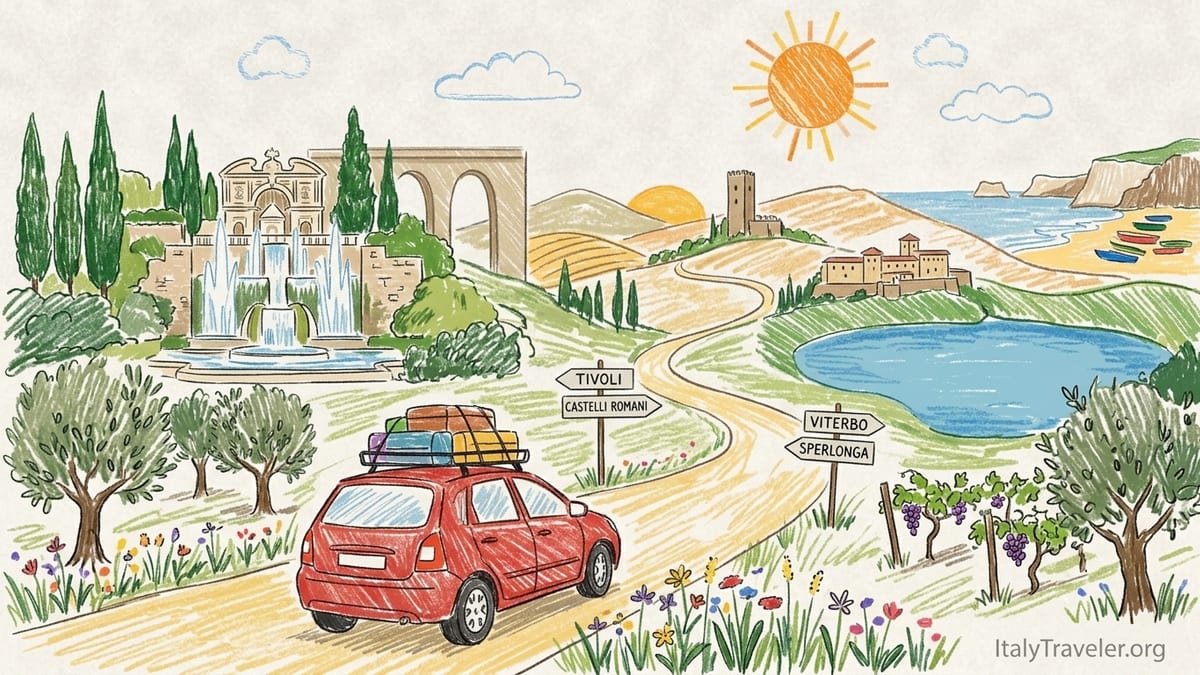
I treated the route as a loose loop, moving Fiumicino to Tivoli, then Castelli Romani, Bracciano, Viterbo, Ninfa and finally the coast, with new overnight bases along the way.
Q7. Could this itinerary work without a car, using only trains and buses?
You could reach some points like Tivoli or the main coastal towns, but combining villas, lakes, thermal baths and small villages in one trip would be very difficult.
Q8. Is parking expensive in places like Sperlonga and Gaeta?
Coastal parking is pricier, especially in summer, but public lots and blue‑line street spaces are available. Inland towns are generally cheaper and less crowded.
Q9. How many days would you recommend for a shorter version of this trip?
For a condensed trip, five or six days is enough to include Fiumicino, Tivoli, one lake area, Viterbo or Ninfa and two nights on the coast.
Q10. What is the single biggest advantage of having a car on this Lazio route?
The main benefit is freedom to link smaller attractions in one logical arc, instead of being limited by train lines that all lead back into central Rome.