


I thought the Garden of Ninfa would be one of those Italian sights you simply slot into a free afternoon from Rome. It took exactly five minutes on the official booking site to realise I was wrong. Visiting this ruined medieval town turned romantic garden is closer to securing a theatre ticket for a single performance than dropping by a public park, and understanding that difference will shape your entire day. Here is how my 2026 visit unfolded, what I wish I had known before I booked, and how to make your own trip smoother.
Understanding the 2026 Calendar Before You Even Think About Tickets
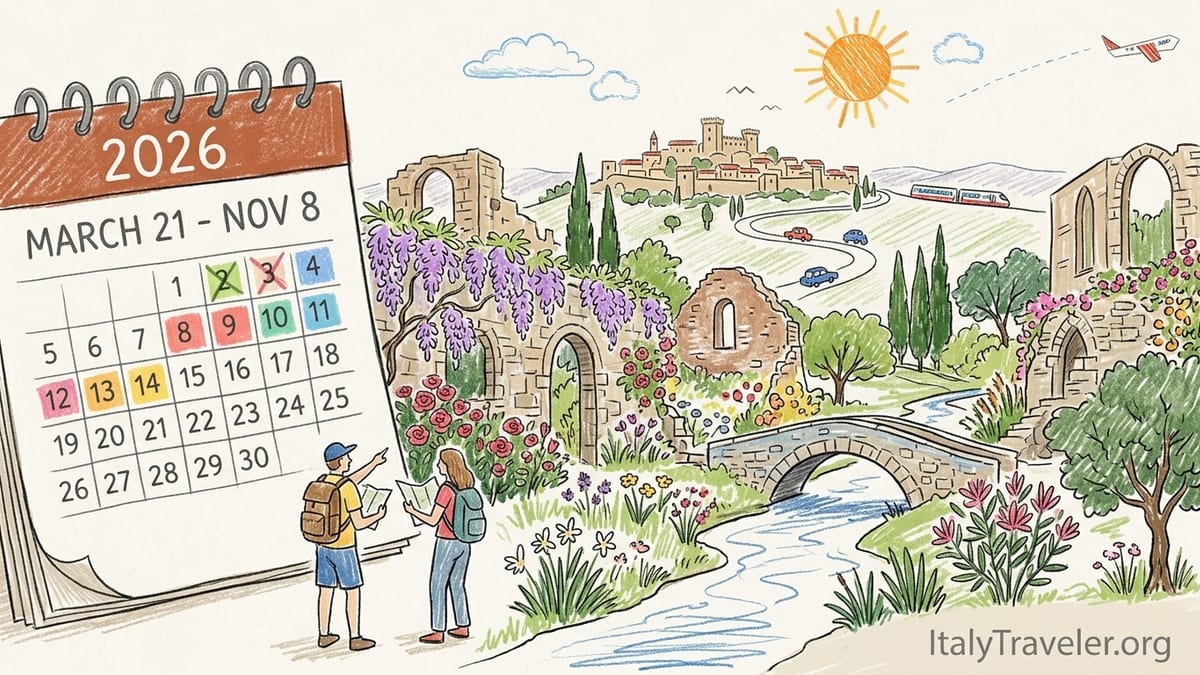
The Garden of Ninfa is not open every day, or even every weekend from March to November. For 2026 the official calendar runs from March 21 through November 8, with openings on selected days only. Between July and August, part of the season shifts to evening access for special sunset itineraries, which completely changes the visiting rhythm compared to spring or autumn.
When I planned my visit, I first checked the 2026 calendar on the foundation’s official site and immediately saw how fragmented availability is. There were clusters of dates in late March and April, more in May and early June, then a clear switch: from early July to late August, regular daytime slots thinned out and many Fridays, Saturdays and Sundays were marked for evening or sunset visits only. In early autumn, openings picked up again, usually on weekends, up to the final dates in November.
This pattern matters if you are trying to fit Ninfa around flights or a set Rome itinerary. For example, if you are in Rome midweek in April, you may find that the only Ninfa dates fall on the weekend before or after your stay. Conversely, if you travel in late July, you might have to decide between a late return to Rome after a sunset visit or an overnight stay somewhere closer such as Latina, Sermoneta or Norma. Treat the calendar as your fixed reference point and build your day around it, not the other way around.
I also noticed that school group bookings and organised tours often target the most obviously attractive weekends in peak bloom, especially in April and May. That keeps independent ticket availability tighter than you might expect so your first move should be to examine the specific 2026 dates during your travel window, then pick two or three that could work instead of locking yourself emotionally to a single day.
How Far in Advance to Book: What Happened When I Tried
Once the 2026 calendar opened, I decided to aim for a Saturday in late April, hoping for roses and wisteria but slightly smaller crowds than the Easter period. I checked the site in mid‑February and realised my preferred date already had only a handful of slots left in mid‑morning and late afternoon. By the time I hesitated for an hour, that morning slot disappeared. That was my first lesson: desired time bands can vanish in a matter of hours once people start planning spring weekends from Rome and Naples.
In the end, I booked an 11:40 entry for the following Sunday instead, about nine weeks before my visit. When I checked back a few days later purely out of curiosity, that Sunday was sold out completely. In practical terms, for high‑interest weeks such as late March to early June, you should think in terms of booking several weeks ahead, especially if you are tied to a Saturday or Sunday. For later in the season, such as late October, there seemed to be more flexibility, but I would still not rely on last‑minute availability.
The official system sells tickets as a “contributo di ingresso” with compulsory pre‑booking. For 2026, individual adult contributions on standard days are around the mid‑teens of euros, with slightly higher prices for special sunset or thematic evening visits. There is a small service fee added at checkout. Payment is by card; you receive a PDF ticket and a booking code by email. On the booking page there is a clear warning that same‑day purchases on site are not guaranteed and are only possible if there are last‑minute cancellations. After watching my chosen time band evaporate, I would not risk turning up without a reservation and hoping for a miracle.
I printed my ticket and also saved it to my phone. This turned out to be useful when the mobile signal in the countryside dropped. The staff at the entrance were equipped to scan both formats, but the line moved much faster for people who had everything ready. If you are planning Ninfa as a day trip from Rome or Naples, consider booking your garden slot before you purchase train tickets so you are not stuck with a non‑refundable rail booking and no garden access.
Getting There, Arrival and Parking: The Practicalities
On the day, I arrived by rental car from Rome, which gave me more control over timing than public transport. From the A1 motorway I exited near Valmontone and crossed the countryside toward Cisterna di Latina and then Ninfa. Without traffic, the drive took about one hour and fifteen minutes. What surprised me most was that the last stretch was not signposted like a major tourist attraction. The garden is part of a protected oasis and a private foundation, not a theme park, so expect low‑key brown signs and narrow rural roads rather than a huge parking complex.
The main visitor parking area sits a short walk from the entrance gate. On my late April Sunday, I arrived nearly an hour before my 11:40 slot and found parking still relatively easy, though the first row near the entrance was already full. The lot is essentially a gravel and packed‑earth area lined with trees, without marked bays in the style of a shopping mall. Staff guided cars loosely into rows. There is no charge for parking itself at the time of writing, but it fills according to the entry waves, so arriving at least 45 minutes before your slot is prudent, particularly on weekends or in peak bloom months.
From the parking area, a short path leads past basic services and a modest check‑in area where staff scan tickets. This is where I appreciated having both a printed copy and the PDF accessible offline. There was a small queue formed by people in the same entry window, but it moved consistently. I noticed a couple who had apparently booked for the previous day and were trying to negotiate entry; staff were sympathetic but firm. Given how controlled numbers are, treat your date and time as fixed. There are portable toilets near the entrance; I strongly recommend using them before you start, because there are no facilities inside the garden circuit itself.
For those without a car, I met several fellow visitors who had come by regional train from Rome to Latina or Cisterna di Latina, then pre‑booked a taxi or transfer. One couple told me their taxi from Latina station cost a few tens of euros and they had pre‑arranged a pick‑up after the visit. They also mentioned that on busy weekends some agencies offer combined transport and ticket packages from Rome, but these still rely on the same limited garden slots. In every case, the key seemed to be aligning train times, taxi bookings and the exact garden entry slot, not assuming flexibility on the garden’s side.
Entry, Time Slots and How the Visit Actually Unfolds
Ten minutes before 11:40, staff began calling our time band. Unlike some attractions where the entry time is understood more loosely, here it functioned as a true wave. Our group gathered just inside the gate, where a guide briefly outlined the rules: no picnics, no wandering off the marked path, no drones, no towels or blankets for sitting on the lawns, no picking flowers or fruit, and no bathing in the streams or river. Dogs are not allowed except for registered assistance animals. These restrictions are not arbitrary; the garden lies within a larger WWF oasis and the medieval ruins are fragile.
My visit was partially guided, partially free. A staff member walked our group into the garden, offering short explanations at key points in both Italian and basic English, then allowed stretches of independent exploration along the signed route, with more guides stationed at corners and sensitive areas. On average, the recommended loop took around one hour and twenty minutes. We were told to imagine the visit lasting about 90 minutes in total, counting the slow start and occasional stops. No one rushed us, but there was also no option to do another lap. Once you emerge at the exit, that is effectively the end of your Ninfa time.
Inside, the atmosphere was calm, closer to a contemplative walk than a noisy tour. Groups were staggered so that you could often frame a photograph without other visitors in view, even on a sold‑out day. I found that the staff acted both as guardians and timekeepers, gently steering people forward when clusters formed at narrow bridges or viewpoints. At first I found this slightly constraining, but as I watched how low branches, delicate groundcover and stonework could be damaged by a single misstep, it made sense.
There are a few benches at strategic points, such as near the mill and along the river, but Ninfa is not set up for lingering picnics. The path is largely flat, with some compacted gravel, grass and earth. After rain it can be muddy. For footwear, I was glad I had worn walking shoes rather than sandals. The route is not long in distance, but you are on your feet almost constantly, stopping and starting for photographs and explanations.
Walking Route, Shade and What I Actually Saw in Spring
The garden is built amid the ruins of the medieval town of Ninfa, so the route naturally winds between roofless stone houses, fragments of towers and churches, tiny bridges and the river Ninfa and its canals. This is less a manicured formal garden and more a landscape where roses, magnolias and maples have been woven through old walls and streams. In late April, I walked under cascades of wisteria draped over a ruined façade, smelled banks of flowering azaleas and saw irises lining the water. On the lawns, fruit trees had mostly finished their blossom, but the first climbing roses were starting to show colour on the pergolas.
Shade was more generous than I expected, but not continuous. Old trees and taller shrubs created pockets of coolness, especially near the river, while more open meadows by the ruined church of Santa Maria Maggiore felt exposed. The spring sun in Lazio can already be strong around midday, and I was glad to have a hat and a small water bottle. There are no kiosks or vending machines inside the circuit, in line with the garden’s conservation approach.
The most memorable stretch for me was near the stone bridge reflected in the glassy water, with pale pink roses climbing over the parapet and the tower of the medieval castle in the distance. In that moment the whole concept of Ninfa as a romantic garden made sense. It is not about rare specimen labels, but about the interplay between architecture, water and planting. I also appreciated how the guides occasionally pointed out less obvious details, such as a rare magnolia variety or the way certain trees were placed to frame the ruins in different seasons.
In other months the palette shifts. Speaking with staff and reading the garden notes, I learned that March and early April are dominated by flowering cherries, daffodils and camellias, while May brings peak roses. Summer puts more emphasis on the coolness of the streams, the shade of mature trees and long views of mixed greens, with fewer dramatic blossoms but a more secret‑garden mood. By October and early November, Japanese maples and other deciduous trees turn red and gold against the stone. If your main goal is flowers, target spring. If you are more interested in atmosphere, reflection and autumn colour, late season has its own quiet magic.
Photography Rules and How to Capture Ninfa Without Spoiling It
Before visiting, I had seen countless dreamy images of Ninfa online and worried that I would be stuck behind a crowd of tripods. The reality in 2026 is more controlled. Handheld personal photography is allowed, both on phones and cameras, but professional equipment such as large tripods, reflectors and drones is not permitted without prior written permission. The guides made this clear at the entrance and gently intervened when a visitor tried to set up a compact tripod in the middle of the path.
I used a mirrorless camera with a 35 mm prime lens and a smartphone for wider shots. The light at late morning in April was luminous but not harsh, thanks to some high cloud. If you prefer softer, more lateral light, consider booking an earlier morning or late afternoon slot in spring. For the special sunset visits in July and August, expect warm, low sun that backlights trees and ruins but can also create strong contrast. In that period I would pack a lens hood or be ready to shade your phone lens with your hand for cleaner images.
Because of the one‑way route and the group structure, there is limited opportunity to double back for a better angle. I found it useful to walk slightly slower than the group ahead, letting a gap form, so that I could frame the Roman bridge, the mill or the church façade without people in the foreground. Staff were patient as long as I did not block the path or stray from the marked areas. The main rule of thumb seemed to be that if your photography did not disturb the vegetation or other visitors, you were fine.
One thing I wish I had known earlier is how reflective the water can be. At several points, such as near the weirs and lakes, the reflections of willows and ruins were as important as the scene itself. A polarising filter would have helped me manage glare and deepen colours. On the other hand, I was glad I had not loaded myself with gear. This is a garden that invites looking as much as shooting, and carrying less made it easier to simply stand and absorb the view.
Timing, Duration and Combining Ninfa With Sermoneta
From my entry scan to exiting the garden, I spent just under an hour and a half inside. Adding arrival buffer, check‑in, a short coffee at the small stand outside after the visit and a quick look at some information boards about the oasis, the experience took around two and a half hours door to door on site. This is relatively compact, which raises the obvious question: is it realistic to combine Ninfa with a visit to nearby Sermoneta and its castle in one day?
The answer is yes, but only with careful planning and a realistic understanding of timing. Sermoneta is a hilltop town a short drive from the garden, and the Caetani castle there is managed by the same foundation. In my case, I left the Ninfa parking area about 30 minutes after finishing the garden loop and drove up to Sermoneta in roughly twenty minutes. The road climbs steeply with curves, and you need time to find parking outside the old town walls and walk uphill to the historic centre.
If you take a late morning slot at Ninfa, such as 11:40, you can comfortably finish by early afternoon, have a light lunch in or near Sermoneta and then join an afternoon castle tour. However, castle visits also run on fixed guided schedules and can sell out for popular weekends or group days. On the day I went, several organised excursions were combining the two sites, and I overheard their tour leader confirming castle times weeks in advance. If you intend to do both independently, check the current opening hours and guided tour schedules for the castle and allow enough buffer for driving, parking and walking into the town.
For those using public transport, combining both in one day is more complex but still possible if you book a transfer or driver to link Latina or Cisterna station with Ninfa and Sermoneta. The real constraint is the garden entry time. When I looked at late afternoon Ninfa slots, such as 15:40, it became clear that fitting in Sermoneta afterward would push dinner very late or require skipping the interior of the castle. My overall impression is that a morning at Ninfa plus an afternoon in Sermoneta works best, whereas an evening Ninfa visit in July or August is more naturally paired with a relaxed afternoon in the hill town first, followed by a sunset walk in the garden.
Seasonal Differences and Choosing Your Ideal Moment
Looking back, I am pleased with my late April choice, but it did involve risk. The week before my visit had been rainy, and there was a non‑trivial chance that bad weather could have affected access. The foundation reserves the right to close the garden for safety or conservation reasons in case of storms or extreme conditions, with refunds handled according to their policies. For a trip tightly tied to flights, that possibility is worth considering.
In terms of what you will see, each part of the 2026 season has a distinct personality. March 21 and the early weekends bring the first big flush of spring: daffodils, camellias, early magnolias and some cherry blossom. By April, these overlap with wisteria and azaleas. May into early June is peak rose time, when climbing roses cascade from walls and pergolas, and the garden feels lush but not yet heavy with summer heat. In July and August, the garden shifts into a more verdant, cool refuge with emphasis on the river, shaded lawns and the evening light of the special sunset openings. When I spoke with staff about these, they mentioned that the paths are similar but the commentary focuses more on the interplay between ruins and twilight atmosphere.
By late September and October, flowering decreases but colour remains, now in the form of foliage. Japanese maples and other deciduous trees flame red and orange against grey stone and green lawns, while light filters more gently through lower sun. The final weekends up to November 8 retain some leaves but also bring a hint of melancholy that suits the ruined town. For photographers and romantics, this period can be especially evocative, though the risk of rain increases.
When choosing your date, also think about temperature and crowd comfort. My spring visit saw mild temperatures and a full allocation of visitors, yet the atmosphere remained calm thanks to staggered entries. Summer sunset visits, by contrast, avoid the hottest part of the day and may feel almost intimate as twilight falls. Autumn can be cooler, which is a relief if you dislike heat, but remember that paths can be damp or slippery after showers. Matching your personal comfort preferences to the calendar will yield a far better experience than simply chasing the most photogenic blossoms.
Finally, consider local events. Some weekends are part of broader garden or cultural initiatives in Lazio, when special thematic tours or events may be offered. These can add depth to your visit but also draw more people to the area. If you prefer a quieter experience, look for standard opening days that are not linked to wider festivals and avoid major Italian holidays when Romans and locals are most likely to head out of the city.
The Takeaway
If I had to condense everything I learned about visiting the Garden of Ninfa in 2026 into a single sentence, it would be this: treat Ninfa like a ticketed performance in a fragile, living theatre, not like a casual stroll through a public park. The fixed 2026 calendar, the limited entry slots and the conservation rules all serve one purpose, which is to protect a unique combination of medieval ruins, intimate planting and surrounding oasis.
From a practical perspective, that means checking the official calendar before booking anything else, reserving your preferred time several weeks in advance for spring and early summer weekends, and aligning your transport and potential Sermoneta stop around the non‑negotiable garden entry slot. Arrive early enough to park without stress, use the facilities before entering, and accept that your time inside is finite. Within that frame, you will find the visit surprisingly relaxed.
On an emotional level, Ninfa rewards slowness and attention. It is not about ticking off famous monuments, but about walking where streets once stood, listening to water sliding past ruined walls, and noticing how a rose stem has been trained for decades along ancient stone. My strongest memories are not the sharpest photographs, but the gentle sense of a place where history, horticulture and ecology have been allowed to intertwine.
If you go in 2026 with realistic expectations about tickets, timing, rules and seasonality, you are far more likely to leave feeling that your carefully planned slot was worth every minute. In a world of overtouristed sights, Ninfa offers something rarer: a deliberately limited encounter with beauty, framed by the knowledge that you are a guest in a very delicate garden city.
FAQ
Q1. Do I really need to book Garden of Ninfa tickets in advance for 2026?
Yes. For 2026, tickets are sold as pre‑booked entry contributions tied to specific dates and time slots. On popular weekends in spring and early summer, standard entries often sell out days or weeks ahead. Same‑day on‑site purchase is not guaranteed and only happens if there are last‑minute cancellations.
Q2. How far ahead should I book if I want a weekend visit in April or May?
Based on my experience and watching slots disappear, you should look at booking several weeks in advance for April and May weekends. When I booked a late April Sunday around nine weeks ahead, the most attractive time band filled completely within a couple of days.
Q3. How long does a visit to the Garden of Ninfa actually take?
The guided and supervised walking route inside the garden usually takes about an hour and twenty minutes, with total time on site closer to two to two and a half hours once you include arrival, check‑in and a short break afterward. You cannot loop around a second time on the same ticket.
Q4. What are ticket prices like in 2026?
For 2026, adult contributions for standard daytime visits are in the mid‑teens of euros, with slightly higher prices for special evening or sunset itineraries. A small booking fee is added online. There are reduced rates for some categories such as children and certain groups, and updated details are provided on the official booking platform when you select your date.
Q5. Is the Garden of Ninfa suitable for children and strollers?
Families do visit, and children are welcome provided they are closely supervised and respect the rules. However, paths are gravel, grass and compacted earth, with some uneven sections and narrow bridges, so pushing a stroller can be challenging in places. Small children need to be kept away from water edges and fragile planting.
Q6. Can I bring food, have a picnic or buy snacks inside the garden?
No. Picnics, blankets and sitting on the lawns are not allowed inside the garden, and there are no kiosks or vending machines along the route. There are basic services and a small refreshment point outside the entrance area, so it is best to eat before or after your visit and carry only a small water bottle during the walk.
Q7. Are there toilets inside the Garden of Ninfa?
Toilets are located near the entrance and parking area, before you pass through the gate. There are no restroom facilities along the internal garden circuit. It is important to use the toilets before joining your time slot, especially if you are visiting with children or older relatives.
Q8. Is combining the Garden of Ninfa with Sermoneta realistic in one day?
Yes, it is realistic if you plan carefully. A late morning garden slot works well with an afternoon visit to Sermoneta and its Caetani castle, which is about a twenty‑minute drive away. You must allow time for driving, parking below the town and walking uphill, and you should check castle tour times separately, as they also run on fixed schedules.
Q9. What should I wear and bring for the visit?
Wear comfortable walking shoes suitable for gravel and earth paths, and bring a hat and small water bottle, especially in spring and summer. Light layers are useful as parts of the route are in full sun while others are shaded and cooler near water. Large bags, picnic equipment and tripods are best left behind, as they are not practical and may not be permitted.
Q10. Which season in 2026 is best for visiting Ninfa?
Each season offers something different. March and April bring cherry blossom, camellias and wisteria, May and early June are peak time for roses, July and August highlight evening light and cool streams during special sunset openings, and late September to early November focuses on autumn foliage and atmosphere. Your ideal moment depends on whether you prioritise flowers, cooler temperatures or quieter, more reflective moods.