

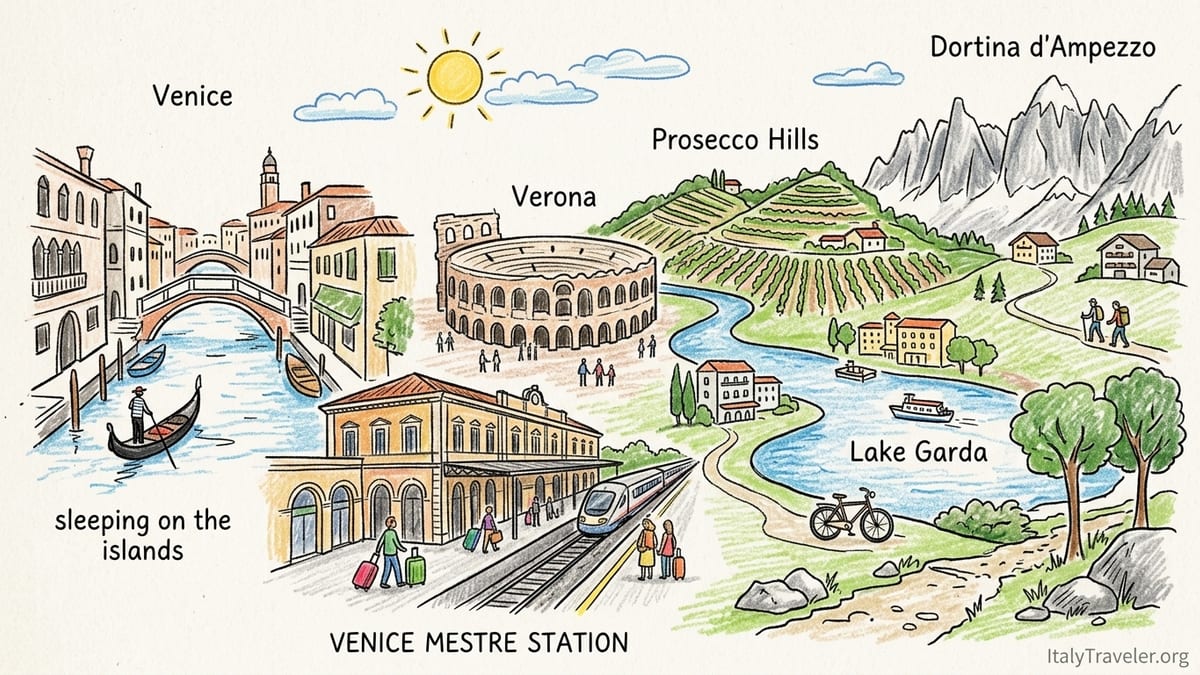
Choosing where to sleep in Veneto shapes your entire trip. Over multiple visits, I have split my nights between Venice and Mestre, Verona’s historic center and station area, lakeside towns on Garda, agriturismi in the Prosecco Hills, mountain hotels in Cortina d’Ampezzo and a couple of strategic nights in Padua. What follows is not a list of hotels but a location decision guide built from those stays: what it actually felt like to wake up in each place, how long transfers took, what I paid, how parking and train access worked, and where I would base myself for 3, 5 or 7 days.
How I Tested These Veneto Bases
Across several years of travel in Veneto, I have tried to treat each trip as a small experiment in where to stay. I have paid out of pocket, booked standard rooms and apartments, and kept notes on journey times and daily routines. In Venice itself, I have stayed in simple guesthouses in the Cannaregio district and a midrange three-star near San Polo, paying between about 130 and 220 euros per night for a double in high season, plus the city tax paid in cash at check-in. In Mestre, on the mainland, I booked clean business-style hotels and one small boutique property within a 5 to 8 minute walk of Venezia Mestre station, with summer rates closer to 85 to 140 euros for comparable comfort, including breakfast.
In Verona, I split my nights between a traditional hotel near Piazza Bra in the historic center and a contemporary place closer to Porta Nuova station, which is the main rail hub used by high-speed and regional trains. Official information confirms that Porta Nuova sits just south of the center and is the primary station for the city and its airport connections. I experimented with both walking and taking buses between station and center, and timed day trips to Vicenza, Padua and Lake Garda to see how realistic it is to base here for wider Veneto travel.
For Lake Garda, I stayed in midrange lakeside hotels and family-run pensions on the eastern shore within easy reach of Verona by bus or regional train plus a short walk to the waterfront. I also used Lake Garda as a soft landing after busier city days, testing what it feels like to stay four to six nights in one lakeside town instead of hopping between multiple villages. In the Prosecco Hills, I booked agriturismi around Valdobbiadene and Conegliano, including one like Agriturismo Vedova where renovated rooms sit among the vines, and used the car to access tastings and walking routes in the UNESCO listed landscape of Conegliano Valdobbiadene Prosecco hills.
In the Dolomites, my base of choice has been Cortina d’Ampezzo, staying in modest three-star hotels on the edge of the center so that I could both park nearby and walk into town for dinner. Local notices from the municipality highlight how parking has been under pressure, with areas near the former station undergoing redevelopment and new park-and-ride lots opening around the town with shuttle buses into the center. Finally, I have stayed in Padua a couple of times, within walking distance of both the station and the Scrovegni Chapel, to test it as a cheaper, well-connected cultural base for visiting Venice, Vicenza and the Euganean Hills.
Venice vs Mestre: Sleeping by the Canals or by the Tracks
My nights in Venice itself were magical in ways that statistics cannot capture. Walking back to a guesthouse in Cannaregio after a late dinner felt like being inside a painting: echoing footsteps in narrow calli, the occasional clatter of a suitcase over a bridge, reflections of street lamps quivering in the water. Practical details, however, came with a price. For a midrange double room in June and September, I paid in the range of 170 to just over 200 euros per night. Rolling a suitcase from the station to my lodging involved 15 to 20 minutes of slow walking with several bridge crossings. The city’s tourist tax was paid separately in cash, and some smaller places preferred cash for final settlement, which matters if you are budgeting tightly.
Transport time adds up subtly when you sleep on the islands. If you arrive at Venice Marco Polo airport and take the airport bus to Piazzale Roma, then walk 15 to 25 minutes to reach a midrange hotel near Rialto Bridge or in San Polo, your door to door transfer can easily reach 90 minutes, longer if you use a boat service. For day trips, walking back from your lodging to Santa Lucia station, catching a regional or high-speed train out to Verona or Padua, then reversing everything in the evening often cost me an extra 45 to 60 minutes each way compared with staying on the mainland. On a three-day trip focused purely on Venice, that tradeoff made sense. On a week where I wanted multiple day trips, it began to feel inefficient.
Mestre gave me a very different rhythm. From a hotel five minutes on foot from Venezia Mestre station, I could get off a train from Verona, cross one street and be checking in within ten minutes. The regional train over the causeway to Venice Santa Lucia usually took around 11 minutes, and services run regularly from early morning into late evening. My commute into Venice each day, including a few minutes of waiting, felt similar in duration to a typical urban Metro ride. Accommodation around Mestre station cost me around 90 to 120 euros per night in spring and early autumn for modern, air-conditioned rooms with breakfast, substantially cheaper than what I was paying in central Venice for equivalent comfort.
The tradeoff was atmosphere. Evenings in Mestre around the station were functional rather than charming, though a ten to fifteen minute walk took me to the revamped center with pedestrian streets and a more local restaurant scene. Dinners were significantly cheaper than in Venice’s tourist-heavy districts, and I appreciated being able to find a table without advance booking. For trips where Venice was just one part of a wider Veneto itinerary, I found Mestre a highly efficient base. For a couple stepping out of Santa Lucia station for the first time and wanting romance at the doorstep, sleeping on the islands still wins despite the higher cost and the luggage drag.
Verona: Cultural Heart and Rail Hub
Verona is where I have probably slept the most nights in Veneto because it balances culture and logistics so well. My stays near Piazza Bra and via Mazzini, within the historic center, were the most enjoyable. Stepping out of a hotel door into streets that lead straight to the Arena, Piazza delle Erbe and the Adige river makes even short breaks feel rich. In summer, opera nights meant walking five minutes to the Amphitheatre and drifting back through crowds of locals and visitors after midnight, stopping for gelato or a final glass of Valpolicella. Those central rooms, however, often cost between 150 and 220 euros per night during busy periods, especially on weekends with big performances or trade fairs.
For train access, I tested hotels in the Porta Nuova and Cittadella districts, roughly midway between the station and the historic core. Official and practical guides agree that this belt is the best compromise for travelers using Verona as a base. From here I could walk to Verona Porta Nuova station in around 10 to 15 minutes, depending on traffic lights on the broad, busy ring road, and reach Piazza Bra in a similar time in the opposite direction. The area felt more modern and less atmospheric than the medieval lanes by the river, but it delivered on convenience. When I booked early through standard platforms, prices were often 20 to 40 euros cheaper per night than visibly similar properties inside the old town walls.
Verona works exceptionally well as a rail base. High-speed services link it with Venice and Milan, while frequent regional trains run to Vicenza, Padua, Lake Garda’s gateway stations and smaller Veneto towns. Official data underline that Porta Nuova is the main station and handles several million passengers annually, which matches the constant flow I experienced. My door to door times were instructive. From a hotel near Cittadella, walking to the station, boarding a regional train and arriving in Padua took about 80 minutes total. A day trip to Peschiera del Garda involved 15 minutes on a regional train plus a short lakeside walk. That meant I could enjoy full days out and still be back in Verona by early evening for dinner.
The station area itself feels utilitarian, particularly after dark, and locals sometimes advise not lingering there longer than necessary. I shared that impression. Even so, on several trips I walked the route between station and center in the late evening without issues beyond traffic at road crossings. For risk-averse travelers, a taxi from station to a central hotel is relatively affordable given the short distance. For a 3-night city break heavy on culture and food, I would choose a hotel inside the historic center. For a 5 or 7-night stay where day trips by train are a priority, I now favor the Porta Nuova and Cittadella belt, which shortens travel days while keeping evenings walkable and pleasant.
Lake Garda: Slowing Down on the Water
Lake Garda became my preferred base when I wanted Veneto to include rest as well as rail connections. On the eastern shore, towns like Peschiera del Garda and Bardolino are close enough to Verona that you can combine lake time with city visits. During one six-night stay in Peschiera, I paid in the range of 130 to 170 euros per night in June for a double room in a lakeside hotel with breakfast, lake views and a small pool. Parking was usually included or charged at a modest daily rate compared with city garages. I arrived by train from Verona, walked 10 to 15 minutes from the station through tree-lined streets, and did not use a car for the entire stay.
What made Garda different from Verona or Venice was the pace of evenings. Instead of rushing back from a day trip to squeeze in one more museum, my days there often began with a slow walk along the waterfront, followed by a ferry ride to another town or a bike rental along the shore. After returning in late afternoon, I could shower, stroll five minutes into the old center and choose from trattorie with outdoor terraces. Prices for a full dinner ran lower than in Venice and in line with Verona’s midrange restaurants. The harbor area stayed lively after dark but never felt overwhelming. For travelers who burn out on dense sightseeing, Garda is a reset button.
The tradeoff is the extra leg that every day trip requires. From Peschiera, for example, reaching Venice in time for a day visit meant a 15-minute walk to the station, a 15-minute regional train to Verona, then boarding a high-speed or regional train onward to Venice. The full journey from lakeside hotel door to Venice Santa Lucia could easily reach two and a half hours one way if connections were not perfect. Shorter hops, like spending a day in Verona or visiting nearby theme parks, worked seamlessly. However, after experimenting, I would not recommend using Lake Garda as the sole base if your main goal is to explore multiple Veneto cities. I now treat it as a longer leisure segment at the end of a trip, or as a five to seven-night base when the lake itself is the main attraction.
Prosecco Hills: Vines, Villages and Car Logistics
Staying among the Prosecco Hills of Conegliano and Valdobbiadene delivered some of my most memorable Veneto mornings. Opening my shutters to see rows of vines on steep slopes, with morning mist in the valleys and the occasional church bell carrying across, felt far removed from the crowds of Venice. UNESCO documentation and regional tourism material describe this landscape of narrow terrace plots, forest patches and hilltop villages as a distinct cultural territory, and waking up inside it makes tasting rooms and walking paths feel part of your doorstep life rather than a day trip. My nights in agriturismi like the renovated farm stays near Valdobbiadene were in the range of about 100 to 150 euros for a double room with breakfast, depending on season.
The essential condition here is having a car. Train access into the core of the hills is limited, and while there are local buses, they run to a timetable that does not lend itself to spontaneous stops at wineries or viewpoints. From Venice or Treviso airports, my transfers involved picking up a rental car, then driving an hour to an hour and a half along a mix of autostrada and smaller roads. Once installed, I could visit two or three different wineries in a day, often using pre-booked tastings to ensure someone was available to receive guests, and then return to my agriturismo for dinner among locals and a small number of fellow guests. Driving after tastings requires discipline about alcohol consumption and planning, something solo travelers or pairs should factor carefully into their plans.
Evenings in the hills are quiet. Restaurant options thin out compared with cities, and many agriturismi offer dinner certain nights but not every night. On one three-night stay near Conegliano, I ate twice at the farm’s own restaurant and once drove 15 minutes to a nearby village for a change of scene, returning along dark, twisting roads. Prices for multi-course meals were fair, often lower than in Venice or Verona, and the quality of local produce was outstanding. Still, travelers who enjoy a choice of bars and late-night gelato walks may find the countryside too subdued for more than a few nights.
Time lost to transfers is the main downside if your broader itinerary includes cities. From the Valdobbiadene area, reaching Venice required a drive to either Conegliano or Treviso, dropping the car in a paid lot, then taking a regional train onward. My door to door times for such combinations were often over two hours each way. For that reason, I recommend the Prosecco Hills as an add-on of two or three nights within a longer trip, particularly for travelers who care about wine and rural landscapes. As an exclusive base for a 5 or 7-day first-time visit to Veneto, it is too remote from the region’s main art cities to be efficient.
Cortina and the Dolomites: Mountain Base with Parking Challenges
Using Cortina d’Ampezzo as my Dolomites base delivered exactly what I hoped for in terms of trails, scenery and crisp air, but it also tested my patience with parking and summer traffic. I stayed in midrange three-star hotels on the edge of town so that I could still walk 8 to 10 minutes into the center for dinner but park the car either in the hotel’s own small lot or on nearby streets. Rates in July and September ranged between roughly 150 and 230 euros per night for doubles with breakfast, rising at weekends and during peak events. Rooms were comfortable but not luxurious, and the mountain views from balconies or breakfast terraces were often the real luxury.
Local notices from the municipality make clear that Cortina has been modifying its parking arrangements. An ordinance published in mid-2024 described how the area of the former railway station car park was temporarily closed for redevelopment, affecting a chunk of central parking. Other communications in 2024 and 2025 mentioned new spaces along the river and park-and-ride car parks such as Acquabona, with several hundred spaces and shuttle buses linking to the town center. In practice, this meant that on days when I arrived back from hikes in the mid-afternoon, I sometimes had to circle a bit longer to find a suitable place, and I learned to value accommodations that guaranteed a spot, even at an extra nightly fee.
For hiking, being based in Cortina cut down transfer times compared with staying in a lower valley town. Most trailheads I used were within a 20 to 40 minute drive, and mountain pass parking lots filled quickly on sunny days. Arriving before 9 in the morning usually secured a place. Evenings in town were sociable but relatively contained: a walk along the main corso, a drink at a bar, then dinner at one of a handful of restaurants within strolling distance. Compared with Venice or Verona, choices were fewer and prices for both food and lodging higher, but being able to return to the same base after long days in the mountains made packing and planning easier.
As part of a Veneto itinerary, Cortina makes the most sense on trips of five days or longer, particularly if at least three full days are dedicated to mountain activities. Transfers from Venice or Treviso airports by car take several hours, depending on traffic and roadworks. Long-haul visitors might consider sleeping one night near the arrival airport or in Venice or Mestre to recover from the flight, then driving up the next morning. For a short three-day break focused on art cities, the Dolomites are too far out of the way. For a week where the priority is hiking with a taste of urban culture at either end, Cortina is a strong candidate.
Padua: Understated, Well-Connected Cultural Base
Padua rarely appears at the top of first-time itineraries, yet my nights there convinced me it deserves more consideration as a base. I chose a small hotel within a 10-minute walk of Padova station and about 15 minutes from the Basilica of Saint Anthony. Official timetables showed frequent regional and high-speed trains linking Padua with Venice, Verona, Vicenza and Bologna. In practice, this meant that on one three-night stay I visited Venice for a full day, Vicenza for architecture, and still had time to explore Padua’s own markets and frescoes without feeling rushed. Door to door, my morning trip from hotel to Venice Santa Lucia generally took about 40 to 50 minutes, shorter than traveling in from some Mestre locations once walking across the causeway station hall was included.
Accommodation in Padua was a notch cheaper than in Venice and often a little lower than in Verona’s historic center. For a decent midrange double room with breakfast in spring, I paid around 110 to 140 euros per night. The city felt very lived-in, with a large student population giving evenings in the piazze a lively but not touristy atmosphere. Restaurant prices reflected this, with many spots oriented toward locals rather than visitors. Being able to walk back from dinner through colonnaded streets, grab a final drink in a student bar, and then reach my hotel on foot made Padua feel manageable and relaxed.
Parking, if you drive, requires planning. Central zones have restrictions, and while there are public garages near the historic center and station, they cost enough per day that booking a hotel with dedicated parking became worthwhile when I had a rental car. When relying solely on trains, Padua shines. For example, reaching Verona from Padua by regional train took about an hour, while Vicenza was closer to 20 to 25 minutes. This made back-and-forth day-tripping feel normal, and I never faced the crowd intensity of Venice at night because I slept in a different city.
For travelers who like museums, churches, and café culture more than big-ticket sights, Padua is an appealing alternative base. You can see Giotto’s frescoes at the Scrovegni Chapel, wander the Prato della Valle, and then choose whether to commute into Venice or not. On a 5 to 7-day trip, pairing Padua with either Venice or Verona splits the difference nicely between cost, convenience and atmosphere.
How I Would Base a 3, 5 or 7-Day Veneto Trip
Looking back on these stays and the actual time I lost to transfers, a clear pattern emerges. For a 3-day trip focused on first impressions of Veneto, I would choose to sleep in Venice itself if the budget allows. The reason is simple: even a short walk back to a room beside the canals after dinner changes how the city feels. You can explore the quieter early mornings and late evenings that most day-trippers miss. Day trips from Venice on such a short break tend to eat too much time, so I would stay put, perhaps adding only a half-day boat excursion to nearby islands.
For a 5-day itinerary where you want both Venice and at least one other city, I now favor a split. I would spend two nights in Venice, then move to either Verona or Padua for three nights. When I tested this pattern, I found that packing and catching a midday train was a small price to pay for the different atmosphere and better access to trains. From Verona, I could add Lake Garda or Vicenza; from Padua, I could still pop back into Venice without paying Venice hotel rates every night. The total time spent on transfers dropped because I was no longer commuting in and out of Venice each day.
For a 7-day trip, there are a few strategies that worked particularly well. One was to combine three nights in Verona, three at Lake Garda, and one night in Venice either at the start or end. This gave me city culture, slow lake days and at least one evening beside the canals. Another option I tested was three nights in Venice, two in the Prosecco Hills, and two in Cortina. That trip prioritized landscape and wine, with less attention to secondary cities. The key lesson was to limit the number of bases. Each accommodation change usually consumed half a day when you factor in check-out, luggage, reaching the next place and settling in.
If someone asked me today, for a balanced first-time 7-night trip that uses trains and maybe a short car rental, I would suggest three nights in Venice, three in Verona, and one at Lake Garda or in the Prosecco Hills as a gentle finale. A more urban traveler could choose three in Venice and four in Padua or Verona to simplify logistics and rely on day trips. Mountain lovers might weight the week toward Cortina after a single night in Venice or Mestre. There is no single right answer, but being honest about what you enjoy in the evenings, how much you mind repacking, and whether you prefer walking to stations or driving country roads will point you toward the base that fits best.
FAQ
Q1. Is it better to stay in Venice or Mestre for a first visit?
For a first short visit of three days or less, I recommend staying in Venice itself if your budget allows, because waking up and going to sleep beside the canals gives you early and late hours when the city is quieter and more atmospheric. Mestre is more practical and cheaper, with quick trains into Venice, but it feels like a commuter town rather than a historic destination.
Q2. How long does it take to get from Mestre to central Venice each day?
From a hotel within a few minutes’ walk of Venezia Mestre station, the regional train ride across the causeway to Venice Santa Lucia is usually around 10 to 15 minutes, and trains run frequently. Including walking to and from platforms, most of my door to door journeys between hotel in Mestre and the Grand Canal area took roughly 25 to 35 minutes.
Q3. Is Verona a good base for day trips by train?
Yes, Verona works very well as a rail hub. From accommodations in the Porta Nuova or Cittadella districts, I could walk to Verona Porta Nuova station in about 10 to 15 minutes and catch frequent trains to Venice, Padua, Vicenza and Lake Garda’s stations. For a five or seven-night stay with multiple day trips, Verona offers a strong mix of culture, restaurants and efficient train access.
Q4. Can I use Lake Garda as my only base for exploring Veneto?
While you can technically reach many cities by combining trains and buses from Lake Garda, I would not choose it as the only base if your main goal is sightseeing in Venice, Verona and Padua. Transfers to Venice in particular become long, often over two hours each way. Lake Garda shines as a place to slow down for four to seven nights, either after or between more city-focused bases.
Q5. Do I need a car to stay in the Prosecco Hills?
In practice, yes. My stays in the Prosecco Hills around Conegliano and Valdobbiadene were only convenient because I had a rental car to reach agriturismi, wineries and viewpoints. Public transport exists but does not easily support spontaneous tasting stops or evening dinners in scattered villages. If you prefer not to drive, limiting yourself to city bases and joining organized day tours into the hills is more realistic.
Q6. How difficult is parking in Cortina d’Ampezzo?
Parking in Cortina requires planning, especially in high season. Some central lots have been affected by redevelopment works, and the municipality has created additional parking areas and park-and-ride options just outside town with shuttle buses. When I stayed, having a hotel that could offer either its own spaces or clear guidance on where to park saved significant time and frustration.
Q7. Is Padua a cheaper alternative to staying in Venice?
In my experience, midrange hotels in Padua cost noticeably less per night than comparable properties in central Venice, and restaurant prices also tended to be lower. Trains between Padua and Venice run frequently, so for travelers comfortable with a 40 to 50 minute journey each way, Padua can be an excellent, less touristy base with rich cultural sights of its own.
Q8. How many bases should I use for a week in Veneto?
After testing various combinations, I find that two or at most three bases work best for a seven-night trip. Each accommodation change typically consumes half a day by the time you pack, check out, travel and settle in. Choosing fewer bases, such as Venice plus Verona or Venice plus Padua with perhaps a short add-on at Lake Garda, preserves more time for actually experiencing places.
Q9. Where would you base a five-day trip that includes both Venice and other cities?
For five days, I would split the stay between Venice and either Verona or Padua. Two nights in Venice let you enjoy the city’s unique mornings and evenings, while three nights in Verona or Padua create an efficient base for day trips to nearby cities by train. This balance reduces daily commuting and gives you two distinct atmospheres.
Q10. Is it worth staying a night in the Prosecco Hills or just visiting on a tour?
I found that at least one or two nights in the Prosecco Hills added a lot to my trips, because sunrise and sunset in the vineyards, and dinners at agriturismi, felt very different from city experiences. However, for first-time visitors with limited time who do not want to rent a car, a day tour from Venice or Verona might be the more practical way to sample the region.