


The morning I left Venice for the Belluno Dolomites, I wanted to prove the brochures right. Veneto’s official tourism material puts the Dolomites on the same level as Venice, Lake Garda and the great art cities. I wanted to see if a single day from the lagoon up to Cortina d’Ampezzo and back could do this mountain world justice, or if the Dolomites really demand at least one night among the peaks.
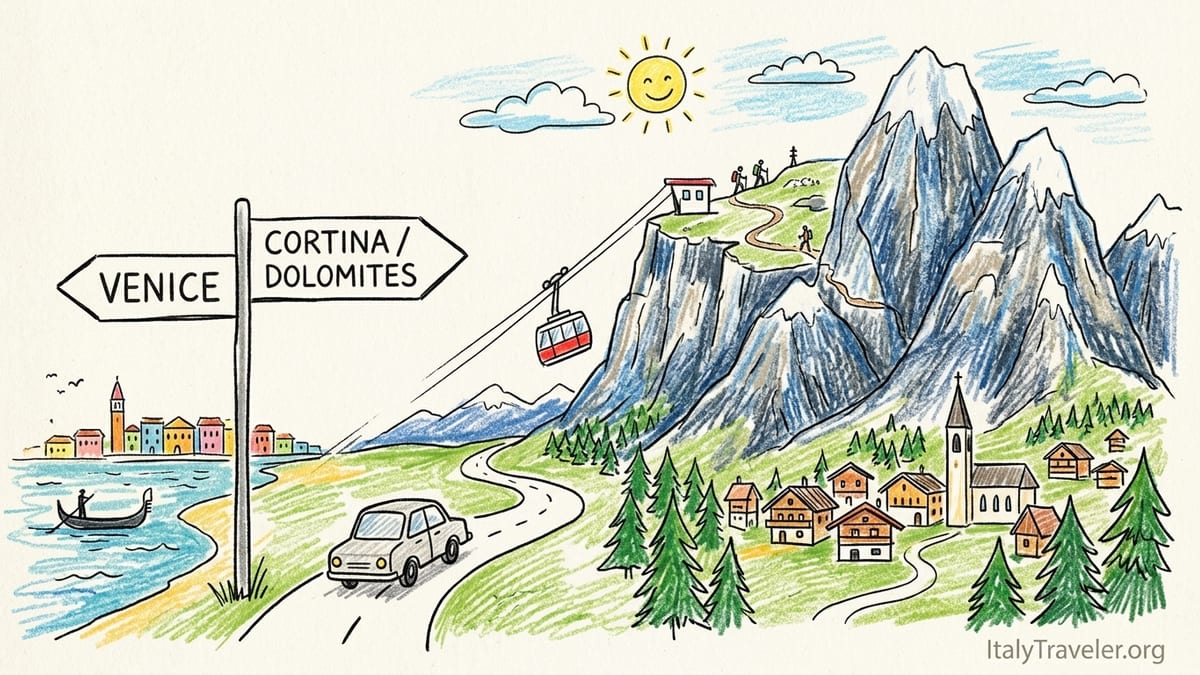
Planning a Dolomites Escape From Venice
I based myself in Mestre, on the mainland just behind Venice, specifically to make the Dolomites easier. From there, road and bus connections head directly toward the Belluno province, the part of Veneto that holds most of the Dolomites and the Dolomiti Bellunesi National Park. Official regional material and Belluno tourism brochures present this mountain area as one of Veneto’s four major pillars alongside Venice, Lake Garda and the art cities, not as a side excursion tacked onto a lagoon holiday. On paper, Cortina d’Ampezzo is less than two hours away by car. In reality, the day looks very different once you add transfers, winding roads and mountain weather.
Because I wanted flexibility to stop at viewpoints and not be tied to bus departure times, I chose to drive rather than rely on the direct ATVO bus service that links Venice (Piazzale Roma, Mestre and Marco Polo Airport) with Cortina d’Ampezzo via Line 29. Regional information showed that this bus takes roughly 2 hours 15 minutes from the airport and a little longer from Venice itself, with a handful of departures each day depending on the season and demand. That sounded convenient, but I was traveling in late September, with shorter daylight, and wanted full control over my schedule.
Car rental at Mestre’s station area opened early, around 8:00, but I had learned that autumn weather in the Dolomites changes quickly. To give myself more mountain time and a margin around any afternoon thunderstorms, I booked the earliest slot and aimed to be on the A27 motorway by 8:30. The plan was simple on paper: Mestre to Cortina, pause at viewpoints, ride at least one cable car, take a short walk at altitude, wander Cortina’s center and be back in Mestre before 21:00. The key question was how this would feel in the body as a same-day return.
From Venice Lowlands to Belluno and the First Dolomites
Leaving Mestre, the A27 motorway northbound feels utterly un-mountainous at first. The landscape is flat and agricultural, with low industrial buildings, vineyards and patches of mist on autumn mornings. Traffic around 8:30 was moderate, mostly commuters. It took about 40 minutes to reach the foothills near Vittorio Veneto, where the road begins to rise gently and the views start to change from plains to pre‑Alpine ridges.
Belluno sits about 100 kilometers north of Venice, acting as the main gateway city to the Eastern Dolomites. Road signs started to mention Belluno, Longarone and Cortina in the same breath, a reminder of how integrated the mountain area is in the region’s tourism and economy. As the motorway ended near Belluno and the route continued as a main road, the driving became more engaging but still far from technical. Curves increased, trucks thinned out and villages began to lean up hillsides.
By the time I reached the valley near Longarone, the first rocky towers appeared through the clouds, still some distance away but clearly different from the green pre‑Alps. The Piave valley funneled me toward Cadore, the historic heartland of the Belluno Dolomites, and the road gradually narrowed. There were no sheer drop-offs right beside the tarmac, but the bends became more frequent and it required more focus, especially behind local drivers who know every curve and take them briskly.
The weather illustrated one of the biggest hidden costs of a day trip. I had left Mestre in weak sunshine around 18 degrees Celsius. By mid-morning, climbing past Pieve di Cadore toward Cortina, the sky thickened to low cloud and light drizzle, the temperature dropping to around 11 degrees. Visibility tightened in places where the road ran through forested slopes. I stopped at a lay-by above the Boite valley and watched as short-lived gaps in the cloud revealed pale cliffs, then sealed them again. On a weekend or in peak summer, these roadside viewpoints can be busy with motorbikes, cyclists and photographers.
Reaching Cortina d’Ampezzo and Navigating Parking
I arrived in Cortina d’Ampezzo a little after 11:00, roughly two and a half hours after leaving Mestre, including one short coffee and fuel stop. The town sits in a wide basin ringed by craggy peaks, and even under a gray sky there was a sense of arrival: pastures, chalets, and a compact center with church towers and upmarket boutiques. Traffic into town was steady but not jammed in late September. In high summer or during winter weekends, Belluno tourism sources warn that Cortina can feel close to capacity, and parking then becomes the first big stress point.
With a car, the immediate question was where to leave it to explore on foot and reach a cable car quickly. Cortina’s center has several paid car parks, some underground and some open-air. I opted for one of the central garages near the pedestrian core, partly because I did not want to spend more precious time circling. Midweek shoulder season meant I found a space without trouble, but even then it felt like a small victory. I paid by the hour at a rate that, while not extreme by Venetian standards, reminded me that staying close in Cortina comes with premium pricing.
From the car park, it was a short walk through the center to the Faloria cable car station. Cortina is not large, but with only an afternoon at altitude you notice every minute lost crossing town. Pavements were busy with a mix of hikers, cyclists and day-trippers like me, some clearly up for serious ascents, others content to browse shops selling technical outerwear and designer ski fashion. The contrast between the rugged mountains overhead and the polished shopfronts on Corso Italia is one of Cortina’s defining images.
Even in the shoulder season, I queued briefly at Faloria for tickets. Recent price information indicated that a round-trip ticket for the Cortina – Faloria cable car in summer cost in the region of several dozen euros per adult, with variations depending on age and any promotional offers. Prices have tended to rise gradually in recent years, and staff advised checking current tariffs closer to travel dates, especially around major events and the build-up to the Milan-Cortina 2026 Winter Games.
On the Faloria Cable Car and Short Walks at Altitude
The Faloria cable car climbs steeply from Cortina’s edge up to a plateau on Monte Faloria. The cabin filled with hikers and a small group geared for via ferrata. During the ascent, the town dropped away under us, its buildings shrinking as the surrounding ridges expanded, finally taking over the horizon. The ride itself felt smooth and secure, but those with a fear of heights might be challenged when the cable passes over pylons and the car sways briefly.
At the top station the weather had shifted again. The drizzle from the valley was now low cloud racing over the plateau, with occasional sunbursts that lit up the pale rock faces in luminous tones. Temperatures hovered just above single digits Celsius. Within a few minutes of walking away from the station, the sense of being on a quick day trip from Venice evaporated. Underfoot were alpine meadows and gravel paths, over our heads ragged spires and, every so often, small avalanches of cloud pouring over ridges.
With only a day to spare and a long drive home ahead, I chose a moderate loop walk from the top station that could be completed comfortably in 90 minutes, including pauses for photos. Signage in this part of the Dolomites is generally excellent, with numbered paths and clear direction markers, a result of decades of investment in the hiking network that covers the Belluno Dolomites and the wider UNESCO-listed areas. Even so, the terrain is not to be taken lightly if fog descends or storms move in. I carried a lightweight waterproof, hat and gloves despite having left Mestre in a T‑shirt.
The short hike was spectacular yet frustrating. Spectacular because even brief views over the Ampezzo basin and surrounding massifs like Cristallo and Sorapis were enough to justify the journey from Venice. Frustrating because every junction in the trail network offered tempting options: longer traverses, links to mountain huts, approaches to more challenging peaks. Time pressure hovered constantly in my mind. I needed to be back at the car by mid-afternoon to avoid driving long stretches of mountain road in the dark and to beat evening traffic near Mestre.
Driving Back to Venice and How the Day Felt Physically
I took the cable car back down from Faloria around 14:30 and allowed myself one hour to stroll Cortina’s center and grab a late lunch. A simple plate of local casunziei dumplings and a coffee at a central café came to roughly what I might have paid in Venice’s more central quarters, reminding me that Cortina is very much in the same league in terms of visitor spending. By 15:45 I was back in the car, inching out of town with others doing the same calculation about daylight.
The first part of the return route, descending toward San Vito di Cadore and the Cadore valley, demanded concentration. Afternoon light angled across the road, alternating sharp brightness and shadow under trees. Local drivers moved quickly and overtaking opportunities were limited. Road conditions were good, but any sudden weather change here would have made the drive significantly more tiring, especially for those unused to mountain roads. On the day of my trip, rain held off, but low cloud continued to cling to the higher slopes.
By the time I rejoined the A27 near Belluno, I had been on the move almost continuously for about eight hours. The motorway section back to Mestre was straightforward but felt longer than in the morning. The mental shift from alpine passes to industrial estates and shopping centers outside Venice is abrupt. I dropped the car back shortly after 18:30, almost exactly ten hours after setting out.
Physically, the day was more draining than the distances suggest. The combination of early start, mountain weather, altitude adjustment, constant time awareness and two extended driving stints left a residue of fatigue that evening. I still had enough energy for a short walk in Venice’s quieter sestieri, but I would not have wanted to repeat the trip the next morning. If I had traveled by bus, the fatigue would have been different: less from driving, more from waiting, connections and being tied to fixed departure times.
Does Cortina and the Belluno Dolomites Work as a Day Trip?
Based on this experience, the honest answer is that the Dolomites from Venice do technically work as a day trip, but only under certain conditions and with clear expectations. You can leave Mestre around 8:30, be at a mountaintop viewpoint such as Faloria by late morning, fit in a short walk and a simple meal, and be back on the Venetian mainland by early evening. In good weather and outside peak traffic, it is logistically realistic. Emotionally, it feels like tasting a single course of a multi‑course meal.
What that day trip offers is an intense visual and sensory hit: the sudden switch from canals and lagoon to limestone towers, from Adriatic humidity to sharp mountain air. It is ideal for travelers who are short on time, uneasy about spending nights away from a Venice base, or simply want to verify with their own eyes that the Belluno Dolomites deserve their place alongside Venice and Lake Garda in Veneto’s tourism identity. For those aims, one day is enough to be convinced.
However, if the goal is to experience the Dolomites as a destination rather than a backdrop, the same day return feels compressed. Every decision is framed by the return clock. I found myself cutting short a trail that begged exploration, skipping museums in Cortina, and passing signposts for the Dolomiti Bellunesi National Park without time to detour. Weather risk looms larger on a one-day plan. A cloudy morning can hide the famous alpenglow on the cliffs entirely, and by the time clouds lift it may already be time to drive back.
From my own trip, if I were advising another traveler with a flexible schedule, I would say that the Belluno Dolomites deserve at least one overnight stay, preferably two, to align with how the region itself promotes them. A single day can stand as an introduction or a consolation prize. An overnight turns it into a true mountain visit, with sunsets, early morning light and the chance to adapt plans to weather rather than to a car rental return time.
Why an Overnight Stay Changes Everything
Staying one or more nights within the Belluno Dolomites extends your experience in several ways that became painfully obvious only after my rushed return. First is light. On my day trip, I left Mestre after sunrise and arrived in Cortina with the sun already high and softened by cloud. I missed dawn on the peaks and had to leave long before evening alpenglow. An overnight stay in Cortina, nearby San Vito di Cadore, or in smaller villages closer to the Dolomiti Bellunesi National Park would have allowed slow, low-angle light at both ends of the day, which is when the Dolomites are most photogenic.
Second is access to variety. From Cortina and the surrounding Belluno area, a full day or more opens up options such as visiting Lago di Misurina, tackling a longer hike toward iconic formations like Tre Cime di Lavaredo, or exploring the southern Belluno Dolomites around Valbelluna and the national park, where trails and viewpoints showcase a quieter, less famous side of the range. These are the kinds of activities that regional promotional material highlights when it positions the Belluno Dolomites alongside Venice and Garda as a destination with its own depth.
Third is psychological space. On my one-day trip, even the simple pleasure of sitting at a mountain hut terrace was trimmed by thoughts of traffic and driving time. With a room booked nearby, a late-afternoon storm becomes something to watch from shelter rather than a reason to worry about slick roads. Conversations with local guides and hut owners can stretch beyond a few rushed questions at the bar. Mountain culture, from Ladin heritage to local food, is easier to absorb when you are not of necessity a commuter.
Finally, an overnight stay makes public transport more viable. The ATVO line between Venice and Cortina runs a limited schedule depending on season, and while it can work for a day trip if your dates align exactly with early morning and late afternoon departures, its timing is far better suited to travelers who intend to stay in the mountains at least one night. You then travel up one day, explore the next, and return another, in tune with the way local tourism planners imagine the flow of visitors between lagoon and peaks.
Researched Alternatives for Reaching the Belluno Dolomites
Separately from my own drive, I looked into the main current alternatives for travelers deciding how to reach the Belluno Dolomites from Venice. The most widely publicized direct option is the ATVO bus line connecting Venice’s Piazzale Roma, Mestre railway station and Marco Polo Airport with Cortina d’Ampezzo. Recent schedules indicate that this Line 29 service typically runs several times a day in winter and summer seasons, with fewer departures in shoulder periods. Journey time from the airport is advertised at around 2 hours 15 minutes, slightly more from Venice itself, on coaches equipped with luggage holds and free Wi‑Fi.
Another increasingly visible option is private or small-group tours operated by local companies that bundle transport from Venice with curated stops in the Belluno Dolomites. These tours often market themselves as Dolomites day trips and may include visits to lakes such as Misurina or Braies, viewpoints near Cortina, and short walks suitable for a wide range of fitness levels. Prices for these full-day excursions typically sit in the low to mid hundreds of euros per person, depending on group size, season and inclusions such as lunch or cable car tickets. They remove the stress of driving and parking, but still compress a great deal into a single long day.
Independent travelers without a car sometimes combine regional buses and trains. One common pattern is to take a regional train from Venice to a railhead such as Calalzo di Cadore, then transfer to a local bus up the valley toward Cortina or other Belluno Dolomites villages. This route requires close checking of timetables, particularly outside peak season and on Sundays, when services can be sparse or require multiple changes. Some visitors also arrive from elsewhere in northern Italy, linking the Belluno Dolomites with Trentino or South Tyrol, where additional bus and cable car networks open up circular itineraries through different valleys.
For those specifically interested in the Dolomiti Bellunesi National Park area south of the main Cortina basin, a car or organized tour is especially useful. While buses do reach gateways such as Belluno and some park villages, the network within the park is designed around local needs and trailhead access rather than around fast tourist connections. Regional planning documents and park material consistently stress sustainable transport and careful route planning, along with respect for trail etiquette and protected habitats, which is essential reading before any deeper foray into these mountains.
The Takeaway
My day from Venice to the Belluno Dolomites, focused on Cortina and the Faloria plateau, delivered exactly what I had hoped and, at the same time, made clear what I had missed. In just ten hours door to door from Mestre I had watched the Veneto plains give way to limestone towers, ridden a cable car into the cloud line, walked among alpine meadows and tasted a slice of Cortina’s mix of mountain and luxury culture. I proved to myself that the Dolomites can be sampled as a day trip, especially for those with limited time or a strong preference to stay based in Venice.
Yet the feeling I carried back onto the A27 motorway that evening was one of unfinished business. The Belluno Dolomites are not just scenic wallpaper for a Venetian holiday, but a core part of the region’s identity, protected by a national park and celebrated in official tourism strategies alongside the lagoon, Lake Garda and the great art cities. To treat them as a quick excursion is to underplay what they offer in terms of nature, culture and outdoor experience.
If you have only one spare day and good weather, a carefully planned day trip by car or organized tour from Venice can be rewarding and memorable. Aim for an early start, choose one primary goal such as a specific cable car or lake, and accept that you are there to taste, not to feast. If your schedule allows any flexibility at all, give the Belluno Dolomites at least one night, ideally two, to match what the region itself promises: a mountain destination that stands beside Venice, not behind it.
FAQ
Q1. Can I really visit the Dolomites as a day trip from Venice?
Yes, it is possible to visit the Belluno Dolomites and Cortina d’Ampezzo as a day trip from Venice or Mestre if you start early and focus on one area, but it will be a long, fairly tiring day with limited time for hiking or exploring multiple sights.
Q2. How long does it take to drive from Venice or Mestre to Cortina d’Ampezzo?
In typical conditions, driving from Mestre to Cortina d’Ampezzo via the A27 and the Cadore valley takes around two and a half hours each way, longer if you hit heavy traffic, weather issues or make scenic stops along the route.
Q3. Is the mountain road from Venice to Cortina difficult or dangerous to drive?
The main route to Cortina uses a well-maintained main road with curves and elevation changes but without extreme cliff-edge exposure; it is considered normal mountain driving, though you should be cautious in bad weather, at night or in winter when snow and ice are possible.
Q4. Are there direct buses from Venice to the Belluno Dolomites?
Yes, a direct coach line operated by a regional company connects Venice’s Piazzale Roma, Mestre and Marco Polo Airport with Cortina d’Ampezzo, usually taking a little over two hours from the airport, although departure frequency and exact timings vary by season.
Q5. Which cable car near Cortina works best for a short visit?
For a first-time day visitor, the Faloria cable car above Cortina is a practical choice because its lower station is close to the town center and the top offers marked paths, viewpoints and basic services suitable for a few hours at altitude.
Q6. How much walking or hiking can I realistically do on a day trip?
If you travel from Venice and return the same day, you typically have time for one cable car ride and a short hike of one to two hours at altitude or around a lake, plus a brief stroll in town, assuming you keep a close eye on the clock.
Q7. Is it worth staying overnight in the Belluno Dolomites instead of doing a day trip?
Yes, an overnight stay, preferably two nights, greatly improves the experience by giving you sunrise and sunset light, flexibility in case of bad weather and enough time for longer hikes or visits to other valleys and lakes.
Q8. What should I pack if I am going from Venice to the Dolomites just for the day?
Even if Venice is warm, you should bring layers including a light insulated jacket, waterproof shell, sturdy shoes with good grip, a hat, gloves in cooler months, water and simple snacks, since temperatures and weather change quickly at altitude.
Q9. Are food and prices in Cortina much higher than in Venice?
Prices for meals, coffee and services in central Cortina are broadly comparable to busy central areas of Venice, with simple lunches and café stops costing more than in smaller Veneto towns but not wildly higher than other prime tourist centers.
Q10. How do the Belluno Dolomites fit into Veneto’s overall tourism offer?
The Belluno Dolomites are officially promoted as one of Veneto’s major destinations, alongside Venice, Lake Garda and the region’s art cities, reflecting their importance as a stand-alone mountain area rather than a minor side trip.