

I had been writing about Italian wine regions for years, yet somehow the Prosecco Hills between Conegliano and Valdobbiadene had remained a gap on my personal map. This spring I finally fixed that, booking a full day in the UNESCO-listed landscape that produces Conegliano Valdobbiadene Prosecco Superiore. What follows is not a theoretical guide but a straight account of what my day actually looked like: the wineries I booked, how I moved between them, what I paid, what I drank, and what I would do differently next time.
Why I Chose a Guided Prosecco Hills Day Instead of Driving
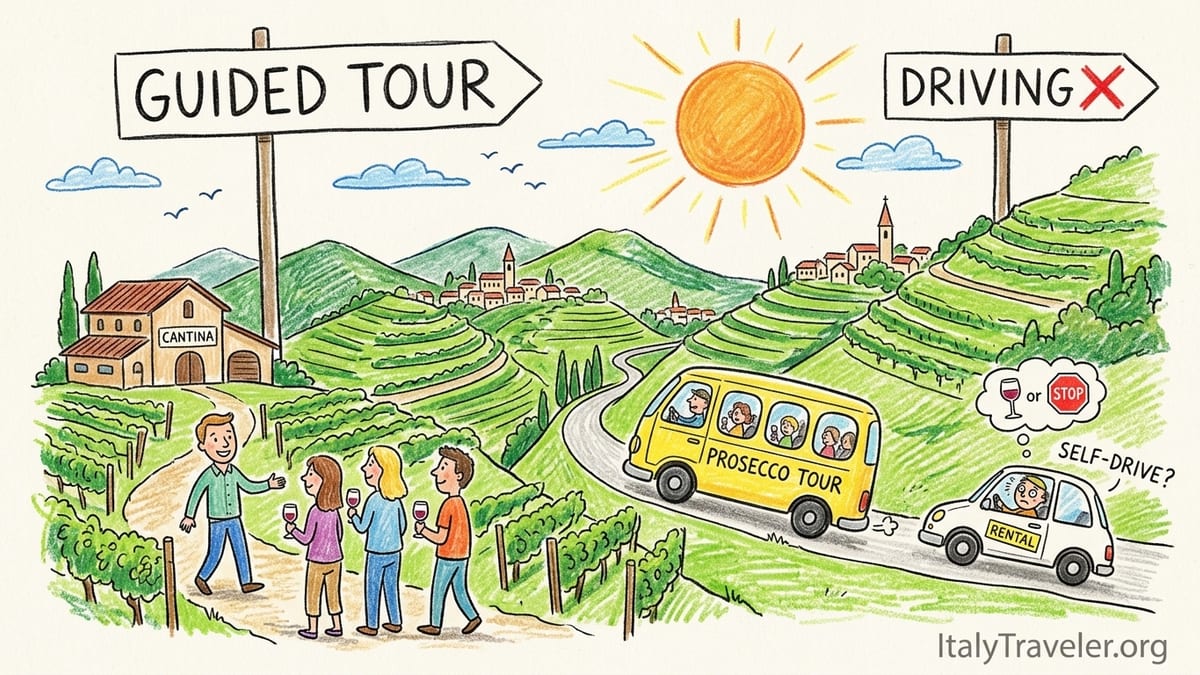
My original plan was to rent a car in Venice and follow the classic wine road that links Conegliano and Valdobbiadene, winding through villages like Refrontolo, Farra di Soligo and Santo Stefano. The idea of stopping whenever a hillside cantina caught my eye sounded romantic. Then I started adding up what a realistic tasting day would involve. Most cellar doors between Conegliano and Valdobbiadene now offer structured tastings that include four to six wines as standard, sometimes more if you add a Cartizze or a special cuvée. With two or three appointments, I would easily be at or over Italy’s legal blood alcohol limit of 0.5 g/l, especially once I factored in an aperitivo and lunch wine.
At the same time, the official tourism material for the Prosecco Hills strongly encourages visitors to use shuttle services, transfers and small-group tours, precisely because the roads are narrow and the tastings generous. The Strada del Prosecco, established in the 1960s, snakes along steep ridges, with sharp bends and occasional gravel pullouts instead of full parking lots. On a map, Conegliano and Valdobbiadene are only about 30 kilometers apart; on the ground, that distance means a lot of second-gear driving among tractors, cyclists and Vespas.
In the end I booked a small-group Prosecco tour that started in Conegliano and finished in Valdobbiadene, with transport in a nine-seater van and a driver-guide who did not drink. Several operators now offer similar experiences in the 170 to 210 euro range per person for a full day, including two or three winery visits, tastings of at least eight to ten wines in total, and a substantial lunch. The price felt significant, but when I compared it with a rental car, fuel, the risk of a drink-driving fine, and the extra time needed to design and confirm a route on my own, it looked far more reasonable.
There was also the question of access. Many better-known names in the hills, such as Nino Franco and Bortolomiol in Valdobbiadene or Bellenda closer to Conegliano, welcome independent visitors only with advance reservations and at specific time slots. Some keep their more in-depth vineyard and cellar tours for booked groups. A small-group tour guaranteed confirmed appointments at two family-owned estates, a stop in a panoramic vineyard, and the chance to ask technical questions without worrying about the drive ahead.
Morning in Conegliano: Booking, Meeting Point and First Glasses
I organized the tour about three weeks in advance. Spring and early summer dates in the Prosecco Hills fill fast, especially on Fridays and Saturdays, as Venice-based visitors increasingly treat a Prosecco day as a counterpart to popular Chianti or Valpolicella excursions. The booking process was straightforward: a fixed per-person price just under 180 euros, payable online, with confirmation emails listing the start time, meeting point outside Conegliano’s train station, and a promise of “at least eight different Prosecco Superiore DOCG wines plus local food specialties.”
On the day, I arrived in Conegliano by regional train from Venice Santa Lucia, a journey of just under an hour with tickets in the 6 to 8 euro range in second class. Conegliano immediately felt like a real working town rather than a wine theme park: commuters stepping off trains, teenagers on bicycles, and locals clustering at the station bar for morning espresso. Our guide, a Venetian in his thirties who had been leading tours in the hills for several years, was waiting by a clearly marked van.
There were six of us on the tour, which made conversation easy without feeling cramped. From the station, we headed out of Conegliano past the historic enology school and its teaching vineyard, then began to climb. The road quickly narrowed from two clean lanes to a winding strip that threaded between terraced vines. Our guide used the ascent to explain how the UNESCO World Heritage designation, granted in 2019 to the “Colline del Prosecco di Conegliano e Valdobbiadene,” had accelerated tourism investment and formalized experiences such as Vespa and e-bike tours, but also pushed more wineries to professionalize their hospitality and tasting rooms.
Our first stop was near Susegana at a mid-size family estate that produces Conegliano Valdobbiadene Prosecco Superiore DOCG in several expressions: Brut, Extra Dry, vintage-specific bottlings, and a still white made from the Glera grape. The tasting started not in the cellar but beside a hillside plot, reached by a narrow concrete track where our van barely fit. Standing between vines that clung to the slope in tight rows, we tasted our first glass of Extra Brut while looking back across the valley toward Conegliano’s castle.
Inside the Cellars: Tasting Formats, Number of Wines and Food
The cellar visit at this first winery followed a format that has become common throughout Conegliano and Valdobbiadene. We moved from the vineyard down into the production area, past stainless steel tanks used for primary fermentation and the pressurized vessels for the second fermentation that gives Prosecco its bubbles. The formal tasting took place in a dedicated room with floor-to-ceiling windows over the vines rather than a corner of the working cellar.
We tasted four wines here: a Conegliano Valdobbiadene Prosecco Superiore Brut, an Extra Dry from a selection of higher-altitude parcels, a millesimato (vintage) wine, and a still Glera. Pours were modest, roughly tasting-room size, but by the time I had compared residual sugar levels and fruit character between Brut and Extra Dry, the alcohol had started to register. The estate provided a simple but satisfying spread of crusty bread, local salumi, and a mild cow’s milk cheese to keep us grounded. The entire experience lasted about an hour and a half, including time for questions and a short walk through the on-site shop, where bottles ranged mostly between 10 and 18 euros.
One detail that impressed me was the guide’s coordination with the winery staff. Before each wine, he checked that any guests with preferences for drier or sweeter styles understood what was in the glass. When I asked about Rive bottlings, the single-village or single-slope wines that highlight steep sites such as Santo Stefano or San Pietro di Barbozza, he translated my more technical questions for the winemaker and added context about how these labels fit into the larger DOCG pyramid.
By late morning, we were back in the van and following the ridge road toward Refrontolo and Pieve di Soligo, passing signs for other estates, including several listed on regional wine tourism guides. Here the landscape turned more dramatic. The vineyards around the so-called heroic slopes rose in angles that made hand-harvesting a necessity. Cyclists and a handful of Vespa riders shared the road, and I was grateful not to be calculating braking distances in my own car after multiple glasses of sparkling wine.
Lunch came in the form of a fixed menu at a traditional trattoria near Farra di Soligo that often works with tour groups. It was not a tourist trap; several tables around us were occupied by local workers eating quickly. Our meal included a prosecco-based aperitivo, a generous plate of asparagus risotto, grilled meats, mixed vegetables, and a glass of house Prosecco Superiore that the restaurant sourced from a neighboring producer. Coffee ended the meal, but there was no amaro, a deliberate choice according to our guide, who wanted to keep everyone fresh for the afternoon visit.
Afternoon in Valdobbiadene: Iconic Hillsides and Second Winery
The most cinematic stretch of the day came after lunch, as we moved toward Valdobbiadene. The van wound through hamlets like Santo Stefano and San Pietro di Barbozza, names that appear on some of the most highly regarded Rive labels and on the maps of serious Prosecco drinkers. From time to time, the road squeezed through clusters of stone houses, then opened suddenly onto steep amphitheaters of vines where terracing and narrow paths showed how labor-intensive viticulture is here.
Our guide pulled over at a signed viewpoint just outside Valdobbiadene to let us walk along a ridge path. From there, the pattern of the hills made sense: a folded landscape of parallel ridges and deep folds, with vineyards clinging to the sunniest exposures and patches of woodland in the cooler hollows. It was easy to understand why UNESCO cited this “checkerboard of small vineyards on steep, grassy terraces” when recognizing the area. The air smelled of cut grass and wild herbs, and in the distance we could see the church spires of Valdobbiadene itself.
The second winery lay on the Valdobbiadene side of the hills, a short drive from the town center. It was slightly larger than our morning stop and had clearly invested in hospitality, with a landscaped garden, modern tasting room and a view across to some of the Cartizze slopes that produce the most prized and expensive Prosecco Superiore. Here the tasting was more extensive: six wines in total, including a Brut, Extra Dry, a Rive-designated bottling, a Cartizze, and two limited cuvées with longer lees contact.
Food accompaniments stepped up accordingly. Alongside grissini and cheeses, the winery served a local cured meat seasoned with spices and slices of focaccia topped with herbs and olive oil. The tasting was guided by an in-house educator in tandem with our external guide, and it felt more like a structured seminar than a casual bar pour. Each wine was introduced with context about altitude, exposition and residual sugar, and there was time between pours to discuss foam, bubble texture and pairing suggestions. By the end of the sixth glass, even with spitting and small portions, I felt pleasantly foggy and very certain I would not have wanted to be responsible for steering a rental car back across the hills.
After time to buy bottles and ship a mixed case home, we made a short stop in Valdobbiadene itself, walking through the central square where banners advertised upcoming wine exhibitions and summer events that mix jazz and Prosecco tastings. The town felt compact and relaxed, with a handful of bars offering by-the-glass lists focused on local producers and a noticeable absence of big tour buses. From there, our driver took the faster, less scenic route down to the valley floor and back toward Conegliano, where he dropped those of us returning to Venice at the train station in time for early evening departures.
Transport Choices and How the Alcohol Shaped My Day
Looking back, the decision not to drive myself was central to how much I enjoyed the Prosecco Hills. Over the course of the day, I tasted ten distinct wines at the two estates, plus an aperitivo and a glass with lunch. Even using the spit bucket for part of the tastings, there was no realistic way I could have stayed comfortably under the Italian legal limit while also paying full attention to the aromas and textures in the glass.
The roads themselves confirmed what I had suspected from satellite images. This is not a landscape of wide, straight avenues where a slightly impaired driver would be only a danger to themselves. The traditional Prosecco road between Conegliano and Valdobbiadene curls along exposed ridges and drops suddenly through forested slopes. Farmers pull tractors into the lane without warning. Cyclists claim the shoulder that might elsewhere serve as a recovery strip. Several times, our professional driver rounded blind curves that required a quick negotiation with oncoming vehicles that sat half in a ditch to let us pass.
Equally important, not having to drive quieted the background mental noise that can accompany self-guided tasting: watching the clock, double-checking GPS instructions, calculating how long until the next appointment. When a discussion about Cartizze soils at the second winery ran charmingly over time, no one in the group minded; the guide simply phoned ahead to adjust our schedule. Had I been alone in a rental car, that same overrun would have translated into stress about losing a later booking or rushing the drive.
For travelers who strongly prefer independence, there are alternatives to both driving and a classic minivan tour. The official tourism board actively supports Vespa and e-bike rentals for those who want the freedom to stop at viewpoints and villages. However, the same caution about alcohol applies. Several operators now bundle e-bike or Vespa hire with a single structured tasting at the end of the ride, which strikes me as a safer pattern than multiple appointments across the day. Trains and local buses connect Conegliano, Vittorio Veneto, Valdobbiadene and nearby towns, but services thin out in the evenings and rarely line up conveniently with mid-afternoon tasting slots.
Private Tour, Small Group or Self-Drive: What I Would Do Next Time
After this first visit, I can see clear pros and cons to each style of exploring the Prosecco Hills. The small-group format I chose worked well for getting an overview: a curated route, two serious tastings, relaxed lunch, and a rhythm that matched what my palate and attention span could handle. With six guests plus the guide, conversations ranged from basic questions about what “Brut” means to narrow topics like vine training systems on steep slopes. No one dominated, and there was enough flexibility to linger where the group showed most interest.
Next time, though, I would seriously consider booking a private driver-guide for a day built around more focused visits. Prosecco has its own internal hierarchy, from broader DOC bottlings to Conegliano Valdobbiadene Prosecco Superiore DOCG, then Rive single-slope or single-village wines, and finally the tiny Cartizze area near Valdobbiadene. A private itinerary would allow me to spend more time at producers who work intensively in these top sites, perhaps visiting one Conegliano-based estate with experimental methods in the morning and a Valdobbiadene producer with historic Cartizze holdings in the afternoon.
A private day in a similar van would almost certainly cost more than the 170 to 200 euro small-group range, especially if starting from Venice or including hotel pickup in Asolo or Treviso. Based on current quotations from local operators, a full-day private driver with wine-country expertise and two or three pre-booked cellar visits tends to fall somewhere between 450 and 700 euros for two people, not counting the actual tasting fees or lunch. That feels steep for solo travelers but reasonable for a couple or small group of friends who want depth over breadth.
Self-driving, in contrast, makes the most sense for travelers who intend to spit rigorously at tastings or who are content to focus on short, low-alcohol visits. The hills between Conegliano and Valdobbiadene are crisscrossed with small roads that are not always well signed. While that can be part of the charm, it demands a level of navigation attention that clashes with even mild wine effects. If I were to rent a car on a future trip, I would likely combine a morning in the vineyards with a single pre-booked afternoon tasting and spend the rest of the time walking through villages or along short signed trails, limiting actual drinking to a glass at lunch once the driving wasfinished for the day.
Practical Tips for Booking Your Own Day Between Conegliano and Valdobbiadene
My experience confirmed several practical points that are worth keeping in mind if you are planning a similar Prosecco Hills day. First, assume that you will need to reserve winery visits ahead of time, even for estates that appear casual from the road. Many producers organize their hospitality around set time slots to avoid overloading small teams. Booking a tour that already has cellar appointments locked in can save a flurry of emails in Italian and prevent disappointment, especially on weekends and in harvest season from late August into October.
Second, check exactly what your chosen experience includes. Some packages around the 170 euro mark cover transport, two wineries and lunch but charge separately for tastings, which can add 20 to 35 euros per estate depending on how many wines are poured and whether a visit includes Rive or Cartizze labels. Others bundle everything into a single price. Read the descriptions carefully and do not hesitate to ask operators for details about the number of wines, whether food is included at the wineries, and how long you will spend at each stop.
Third, think about where you want to start and end. Conegliano is particularly practical because it sits on a main rail line. You can stay in Venice or Treviso, come in by train in the morning, then rejoin the rail network in the evening without ever driving. Valdobbiadene has bus connections but is less straightforward for same-day rail travel. Some operators offer transfers directly from Venice or Mestre, which pushes prices higher but simplifies logistics if you are not comfortable with Italian train stations.
Finally, align your expectations with the pace of the hills. A realistic full day might include two in-depth tastings with four to six wines each, a substantial lunch and a couple of scenic stops. Trying to fit four or five wineries into a single day between Conegliano and Valdobbiadene does not just dilute the experience; it can also lead to rushed driving on roads that reward patience. The quiet, incremental rhythm of the Prosecco Hills is part of their charm. It is worth matching your schedule to that tempo rather than importing a checklist mentality from bigger, flatter wine regions.
The Takeaway
When I finally boarded the evening train back to Venice from Conegliano, two bottles of Prosecco Superiore wrapped in my bag and the taste of Cartizze still fresh, I felt both satisfied and slightly humbled. The Prosecco Hills had turned out to be more complex, more physically dramatic and more serious about their wine culture than the party-image reputation of generic Prosecco might suggest.
The day between Conegliano and Valdobbiadene had shown me vineyards clinging to improbable slopes, family estates pouring carefully made wines, and a tourism infrastructure that is increasingly well organized around safe, guided experiences. The choice to travel with a small group in a dedicated van, led by someone who knew both the roads and the producers, allowed me to focus on the glass and the landscape instead of the GPS.
If your idea of a perfect Italian day includes sparkling wine, hillside roads, and time to stand quietly in a vineyard as church bells ring in the distance, the Prosecco Hills deserve a place high on your list. Just be honest about how much you plan to taste and choose a transport option that keeps both you and everyone else on those narrow roads safe. Whether you opt for a curated small-group tour, a private driver-guide or a carefully limited self-driving itinerary, this corner of Veneto has the potential to deliver one of the most memorable wine days in Italy, as it did for me.
FAQ
Q1. Can you visit Conegliano and Valdobbiadene as a day trip from Venice?
Yes. Regional trains connect Venice and Conegliano in about one hour, and many tours start near Conegliano station, making a same-day return to Venice very feasible.
Q2. How many wineries can you realistically visit in one day in the Prosecco Hills?
Two in-depth visits plus a long lunch is a comfortable pace. Trying to see four or five wineries often leads to rushed tastings and stressful driving on narrow roads.
Q3. How much does a small-group Prosecco Hills tour cost?
Current full-day small-group tours with transport, two or three tastings and lunch typically start around 170 to 210 euros per person, depending on inclusions.
Q4. Do you need to book Prosecco tastings in advance?
Yes. Most estates between Conegliano and Valdobbiadene require reservations for tastings, and popular time slots, especially on weekends and in harvest season, often sell out.
Q5. Is it safe to drive yourself after Prosecco tastings?
It is only safe if you drink very lightly or spit consistently. Italy’s drink-driving laws are strict, and the Prosecco roads are narrow and winding, so many visitors prefer guided transport.
Q6. What is the difference between Prosecco DOC and Conegliano Valdobbiadene Prosecco Superiore DOCG?
Prosecco DOC covers a broader area, while Conegliano Valdobbiadene Prosecco Superiore DOCG comes from specific hillside vineyards and tends to offer more complexity and higher average quality.
Q7. When is the best time of year to visit the Prosecco Hills?
Late spring and early autumn are ideal, with green or golden vineyards, active cellars and milder temperatures. Summer can be hot, and harvest periods are busy but atmospheric.
Q8. Can you explore the Prosecco Hills by bike or Vespa?
Yes. Several operators rent e-bikes and Vespas and offer routes through the hills. However, given the terrain and alcohol, many cyclists plan only one tasting at the end of the ride.
Q9. Are there good food options on a Prosecco Hills wine day?
Absolutely. Traditional trattorie throughout the hills serve dishes such as risotto, grilled meats and seasonal vegetables that pair well with Prosecco Superiore and local still wines.
Q10. Is a private tour worth the extra cost in the Prosecco Hills?
If you are a serious wine enthusiast or traveling as a small group, a private driver-guide can justify the higher cost by tailoring visits to specific producers, styles and vineyards you care about most.