


I live in the Veneto region, close enough to see Venice on the departure boards yet far enough that visiting still feels like an occasion. This summer I finally did something many locals take for granted: I treated myself to a full day trip into Venice by train, from my small town outside Padova to Venezia Santa Lucia and back the same evening. I went in with a notebook and a skeptic’s eye, determined to understand how the trains work in practice, how the short-lived Access Fee has changed things, and what the crowds feel like on an ordinary peak-season day trip. Here is exactly how the day unfolded and what I learned.
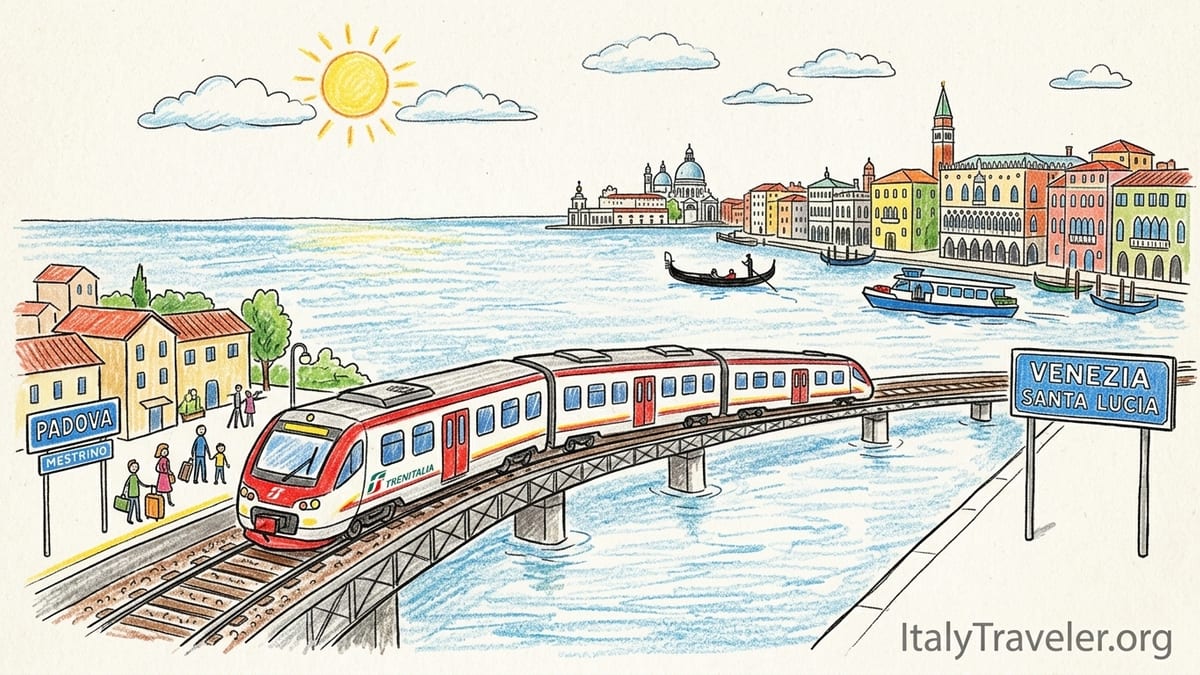
Where I Started: A Base in Padova’s Suburbs
For this day trip I stayed in Mestrino, a commuter town just west of Padova on the main line toward Venice. The local station is small, with a single bar, one ticket machine and a shelter that catches the morning sun. Regional trains here feed into Padova, where there are frequent connections onward to Venezia Santa Lucia. Living there for a week gave me a good sense of how people in the Veneto actually move around for work and leisure, not just how tourists do it.
The evening before my trip I opened the Trenitalia app and checked the morning departures from Mestrino to Padova and then Padova to Venice. Regional trains on this stretch are frequent, and journey planners such as Trenitalia, Trainline and Omio all show dozens of daily regional services from Padova to Venezia Santa Lucia, usually taking around 25 to 30 minutes and covering roughly 34 kilometers. A typical Regionale ticket for this link can cost around 4 to 6 euros if bought as an ordinary fare, while high speed services that happen to run on the same corridor cost more but save very little time on this short hop.
I deliberately chose to travel on a weekday in high season, because I wanted to see Venice under pressure. Cruise timetables and anecdotal reports from travelers suggest that weekends and days with multiple big ships can feel noticeably more crowded, but even midweek summer days attract intense daytime flows. I set myself a simple plan: leave Mestrino early enough to be walking out of Santa Lucia by about 9:30 in the morning, then stay until after dinner to see what the city feels like once many day trippers have gone.
The biggest surprise even before leaving home was how flexible regional train tickets can be if you understand the rules. In the app, the Padova to Venezia Santa Lucia ticket I bought was not tied to a seat or a specific train number. Instead it was valid for a set window of time, which meant that if I missed my intended regional departure I could simply board the next one without penalty, as long as I validated the ticket properly and stayed within the allowed time limit.
On the Rails: Regional Trains Into Venice
My day started with a short Regionale ride from Mestrino to Padova, about 10 minutes, just after 8:00. These commuter trains are basic but functional, with a mix of students, office workers and a few travelers with rolling bags heading to Venice. At Padova the contrast was immediate: electronic boards buzzing with departures to Bologna, Verona, Venice and Milan, regional and long distance trains all sharing the same concourse.
For Venice itself I deliberately chose a Regionale Veloce instead of a high speed Frecciarossa. Live timetables show that regional and Regionale Veloce services from Padova to Venezia Santa Lucia run roughly every 15 to 30 minutes for most of the day, and the difference in journey time between them and the high speed trains on this particular stretch is often just a handful of minutes. One recent evening departure, for example, covers Padova to Venezia Santa Lucia in about 27 minutes and sells at under 10 euros when booked through major ticket platforms, which matches the pattern I saw on my own travel date.
On board my mid-morning Regionale Veloce I shared a four-seat bay with a Venetian grandmother carrying shopping bags, two German backpackers puzzling over vaporetto passes, and a young commuter scrolling news on a phone. The train had air conditioning, power sockets in some carriages and bike spaces near the doors. Conductors checked tickets but did not assign seats. The train rolled past Mestre and Porto Marghera, then slowed as the first views of the lagoon opened up: pale water, industrial structures in the distance and the low causeway carrying the road traffic parallel to the rails.
By the time we pulled into Venezia Santa Lucia, right on the edge of the Grand Canal, I had already learned my first practical lesson. For a day trip within Veneto, regional trains are usually the sweet spot between cost and convenience. They are frequent, rarely sell out, and allow enough flexibility to adjust to tired feet, late dinners or an unexpected spritz.
Arrival at Santa Lucia: First Steps and First Mistakes
Santa Lucia station is Venice’s rail gateway, built flush with the Grand Canal. Stepping off the train you are funneled through the main concourse and out through a broad glass front into a shallow set of steps. At the bottom, vaporetto pontoons bob on the water and the Ferrovia stop is already humming. This is where many visitors make their first decisions under pressure, with luggage, heat and crowds in the mix.
I paused just outside the station to get my bearings. To the left, the Scalzi Bridge arched over the canal toward the Cannaregio district. Straight ahead a line of people queued for vaporetto line 1, which stops at almost every pier along the Grand Canal toward San Marco. To the right, a constant flow of pedestrians poured across the small bridges leading toward the bus terminal at Piazzale Roma. I had promised myself I would walk first and only use boats later, so I turned away from the crowds surging toward the waterbus pier and slipped behind the station into the quieter back streets of Cannaregio.
Here I made my second useful discovery of the day. The signage for walking routes in Venice is better than many travelers think, but it rewards patience. Yellow signs painted on the walls point toward key landmarks such as “Rialto,” “San Marco,” “Ferrovia” and “Piazzale Roma.” Following them produced a slow, zigzagging path that threaded through local bakeries, laundry strung between windows and residential squares where children played football before the day heated up too much. It was the opposite of the packed Strada Nova, the main artery many visitors instinctively follow from the station to the Rialto Bridge.
By giving myself permission to wander for my first hour, I not only avoided the densest early-morning crowd but also reset my image of Venice. The city is not only the postcard views of San Marco and Rialto. It is also narrow alleys that dead-end at water, tiny bridges over greenish canals, and church squares where older residents park their wheeled shopping trolleys in a row outside the supermarket.
Crossing the City on Foot: A Realistic First Route
My first planned route was simple on paper: walk from Santa Lucia through Cannaregio, cross near the Rialto, then continue to Piazza San Marco in time for a late-morning coffee. In practice, walking anywhere in Venice is a lesson in allowing extra time. The distance from the station to San Marco is only around two and a half kilometers as the crow flies, but dense crowds, narrow bridges, photo stops and dead ends stretch it into a good 45 to 60 minutes even at a steady pace.
I used the Strada Nova only in short stretches, ducking off whenever the press of people became uncomfortable. By about 10:30 the main route was already crowded with cruise ship groups following flags, families with strollers, and rolling luggage being dragged toward rented apartments. Every bridge became a mini bottleneck as people stopped for photos. Side alleys just one or two turns away from the main spine, however, were often half empty, with the same peeling paint and green shutters but none of the noise.
Near the Rialto Bridge I made my first real tactical error. I joined the flow up to the top of the bridge, which was packed tight with people shoulder to shoulder at the railings. The views up and down the Grand Canal are extraordinary, but if you dislike crowds this is an area to cross quickly or approach from less busy directions. By the time I descended on the San Marco side I felt noticeably more tired and impatient than I expected so early in the day.
From Rialto to San Marco the density increased further. The last few hundred meters before the square were clogged with tour groups and shopfronts selling glass, masks and clothing. Traffic moved slowly in bursts between tight corners. It drove home an important point for any day tripper: if your only impression of Venice is this corridor from the station via Strada Nova and Rialto to San Marco in late morning, the city can feel stifling and even hostile. Planning alternative walking routes, even if they are a little longer, radically changes the experience.
Vaporetti, Tickets and Getting Around on the Water
I reached Piazza San Marco shortly before 11:30 and immediately decided that my return journey across the city should be by water. This gave me an excuse to study how the vaporetto system feels on a real visit. At the San Zaccaria stop, just along the waterfront from the Doge’s Palace, I bought a 24-hour ACTV travel card at the ticket office, paying in cash. Prices can change, but at the time of my visit a one-way vaporetto ticket on the basic lines cost well into double digits in euros, while a 24-hour pass that includes vaporetto and city buses cost several times more. The pass made sense for me because I expected to use at least three boats during the day and wanted the psychological freedom to hop on and off without doing fare math each time.
My first boat ride was on line 1 from San Zaccaria back up the Grand Canal toward Rialto and Ferrovia. Line 1 is the slow, all-stops vaporetto, taking close to 45 minutes from one end to the other, but it is outstanding as a moving viewpoint. I managed to claim a standing spot at the rail on the outside deck. The boat was busy but not dangerously full, with a mix of locals using it like a bus and visitors recording every palazzo, dome and gondola they passed.
Later in the day I used a faster, limited-stop line along the Grand Canal, and one ride across to Giudecca for a late-afternoon pause away from the main islands. These short crossings were worth every minute. Not only did they save my feet, they gave me breathing space. The boats run late into the evening, but frequencies on some lines drop after dark, so it pays to check the current timetable on ACTV’s official channels if you plan to rely on the waterbuses after about 10 p.m.
What I learned is that for a single day trip you do not need to memorize the entire vaporetto map. Choose one or two core routes, such as line 1 up the Grand Canal and a cross-lagoon line like the one to Giudecca, and treat them as your relief valves from the walking crowds. Buying a time-based pass early in the day also simplifies decisions and reduces queues at busy stops such as San Marco and Rialto.
Eating on a Day Trip: When and Where It Worked
With only a single day in the city, meals can easily become either rushed or forgettable. I opted for three simple food stops that slotted naturally into my route without requiring reservations or long waits. Late morning, after surviving the crush between Rialto and San Marco, I stepped just a block away from the main path into a small bacaro that advertised cicchetti at the counter. A couple of small slices of bread topped with baccalà mantecato and a glass of ombra, the local term for a small wine, cost around what a basic coffee and pastry would cost in a more touristed spot closer to the square.
For lunch I deliberately avoided the waterfront by San Marco, where laminated menus and staff touting tables are common. Instead I rode the vaporetto back toward the San Stae area and wandered two or three streets inland from the nearest stop. There I found a trattoria filled mostly with Italian voices, serving a fixed-price lunch that included a simple seafood pasta and a salad. While I will not name it to avoid overexposure, the pattern is what matters: look for handwritten menus, a mix of workers and families, and prices that do not spike just for being next to the canal.
In the late afternoon, after a quiet hour on Giudecca watching the skyline of Venice proper, I returned to Dorsoduro for an early evening spritz and small plate at a bar that spilled out into a campo. The mood was far more local than in San Marco. Office workers in rolled-up sleeves and students with backpacks mixed with a few visitors consulting folded maps. Sitting there around 18:30, with the sun softening and the air finally starting to cool, I understood why many Venetians insist that the city is still livable if you sync your schedule more with their rhythms than with the rigid timeline of a cruise excursion.
Dinner before my return train took place back near the station, a deliberate choice to avoid rushing. Around 20:00 I sat down at a simple pizzeria on a side street five minutes from Santa Lucia. By that time the area was lively but not packed, and the atmosphere felt more like a neighborhood edge than a transit zone. I left the restaurant with a comfortable 40-minute cushion before my planned train, which turned out to be exactly the margin I needed when the departure board shuffled and my Regionale was reassigned to a different platform.
Crowds, Rhythm and How the City Changed Through the Day
Watching how the crowds in Venice evolve across a single day was one of the most instructive parts of the trip. By 9:30 in the morning, when I first stepped out of Santa Lucia, the forecourt and vaporetto stops were already busy, but the back streets of Cannaregio still felt calm. Around 10:30 to 12:30, as I approached Rialto and San Marco, the city hit its midday crush. Every main artery was thick with day trippers, organized tour groups and visitors checking maps mid-bridge. This pattern matches what many recent reports have described: that late morning through mid-afternoon see the highest congestion, especially in the triangle between Santa Lucia, Rialto and San Marco.
In the early afternoon, around 14:00 to 16:00, things shifted slightly. Temperatures rose, and some of the visitors retreated indoors to museums, churches or long lunches. Streets did not empty, but movement became easier, especially in districts such as Dorsoduro and parts of Castello. Crossing to Giudecca on a mid-afternoon vaporetto, I felt another step down in intensity. There were tourists and residents alike, but nowhere near the shoulder-to-shoulder conditions near San Marco.
The most striking change came after 18:00. As some cruise passengers returned to their ships and day trippers from elsewhere in Veneto started drifting back toward the station, the atmosphere in many neighborhoods grew softer. Campo Santa Margherita began to fill with students and locals catching up over drinks. Small bakeries closed their doors and restaurants gradually set tables outdoors. By 20:00, when I ate near Santa Lucia, the flows heading into the city had largely reversed, and most pedestrians near the station were outbound, trundling luggage or walking with the relaxed gait of people who have already seen what they came for.
Staying into the evening, then returning to the mainland after dark, changed my view of whether a Venice day trip is worthwhile. Yes, the midday crush can be severe, and anyone sensitive to crowds should prepare mentally for pinch points near the famous sites. Yet if you structure your day to include early and late walking in quieter quarters and use boats to bypass the most congested corridors during peak hours, even a single day can feel surprisingly rich rather than rushed.
Venice Access Fee in 2026: What Actually Applied and What Comes Next
Because my visit took place in 2026, I was determined to understand how the much-debated Venice Access Fee intersected with a simple day trip by train. In previous years, notably 2024 and 2025, the city ran time-limited trials of a day-tripper fee on selected peak days. Visitors who were not staying overnight inside the municipality and who entered the historic center on specified dates were asked to book and, in many cases, pay a flat fee, widely reported as 5 euros on many of the trial dates.
For 2026 the city again adopted a trial structure, with the official Venice access portal explaining how the fee applied during the designated period. In practice, that meant that on specific Fridays, Saturdays, Sundays and certain holidays earlier in the season, day visitors could be subject to the fee, while Venice residents, people staying in registered accommodation within the municipality and several other categories were exempt. Travelers staying in hotels in Mestre and other mainland areas had to pay attention, because the rules on exemptions for these stays shifted between different years of the trial.
The crucial detail for my own day trip in late summer 2026, however, was what happened after the trial period ended. According to the city’s official information, the 2026 trial concluded in late July, specifically on July 27. From July 27 onward in 2026, no Access Fee was applied for entering the historic center on the dates that fell outside the trial period. In other words, on the weekday when I arrived by train in August there was no requirement for me to obtain an access QR code or pay a day-tripper fee, because my visit occurred after the end of that year’s trial window.
What matters for future readers is not my specific date but the pattern. Venetian authorities have publicly discussed new approaches for future years, including more dynamic pricing concepts that could raise fees on the busiest days and lower them on quieter ones. As of October 2026, however, city sources indicate that rules for the years beyond 2026 have not yet been finalized. That means that any traveler planning a future trip should be wary of relying on outdated figures such as a flat 5 or 10 euro fee quoted from 2024 or 2025 news articles or blogs. Instead, plan to check the current official Venice access information in the months before your own visit and again in the days just before you travel, especially if you are coming in only for the day from elsewhere in Veneto.
Heading Home: How Late I Stayed and Whether It Felt Rushed
I boarded my return Regionale Veloce from Venezia Santa Lucia to Padova shortly after 21:30. The platform was calm, with small clusters of commuters, a few students and several obvious day trippers from Verona and Padova clutching souvenir bags and phone chargers. The journey back across the causeway felt almost contemplative. Industrial lights glowed in the distance, and the seats were sparsely occupied enough that everyone had room to spread out.
From Padova I had an easy connection back to Mestrino, arriving around 22:30. This meant my total day, platform to platform, ran from just after 8:00 in the morning to about 22:30 at night, with roughly 11 hours spent inside Venice itself. For me, that span felt generous rather than rushed. I had time to walk three substantial routes on foot, ride multiple vaporetti, sit down for unhurried meals and drinks, and simply wander through neighborhoods without checking the clock every few minutes.
Would the day have felt different if I had aimed for a very early first train and a last departure close to midnight? Possibly. The vaporetto network and city lighting make late-night returns feasible, but fatigue and diminishing train frequencies on some lines can introduce stress. At the same time, leaving Venice too early, say at 18:00 or 19:00, would have meant missing the evening softening of the city when many day visitors have departed and locals reclaim more of the streets and squares.
My main conclusion is that for a day trip from elsewhere in Veneto, such as Padova, Vicenza or Verona, aiming to arrive in Venice around 9:00 to 10:00 in the morning and leave between 20:30 and 22:30 in the evening offers a good balance. It maximizes your exposure to both the intense midday energy and the calmer evening atmosphere without pushing you so late that every connection feels like a race. Building in at least one full hour near Santa Lucia at the end, for dinner or a drink, is a simple way to insulate yourself from minor timetable shifts or platform changes.
The Takeaway
Looking back on this single day, what stands out is not simply that Venice is crowded, but that its crowds are highly uneven in space and time. The dominant impression many visitors take away comes from the tightest corridors at the busiest hours. By starting my walk in Cannaregio’s back streets, breaking up the day with targeted vaporetto rides, and staying long enough to see the evening shift, I caught a more layered picture of the city.
The trains were a key part of that success. Using regular Regionale and Regionale Veloce services from Mestrino to Padova and then to Venezia Santa Lucia kept costs reasonable and timings flexible. Buying tickets through the Trenitalia app, paying attention to validation rules and allowing a margin in Padova for platform changes removed most of the stress from the rail side of the trip. Anyone basing themselves in cities like Padova, Verona or even Vicenza can replicate this pattern, using regional trains as their bridge into and out of Venice without committing to overnight stays in a city where accommodation prices can run high.
The Access Fee story is still evolving. In 2026, the fee applied only on specific days until July 27, after which my own August weekday visit was not subject to a surcharge. Future visitors should not assume that yesterday’s numbers will apply tomorrow. Instead, think of the fee as one more practical detail to confirm close to departure, like checking strike calendars or vaporetto timetables.
Most importantly, my day trip showed that even within the constraints of a single day, Venice can feel less like a box-ticking exercise and more like a temporary adoption of the city’s own rhythm. Start in quieter quarters, take the long way round on foot, mix in time on the water, and stay late enough to see lights glinting off the Grand Canal as you walk back to Santa Lucia. Arriving and leaving by train in the same day will still leave you tired, but if planned with care it need not leave you feeling rushed.
FAQ
Q1. Is a day trip to Venice by train from Padova or Verona really worth it?
Yes, a day trip is worthwhile if you plan your timing and routes carefully. With an early arrival and late-evening return you can walk several neighborhoods, ride the vaporetto along the Grand Canal, visit at least one major sight and still sit down for proper meals without feeling constantly rushed.
Q2. Which train should I take into Venice for a day trip from elsewhere in Veneto?
For most visitors, Trenitalia regional or Regionale Veloce trains into Venezia Santa Lucia offer the best balance of cost, flexibility and frequency. They usually run every 15 to 30 minutes from hubs like Padova and Verona, take roughly half an hour from Padova, and do not require seat reservations.
Q3. Is Venezia Santa Lucia the station I want, or should I get off at Mestre?
If your goal is to explore historic Venice in a single day, aim for Venezia Santa Lucia, which sits directly on the Grand Canal at the edge of the old city. Venezia Mestre is on the mainland and is useful for accommodation or onward rail connections, but it adds an extra step to reach the canals and main sights.
Q4. How early should I arrive in Venice and how late can I stay on a day trip?
Arriving between 9:00 and 10:00 in the morning lets you experience the city before the midday peak, while returning between about 20:30 and 22:30 allows you to enjoy the calmer evening atmosphere without cutting rail connections too fine. Check live timetables for your exact dates, as some late regional trains run less frequently.
Q5. Do I still need to pay a Venice Access Fee after July 27, 2026?
The city’s official information indicates that the 2026 Access Fee trial ended on July 27, and no fee applied for entering the historic center after that date in 2026. Authorities have not yet finalized rules for later years, so you should check the current official Venice access information before your own trip rather than relying on older 5 or 10 euro figures.
Q6. Should I buy a vaporetto pass or pay per ride on a day trip?
If you expect to take several vaporetto rides, such as along the Grand Canal and out to another island, a time-based ACTV pass can be more economical and far more convenient than buying single tickets. Passes are sold for various durations, often starting at 24 hours, and let you board without queuing for each fare.
Q7. What walking route from Santa Lucia avoids the worst crowds?
From Santa Lucia, heading into the back streets of Cannaregio before turning toward Rialto or San Marco keeps you off the busiest stretch of Strada Nova for much of the way. Following yellow wall signs to “Rialto” and “San Marco” but stepping into side alleys whenever the main route feels too dense helps you experience quieter residential corners.
Q8. How bad are the crowds in Venice during the middle of the day?
Between roughly 10:30 and 15:30 main corridors such as the paths between Santa Lucia, Rialto and San Marco can become very crowded, especially when cruise ships are in port or on peak weekends. Bridges can turn into bottlenecks and walking speed slows considerably. Planning indoor visits, boat rides or detours into less famous districts during these hours can make the experience more comfortable.
Q9. Is it possible to have a proper sit-down meal on a Venice day trip without losing too much sightseeing time?
Yes. If you choose restaurants a few streets away from major squares like San Marco or Rialto, you can usually have a relaxed sit-down meal in about an hour. A good pattern is a light, quick cicchetti stop late morning, a sit-down lunch in a quieter neighborhood such as Cannaregio or Dorsoduro, and an early dinner near Santa Lucia before your train.
Q10. Will returning to the mainland the same evening feel too rushed compared with staying overnight?
Returning the same evening does limit how many museums or guided tours you can fit in, but it does not have to feel rushed. With about 10 to 12 hours in the city and a clear plan that mixes walking, vaporetto rides and rest breaks, many travelers find a day trip satisfying, especially if they are based in nearby Veneto cities and mindful of train times.