

I arrived in Veneto convinced I already knew it. I had been to Venice years before, and in my mind the region was essentially the lagoon with a supporting cast of easy day trips. On a recent return, I stitched together a loop from Venice to Verona, Padua, Vicenza, Treviso, the Prosecco Hills, Lake Garda, Cortina d’Ampezzo and Abano Terme. It required regional trains, a rental car, parking gambles and one frustrating hotel change. Somewhere between the lagoon and the Dolomites, Veneto stopped being “greater Venice” and became a patchwork of distinct worlds that really deserved their own trips.
Starting in Venice: More Rules, Fewer Illusions
I based my first two nights in Venice itself, near Santa Lucia station, partly because of the new access rules for day-trippers. As of summer 2026, Venice charges an access fee on selected peak days, usually spring weekends and some holidays, for people who enter the historic center without staying overnight. The fee has been in the range of 5 to 10 euros depending on how early you book, with talk of dynamic pricing that could raise it much higher on the busiest days. Overnight guests are exempt but must still register through their accommodation. Landing late in the day, I was relieved to know that my booking in the city meant no separate day-tripper fee or QR code drama at the causeway checkpoints.
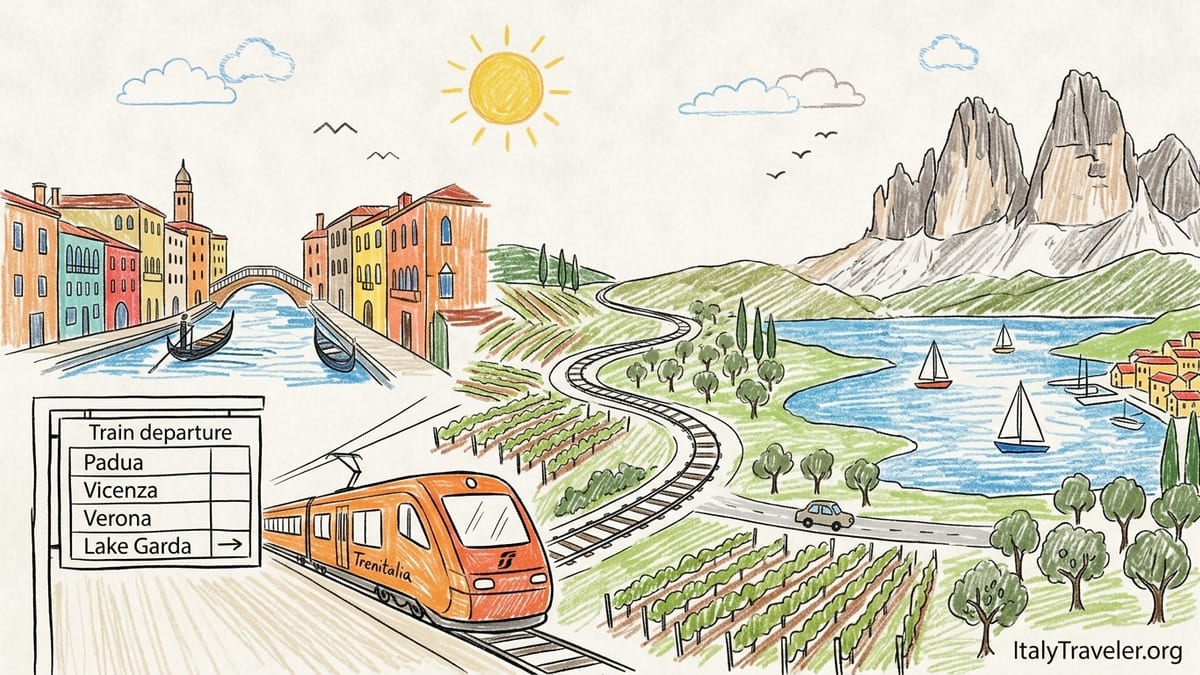
From the hotel, it took less than ten minutes on foot to reach Santa Lucia, which became my anchor for the entire trip. Regional trains fan out from here across Veneto, and high-speed Frecciarossa services also run the Milan–Venice corridor through Padua, Vicenza and Verona. On my first morning, I watched the departure board flip through places I had long dismissed as side notes: Verona Porta Nuova, Vicenza, Treviso, Conegliano. Seeing them all lined up as endpoints rather than “day trip” labels was the first clue that I had underestimated distances, logistics and how different each stop would feel.
Venice itself felt more controlled than on my earlier visit. Crowd management barriers around St Mark’s, tighter rules on sitting and picnicking and the prospect of higher access fees on future peak days all pushed me to treat Venice not as the whole story but as the gateway to a wider region under pressure from tourism. The city was still magical in the early morning, when delivery boats zigzagged through silvery light and the alleys smelled of coffee instead of sunscreen. But this time I treated it as a starting point, not the main event.
What surprised me most at this stage was how quickly the urban lagoon identity disappears once you look at the departure board. In under an hour by regional train you can be standing among university buildings in Padua or Palladian palaces in Vicenza. Yet most people I met at breakfast were plotting nothing more ambitious than Murano, Burano and back. I had done that on my first trip. This time, I wanted to see what happened if I kept riding the trains until the station names stopped sounding like suburbs of Venice and started sounding like destinations in their own right.
Padua and Vicenza: Same Train Line, Completely Different Worlds
I began with a simple move: Venice to Padua on a Trenitalia regionale veloce. The ride officially takes around half an hour, sometimes a bit more if there are intermediate stops. I bought my ticket on the Trenitalia app the night before and validated it digitally, which avoided any fuss with machines at Santa Lucia. The train rattled across the lagoon causeway, past Mestre’s warehouses and apartment blocks, and soon the landscape flattened into a quilt of industrial estates, vegetable fields and distant bell towers. By the time we pulled into Padua, the salt tang of Venice had been replaced by the warm smell of coffee and diesel.
I chose to stay one night just off Padua’s Prato della Valle, a huge oval piazza lined with statues and crossed by stone bridges. It was an instant contrast with Venice. Cars circled the square, trams dinged past, and students sprawled on the grass with laptops. I walked to the Scrovegni Chapel on a timed ticket in the late afternoon and spent my evening eating bigoli pasta with duck ragù at a trattoria near the university. It felt like an ordinary Italian city with extraordinary art, not an open-air museum. In hindsight, Padua deserved at least two nights. I left without seeing the Botanical Garden or the full cycle of Giotto sites beyond Scrovegni, which turned out to be one of my main regrets of the trip.
The next morning I backtracked slightly on the same rail line to Vicenza. The regional trains that continue towards Verona stop here after roughly twenty minutes from Padua. As we approached Vicenza, the urban sprawl thinned and low hills rose up, flecked with villas. I rolled my suitcase fifteen minutes from the station to a guesthouse near Piazza dei Signori and felt again that I had misjudged scale. This was not a half-day add-on to Venice; it was a compact city whose rhythm slowed in the heat of the afternoon and revived in the evening when families filled the squares for aperitivo.
Walking around Vicenza, the Palladian architecture shifted my mental map of Veneto. I had always associated the region with water: canals, lagoons, lakes. Instead, here were creamy stone palaces and the basilica, all about proportion and perspective. A local wine bar served me a glass of Garganega from the nearby Berici Hills, and for the first time on the trip someone talked to me about Veneto as a wine region rather than simply “the region where Venice is.” If I went back, I would base myself here for a couple of nights and use Vicenza as a calmer hub to visit the Palladian villas in the surrounding countryside.
Verona and Lake Garda: From Rail Lines to Lakeshore Roads
From Vicenza to Verona Porta Nuova, I stayed on the same Milan–Venice rail corridor. The regional train took roughly 40 minutes, sliding through flat farmland punctuated by storage silos and small towns. At this point my mistake became one of sequence. I had booked only a single night in Verona because I wanted to push quickly to Lake Garda, thinking the city would be crowded and overwhelming. It was busy around the Arena, but by staying ten minutes’ walk away on a side street I found a pocket of quiet that made me wish I had allowed an extra day.
Verona felt like a place where Venetians might come for a change of scenery. The river Adige wrapped around the historic center like a moat, and in the early evening locals filled the bridges and riverfront paths. I climbed up to Castel San Pietro for a view across the tiled roofs and realized that this was the first truly inland panorama of the trip. No lagoon, no hints of the sea, just terra-cotta, cypresses and distant hills. Dinner was a plate of risotto all’Amarone and a glass of Valpolicella in a small osteria behind Piazza delle Erbe. Prices in the historic center were higher than in Vicenza or Padua but still felt reasonable compared with Venice’s San Marco area.
The next morning I picked up a rental car from a desk across from Verona Porta Nuova. This turned out to be the pivot point of the whole journey. Trains serve the southern shore of Lake Garda well, especially Desenzano and Peschiera, but I wanted the eastern shore villages around Garda, Torri del Benaco and Malcesine, and eventually an easy line north towards the Dolomites. Having a car opened that up. It also introduced the headache of parking, ZTL restricted zones and the nagging worry that came with every narrow village lane.
Driving from Verona to Garda town on the SR249 took under an hour outside of rush hour. The plains quickly gave way to low hills striped with vineyards and olive groves. As I curved around the southern section of the lake, the water appeared in sudden flashes between campsites and hotels. Garda’s waterfront was crowded by late morning, and the public parking lots near the center were already close to full. I found a pay-and-display lot a ten-minute walk away, fed the machine for a few hours and promised myself I would arrive earlier if I ever came back in summer. This became the pattern on Lake Garda: arrive before 10 a.m., park on the edge of town and walk.
Lake Garda felt like another region entirely. Sailboats leaned into the wind off the shore of Malcesine, ferries crisscrossed the water and German was almost as common as Italian on the promenade. I stayed in a small guesthouse uphill from the lake with a view across red rooftops to the water. Prices here, at the height of swimming season, were noticeably higher per night than my stays in Padua or Vicenza, closer to what I had paid in Venice but with more space and a balcony. Watching the sun slide behind the mountains, I found it hard to connect this alpine lake ambiance with the crowded calli of Venice where the trip had started only days before.
The Prosecco Hills and Treviso: Where Veneto Turns to Vines
If Lake Garda showed me Veneto’s lakeside resort personality, the hills between Conegliano and Valdobbiadene finally convinced me that thinking of the region as mere greater Venice is a category error. I left Lake Garda early, drove back past Verona, then cut across the plain towards Treviso. This was my worst bit of backtracking and the one thing I would redesign. I had underestimated how tiring it would be to retrace long sections of autostrada just to reposition myself for the Prosecco Hills. A smarter route would have been Venice to Treviso and the Prosecco area first, then Vicenza and Verona, then Lake Garda, to avoid zigzagging.
In Treviso I dropped the car at a central garage and checked into a modest hotel inside the city walls. The town gets far fewer international visitors than Venice but shares the same water-threaded charm. Canals run between pastel houses, and in the evening people stroll under arcades with gelato. It felt like a gentler prelude to Venice or a decompression stop after it. I used Treviso as a base to explore the Prosecco Hills to the north, keeping the car only for those days instead of dragging it to every city stop.
Driving up from Treviso, the landscape changed almost abruptly. Flat fields gave way to steep, patchwork hills laced with vineyards and tiny roads that switchbacked through villages like Valdobbiadene, Follina and Rolle. Signs pointed to cantine offering tastings of Prosecco Superiore. I booked ahead at a mid-sized family-run winery so that someone would be available, which is important in this area, especially on weekends and during harvest. Sitting on a terrace looking across perfectly combed rows of vines, sipping a pale glass of extra-dry Prosecco, I could not have felt farther from Venice, even though in actual kilometers I was not very far at all.
The Prosecco Hills area is well set up for slow tourism, with cycling routes and hiking paths between villages. I had planned just a day with the car there, but it deserved two or three. Instead, I found myself watching the time, conscious of returning the car to Treviso before dark to avoid navigating unfamiliar hairpin roads in the evening. That rush was my own fault. I had mentally filed the Prosecco Hills under “quick wine country detour” and not as a standalone landscape with its own rhythm and distances.
Cortina d’Ampezzo and the Dolomites: Into High Country
The most dramatic shift of the entire trip came when I pointed the rental car north towards Cortina d’Ampezzo. From Treviso I joined the A27 motorway, a key route that runs from the Venetian plain towards Belluno before linking with alpine roads into the Dolomites. Within an hour the flatlands were gone, replaced by forested slopes and glimpses of rocky summits. Service areas here offered local cheeses and cured meats alongside the standard espresso bar, a small hint that I was entering a mountain culture.
Cortina itself sits in a wide bowl of peaks, famous as a ski town and preparing for the Milan–Cortina 2026 Winter Games. Arriving in shoulder season, I was spared the full force of winter crowds and summer hikers, but the construction sites and upgraded lifts made it clear that the area is bracing for a new surge of visitors. I parked at a paid lot near the center, where hourly rates felt high compared with smaller towns but were still manageable for a day’s exploration. Parking in Cortina is essential to plan in advance, especially if you are staying outside the core and driving in for cable cars or trailheads.
I had booked a guesthouse on the edge of town, about fifteen minutes’ walk from Corso Italia, the main pedestrian street. In the evening, the scene was all alpine chic: wooden balconies, flower boxes, people in hiking gear or stylish jackets promenading past pastry shops. Dinner was polenta with wild mushrooms and a glass of local red wine, hearty and miles away from seafood risotto in Venice or spritz-fueled cicchetti in Treviso. The night air was cold enough that I needed a jacket, a stark contrast to the sultry evenings on Lake Garda just a few days earlier.
The next day I drove up towards one of the high passes, switchbacking through forests that opened suddenly onto sheer cliffs and scree slopes. Every bend offered a new perspective that underscored how enormous Veneto really is. From lagoon to Dolomites in a single region sounds simple on paper. In reality the transition involves hours of driving, serious changes in climate and a complete flip in the style of accommodation and activities. Hiking maps replaced vaporetto timetables, and I found myself checking weather forecasts for mountain storms rather than wondering which Venetian church might flood at high tide.
Abano Terme and the Euganean Hills: Slowing Down in Thermal Country
After Cortina, I dropped down again towards the plain, returning the car further south and taking a train connection that delivered me eventually to Terme Euganee, the rail stop for Abano Terme and Montegrotto. The last stage from the station to my spa hotel was a short taxi ride, but it felt like stepping into yet another micro-region. Gone were the jagged peaks. In their place rose soft, rounded volcanic hills covered in vineyards and woods, with clusters of large hotels built around thermal springs that have drawn visitors for centuries.
Abano Terme is not as photogenic as Verona or Treviso, but it offers something entirely different: structured relaxation. Most hotels include access to thermal pools and mud treatments, and many guests seem to stay for a week or more. I booked only one night and immediately regretted it. After long days juggling train schedules and mountain roads, floating in outdoor pools of warm, mineral-rich water under a pale evening sky was the reset I had not realized I needed. Here, Veneto presented itself not as a cultural powerhouse or alpine playground but as a wellness destination in its own right.
Walking through the town center, I noticed more Italian and Central European guests than long-haul tourists, and prices in cafes were gentler than on Lake Garda or in Venice. A simple dinner of grilled vegetables, local cheese and a glass of Colli Euganei white wine felt like the perfect bookend to a week in motion. If I could redo the trip, I would slide Abano Terme to the middle rather than the end, using it as a pause between city-hopping and the more demanding days in the Dolomites.
This area also drives home how compact yet varied Veneto is. The Euganean Hills sit not far from Padua, which means you can combine university cloisters and Giotto frescoes with spa afternoons and short vineyard walks in a single stay. That layered possibility is what I had entirely missed when I first thought of Veneto only in terms of Venice and a few postcard day trips.
What I Would Do Differently Next Time
By the end of the journey I had crossed the region in what felt like every possible direction, often more than once. Looking back, the itinerary worked, but not efficiently. My biggest mistake was assuming that distances between Veneto’s highlights are trivial just because they appear close on a map. Backtracking from Lake Garda to Treviso and then north again to Cortina added hours on the road that could have been spent walking vineyard paths or lingering in Verona’s backstreets.
If I were planning the trip now, I would map it as a rough arc rather than a starburst from Venice. One possible route would be: Venice to Padua and the Euganean Hills, then Vicenza, on to Verona and Lake Garda, and finally up to the Dolomites, before dropping down towards Treviso and the Prosecco Hills if time allowed. Alternatively, for a shorter journey, I might choose between “western Veneto” (Verona, Lake Garda, Vicenza) and “eastern and northern Veneto” (Venice, Treviso, Prosecco, Cortina) instead of trying to do everything in one go.
I would also build in more two-night stops. One night in Verona was not enough to feel the city breathe once the day-trippers retreated. A single night in Abano Terme barely allowed for a full afternoon and morning in the pools. Even the Prosecco Hills, which I had penciled in as an in-and-out tasting excursion, could easily absorb several days if you enjoy food, wine and gentle walking. Veneto rewards travelers who slow down and accept that they will not see everything.
Finally, I would treat Venice differently. Instead of spending my first two nights there and then leaving, I would consider staying the first night near Mestre or Treviso to handle early trains without navigating the lagoon with luggage, then returning to Venice at the end when I am tired and content to wander aimlessly. With the evolving access fee rules for day visitors and the pressure of crowds, basing yourself in the lagoon once you are already in “travel mode” might feel more relaxed than trying to figure it all out straight off an international flight.
The Takeaway
Traveling across Veneto taught me that regional labels can be deceptive. Before this trip, the word “Veneto” barely appeared in my planning notes. Everything was “Venice plus side trips.” After a week of trains, rental cars, access rules, parking tickets avoided by luck and missed chances in cities that deserved longer, I left with a very different sense of place. Venice is both the jewel and the problem child, crowded enough to require entry fees on peak days and famous enough to eclipse everything around it. But the rest of the region is not a supporting act. It is a constellation of landscapes and cultures that only makes sense once you physically move through it.
From the lagoon’s shifting light to the plains stitched with rail lines, from the vineyards of the Prosecco Hills and the olive groves above Lake Garda to the sharp skyline of the Dolomites and the steaming pools of Abano Terme, Veneto feels less like a backdrop and more like a series of distinct stages. Planning purely around Venice risks missing that richness. The real surprise for me was not that the region is varied. It was how dramatically it changes in such short distances and how each change demands its own pace.
If you travel here, resist the urge to see Veneto as a checklist of excursions from Venice. Give Verona and Padua the dignity of overnight stays. Let Treviso and the Prosecco Hills slow you down. Save space in your schedule for a day to float in thermal water or a morning to sit with a coffee under an arcade in Vicenza, watching local life unfold. Venice might bring you to Veneto, but it does not have to define what you do once you arrive.
I left with a folder full of unused ideas: trails I had not hiked in the Dolomites, villas I had not visited near Vicenza, wineries in the Prosecco Hills I had marked on a map but never reached. That might be the best measure of a good trip. Veneto is no longer “the region where Venice is.” It is the place I now picture when I think about returning to Italy, not to repeat what I have already seen, but to pick up the threads I had to leave hanging the first time around.
FAQ
Q1. Do I need to pay an access fee to visit Venice?
On certain peak days, day-trippers entering the historic center must pay an access fee and register in advance, while overnight guests are exempt but still recorded through their accommodation.
Q2. Is it better to explore Veneto by train or by rental car?
Trains work very well between major cities like Venice, Padua, Vicenza and Verona, while a rental car is more practical for Lake Garda, the Prosecco Hills and the Dolomites.
Q3. How many days should I spend in Verona?
I found that one night was too short and would suggest at least two nights so you can enjoy the evenings after day-trippers leave and still have time for the riverfront and viewpoints.
Q4. Can I visit the Prosecco Hills as a day trip from Venice?
It is possible by car or with organized tours, but after driving up from Treviso I felt the area deserved at least one or two full days rather than a rushed tasting stop.
Q5. Do I need to book winery visits in the Prosecco area in advance?
Yes, especially for smaller family-run estates or visits on weekends, booking ahead helps ensure someone is available to host you and avoids wasted drives between closed cellars.
Q6. Is parking difficult around Lake Garda and Cortina d’Ampezzo?
In busy seasons, central lots in lakeside towns and in Cortina fill quickly, so arriving before mid-morning and being prepared to park slightly outside the center makes a big difference.
Q7. Are Padua and Vicenza worth overnight stays or just day trips from Venice?
After staying overnight in both, I would strongly recommend at least one night in each so you can experience their evening atmospheres and see more than a single headline attraction.
Q8. When is a good time to visit the Dolomites from Veneto?
Summer and early autumn work well for hiking, while winter is ideal for skiing, but shoulder seasons offer quieter towns and still impressive mountain views, as I experienced around Cortina.
Q9. What surprised you most about traveling beyond Venice in Veneto?
The biggest surprise was how quickly the landscape and culture changed from lagoon to plains, vineyards, lake and high mountains, making the region feel like several trips in one.
Q10. If I have limited time, which areas beyond Venice should I prioritize?
With a short schedule I would pair Venice with either Verona and Lake Garda or with Padua, Vicenza and the Prosecco Hills, rather than trying to stretch all the way to Cortina on the same trip.