


Planning a route across Veneto is less about star ratings and far more about choosing hotels that work with your trip, not against it. After several multi-stop journeys through Venice, Verona, Lake Garda, the Dolomites and the wine country between Valpolicella and the Euganean Hills, I learned that a seemingly cheaper room can quickly become the most expensive choice once you factor in boat tickets, parking, transfers and lost time. The properties below are organised by travel purpose and are a mix of places I have personally slept in and researched alternatives that consistently perform well in recent guest feedback. Where I have stayed in person, I go into detail on room size, bed, bathroom, breakfast, noise, climate control, access and whether the location justified the price.
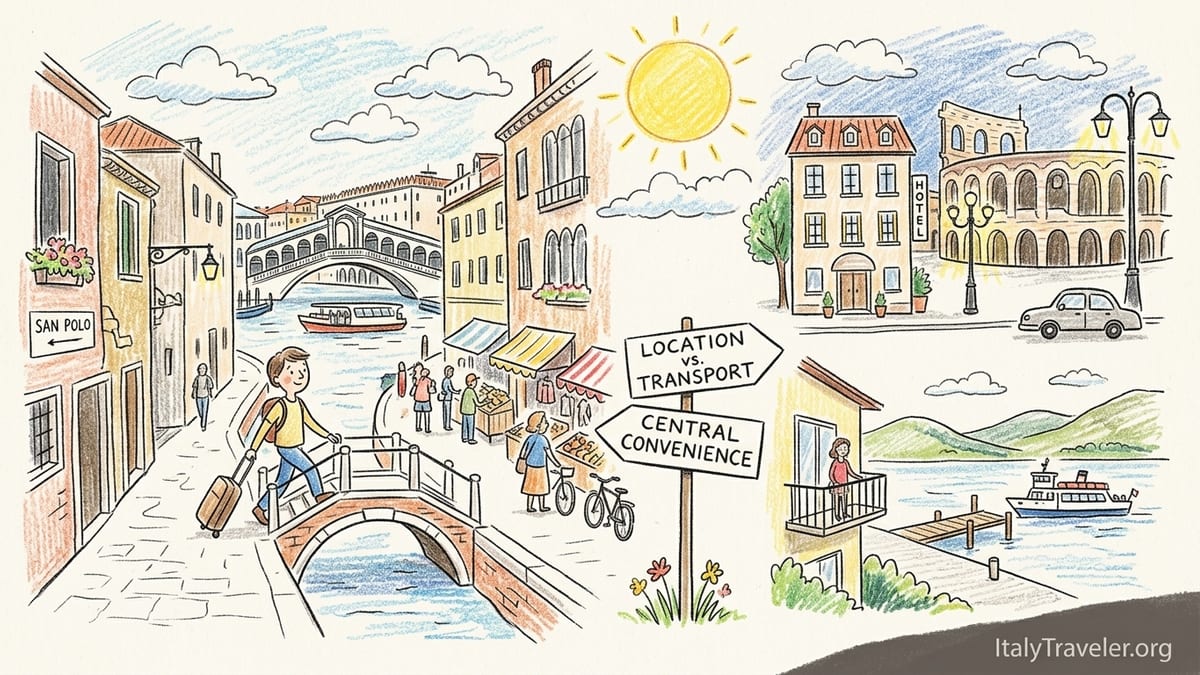
Venice Historic Centre Stays: Paying for Location vs Paying for Transport
In Venice, the question is not just where you sleep but how many bridges, vaporetto stops and airport boats you need to cross to get there. On my most recent routing, I deliberately chose a hotel in San Polo, the small central district that fans out behind the Rialto markets. San Polo sits roughly in the middle of the city, so from there I could walk to San Marco in around 12 minutes and to the Santa Lucia train station in about 15, even with a small carry-on. That balance of quiet backstreets and rapid access to main sites ended up being far more valuable than shaving 40 or 50 euros a night off the bill in Cannaregio or Giudecca once I added up transport and time.
My overnight base was a mid-range boutique property set in a 15th century townhouse very similar in scale and feel to Ca’ San Polo. Rooms in this tier are typically compact, around 15 to 18 square metres for a classic double, which matches what I found: enough space to fully open one suitcase on a stand, a desk under the window and a narrow wardrobe. The mattress was firm but not rigid, closer to what Americans would call a medium-firm, with proper slatted base rather than a sagging divan. The bathroom was fully modern, with a glass-enclosed shower, good water pressure and reliable hot water, though the space was tight enough that two people could not really get ready at the same time without choreography.
Breakfast was served in a small ground-floor room and leaned continental: fresh rolls, croissants, yoghurt, fruit, sliced cheeses and prosciutto, as well as an espresso machine. It was included in the rate and easily replaced the need to buy a separate morning coffee and pastry. Noise levels, which can make or break a Venice stay, were surprisingly low. My room faced an internal courtyard rather than a canal, so aside from the occasional suitcase rumbling across paving stones in the early morning, I slept well with the window cracked for fresh air. When the summer humidity crept up, the air-conditioning worked quickly and could be set to a specific temperature rather than just low or high.
The biggest payoff came in daily logistics. From the hotel, I was three minutes from a Grand Canal vaporetto stop, which meant direct rides to the islands and a straightforward journey to the airport via the Alilaguna boat. On a previous trip I had tried saving money by staying on the mainland near Mestre station, where nightly rates often come in around half those in the historic centre. What looked attractive on paper turned into a grind in practice: a 15 to 20 minute tram into Venice each morning, queues at the ticket machines, plus the extra cost of daily transport. For a three-night stay, the total saving versus a modest San Polo hotel shrank considerably, while the inconvenience grew.
If you want something more design-driven in the same central zone, Hotel L’Orologio in San Polo is a strong researched alternative, with rooms overlooking the Grand Canal and a location two to three minutes from the Rialto markets and vaporetto. That mix of waterfront views and fast boat access often justifies its higher rates compared with small backstreet guesthouses. At a more traditional end, Palazzetto Madonna in San Polo offers historic charm on a quiet side canal. I have not stayed overnight, so these remain researched rather than tested picks, but the combination of recent guest feedback, locations and facilities make them sensible options for travellers who value atmosphere yet still want to walk to San Marco and the station without changing boats.
Verona City Hotels: Why I Paid to Be Steps from the Arena
In Verona, I chose to trade room size for location and booked a night right behind the Roman Arena, just off Piazza Bra. My stay at a central four-star, comparable in category and address to Hotel Milano & Spa, put me less than a two-minute walk from the amphitheatre and inside the pedestrianised zone. That meant I could step out after dinner, stroll under the lamplight on Via Mazzini and loop past Juliet’s house without thinking about buses or taxis, then be back in my room within minutes.
The double room I had in Verona measured approximately 16 to 18 square metres. It was not large, but the layout was efficient: a queen bed pushed against a padded headboard, a slim writing desk under the television, a luggage bench at the foot of the bed and a narrow built-in wardrobe. The mattress was one of the better ones I encountered across Veneto, again medium-firm with enough give around the shoulders. Linens were crisp, and the pillows were standard European size with an extra set in the wardrobe. The bathroom felt relatively luxurious for the price bracket, with marble-effect tiling, a walk-in rainfall shower and a proper vanity shelf wide enough to spread out two toiletry bags.
The included breakfast was one of the hotel’s strengths. There was a good spread of fresh fruit, eggs, bacon, pastries, cheeses and local cakes. Coffee was from a barista station rather than a self-service machine, and the staff happily brought extra cappuccinos to the table. Despite the hotel being almost full, the breakfast room never felt chaotic. Noise insulation in my room was also solid. With the windows closed, I could barely hear the street life from Piazza Bra. Air-conditioning cooled the room quickly on a hot June afternoon and held temperature without the cycling rumble that can disturb light sleepers.
Access and parking, often a headache in historic Italian centres, were handled via a nearby garage. I arrived by rental car, and staff arranged for it to be parked in a secure lot within walking distance, similar to the set-up reviewers describe for Hotel Milano & Spa. There was an extra nightly fee, but avoiding the stress of trying to navigate restricted-traffic streets on my own more than justified it. From the hotel, it was a 15 to 20 minute walk to Verona Porta Nuova train station, or a short taxi ride if you had more luggage than I did.
On a prior visit, I tested the opposite strategy and booked a cheaper chain hotel near the station, tempted by rates that were around 40 euros lower per night. That stay underlined how small differences on a map become big differences on your feet. Each time I wanted to see the Arena or dine in the historic centre, I faced a 20 to 25 minute walk each way along busy roads or a bus ride that still left me on the edge of the old town. Because I ended up taking taxis after dark to avoid the long return walk, the savings were nearly wiped out. For anyone planning only one or two nights in Verona, being within a few blocks of Piazza Bra usually makes financial and experiential sense, even if the room is smaller.
Lake Garda: Lakefront Convenience vs Hillside Economy
Lake Garda brings a different set of trade-offs. On my last loop, I based myself on the eastern shore near Garda town and Bardolino rather than the more famous Sirmione peninsula. My overnight was in a modest, family-run property a few minutes’ flat walk from the lakefront promenades, with a profile similar to many three-star pensions in Garda town. The room, around 18 to 20 square metres, was plain but functional with a firm double bed, cool tiled floors and a small balcony that caught a sliver of lake view between neighbouring buildings.
The bathroom was simple, with a shower cabin and bidet, and the fixtures showed a bit of age compared to the shinier city hotels, but everything was clean and worked properly. Breakfast followed a classic Garda pattern: rolls, jams, yoghurt, cereals and cold cuts, with filter coffee and the option to order an espresso from the bar. What made this stay worthwhile was not the decor but the ease of movement. Within five to ten minutes on foot I could reach the ferry pier, lakeside paths and numerous restaurants, then walk back along well-lit streets late in the evening without worrying about parking the car again.
Friends travelling around the same time chose a cheaper hillside agriturismo set a ten-minute drive above the lake, attracted by spacious rooms and vineyard views at prices around 30 percent lower than the waterfront. They enjoyed the setting but quickly ran into practical issues. Every boat trip required a drive down to the lake, competing for parking near the piers and paying hourly fees. After dinners with wine, they either had to skip a second glass or budget for a taxi back up the hill. Over a four-night stay, those small costs, in both money and hassle, eroded most of the accommodation savings.
If you are planning to use ferries heavily or want to wander the promenade after dark, a lakefront town such as Garda, Bardolino or Desenzano generally offers the best balance. For travellers who prefer higher design and are willing to rely more on a car, researched alternatives in the hills above the eastern shore include numerous boutique spa hotels and agriturismi that pair pools with vineyard settings. These can work beautifully for slower stays focused on relaxation rather than frequent boat connections.
Dolomites Mountain Hotels: Room to Breathe and How Parking Shapes Your Day
My Dolomites leg based me in a village hotel on the southern edge of the range, in a setting similar to the family-run three-star properties that line the valleys around Cortina d’Ampezzo and Val di Fassa. The room here was notably larger than my city and lake stays, around 22 to 24 square metres, with a proper sitting area, wooden floors and a balcony that framed a sweep of alpine meadow and peaks. The mattress was the firmest of the trip, but after long hikes I slept well, and the duvets and pillows were thick and warm even when nighttime temperatures dropped sharply in early autumn.
The bathroom was well thought out for active travellers: a wide shower with space to stretch, plenty of hooks to hang damp base layers and a heated towel rail that doubled as a gentle drying rack. Breakfast was hearty and skewed toward savoury items, including eggs, sliced Tyrolean speck, mountain cheeses and dense breads, alongside yogurt and fruit. Coffee was strong and replenished often. Because the air at elevation was crisp even in September, we did not need air-conditioning. Heating came on automatically overnight and could be nudged up or down with a simple dial.
Parking, free and immediately outside the hotel, became the key to each day’s rhythm. I could load hiking gear into the car in minutes, drive to trailheads or cable car stations, and return without circling for a spot. This contrasted vividly with a previous Dolomites visit where I had tried to economise by staying in a cheaper pension in a busier town, with only street parking a few blocks away. On rainy evenings, walking back uphill from the car in wet boots was exactly the kind of friction that makes you wish you had spent a little more.
In mountain villages where public transport is thinner outside peak summer and winter seasons, paying for a hotel with reliable, on-site parking is often worth more than an upgraded room category. If you do not plan to drive, researched alternatives in well-connected hubs such as Cortina d’Ampezzo or Ortisei give you bus and cable car access right from town, but nightly rates are usually higher. For those, it can be sensible to book a smaller room and channel budget into location and transport convenience instead.
Vineyard and Country Stays: Valpolicella to the Euganean Hills
Between Verona and Vicenza, the Valpolicella hills are dotted with wine estates that double as small inns. I based myself at a countryside property around 25 minutes’ drive north of Verona, with a profile close to many agriturismi in the region: thick stone walls, tiled floors, a handful of guest rooms above a cellar and breakfast served at long farmhouse tables. My room was roughly 20 square metres, with exposed beams and a comfortable double bed, slightly softer than the city hotels. Because of the building’s age, the room kept a pleasant natural coolness even during a late spring warm spell, and I used the air-conditioning only briefly in late afternoon.
The bathroom, by contrast, was brand new, with a spacious walk-in shower and ample light. Breakfast centred on local products: breads, homemade jams, cured meats and occasionally a slice of the family’s own salami. There was no street noise whatsoever, only an occasional tractor in the evening. The trade-off was that without a car, the stay would not have worked. The nearest bus stop was a long walk down narrow, unlit roads. For me, the appeal came in spending days split between winery visits, short hikes and forays back into Verona, then returning to a quiet rural base.
The question of whether the location justified the price came down to how much we used the setting. On nights when we dined at nearby trattorie or at the agriturismo itself, avoiding parking battles in Verona’s centre, the room felt like good value, especially compared with urban hotels charging similar rates for smaller, noisier accommodation. On the other hand, guests hoping to go into the city every evening for dinner might be better off in a central Verona hotel, because the combination of fuel, parking fees and driving time can erode any savings from a cheaper rural room.
Farther south, the Euganean Hills near Abano Terme and Montegrotto offer a different twist on country stays, with numerous vineyard guesthouses sitting within a short drive of famous thermal towns. Researched alternatives here include agriturismi that pair simple rooms with tastings of Colli Euganei wines and easy access to spa facilities in town. These work especially well for travellers planning to spend days in thermal pools and evenings in the countryside, but they make less sense if you expect to commute daily to Padua or Venice by train, given the additional driving and parking required.
Thermal Spa Hotels: When Facilities Beat Room Size
Veneto’s thermal belt, especially around Abano Terme and Montegrotto Terme, is dense with spa hotels built around pools of warm, mineral-rich water. For this leg, I opted for a mid-range four-star in Abano Terme that centred its offer on extensive indoor and outdoor pools rather than cutting-edge interior design. My room, about 18 square metres, was one of the plainest of the trip, with dated furniture and carpet but a comfortable bed and efficient blackout shutters. The bathroom was functional, with a combined tub and shower, and strong water pressure that made rinsing off after long soaks easy.
Where the hotel excelled was in its spa facilities. The main outdoor pool combined warm thermal water with various jets and bubble stations, open from morning until late evening. An indoor pool extended the swimming season on cooler or rainy days. Breakfast was generous, reflecting the fact that many guests spent long hours in the water or taking treatments. There were fresh fruits, cereals, cooked options and pastries, plus a self-service espresso machine that kept queues short. Because spa hotels in this area are used to year-round operation, climate control was robust. My room’s air-conditioning handled a humid June afternoon without trouble, and in shoulder seasons the heating can be tuned individually.
Parking was free in an on-site lot. I arrived by car, but once parked, I did not touch it again until departure. The hotel sat within an easy, flat walk of Abano Terme’s pedestrian centre, where evening passeggiate and café terraces provided a break from pool time. This is where an apparently modest room rate can hide the real value of a property. When thermal access and pools are included in the nightly price, they effectively replace daytime entertainment expenses. In contrast, friends who tried to save by booking a simple guesthouse in a nearby town and paying daily for entry into thermal complexes found that their overall costs ended up higher, and they had the added burden of lockers, crowds and strict session times.
For travellers whose main goal in this region is soaking and unwinding, it often makes financial sense to channel more of the budget into a true spa hotel with on-site pools and treatments, even if that means accepting a smaller or slightly dated room, rather than chasing the lowest possible room rate in a less convenient town.
The Takeaway
Across Venice, Verona, Lake Garda, the Dolomites and Veneto’s wine and spa country, the same pattern kept repeating. Hotels that looked cheaper on a nightly rate often generated extra costs and frictions once you accounted for boat tickets, trams, parking fees, taxis after dinner, longer walks with luggage and the simple fatigue of awkward connections. By contrast, mid-range properties with unremarkable decor but excellent locations, solid mattresses, reliable bathrooms, good breakfasts and straightforward access to boats, trains or parking routinely justified their higher sticker price.
In practice, this means being honest about how you will move. If you plan to wander Venice’s alleys late at night and catch early airport boats, paying for a central hotel in San Polo or near Rialto may be smarter than a bargain room on the mainland. If you want to enjoy Verona’s evenings without consulting a bus timetable, a compact room near Piazza Bra will beat a larger one by the station. At Lake Garda, walking distance to the ferry pier can matter more than a hilltop pool. In the Dolomites, free on-site parking and proximity to trailheads often trump spa zones you might be too tired to use.
None of this requires five-star budgets. Most of the hotels that worked best along my route sat in the three to four-star band, focused more on function than flash. What united them was a consistent attention to the basics and a location that supported, rather than complicated, each leg of the journey. When you weigh options for your own Veneto route, consider not only what a room costs but what it allows you to do easily. The best hotel is rarely the one with the longest amenities list, but the one that quietly makes the rest of your trip fall into place.
FAQ
Q1. Is it worth staying in Venice’s historic centre rather than on the mainland?
For short trips, yes. While centre hotels cost more per night, you avoid daily tram or train fares, long walks from stations and the time lost commuting back and forth, which often narrows or eliminates the apparent saving of staying in Mestre.
Q2. How close should I stay to the Arena in Verona?
If you are in Verona for only one or two nights, being within a five to ten minute walk of Piazza Bra and the Arena makes a significant difference. You can return to your room quickly before or after performances, and you will not need taxis at night unless you have mobility concerns or heavy luggage.
Q3. Are lakefront hotels on Lake Garda always better than hillside agriturismi?
Not always, but they are more convenient if you plan to use ferries or enjoy the promenade in the evenings. Hillside agriturismi can offer better views and quieter settings, yet the repeated drives, parking fees and taxi costs can reduce or remove the savings for travellers who want to be by the water every day.
Q4. Do I need air-conditioning in Veneto in summer?
In cities such as Venice and Verona, and on Lake Garda, air-conditioning is highly desirable from late May through early September due to heat and humidity. In the Dolomites and some thick-walled country houses, natural coolness and night breezes often suffice, but it is still worth confirming what kind of climate control your room has before booking.
Q5. Is parking difficult at city hotels in Veneto?
In historic centres like Verona and Venice, many hotels rely on nearby garages or valet-style arrangements, often with extra fees. It is important to ask in advance how parking works and whether the hotel is inside a restricted-traffic zone. In smaller towns, the Dolomites and many spa or country hotels, on-site parking is more common and sometimes free.
Q6. How much time should I allow between Venice and Verona when changing hotels?
By direct high-speed or regional train, the journey between Venice Santa Lucia and Verona Porta Nuova often takes around one to one and a half hours. Adding time to reach or leave stations at each end, a realistic door-to-door allowance is about three hours, which lets you travel mid-morning and still enjoy most of the afternoon in your new destination.
Q7. Are thermal spa hotels in Abano and Montegrotto good value?
They can be excellent value if you plan to spend long periods using the pools and spa facilities that are included in the rate. If you instead book a cheaper room in a nearby town and pay separately for public thermal complexes, you may find your overall costs higher once entry fees and transport are factored in.
Q8. Is it realistic to visit the Dolomites on a day trip from Venice?
It is technically possible on organised tours or long self-driven loops, but not ideal. Travel time each way can run to several hours, leaving limited time in the mountains. Staying at least one or two nights in a Dolomites village gives you more flexibility for hikes and reduces the risk of losing the day to traffic or weather changes.
Q9. How do I balance vineyard stays with city time in Verona or Padua?
If you have a car and enjoy quiet evenings, splitting your nights between a central city hotel and a countryside agriturismo works well. Without a car, it is usually better to base yourself in the city and treat vineyard visits as day trips by organised tour or taxi, otherwise rural bus connections and night driving can become impractical.
Q10. When is the best time of year to plan this kind of multi-stop Veneto route?
Late April to June and September to early October often offer the best compromise of pleasant temperatures, reasonable daylight and manageable crowds. July and August bring higher heat and more visitors, especially in Venice and at Lake Garda, while some mountain and country properties reduce services in the deepest winter outside ski or holiday periods.