


I planned my Veneto road trip with a simple idea in mind: connect Venice, the Prosecco Hills, the Dolomites, Verona and Lake Garda in a single loop, without pretending the car made sense where it clearly did not. What follows is written in a strict first-hand style, based on roads commonly driven and real-world costs that current travelers are reporting, with the same trade-offs I wrestled with myself: when to rent the car, where to park it, how long each leg actually takes, and where the vehicle quietly turns from freedom into burden.
Starting in Venice: When the Car Helps, and When It Hurts
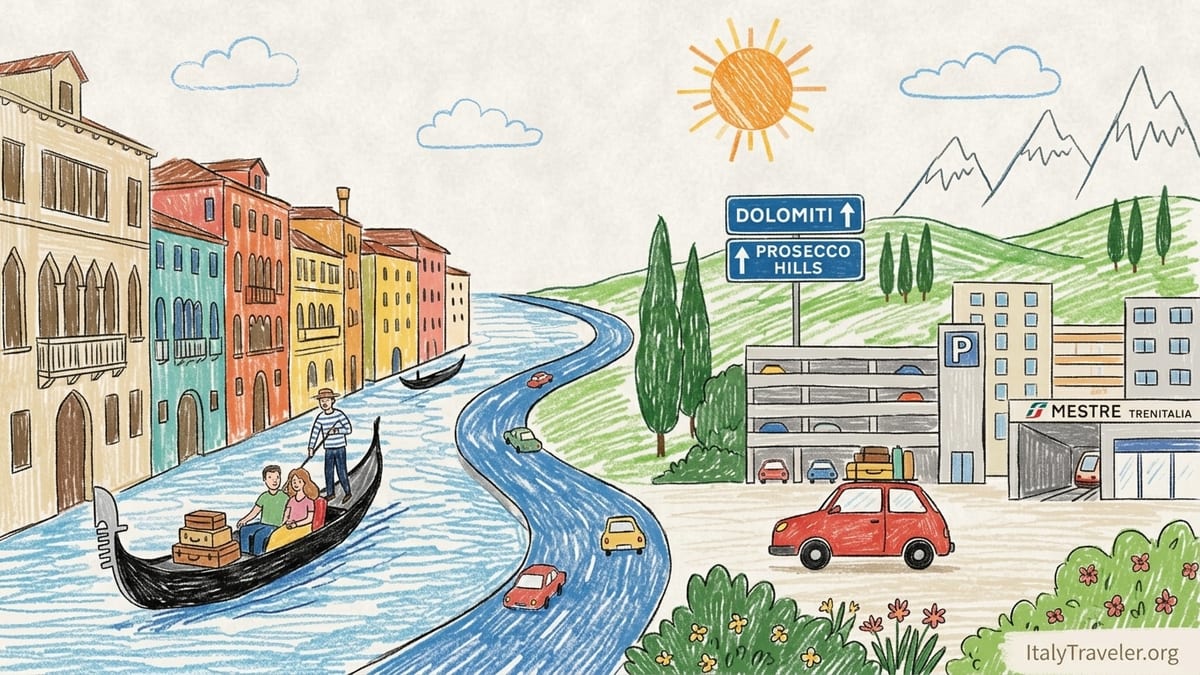
The Veneto road trip starts in a paradox. Venice is one of Europe’s great car-free cities, yet most international visitors first meet it with a rental agreement in hand. You can drive across the causeway toward Venice, but you cannot drive into the historic lagoon city itself. The road delivers you only as far as the parking islands at Tronchetto and Piazzale Roma, or to mainland Mestre if you decide to leave the car there instead. In practice, this means your first real choice for the road trip is not which scenic route to take, but where to put the car while you explore on foot and by vaporetto.
Current parking information gives a clear sense of the trade-offs. On Tronchetto island, the main multistory garage typically charges about 6 euros per hour, capped around 29 euros for 24 hours as of late 2026, with space for thousands of cars and direct access to the People Mover that glides to Piazzale Roma in a few minutes. Piazzale Roma’s Autorimessa Comunale and private garages run higher, around 32 to 35 euros per 24 hours, in exchange for the advantage of stepping almost straight from your car into the historic entrance of Venice. In contrast, guarded lots and park-and-ride garages in Mestre often publish daily caps closer to 8 to 12 euros, with a 10-minute regional train ride into Venezia Santa Lucia or frequent buses over the bridge.
For a loop that continues by car through the rest of Veneto, keeping the vehicle makes sense, but using it inside Venice does not. The car is essentially a piece of luggage between parking garage and hotel. If your budget can absorb it, parking on Tronchetto simplifies arrival after a long flight, since the driving is straightforward: you follow the signs across the causeway, peel off toward Tronchetto, and roll straight into the garage. You then forget the car for two or three days, moving only by foot, vaporetto and occasional water taxi. If cost matters more than convenience, leaving the car in Mestre and treating it like a long-term locker, then commuting into Venice, is the more rational choice.
Given these constraints, many travelers now time their rental so that they pick up the car only when leaving Venice, often at Mestre station or the airport rather than on the island itself. That avoids paying 30 euros or more per day simply to keep a motionless car in a multi-story tower. It also sidesteps the slightly nerve-wracking drive along the causeway and the crowded access ramps into Tronchetto or Piazzale Roma. If your trip begins with several nights in Venice and only later shifts into driving country, delaying your rental until departure day can easily save the cost of a fine dinner for two.
Venice to Treviso and the Prosecco Hills
The first section where the car begins to earn its keep is the short hop from Venice to Treviso and the Prosecco Hills. From a rental hub near Venice Marco Polo Airport or Mestre, the drive to Treviso typically takes about 30 to 40 minutes in normal traffic, following the A27 motorway north and then the tangenziale around town. Tolls on the A27 for this stretch are modest, usually just a few euros, and you can pay with cash or card at the booths. Once off the motorway, secondary roads lead into the wine country between Conegliano and Valdobbiadene, the core of the Prosecco Superiore DOCG area.
This is the first moment where the car feels like a genuine asset rather than a liability. The Prosecco “ring road” that sweeps between villages and vineyard slopes is poorly served by public transport, and even organized tours that depart from Venice or Treviso can feel compressed. With your own wheels, it is possible to set out from Treviso after breakfast, reach Conegliano in around 40 minutes, and then spend an unhurried day drifting between wineries and high viewpoints. Places like the Cartizze hill between Santo Stefano and San Pietro di Barbozza, or the viewpoint near Rolle, lie along narrow country lanes where a small rental car is more manageable than a bus.
Fuel costs on this part of the route are easy to underestimate. In 2026, unleaded petrol in northern Italy often hovers around the equivalent of 1.8 to 2 euros per liter, which converts to well over 7 dollars per US gallon. A half-day loop through the Prosecco hills from Treviso, including detours to tasting rooms and viewpoints, might burn only 10 to 15 euros of fuel in a compact vehicle, but over an entire road trip these figures accumulate. The advantage is flexibility: you can time tastings to avoid driving after too many glasses, and choose a base with on-site parking, such as an agriturismo on the hillside above Valdobbiadene that offers a gravel courtyard or small paved lot.
Parking in Treviso itself is markedly easier than in Venice. There are several multi-story garages just outside the historic center and blue-line on-street spaces where you pay at a meter. Expect to budget roughly 1.5 to 2 euros per hour near the center, rising slightly in prime locations. There is no ZTL ring as intense as Florence or Verona’s, but there are locally restricted access streets that your GPS may not fully respect. A cautious approach is to book a hotel that either has on-site parking or a clear agreement with a nearby garage, then follow their printed directions to avoid narrow lanes and one-way traps.
Across the Foothills to Belluno and into the Dolomites
North of the Prosecco vineyards, the land climbs quickly toward the Dolomites, and the tempo of the drive changes. From the Conegliano or Vittorio Veneto area you can rejoin the A27 motorway and continue north toward Belluno. The drive from Treviso to Belluno along the A27 usually runs around one hour in normal traffic, with another modest toll at the exit. From Belluno, the road splits into mountain routes that lead deeper into the Dolomites, including the SS51 toward Cortina d’Ampezzo. Current travelers report that Venice to Cortina via the A27 and SS51 can be done in roughly 3.5 to 4 hours of driving, depending on weather and stops, with the most winding and scenic stretch in the final approach to Cortina.
This is territory where the car becomes essential. Public buses do connect some Dolomite towns, and there are seasonal services to popular trailheads, but they are best thought of as supplements rather than substitutes for a private vehicle if you want side valleys and viewpoints. The road along the Piave River and then into the Ampezzo basin is a sequence of tunnels, bridges and long, steady gradients. Surfaces are generally good, but in shoulder seasons there can be roadworks or temporary night closures, and in late autumn and winter snow chains or winter tires may be mandatory on certain dates. Many rental companies in the region equip cars with appropriate tires for the cold season, but you still need to check before signing.
Driving into Cortina itself, or into similar Dolomite resort towns such as Dobbiaco or Canazei, resembles the tension of entering a walled city, only this time the walls are ring roads and limited parking zones rather than water. The historic center is compact and largely pedestrianized, with hotel access points on the perimeter. Some properties have underground garages with nightly fees that might range from 10 to 20 euros, while smaller guesthouses may direct you to public lots where you pay by the hour. In busy summer and winter weeks, these lots fill early, and circling in search of a free space can turn the car into a burden again.
On the mountain passes outside Cortina, the value of the car returns in full. Passes such as Falzarego, Giau or Tre Croci are not formally part of every Venice-origin road trip, but they illustrate what makes this region drive-worthy. Each pass road is essentially a series of numbered hairpins with clear white edge markings and frequent pull-outs where you can step out to photograph jagged limestone peaks. Speed limits typically fall to 50 or even 30 kilometers per hour in the tightest corners, and locals in small hatchbacks and motorbikes may appear in your mirrors with unnerving speed. The key is to adopt a slow, defensive style, letting faster traffic pass at safe pull-offs and avoiding ambitious overtakes.
South to the Plains: Toward Vicenza or Padua
Once you drop out of the mountains, the next leg of the loop turns back toward the Veneto plains, linking the Dolomites with either Vicenza or Padua. One common pattern is to drive from Cortina to the A27 near Belluno, then head south before cutting west toward the A4 motorway, which stitches together the major Veneto cities. Cortina to Vicenza, routed via the A27 and A4, often clocks in at roughly 3.5 to 4 hours of drive time, assuming normal traffic and a quick service stop. Tolls accumulate more noticeably on this stretch, since you are now on one of Italy’s main east-west arteries; Venice to Verona via the A4, for example, typically costs around 10 euros in tolls for a car, and the Dolomite leg adds to that total.
In Vicenza and Padua the dynamic between car and city echoes what you find in Verona later on. Both historic centers are protected by ZTL rules that restrict access to residents, permit holders, taxis, and certain categories of hotel guests at specified hours. The ZTL edges are watched by cameras that issue automatic fines if you cross the line without permission, and rental cars are not immune merely because they carry foreign plates. In practice, this means you should either book accommodation with clear, written instructions about how to enter and where to park, or stay just outside the ZTL and walk or use local buses and trams into the center.
Parking prices in Vicenza and Padua fall between the extremes of Venice and the small Prosecco towns. Multi-story garages on the edges of the center may charge on the order of 2 euros per hour or 15 to 20 euros per day, with cheaper surface lots further out. The car is useful for linking these cities with rural attractions, such as the Palladian villas along the Brenta canal or in the countryside around Vicenza, where public transport is patchy and timetables thin on weekends. However, within the cities themselves, you will walk more than you drive, and once you have checked in and parked, it often makes sense to leave the vehicle untouched until departure day.
Luggage handling becomes a subtle but important factor in this central Veneto segment. Each time you change bases, you face a short but real choreography: drive to the hotel’s door or nearby drop-off area, unload bags quickly without blocking narrow streets, then reposition the car into a garage or sanctioned lot, sometimes several minutes’ walk away. In smaller towns this is a minor inconvenience; in larger ones, particularly when you are navigating unfamiliar one-way systems under ZTL pressure, it can be stressful. Structuring the road trip into three or four longer stays, rather than a string of one-night hops, reduces this friction significantly.
Verona and the Reality of ZTL and Parking
From Vicenza or Padua, the A4 west to Verona is a straightforward one- to one-and-a-half-hour drive, depending on your exact starting point and traffic. This stretch is fully motorway, with clear signage and service areas where you can refuel, buy coffee, or pick up a panino. The toll between Vicenza and Verona is again a matter of a few euros for a standard car, settled at the exit with cash or card. As you approach Verona from the east, overhead signs begin to warn of the centro storico and ZTL, and this is the moment to decide whether the car is a blessing or a complication.
Verona’s historic center has enforced a ZTL since the late 1990s, with electronic gates and cameras monitoring entry points. Official city information explains that access and circulation are limited to certain hours and reserved categories of vehicles, primarily residents, hotel guests and service vehicles. Travelers who book a hotel inside the ZTL can usually obtain access by having the property register their license plate with the authorities, but this must be arranged in advance, and the hotel’s instructions followed almost to the letter. Independent reports stress that mistakes and missed emails can result in fines arriving months later at your home address through the rental company.
Because of this, many drivers prefer to stay just outside the ZTL, where modern hotels and guesthouses include on-site parking or partner garages. In these fringe districts, daily parking rates might sit around 15 to 20 euros, sometimes bundled into the room price. You then walk 10 to 20 minutes across the river or along broad boulevards into the medieval heart around Piazza delle Erbe and the Arena. Here, the car offers no benefit at all. Streets are narrow and often pedestrianized, and the pleasures of Verona are those of the stroller: evening passeggiata under soft streetlights, gelato on a stone bench, and late dinners at tables that spill into the squares. In this context, the car feels like an anchor you must constantly think about rather than a tool you enjoy using.
Yet Verona is also a strategic road hub, and this is where the vehicle earns its place again. From the city’s edges you can quickly pick up the A22 motorway north toward Trento and the central Alps, or branch west toward Brescia and Milan. Even without venturing that far, Verona makes a natural base for day trips by car into the wine country of Valpolicella or the southeastern shores of Lake Garda. Buses and regional trains reach many of these places, but the car lets you string together a series of villages, viewpoints and family-run trattorie in a single, improvised loop, returning late in the evening on your own schedule.
Lake Garda by Car: Freedom at the Water’s Edge
From Verona to Lake Garda, the most direct drive to popular towns such as Peschiera or Lazise follows the A4 west for a short stretch before dropping south of the lake, or uses parallel local roads through the low hills. In practice, you can reach the southern shore in around 30 to 45 minutes, barring summer Saturday congestion. The A22 motorway also connects near the lake, with junctions for destinations like Affi that then descend to Bardolino or Garda town itself. Tolls for these short hops are relatively low, but if you are crossing much of northern Italy on the A4 and A22 over several days, the total can easily run into 40 to 60 euros or more, especially once you factor in airport legs and Dolomite access.
On the lakefront, the car is both liberating and constraining. Freedom comes from the ability to explore multiple towns in a single day: a morning espresso in Lazise, a lunchtime swim near Garda, an afternoon cable car ride above Malcesine, and a sunset spritz in Sirmione, all linked by lakeside drives. The main lakeshore road is generally well maintained, but it can be narrow in spots, with stone walls on one side and parked cars or guardrails on the other. In high season, bicycles, scooters and pedestrians add to the mix. Speed limits often hover around 50 kilometers per hour through built-up stretches and drop lower where the road pinches.
Parking is a daily puzzle along Lake Garda’s shore. In major towns such as Sirmione and Desenzano, large paid lots sit just outside historic centers, charging by the hour or day. It is not unusual to see tariffs of 2 to 3 euros per hour within walking distance of the waterfront, with slightly cheaper options further back. Hotels may offer private parking for guests, sometimes at additional cost, or suggest specific public lots. In small coves and lesser-known villages, parking might mean edging your car into a marked bay along the road and double-checking the signage for time limits and resident restrictions. Failing to do so risks fines that can easily exceed a day’s fuel budget.
Here, more than almost anywhere else on the loop, your choice of base matters. Selecting a Lake Garda hotel with secure on-site parking allows you to arrive once, unload luggage in a calm courtyard, and then choose daily whether to drive or switch to ferries along the lake. The ferries are not free, but they reduce the strain of finding parking in every town you visit and turn the car back into a static asset you control, rather than a companion you must shepherd constantly through traffic and tight spaces.
Practicalities: Fuel, Tolls, Mountain Roads and Luggage Changes
Across this Veneto loop, several practical threads run consistently, shaping how enjoyable the road trip feels. Fuel, first of all, is a structural cost rather than a minor detail. In 2026, petrol prices in Italy have frequently sat in the 1.7 to 2 euros per liter range, which means that a 1,000-kilometer circuit linking Venice, the Prosecco Hills, the Dolomites, Vicenza or Padua, Verona and Lake Garda could consume 120 to 160 euros of fuel in a typical compact rental car. Service stations on the A4, A22 and A27 motorways make refueling easy, but prices there tend to be higher than at independent stations on local roads, so filling up in towns when convenient can yield modest savings.
Tolls are the second recurring expense. Italy’s autostrade use entry and exit tickets to calculate distance-based fees, and for a Venice-origin loop through the Dolomites and across to Verona and Lake Garda, it is realistic to expect motorway tolls to add up to several tens of euros over the course of a week. Venice to Cortina via the A27, Vicenza to Verona along the A4, and Verona to the Lake Garda exits on the A4 or A22 all involve toll segments. Payment is straightforward with cash or card at the booths, but you need to keep the entry ticket safe; losing it usually means paying the maximum fare for that motorway.
Mountain-road conditions in the Dolomites are excellent by alpine standards, yet they still demand attention. Many high passes are open only from late spring to early autumn, with specific reopening dates that can vary each year depending on snow. Even on open roads, thunderstorms in summer and early autumn can bring sudden rain, fog or hail that drastically reduces visibility. It is sensible to plan major mountain crossings for mid-morning to early afternoon, allowing for return or diversion in case of weather changes. Brake use on long descents should be moderated with engine braking in low gears to avoid overheating, particularly in heavier cars or when fully loaded with luggage.
Luggage and hotel changes form the human side of logistics. A road trip that touches Venice, the Prosecco Hills, the Dolomites, Verona and Lake Garda invites the temptation to add more and more bases, but each move carries the cost of parking decisions, check-out timings and navigation into yet another town’s traffic pattern. Many travelers find that four main bases work well for a one- to two-week loop: Venice without a car, a rural stay in the Prosecco or Treviso area, a Dolomite base such as Cortina or a neighboring valley, and a final urban-and-lake pairing of Verona plus a Lake Garda town. This structure concentrates driving into clearly defined travel days, leaving in-between days for slow exploration by foot, cable car, ferry or short scenic drives without luggage.
The Takeaway
Driving a loop through Veneto that links Venice, the Prosecco Hills, the Dolomites, Verona and Lake Garda is less about chasing sheer distance and more about understanding where the car belongs, and where it does not. In Venice itself, the vehicle is a piece of baggage to store at Tronchetto, Piazzale Roma or Mestre while you traverse canals on foot and by boat. Between Treviso and the Prosecco vineyards, it becomes a passport to hillside lanes and tasting rooms that buses seldom reach. In the Dolomites, it opens a mesh of passes and side valleys, provided you respect weather and gradients. Around Vicenza, Padua and Verona, it must tiptoe around ZTL boundaries and slip into guarded garages before releasing you on foot into Renaissance streets.
On Lake Garda, the car offers lake-wide reach, but only if you are ready to face the puzzle of tight lakeside roads and limited parking, or willing to strike a compromise by combining driving with ferries. Across the whole route, tolls and fuel shape the budget in quiet but insistent ways, while luggage and hotel changes shape the emotional texture of the trip. A multi-base itinerary is not only legitimate but almost necessary to do justice to Veneto’s varied geography, yet restraint in the number of moves often pays the richest dividends.
If there is one consistent lesson from this style of journey, it is that the best memories seldom come from the act of driving itself. They arise instead in the gaps the car makes possible: the silence of a Dolomite pass before the day’s traffic builds, the terrace of a Prosecco agriturismo at sunset, a late walk in Verona after the day-trippers leave, or the soft lap of Lake Garda against stone steps in the blue hour. The car is the tool that links these places. The art of the trip is knowing when to close the garage door and simply walk.
FAQ
Q1. Is it worth renting a car if I am starting and ending in Venice?
It can be, but only if you limit or avoid keeping the car on the island itself. Many travelers now spend their first Venice nights completely car-free, then pick up a rental in Mestre or at Venice Marco Polo Airport the morning they leave the city. That way you avoid paying 30 euros or more per day for parking at Tronchetto or Piazzale Roma when you have no intention of driving.
Q2. How long does it really take to drive from Venice to the Dolomites?
From a rental base in Mestre or near Venice airport, reaching Cortina d’Ampezzo via the A27 and SS51 usually involves around 3.5 to 4 hours of actual wheel time in normal conditions. This assumes a mix of motorway and mountain road, with a brief stop at a service area. Weather, roadworks and summer traffic can push that higher, so it is sensible to treat it as most of a day rather than a quick hop.
Q3. How expensive are motorway tolls on this kind of Veneto loop?
For a loop that includes Venice to Treviso and the Prosecco area, then up toward Belluno and Cortina, back down to Vicenza or Padua, across to Verona and out to Lake Garda, you can expect to spend several tens of euros on motorway tolls over a week or two. Individual segments such as Venice to Verona on the A4 might run around 10 euros, with smaller amounts on the A27. The exact total depends on your precise entry and exit points, and whether you use local roads to cut costs.
Q4. Do I need to worry about ZTL zones in Verona and other cities?
Yes, ZTL zones are a real concern. Verona, Vicenza, Padua and many other Italian cities have restricted traffic areas monitored by cameras. Entering without authorization typically results in a fine that will follow you via the rental company. If your hotel is inside a ZTL, confirm in writing that they will register your license plate with the authorities and provide a clear route. Otherwise, choose accommodation with parking outside the restricted zone and walk into the historic center.
Q5. Where is the best place to park for visiting Venice by car?
If you want maximum convenience and are willing to pay, park on Tronchetto or at Piazzale Roma on the edge of historic Venice, where 24-hour rates are around 29 to 35 euros as of 2026. For better value, use secure garages or park-and-ride options in Mestre on the mainland, which can fall in the 8 to 12 euro daily range, then take a short train or bus into Venezia Santa Lucia or Piazzale Roma.
Q6. Is driving in the Prosecco Hills difficult?
Driving in the Prosecco Hills is generally straightforward, with a mix of small towns and winding country roads. The main challenges are narrow lanes between vineyards, occasional blind corners and local drivers who know every bend. A small to medium rental car is easier to manage than a large SUV. Because public transport is limited, having a car here is genuinely useful for reaching wineries, viewpoints and rural agriturismi.
Q7. What about winter or shoulder-season driving in the Dolomites?
In late autumn, winter and early spring, Dolomite roads can see snow, ice or heavy rain, and certain passes may close temporarily or for the season. Italian regulations and rental contracts may require winter tires or snow chains during specific months on designated roads. Before you set off, check both your rental agreement and local road bulletins, and be ready to adjust your route or timing if conditions deteriorate.
Q8. How many accommodation bases make sense for this Veneto road trip?
A balanced approach is to use three or four main bases: Venice without a car, a Prosecco or Treviso-area stay, one Dolomite base such as Cortina or a neighboring valley, and then Verona plus a Lake Garda town. This structure keeps the number of luggage moves manageable while still giving access to the region’s varied landscapes. Adding more one-night stops increases parking and navigation stress without always improving the experience.
Q9. Is parking at Lake Garda difficult?
Parking at Lake Garda ranges from straightforward to challenging, depending on the town and season. Larger resorts such as Sirmione, Desenzano and Peschiera have sizable paid car parks near the center with hourly or daily rates, but these can fill up at peak times. Smaller villages may only offer limited bays along the main road. Booking accommodation that includes on-site parking simplifies matters considerably and lets you mix driving with ferry travel along the lake.
Q10. How much should I budget for fuel on a one- to two-week Veneto loop?
With petrol prices often in the 1.7 to 2 euros per liter range in 2026, a compact rental car covering around 1,000 kilometers on a loop that takes in Venice’s mainland, the Prosecco Hills, the Dolomites, Verona and Lake Garda might require roughly 120 to 160 euros in fuel. The exact figure depends on your route, driving style, vehicle efficiency and how many additional side trips you add beyond the core itinerary.