


I have stayed in Venice, Verona and around Lake Garda on separate trips, each time using them as my main base to explore Veneto. What follows is not a theoretical comparison but a synthesis of those real stays: sweating across Venice’s bridges with a wheeled suitcase on a humid July afternoon, walking back from an opera at the Verona Arena close to midnight, and lingering beside Lake Garda after dinner while the last ferries nudged into port. I will flag clearly where I lean on current research for details like prices and schedules, but the structure and judgments come from those days on the ground.
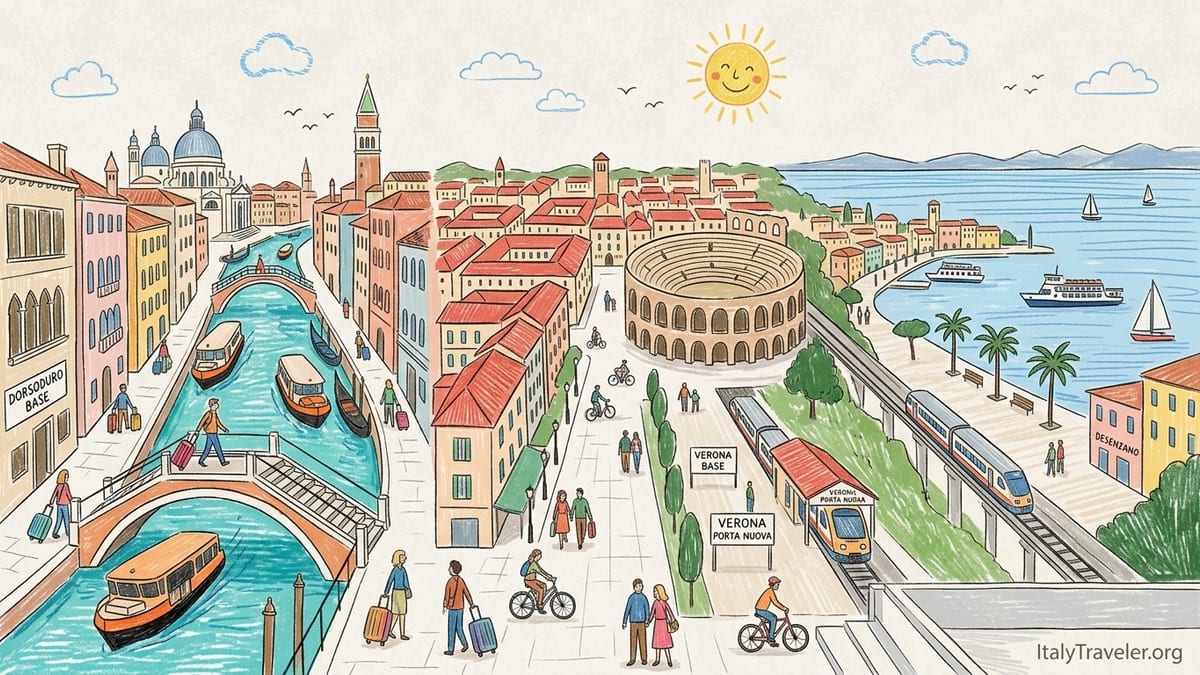
How I Arrived and First Impressions in Each Base
My Venice base began at Tronchetto, the artificial parking island at the western edge of the city. I arrived by car from the Dolomites and rolled into the multistorey Venezia Tronchetto Parking, then one of the most practical options for drivers who want to leave the car and move by boat or on foot. Current online information still presents Tronchetto as a covered, relatively economical choice at the gateway to Venice compared with the tighter, more expensive garages at Piazzale Roma. My own arrival felt surprisingly straightforward: ticket at the barrier, follow the ramps, park, then straight to the elevated People Mover that glides into Piazzale Roma in a couple of minutes. That quick transition from motorway to lagoon stays with me as one of the smoother big-city arrivals in Italy.
Verona was the opposite. I arrived by train at Verona Porta Nuova and walked to my accommodation near Piazza Bra with a small carry-on. Even with suitcase wheels catching occasionally on the pavements, it felt like a calm, compact arrival. Within 20 minutes of stepping off the Frecciarossa I was dropping my bag in a guesthouse a short stroll from the Arena. The impact here was spatial rather than scenic: Verona’s historic center is dense but not overwhelming, with Roman, medieval and Renaissance layers revealed slowly as you walk, rather than Venice’s tidal wave of beauty that hits you as soon as you see the Grand Canal.
My Lake Garda base was in Desenzano del Garda, on the southern shore. I arrived again by train, this time stepping into a town that feels more like a lived-in lakeside community than a resort built purely around tourism. From the station, it is a downhill walk of about 15 to 20 minutes into the old port area where I stayed in a small hotel overlooking the water. Here, the defining first impression was space and horizon: low, pastel buildings, promenade palms and the flat spread of the lake with ferries from the state-run Navigazione Laghi crossing in the distance. It immediately signaled a slower rhythm than either Venice or Verona.
Accommodation, Walkability and Moving Around
In Venice I have twice stayed in small hotels in Dorsoduro, roughly a 15 to 20 minute walk from Piazzale Roma. That location meant I could drag luggage over three or four bridges, rather than the dozen or more it would have taken to reach San Marco. It is an effort, especially in summer heat, but manageable if you pack light. The payoff was staying in a quieter neighborhood with canals, squares and bars that feel more residential once day-trippers have gone. For longer rides I relied on ACTV vaporetti, Venice’s public water buses. Based on publicly available information in early 2026, a single vaporetto ticket is around 9.50 euros valid for 75 minutes, while 48 or 72 hour passes significantly cut costs for frequent use. Those passes matched my own strategy on later visits: pay once, then relax about hopping on boats across the lagoon.
Venice on foot is both a dream and a puzzle. Distances are short on the map, but the network of alleys and canals constantly bends you away from straight lines. My most vivid navigation memory is trying to catch an early boat to the airport with a backpack and a small suitcase, only to discover that the direct route from my hotel was blocked by construction, forcing a detour across an extra bridge and through a market just as stalls were being rolled out. It was exhilarating but stressful. For travelers with limited mobility, the sheer number of bridges and steps makes Venice the least forgiving of the three bases.
Verona, by contrast, is arguably the easiest to move around on foot. From my base near Piazza Bra, nothing I wanted to see was more than a 20 minute walk: the Roman Theater across the river, the Duomo, Juliet’s House, Castelvecchio, the riverside promenades. The streets form a clearer grid than Venice’s maze, and even when I wandered into residential pockets north of the center, it was simple to navigate back to the Adige River and follow it home. I barely used public transport, apart from a bus to the hilltop Sanctuary of Madonna di Lourdes. That sense of legible scale is part of what made Verona effortless as a base.
On Lake Garda, walkability depends on which town you choose. In Desenzano, my hotel was a five minute walk from the ferry harbor and ten minutes from the main beach, which meant that a day without any vehicle was not only possible but pleasant. I could stroll along the promenade in the morning, have a coffee in the old port, then catch a boat in the afternoon. However, the climb back up to the train station with luggage is a reminder that Garda towns are built on slopes. When I based myself for a later trip in Lazise, on the eastern shore, the town itself was very walkable, but beaches, campsites and some larger supermarkets lay outside the medieval walls, nudging you toward a bike or car for certain errands.
Restaurants, Evening Atmosphere and Crowds
Venice in the evening divides sharply between the crowded icons and the quieter outer districts. Around Rialto and San Marco, even at 10 p.m. in high season, I found lines for gelato, music spilling from café terraces, and a constant shuffle of visitors posing on bridges. Restaurant hosts called out with menus in multiple languages. Yet a 10 or 15 minute walk into Dorsoduro or Cannaregio changed the tone entirely: locals carrying bags of groceries, children kicking a ball in a campo, and bacari serving cicchetti to a mix of Venetians and travelers who had gone looking for something less polished. One of my favorite memories is standing at a crowded counter near Fondamenta della Misericordia with a small glass of ombra wine, balancing a plate of grilled polenta and baccalà mantecato while vaporetti hummed past outside.
Prices in Venice restaurants skew higher than in Verona or on much of Lake Garda, especially near the main squares. I paid close to 30 euros for a simple plate of grilled fish and a glass of house white within a few streets of San Marco, and under 15 euros for hearty plates of pasta and local wine in family-run trattorias in Verona. You are paying in Venice not only for food but for the privilege of eating in scenery that millions of people cross the world to see. It can still be worth it if you choose carefully and step away from the densest corridors.
Verona’s evenings felt more intimate. On the nights without performances, Piazza Bra settles into a gentle hum, with locals strolling for the passeggiata and families sharing pizza at outdoor tables. When the Arena di Verona Opera Festival is in season, usually running from mid June into early September, the dynamic changes dramatically. On my opera night, I entered the Roman amphitheater just before sunset, climbed to the stone steps of the unnumbered seats, and watched the sky fade behind the stage. Leaving close to midnight, I joined thousands of people spilling out into the square. Yet within ten minutes, away from Piazza Bra, the city returned to quiet side streets, with a handful of wine bars still open near Via Mazzini and the river. It felt safe and walkable, and because I was staying nearby, I did not have to worry about late public transport.
Lake Garda’s evening atmosphere varies by town. In Desenzano, summer nights center on the lakefront. After dinner, I would sit on the low stone edge of the old harbor and watch small boats rock gently against their moorings. Couples strolled past with gelato from the nearby gelateria, and children chased each other along the promenade late into the evening. In Sirmione, by contrast, the historic peninsula is dense with visitors until sunset, when day-trippers finally filter back to the car parks and ferries. Staying inside the castle walls one night, I was struck by how suddenly tranquility returned around 9 p.m., leaving the narrow alleys almost empty except for a few guests lingering on hotel terraces.
Costs, Parking and Transport Practicalities
Using these places as bases brings up costs and logistics that you do not feel on a simple day trip. In Venice, the big extra cost for car travelers is parking. At Tronchetto, recent discussions and parking information indicate full-day prices in the range that makes a three day stay a noticeable line in your budget, especially if you add the daily cost of vaporetto passes. On my trip, I left the car there for several days while I explored on foot and boat, effectively treating the garage as a long-term car park. Paying at the end felt like settling a hotel bill. For many travelers, it makes financial sense to drop a car in Verona or another mainland city and arrive in Venice by train instead.
Within Venice, public transport is both a cost and a sightseeing experience. Vaporetti are not cheap if you buy single rides, but scene-for-scene they offer some of the best value cruises in Europe: gliding up the Grand Canal, crossing to Giudecca at sunset, or riding out across the lagoon to Murano and Burano. My approach has been to walk as much as possible in central districts, then use passes for longer or repeated journeys, especially when staying on the Lido or further out in the lagoon where a boat ride is unavoidable.
Verona is friendlier to budgets. Because I walked almost everywhere, my local transport costs were negligible. Accommodation prices in the historic center, especially near Piazza Bra or along the river, can still be high at weekends and during major events, but they tend to remain below the equivalent in central Venice. Parking is also easier and generally cheaper than in Venice if you arrive by car, with several garages and blue-line street parking options within walking distance of the center. I left a rental car in a covered garage for two nights and paid less than I had for a single day at Tronchetto.
On Lake Garda, car-based travelers face another kind of cost: parking at popular lakeside towns and attractions. In Desenzano and Sirmione, most central car parks were paid, often by the hour, which adds up if you are hopping between towns. My later trip with a car made this more obvious: a morning in Malcesine, an afternoon in Riva del Garda, and a sunset stop in Limone each came with a parking ticket. Ferries operated by Navigazione Laghi, the state-managed company for public boat transport on the major northern Italian lakes, provide an alternative. Official fare tables for 2026 show tiered prices depending on distance, and on my visit I found that a return between mid-lake towns roughly matched what I might have expected to pay for a couple of hours of central parking plus fuel, with the added pleasure of being on the water.
Day Trip Potential and Overall Sightseeing
Each base offers a very different menu of day trips. From Venice, my favorite excursions have not been to other cities but across the lagoon: Murano for glassmaking, Burano for brightly painted houses and lace heritage, and Torcello for its quiet basilica and marsh landscapes. Reaching these islands is straightforward with ACTV boat lines once you understand the directions and line numbers. On another visit I used Venice as a jumping-off point for a day in Padua, an easy regional train ride of under an hour, to see the Scrovegni Chapel and the historic university district. Venice works well if your priority is lagoon culture and nearby historic cities.
Verona sits at a strategic crossroads. From Porta Nuova station, I took a morning train to Vicenza to wander Palladian villas and returned by late afternoon. Milan, Padua and even Venice are all within reach for determined day-trippers, although I generally prefer at least one night in each of those cities. For a more relaxed day, the local trains and buses to Lake Garda are compelling. I once left Verona just after breakfast, reached Peschiera del Garda by mid-morning, and spent the day strolling the lakeside fortifications before watching the sunset over moored boats and catching a late train back. Having the Arena and major art sites at your doorstep, yet water and hills within an hour, makes Verona one of the most versatile bases in northern Italy.
Lake Garda itself can also anchor a network of varied day trips. From Desenzano I used the train for a day in Brescia, whose museums and Roman ruins are still overlooked by many foreign visitors. On another day I took a fast boat to Sirmione to soak in the hot springs atmosphere and explore the castle, then a slower ferry to Bardolino, passing vineyards that feed the local wine culture. Being based on the lake meant that every day trip began and ended with some time on or beside the water. However, cultural heavyweights like Verona, Mantua or Trento sit at least an hour away by road or rail from most lake towns, so if your main focus is museums, churches and opera, Lake Garda functions better as a complement to a city stay than as your only base.
Which Base Worked Best for Different Types of Trips
Looking back across these stays, there is no universal winner, but clear patterns emerged for different types of trips. For a first cultural trip to Veneto, I would personally choose Verona as a base. The combination of the Arena di Verona Festival in summer, Roman and medieval sites, walkable scale, and easy train links to places like Venice, Vicenza and Padua gives new visitors a rich historical canvas without overwhelming them. My own first night at the opera, walking back through the lamplit streets after a performance, captured the region’s blend of antiquity and living culture more gently than Venice’s intensity.
For a romantic weekend, I would give the edge to Venice, with an important caveat: choose accommodation away from San Marco and Rialto. Staying in Dorsoduro or on the quiet back canals of Cannaregio changed my experience entirely. Waking up to the sound of a garbage barge clinking along a side canal, sharing a late-night spritz in a small campo with mostly Italian being spoken around us, and crossing the Accademia Bridge at sunset are hard to beat for atmosphere. However, Venice’s crowds and prices can erode that romance if you remain in the busiest corridors, so a romantic stay here benefits from planning and a willingness to wander off the main route.
For a longer relaxed holiday, especially in warmer months, Lake Garda worked best for me. Having water for swimming, promenades for evening walks, and ferries for low-stress day trips created a rhythm that encouraged slowing down. I spent afternoons reading on a bench under plane trees in Desenzano, occasionally looking up to watch the white ferries of Navigazione Laghi pull in, and evenings stretching dinner into a two hour lakeside vigil. When I wanted a burst of culture, a day trip to Verona or Brescia scratched that itch without destabilizing the sense of retreat.
For car-based exploration, my clear preference is to base in or near Lake Garda or in Verona rather than Venice. In Verona, I was able to park the car, explore the city on foot, and then use it on alternate days to reach Valpolicella vineyards or hill towns like Soave. Around Lake Garda, having a car opened up villages and trailheads that are difficult to reach otherwise, but I quickly learned to combine driving with ferries to avoid retracing long stretches of shoreline. By contrast, bringing a car into Venice and parking at Tronchetto or on the mainland felt like an unavoidable compromise rather than an advantage. Once you are there, the car sits idle while you pay for the space it occupies.
The Takeaway
My own experience using Venice, Verona and Lake Garda as bases confirms that the “best” choice depends entirely on what you want from your time in Veneto. Venice offers unmatched visual drama and lagoon culture at the price of crowds, higher costs and some physical effort with luggage over bridges. Verona provides a compact, cultured city with opera, architecture and easy rail links, balancing atmosphere with everyday Italian life. Lake Garda wraps you in water, horizon and a slower pace, ideal for recovery and gentle exploration by boat and car.
If I were advising a friend visiting for the first time with a strong interest in art, history and opera, I would nudge them toward several nights in Verona with at least a full day trip to Venice, then perhaps a few days on Lake Garda to decompress. For a couple returning to the region seeking pure romance, I would help them design a Venice stay that leans into quieter neighborhoods and evening walks rather than rushed checklist sightseeing. For families or road trippers, I would highlight the flexibility and parking simplicity of Verona and the lake over the logistical knot of driving into Venice.
What united all three bases across my trips was the sense that Veneto rewards staying put long enough to feel a place waking up and winding down, not just its midday sights. Hearing the echo of an aria fade inside the Arena, watching the last ferry lights on Lake Garda, or seeing Venice’s canals almost empty at dawn gave me a deeper connection to each base than any single checklist attraction could. Choosing where to sleep shapes how often you get those moments. That, more than any ranking, is what should guide your decision.
FAQ
Q1. Is Venice, Verona or Lake Garda better for a first-time visit to Veneto?
For a first cultural trip, I would usually choose Verona as a base because it is walkable, less overwhelming than Venice and well connected by train to other cities and Lake Garda.
Q2. Where did you find it easiest to manage luggage on arrival?
Verona was easiest, as I walked from Porta Nuova station to the center in under 20 minutes. In Venice I had to haul bags over several bridges, which can be tiring in heat.
Q3. Which base felt most romantic in the evenings?
Venice felt most romantic when I stayed in quieter neighborhoods like Dorsoduro, away from San Marco, and spent evenings crossing bridges and stopping at small wine bars.
Q4. Is it worth bringing a car if I base myself in Venice?
In my experience, no. I parked at Tronchetto and did not use the car again until departure. You pay for parking while relying on boats and walking inside the city.
Q5. How do costs compare between the three bases?
Venice was the most expensive overall, especially near major sights and with parking and vaporetto passes. Verona and Lake Garda felt more moderate, though lakefront towns can still be pricey in peak season.
Q6. Which place worked best as a hub for day trips by train?
Verona worked best for me, with direct trains to Venice, Vicenza, Padua, Lake Garda towns like Peschiera and Desenzano, and farther cities such as Milan.
Q7. Is Lake Garda a good base without a car?
Yes, if you choose a town with a train station or strong ferry connections such as Desenzano, Peschiera or Riva. Ferries and promenade walks covered most of my needs.
Q8. How crowded did Venice, Verona and Lake Garda feel in summer?
Venice and Sirmione on Lake Garda felt the most crowded during the day. Verona was busy around the Arena on opera nights but calmer in side streets.
Q9. Which base would you choose for a longer relaxing holiday?
I would choose Lake Garda, where days could revolve around swimming, ferry rides and lakeside walks, with occasional excursions to cities for culture.
Q10. Can I reasonably visit all three in one week?
It is possible, but I preferred spending at least two or three nights in each. If you have one week, I would combine Verona with either Venice or Lake Garda rather than all three.