

On my last long trip through Veneto, I promised myself one thing: I would only write about experiences I had actually done, from sweating on stone steps in Verona’s Arena to pruning my fingers in the thermal pools near Abano. Veneto’s tourism brochures talk about culture, mountains, seaside, food, cycling, wellness and nature as if they are separate worlds. Over two weeks, I tried to touch each of them, notebook in hand, timing trams and tallying ticket prices. This is what I would genuinely do again, and what I would quietly skip next time.
Drifting Through Venice’s Lagoon, Not Just its Canals
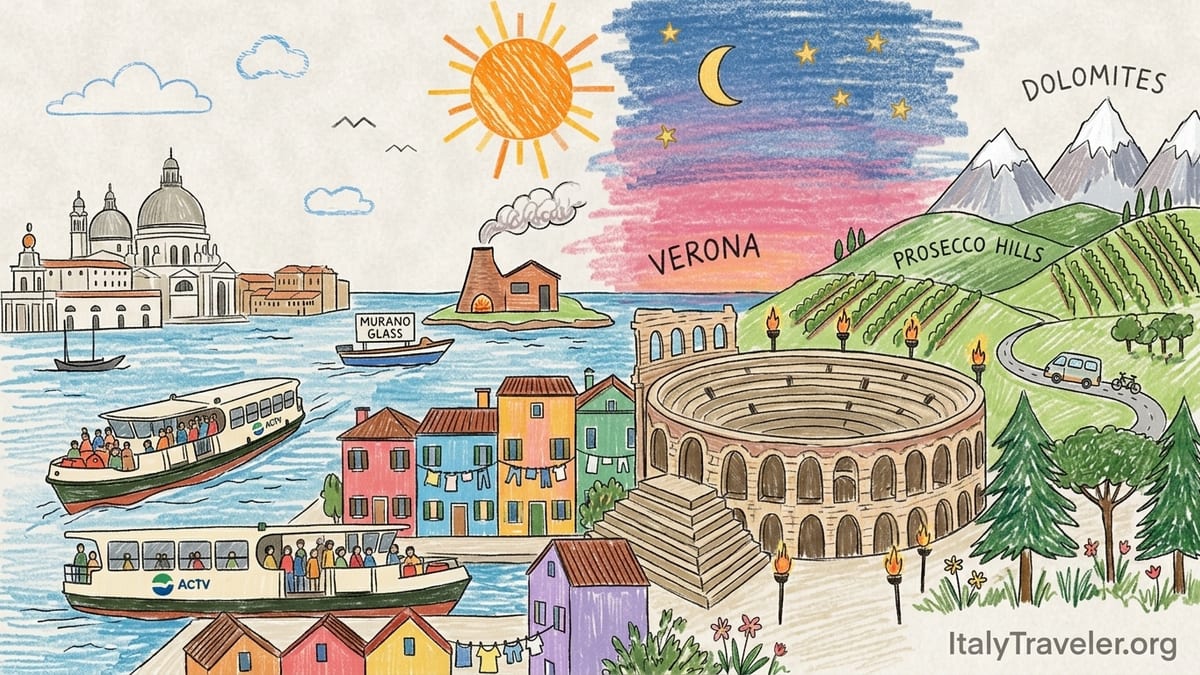
My Venice days tend to blur into crowds around Rialto and San Marco, so this time I based myself in Cannaregio and treated the lagoon itself as the main attraction. I bought a 48 hour ACTV vaporetto pass for 35 euros through the official transport app, which worked out far cheaper than single rides, which in 2025 and 2026 have been around 9 to 10 euros for 75 minutes of travel. That pass covered the classic line 1 down the Grand Canal as well as the boats out to Murano and Burano. I activated it just before boarding my first boat at Fondamente Nove and made a point of leaving the tight alleyways behind.
The most satisfying lagoon day started with an early boat at around 8:30 a.m. to Murano. The weather was clear and cool in late May, about 18 degrees Celsius in the morning climbing to the mid 20s by midday. The ride took about 20 minutes, and the boat was crowded with commuters at first but emptied quickly after the initial stops. In Murano, instead of heading straight into a glass factory demonstration, I walked along the canals to the less busy side streets, then ducked into a small furnace workshop that offered a short, informal demonstration for a few euros dropped into a tip jar. It felt more like visiting a working studio than a show, and I was out in under 30 minutes.
From Murano, I continued to Burano, another 35 to 40 minutes by boat with the same ACTV pass. By the time we approached Burano, the crowds had thickened with day trippers, many carrying selfie sticks and tour stickers. I made the mistake of heading straight to the main square at noon, which felt frantic and overrun. What redeemed the stop was walking out along the quieter perimeter canals where locals hung laundry between candy colored houses and where I could actually hear church bells over the chatter. Lunch was a simple plate of seafood risotto and a glass of house white in a small trattoria for just under 30 euros. The entire lagoon loop, including leisurely wandering and lunch, filled about eight hours.
I would absolutely repeat the lagoon day, but with tweaks. Next time I would catch an even earlier boat, or a late afternoon one, to avoid the midday crush on Burano, and I would consider adding the cemetery island of San Michele or Torcello instead of lingering in the densest tourist zones. What makes this experience worth repeating is not the postcard shots, but the sensation of Venice as a low, flat archipelago between sea and sky, something you only really feel when the domes recede into the distance and you are standing at the rail of a vaporetto with briny air on your face.
A Night on the Stone Steps of Verona’s Arena
I had dreamed of an opera night in Verona’s Roman amphitheater for years, so I planned the entire trip around a performance of Aida during the summer Arena Opera Festival. I booked my ticket months ahead directly through the Arena foundation site, paying about 40 euros for an unnumbered stone step seat high in the gradinata. Premium seats on chairs down near the stage were several times that price, often well over 150 euros, but I wanted the full open air atmosphere with a view of the entire ellipse.
The evening started long before curtain. I arrived at Piazza Bra about 90 minutes before the official start time, around 7:30 p.m. for a 9:00 p.m. performance in late June. Security checks and ticket scans moved reasonably quickly, but the queue for unnumbered steps matters. The earlier you arrive, the better your chance of getting a decent patch of stone. I brought a thin cushion bought that afternoon from a street vendor for 5 euros, a light sweater, and a refillable water bottle. Food and drink rules can shift, but at the time of my visit small snacks and sealed water bottles were allowed, while larger items and glass were not.
Once seated, the atmosphere did not feel like the hushed opera houses in Milan or Vienna. This was communal and noisy. Tour groups filed in, locals greeted friends across rows, and phones glowed everywhere despite announcements asking people to switch them off. As the sky faded from pink to deep blue and the stage torches were lit, the scale of the place took over. The performance itself began just after full dark, and by the first big chorus the sound was rolling around the ancient stone in a way that made the long planning and expense worth it.
Would I repeat it? Yes, with caveats. Performances often run close to four hours, including intervals, and evenings in June and July remain warm, but by September I have heard and read about sudden showers and even cancellations. The Arena’s policy, according to official terms and repeated in traveler reports, is that if a performance is stopped before the end of the first act, partial exchanges or reduced cost rebookings may apply, but if it passes a certain point there may be no refunds even if rain ends the night. To mitigate that risk, I would choose a date in late June or early July again when the chance of storms is lower, and I would be ready for less than perfect audience etiquette. Still, sitting on two thousand year old stone with Verdi swelling into the night is something I would happily plan a trip around again.
Giotto’s Padua and the Calm of a University City
Padua entered my itinerary for one reason: Giotto’s frescoes in the Scrovegni Chapel. Access is strictly timed and requires reservations, which I made online a few weeks in advance for a mid morning slot. The combined ticket that included the chapel and nearby civic museums cost just under 20 euros. On the day, I took a Trenitalia regional train from Venice Santa Lucia to Padova, a journey of about 30 to 40 minutes that cost around 5 to 10 euros each way depending on the specific train and purchase timing.
The visit itself is controlled. You check in about 15 to 20 minutes before your slot at the modern entrance pavilion in the park, stash any large bags, then enter a climate controlled waiting room where a short video plays about the frescoes and restoration. Group sizes are limited, and you are ushered inside for roughly 15 minutes with the paintings. It sounded too rushed on paper, but in practice I found it surprisingly contemplative. In early spring, around late March, our group numbered about 20 to 25 people, and the room never felt packed. Everyone seemed to understand the privilege of standing under that blue vaulted ceiling dotted with gold stars.
Afterwards, I walked through the nearby Eremitani civic museums included in the ticket, then wandered slowly toward the Basilica of Saint Anthony and the Prato della Valle, one of Europe’s largest squares. The city felt like a lived in university town more than a stage set, with students on bicycles and market stalls selling inexpensive panini. Lunch near the University of Padua’s historic courtyard cost about 15 euros for a plate of bigoli pasta and a glass of house red. By mid afternoon the weather had warmed to the low 20s Celsius and the crowds in the main piazzas thinned as locals retreated for riposo.
Padua is an experience I would eagerly repeat, particularly as a counterpoint to Venice’s density. The mix of high art, active academic life and manageable scale felt balanced. The only part I might alter is to pair the Scrovegni Chapel visit with a prebooked guided walk focusing on Giotto and the city’s medieval heritage, which I skipped but later wished I had arranged through the local tourism office. Even without that, the day from Venice and back took about 9 hours door to door and left me feeling energized rather than drained.
Palladian Villas and Porticoes around Vicenza
Vicenza, between Padua and Verona, became my architecture day. The city is closely associated with Andrea Palladio, whose villas and urban palaces are recognized by UNESCO, and I wanted to understand that reputation from the inside. I arrived from Padua by regional train in about 45 minutes for under 10 euros, then stopped first at the tourist office near Piazza Matteotti to pick up a map dedicated to Palladian sites.
My first stop was the Teatro Olimpico, one of the last works of Palladio, where the standard adult ticket was around 11 to 12 euros. Inside, the perspective stage set and intimate horseshoe seating made a sharp contrast to Verona’s vast Arena, yet it felt equally theatrical. I spent about an hour here, lingering over the wooden stage scenery and reading the multilingual panels. From there I walked along Corso Palladio, under continuous porticoes of pale stone, to admire the facades of various palazzi that now host shops and offices.
In the afternoon, I took a local bus up to Villa La Rotonda, one of the most famous Palladian villas just outside the city. Opening hours are somewhat limited and vary by season, so I checked them shortly before my visit and timed my arrival for mid afternoon. The entry fee for the grounds and, on some days, the interior was in the range of 10 to 15 euros. The bus ride itself took about 15 minutes each way, including waiting time, and cost only a few euros. Standing on the lawn outside, with four matching porticoes facing the surrounding countryside, I could finally see how Palladio’s language traveled across Europe and even to North America in later centuries.
I would repeat Vicenza in a heartbeat, although I might rent a bike next time to connect more villas in the surrounding countryside instead of relying solely on bus schedules. The city center was moderately busy but not overwhelmed, even in late April, and I often had quiet side streets to myself. Clouds drifted in by late afternoon, but the weather remained dry and mild. As an experience, it scratched the cultural itch without the pressure of big city museums, and it felt like a day where every euro spent translated directly into insight.
Prosecco Hills: A Day Tasting on the Slopes
The Prosecco Superiore hills between Conegliano and Valdobbiadene had appeared for years in photos of steep vineyards laced with narrow tracks. To move beyond the label on a supermarket bottle, I booked a guided small group tour that included transport from Treviso, visits to two wineries, and tastings of several DOCG Prosecco wines. Many local operators offer such tours, and the one I chose cost about 140 euros per person, reflecting the going rate for a full day with a driver, tastings and light snacks.
We left Treviso around 9:30 a.m. in a minivan of eight people. The drive into the hills took roughly an hour, passing through small villages and increasingly terraced slopes. At the first winery near Conegliano, we walked among the vines while the guide explained the steep hand tended plots that led UNESCO to recognize the Conegliano Valdobbiadene landscape. Inside the cellar, we tasted four different sparkling wines, from a dry brut to a sweeter extra dry, along with small plates of local cheese and salumi. The tasting portion lasted about 90 minutes, and there was no hard sell, just a polite opportunity to buy bottles in the 10 to 20 euro range.
After a light lunch in a nearby osteria that was included in the tour price, we moved on to a second winery closer to Valdobbiadene, where the focus was on explaining the difference between DOC and DOCG, as well as single vineyard bottlings. Again we tasted several glasses, with generous pours, and had time to sit on a terrace overlooking parallel lines of vines climbing the hillside. Weather in early autumn cooperated: about 22 degrees Celsius, sunny with a light breeze that kept the humidity low.
By the time we returned to Treviso around 6:00 p.m., the day had felt thoroughly full. Would I repeat it? With some adjustments, yes. The guided format meant I did not have to worry about drinking and driving on narrow country roads, and having an English speaking guide made the production details more accessible. If I went back, I might try arranging visits directly with individual wineries such as those that advertise tasting rooms and tours for smaller fees, sometimes around 25 to 40 euros for several wines and a cellar visit, and then hire a private driver for flexibility. Still, as an introduction to Prosecco as a serious wine and to the rural side of Veneto’s food and drink culture, the tour was money and time well spent.
Lake Garda and Cycling between Water and Hills
On the western edge of Veneto, Lake Garda offered me a change of rhythm after several city days. I based myself in the town of Peschiera del Garda, which is well connected by train and serves as a starting point for lake ferries and cycling paths. From Verona Porta Nuova station, the regional train took less than 20 minutes and cost under 5 euros each way. I arrived in May under a hazy sky and temperatures around 24 degrees Celsius, warm but with a fresh breeze off the lake.
The first afternoon, I simply walked the fortified walls of Peschiera and took a short ferry ride north along the lake. Single ferry tickets for modest distances on Garda typically run in the 5 to 15 euro range depending on the route, and I queued at the ticket window about 20 minutes before departure. The boat itself was busy but not standing room only, and the view of olive groves, colorful villages and small sailboats gave me a sense of the lake’s scale that no viewpoint on land could match. I disembarked in Lazise, wandered its narrow lanes, and then caught a later ferry back in the early evening when the light turned golden.
The next day, I rented a bike from a shop near the station in Peschiera for about 20 euros for the day, including a simple helmet and lock. My route followed the Mincio cycle path toward Borghetto sul Mincio, a route promoted by regional cycling guides as one of the easier and more scenic rides in Veneto. The path was mostly flat, paved or well compacted gravel, and separated from traffic. It took me about 90 minutes of gentle riding to reach Borghetto, including photo stops along the river and a short detour into the Parco del Mincio wetlands. In Borghetto, I locked the bike, explored the old mills and had a late lunch of tortellini di Valeggio, a local specialty, for about 18 euros including a glass of white wine.
The ride back in the late afternoon was slightly busier with other cyclists, but still felt relaxed. Total time out on the bike, including long breaks and sightseeing, was about seven hours door to door. This is a day I would gladly repeat and even extend by continuing further along the river if time allowed. It combined nature, light exercise, food and small villages in a way that balanced the more intense cultural days in cities like Verona and Padua. The only caution I would offer is to start early in high summer to avoid the strongest midday sun and to carry plenty of water, as shaded stretches can be limited.
Steam and Silence in the Thermal Pools of Abano and Montegrotto
Wellness is one of Veneto’s main tourism pillars, and the cluster of spa towns around Abano Terme and Montegrotto Terme, at the edge of the Euganean Hills, is where that tradition feels most concentrated. The area is known for its mineral rich hot springs and therapeutic mud treatments rooted in Roman history. I chose a mid range hotel in Abano with its own thermal pools open to external day guests for a fee. The day access price, which included use of indoor and outdoor pools, loungers and basic changing facilities, was about 40 euros for a weekday.
Getting there from Padua was straightforward. I took a local bus from near the train station, a ride of about 20 to 30 minutes that cost only a few euros. Buses ran at least once or twice an hour, though schedules can thin on Sundays. I arrived around 10:00 a.m. and left just after 5:00 p.m., spending nearly the entire day alternating between soaking, reading and napping. The outdoor pools were set to different temperatures, with the warmest near 36 to 38 degrees Celsius. In late spring air temperatures around 22 degrees meant I could stay in the water comfortably for long sessions without overheating.
Crowds varied through the day. Mid morning brought a mix of older Italian visitors who clearly knew the routines, slipping quietly from pool to pool, and a few international tourists talking more loudly. By mid afternoon things became busier, especially in the main pool areas, but there were still quieter corners and relaxation rooms. I opted not to book any specialized mud or massage treatments, which would have added 50 to 100 euros or more depending on the package, and instead focused on the simple pleasure of warm water and wide skies.
Would I do it again? Definitely, especially in the shoulder seasons of spring or autumn when the contrast between cool air and hot water feels greatest. In peak summer I suspect the experience might border on oppressive heat, and on winter days some outdoor areas might be less inviting despite the water temperature. As a wellness day, it offered something that city walking and mountain hiking do not: time to slow down, soothe travel weary muscles and watch clouds drift over the low hills. It made me understand why spa tourism remains such a central part of Veneto’s identity.
Dolomites: Hiking above Cortina d’Ampezzo
For the mountain chapter of my Veneto journey, I based myself in Cortina d’Ampezzo, one of the best known Dolomite towns and a place where prices and glamour rise along with the altitude. I reached Cortina by coach from Venice Mestre, a journey of around 2 and a half hours that cost approximately 20 to 30 euros one way with a regional bus operator. I traveled in early September, when the summer hiking season was still in swing but families had mostly returned home after the August holidays. Daytime temperatures hovered around 18 to 20 degrees Celsius in town, cooler higher up, with crisp nights dropping into single digits.
My most memorable hike started from the Rifugio Auronzo car park at Tre Cime di Lavaredo, a circuit that appears often in Dolomite postcards. Reaching the trailhead without a car required some planning. I booked a seat on a shuttle bus that ran from Cortina to the refuge in just under an hour, for about 25 to 30 euros round trip. There is an additional toll road fee for private vehicles, which I avoided by relying on the shuttle. We left Cortina at 8:30 a.m., arriving shortly after 9:20 a.m., and already the parking area was filling with cars and campervans.
The classic loop around the three peaks took me about four hours including stops, on well marked, moderately undulating paths. I passed several rifugi where I could have stopped for a hot chocolate or a plate of speck and polenta for 15 to 20 euros, but I had packed my own picnic of bread, cheese and apples bought in Cortina’s cooperative supermarket the evening before. The crowds near the starting point were thick, with hikers, photographers and families, but once I moved beyond the first main viewpoints the path thinned and I experienced longer stretches of relative quiet. The weather remained clear all day, with only a few clouds brushing the summits, and visibility across the limestone towers was excellent.
Back in Cortina by late afternoon, legs pleasantly tired, I understood both why the Dolomites are part of Veneto’s international image and why planning is essential. This is a day I would certainly repeat, perhaps choosing a different route such as those around Cinque Torri or in the Ampezzo Natural Park to vary the scenery. I would also book accommodation well ahead; even in shoulder season, double rooms in simple guesthouses can run from 120 euros per night upward, and restaurants in town are priced accordingly, with main dishes often between 20 and 30 euros. The trade off is access to a landscape of extraordinary beauty where culture and nature merge in traditions of high mountain rifugi, alpine cuisine and carefully maintained trails.
The Takeaway
After two packed weeks I left Veneto with a notebook full of details and a clearer sense of which experiences truly merit repeating. Venice’s lagoon journeys, particularly early or late in the day with a transport pass in hand, offered a feeling of space that I had never found in San Marco’s crush. Verona’s Arena gave me one of the most dramatic cultural nights I have ever had, even with sore legs and a less than reverent crowd. Padua and Vicenza together formed a satisfying cultural axis, mixing Giotto, Palladio and everyday university life in a way that felt grounded instead of staged.
The Prosecco hills and Lake Garda rides showed me how food, wine and cycling intertwine in Veneto’s tourist offer. Sipping DOCG bubbles on a terrace between Conegliano and Valdobbiadene, or pedaling quietly along the Mincio toward Borghetto, felt both accessible and deeply local. The thermal pools at Abano and Montegrotto provided a day of genuine rest, while the Dolomites above Cortina reminded me that this region’s mountains belong in the same breath as its cities and beaches when people speak about Italy’s greatest landscapes.
If I returned tomorrow, I would repeat most of these experiences with minor tweaks: earlier starts, off season dates, more time in smaller towns, and a closer look at local events calendars and transport timetables. What ties them together is variety. In a relatively compact area, I moved from opera to hot springs, from Gothic basilicas to limestone towers, from glass furnaces to vineyard slopes. That range, more than any single site, is what makes Veneto a destination I already find myself planning to revisit.
FAQ
Q1. How many days do I need in Veneto to cover culture, mountains, seaside and wellness?
For a balanced trip similar to mine, plan at least 10 to 14 days, which allows two or three nights in Venice, Verona or Padua, a night or two on Lake Garda, a night at the thermal spas and three or four nights in the Dolomites without feeling rushed.
Q2. Is it worth buying ACTV vaporetto passes in Venice instead of single tickets?
If you plan to use public boats more than three or four times in 24 to 48 hours, a time based ACTV pass usually saves money compared with single fares that are around 9 to 10 euros per ride, and it makes island hopping in the lagoon much easier.
Q3. When is the best season to attend an opera at Verona’s Arena?
The Arena Opera Festival runs in summer, and I would recommend late June or early July for generally warmer, more stable weather, while avoiding the peak August crowds and still being prepared for possible evening showers.
Q4. Do I need to book the Scrovegni Chapel in Padua and Dolomites shuttles in advance?
Yes. Scrovegni Chapel visits are strictly timed and can sell out days or weeks ahead, and popular Dolomites shuttle routes from Cortina to trailheads often require advance booking in high season to guarantee a seat.
Q5. Can I visit the Prosecco hills without renting a car?
It is possible using guided tours that include transport from cities like Treviso or Venice, which is what I did, though if you want more flexibility to visit multiple wineries independently, hiring a car with a designated driver or a private transfer is helpful.
Q6. Is Lake Garda manageable as a day trip, or should I stay overnight?
You can reach towns like Peschiera del Garda or Lazise as a day trip from Verona, but staying at least one night lets you combine ferry rides, lakeside walks and cycling along routes such as the Mincio path without rushing.
Q7. How expensive are the thermal spas in Abano and Montegrotto?
Day access to hotel spa pools typically ranges from about 30 to 60 euros depending on the property and day of the week, with additional charges from roughly 50 euros upward for mud treatments, massages or wellness packages.
Q8. Do I need special hiking gear for the Dolomites around Cortina d’Ampezzo?
For well known routes like the Tre Cime di Lavaredo loop in good summer conditions, sturdy hiking shoes, layered clothing, sun protection, water and a basic daypack are usually sufficient, but more technical routes may require advanced gear and experience.
Q9. Is it feasible to rely on trains and buses for this kind of multi stop Veneto trip?
Yes. I completed the itinerary using regional trains between major cities and lakes, plus local buses to spa towns and mountain hubs, though travel times require planning and some rural or mountain connections run less frequently, especially on Sundays.
Q10. What would you skip or shorten if you had only one week in Veneto?
With just seven days, I would focus on Venice and its lagoon, Verona with a possible Arena evening, a Giotto visit in Padua, and either Lake Garda or the Dolomites, and I would leave the thermal spa day and some smaller towns for a future visit.