


When I finally planned a proper week in Tuscany, I faced the same impossible question many travelers do: should I stay in Florence for the museums and trains, Siena for that medieval evening magic, in the vineyards of Chianti, or among the postcard hills of the Val d’Orcia near Pienza, Montalcino and Montepulciano? After several trips, hauling bags across cobbles, missing turns in hilltop towns and tasting more than a little Sangiovese, I have stayed overnight in each of these four areas. This article is my honest comparison of what it is actually like to base in each one, with the messy realities of parking, luggage, restaurant access, driving time and whether changing hotels was really worth it.
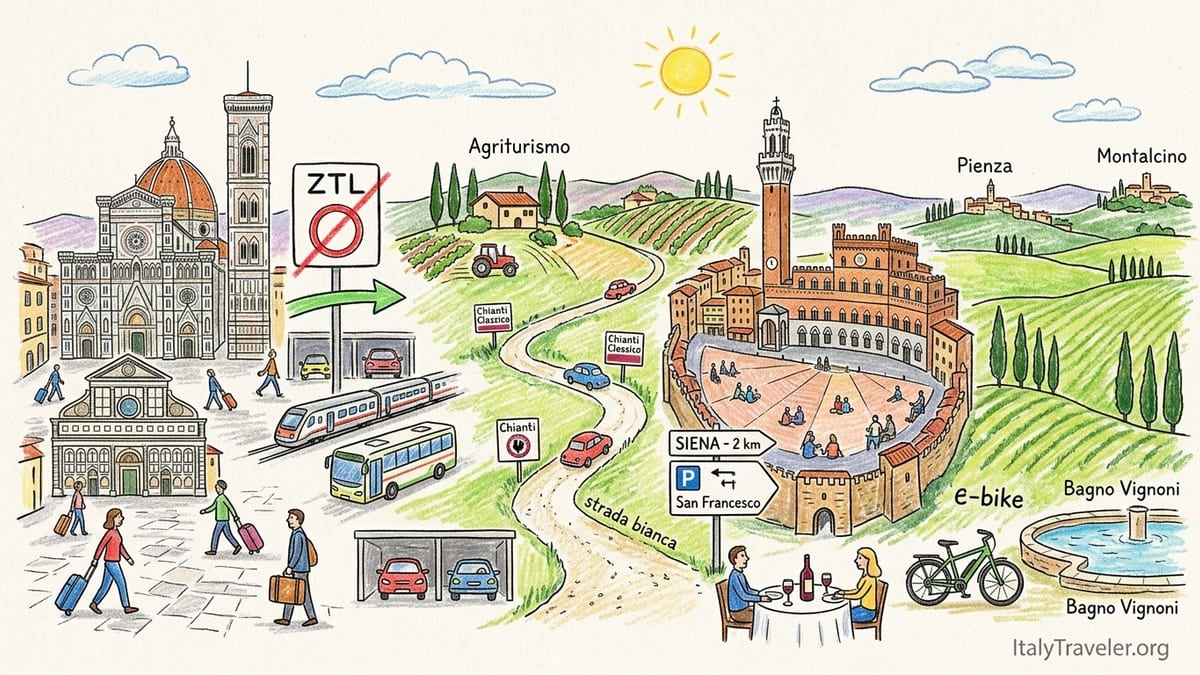
How I Tested These Four Tuscany Bases
Across three separate trips, I spent four nights in central Florence near Santa Maria Novella, three nights inside Siena’s walls close to Piazza del Campo, three nights on a vineyard agriturismo between Greve and Panzano in Chianti, and four nights in the Val d’Orcia split between Pienza and a farmhouse outside San Quirico d’Orcia. I moved around more than I usually recommend, precisely to feel how each base works in real life.
In Florence I traveled car free, arriving by train from Rome and using regional trains and buses for day trips. In Siena, Chianti and Val d’Orcia I rented a car, which meant navigating ZTL zones, multilevel parking garages, gravel drives and the occasional wrong turn on a white road. The mix of stays ranged from small city hotels where I dragged a roller bag across stone alleys, to agriturismi where breakfast overlooked vineyards, to a small inn tucked just off Pienza’s main corso.
What follows is not a hotel list but a location decision guide. I will look at Florence as a base for culture and public transport, Siena as a hub in central Tuscany, Chianti for vineyard immersion and road trips, and Val d’Orcia for that cinematic countryside around Pienza, Montalcino and Montepulciano. For each, I focus on the practical realities that rarely make it into glossy brochures: parking costs, how far you actually walk with your luggage, how easy it is to find dinner, and whether staying in multiple places felt worth the packing and unpacking.
Because prices, rules and schedules change regularly, always double-check details like ZTL regulations or parking tariffs shortly before you travel. Where I mention specific costs or times, they are based on recent official or local sources at the time of writing, but should be treated as approximate rather than guaranteed.
Florence: Museums, Trains and a Car-Free Base
Florence is the obvious base for first-time visitors who dream of the Uffizi, the Duomo and the Accademia. On my Florence stays I never missed having a car. I arrived by train into Santa Maria Novella and rolled my suitcase five minutes to a small hotel just outside the tightest part of the historic center. From there, I could walk to most sights in fifteen minutes and access regional trains to Pisa, Lucca and Bologna, and buses towards Siena and the Chianti villages.
The main complication in Florence is the ZTL, the restricted traffic zone that covers much of the historic center and is enforced by cameras. Current city guidance explains that visitors can only drive into the ZTL if they are heading to a registered garage or hotel that registers their plate, and that on-street parking is not allowed inside the ZTL at all. Public garages inside the ZTL can charge well over 30 euros per day, while larger car parks outside the zone, such as those near Piazza Libertà, tend to be noticeably cheaper per day and avoid the risk of fines. As of 2025 the city has also introduced a broader “Scudo Verde” environmental cordon around parts of Florence that further limits access for older polluting vehicles.
All of this is a long way of saying that if Florence is your base, the simplest strategy is often to skip the car. I found it very comfortable to combine walking with buses and trains. For example, regional trains from Florence to Pisa or Lucca are frequent and inexpensive, and buses to Siena depart from close to the station. I could step off a morning train in Lucca, circle the city walls by bike, and be back in Florence for an evening spritz on Piazza Santo Spirito without worrying about parking meters or reading Italian traffic signs.
Evenings in Florence feel surprisingly local once you move a few streets away from the Duomo. Around San Lorenzo the streets stay busy with a mix of students and visitors; in Oltrarno, the south side of the river, I often lingered in small wine bars that filled around 8 pm. From a logistics point of view, having hundreds of restaurants within a ten-minute walk of the hotel removed stress. After a long museum day, I could choose between simple trattorie with pastas around 12 to 16 euros and more creative bistros, without ever touching a car or bus. For a car-free, museum-heavy trip, Florence is still the base I would choose.
Siena: Central Tuscany and Atmospheric Evenings
Siena sits almost in the geographical middle of what many travelers think of as Tuscany, roughly an hour and a half by car south of Florence and within easy reach of Chianti to the north and the Crete Senesi and Val d’Orcia to the south. When I based in Siena with a rental car, I chose a small guesthouse inside the walls but outside the tightest ZTL, then parked in a nearby structure managed by the municipal parking company. Siena’s official tourism information and the operator Si.Ge.Ri.Co. describe several multistory car parks hugging the walls, including San Francesco, Santa Caterina, Il Campo, Il Duomo and Stadio Fortezza, with over 4,000 spaces between them.
In practice I found two car parks most convenient. Coming from the north, I entered the Stadio Fortezza garage, which sits by the Medici Fortress and the stadium and offers hundreds of paid spaces with a straightforward walk into the center. Later in my stay I tried the San Francesco car park. From there, long escalators carry you up to near the historic core, so you avoid a steep climb with luggage. Recent guidance from local tourism offices quoted hourly rates around 3 euros in some central garages and capped daily rates that can reach roughly 35 euros in the most central options like Il Campo or Duomo, with slightly cheaper night flat rates in others. My overnight bill at San Francesco worked out to around what I would expect for a city-center garage in a major European city, certainly not cheap but worth it for the convenience.
Once parked, I did not touch the car in the evenings. That is where Siena really shines as a base. My guesthouse was a five-minute walk from Piazza del Campo, and every night I joined the slow flow of people heading there and along the main pedestrian streets. The Campo functions as a giant outdoor living room. I remember buying a gelato from a side street and sitting on the sloping bricks with students and families, listening to the echo of conversations. Dinner choices were plentiful within ten minutes on foot: rustic osterie serving pici all’aglione, wine bars pouring Brunello by the glass, and a few more polished restaurants serving multi-course tasting menus.
For day trips by car, Siena worked very well. One day I drove north through the Chianti Classico hills, reaching Castellina and Radda with about 40 to 50 minutes of driving on curving two-lane roads lined with vineyards. Another day I headed south, crossing the rolling Crete Senesi to reach tiny villages and then looping towards the Val d’Orcia. Most drives were under ninety minutes one way. The trade-off was that I usually had to drive back the same way in late afternoon, re-enter Siena’s ring roads and find space in the garage again before strolling back into the pedestrian core.
Chianti: Vineyard Stays and Classic Road Trips
Chianti is the name that sells postcards, but on the ground it is a large hilly wine region between Florence and Siena rather than a single town. On my vineyard stay I booked an agriturismo near Greve in Chianti, set along a gravel road amid rows of Sangiovese vines. Places like this typically include a small cluster of apartments or rooms in a farmhouse, a pool for summer stays and on-site wine production. The one I chose had a tasting room where the family poured their Chianti Classico and olive oil, and breakfasts were served on a terrace overlooking the valley.
Arriving was simple with a car but would have been awkward by public transport. I picked up a rental car in Florence, immediately exited the city to avoid the ZTL, then joined the main Chiantigiana road, which meanders through Impruneta and Greve towards Panzano, Castellina and Radda. Distances here are not large on a map but driving is slow because the road is narrow and curvy, with many panoramic stops. For example, Greve to Panzano might be only around 8 to 10 kilometers, yet it took me close to fifteen minutes due to the gradient and constant bends, not counting stops to photograph vineyards.
Parking at agriturismi in Chianti is usually straightforward and free. At my farmhouse I parked under olive trees a few meters from the entrance. In villages like Greve, Panzano or Radda the reality is different: gravel lots on the edge of town, marked spaces around the main piazza and some blue-line paid parking that may require tickets during the day but often becomes free at night. When I drove into Greve on a Saturday, market stalls took over the square and I had to circle to a signed parking area a few streets away, then walk five minutes back into the action. Luggage handling in Chianti is rarely more than a short carry from your car to your room, which is a relief compared with city centers.
Evenings in Chianti were quieter than in Florence or Siena. At my agriturismo, most guests ate there once or twice during their stay, but on other nights I drove into nearby villages. That required planning around driving and wine tasting. In Panzano I booked dinner for 8 pm at a well-known steak trattoria. The village was lively at dinner time, with wine bars and shops around the central square, but I limited my wine and drove back along dark, winding roads. This is a key consideration: if you want to drink freely at dinner, either choose a place you can reach on foot from your accommodation or budget for local taxis, which can be limited and should be booked in advance.
As a base for day trips, Chianti is beautiful but not especially fast. From my farmhouse it took about an hour and a quarter to drive into central Siena via Castellina, including some time to park. Getting into Florence by car would have taken a similar amount of time plus city traffic, which is why many people use Chianti as a second or third base rather than their only home for a first Tuscan trip. Where Chianti excels is in that feeling of living among vines, hearing tractors in the late afternoon and waking up to mist over the hills.
Val d’Orcia: Pienza, Montalcino, Montepulciano and the Postcard Hills
South of Siena, the landscape opens into the Val d’Orcia and its surroundings, a UNESCO-listed area of rolling wheat fields, cypress-lined drives and stone farmhouses. Basing here felt very different from Chianti. The hill towns are smaller but exceptionally scenic, and the drives between them pass some of the classic viewpoints people associate with Tuscany. I split a four-night stay between a tiny apartment just inside Pienza’s walls and a countryside agriturismo near San Quirico d’Orcia.
With a car, reaching the Val d’Orcia from Siena took me roughly an hour, depending on the exact route and traffic. From Florence, the distance is longer: many travelers drive the A1 autostrada towards Rome, exit near Montepulciano or Chiusi and then continue on local roads, which often totals around two to two and a half hours. The upside of this relative remoteness is that once you arrive, the region feels spacious and calm, especially in the early morning and evening.
Parking in the Val d’Orcia towns followed a common pattern. In Pienza, cars are not allowed inside the historic core, so I used one of the pay lots outside the walls and walked in with my bag, about seven minutes uphill but manageable with a suitcase. The apartment owner gave me advice on which lots had better availability and approximate daily caps. In Montepulciano there are multiple tiered car parks stepping up the hill; I chose a mid-level option and rode an elevator a section of the way up, then walked ten minutes through narrow streets to my guesthouse. Montalcino also offers signed parking areas below the fortress and around the lower town, with paid hours by day and quieter evenings. Compared with Siena, daily parking costs felt slightly lower in these smaller towns, though still meaningful over several nights.
Once I was settled, the trade-off became obvious. The countryside is spectacular, and day trips between Pienza, Bagno Vignoni, Montalcino and Montepulciano are short and deeply enjoyable. One day I spent the morning cycling a rented e-bike along quiet strade bianche between Pienza and San Quirico, then drove twenty minutes to soak in the historic thermal pool view at Bagno Vignoni, followed by a late-afternoon glass of Brunello on a terrace in Montalcino. Distances are usually twenty to forty minutes by car, but the roads are slow and you will constantly be tempted to stop for photos.
Evenings in the Val d’Orcia were intimate rather than lively. Pienza’s main street filled with strolling visitors before dinner, and I tried two small osterie where mains hovered in the mid-teens of euros and local pecorino cheese dominated the menus. After 10 pm, streets emptied quickly, and I walked home under very quiet skies. At the countryside agriturismo, dinner was either a communal home-cooked meal on-site or a ten-minute drive to a nearby village. If you enjoy stars, silence and early mornings with fog in the valleys, this region is ideal. If you crave nightlife, you might find the evenings too sedate for a full week.
Parking, Luggage and the Reality of Changing Bases
When I mapped out my trips, I was tempted to sleep in as many places as possible. In practice, every base change cost at least half a day. Checking out, loading the car, driving an hour or more along scenic but slow roads, navigating the approach to a new town while watching for ZTL cameras, finding the right garage or car park, and then hauling luggage to the hotel all take time and energy.
In Florence, because I visited car free, luggage management was relatively simple. I rolled my bag from the train station to the hotel in under ten minutes. In Siena, luggage was more involved. I parked in the Stadio Fortezza garage, then walked about fifteen minutes through the city with a medium suitcase and backpack. The route included slopes and uneven stones. For some travelers, that short urban hike is part of the experience; for others, especially in summer heat or with mobility issues, it is a real consideration and might justify choosing accommodation closer to escalators like those connecting the San Francesco or Santa Caterina car parks with the center.
In hill towns of the Val d’Orcia, the “last mile” with luggage was similar. Even when I found a reasonably close parking area, the final approach to the guesthouse took effort with bags. Some properties help by allowing quick drop-offs inside limited-traffic zones before directing you back to public parking, but this requires careful communication to avoid fines. In Chianti agriturismi, the opposite was true; I parked at the door and carried my bag a few steps, which was bliss after city stays.
Looking back, the moves that felt most worth it were those between fundamentally different environments. Shifting from Florence to Chianti changed the pace and surroundings completely. Moving again from Chianti to the Val d’Orcia added different scenery and access to Pienza and Montalcino. By contrast, moving between two similar hill towns for only one night each felt like packing and unpacking for marginal gain. For a week-long trip, I would generally limit myself to two bases, maybe three if one is Florence without a car and two are countryside stays with easy front-door parking.
The price of parking across these bases can add up to the cost of one nice dinner per day. City garages in Florence and Siena sit at the top end of the range, often around several euros per hour and a few tens of euros per 24 hours, while smaller town lots in Chianti and Val d’Orcia may be less expensive or free at night. Factoring that into your accommodation budget keeps surprises down. If you will have a car for only part of your trip, consider scheduling it for the countryside segment and avoiding the city parking puzzle altogether.
Which Base for First Trip, Wine Trip, Romantic Trip and Car-Free Trip
For a first trip to Tuscany, especially if you have five to seven nights, I would personally base in Florence and add a second base either in Chianti or the Val d’Orcia. Florence anchors the classic art and architecture bucket list, provides simple transfers by train from Rome or Milan, and allows car-free day trips for those not ready to drive. After three or four nights in Florence, pick up a rental car just outside the center and spend the remaining nights in the countryside. If you dislike packing, make that countryside base Siena instead, using it for day trips north and south while enjoying its evening atmosphere and centrality.
For a dedicated wine trip focused on tastings, I would choose Chianti or the Val d’Orcia rather than the larger cities. Chianti offers dense clusters of wineries between Greve, Panzano, Castellina and Radda, many with tasting rooms and direct sales. Staying on an agriturismo that produces its own wine simplifies logistics because you can taste without driving and some estates can arrange taxis or guided visits. The Val d’Orcia area, centered on Montalcino and Montepulciano, is ideal if you love Brunello and Vino Nobile, with dozens of estates a short drive apart. For serious tasting days, hiring a driver for one or two days or joining small-group tours from Siena or local towns reduces alcohol-related driving worries.
For a romantic trip, my heart goes to the Val d’Orcia, especially if you can split time between a hill town like Pienza and a farmhouse surrounded by fields. The combination of sunset walks along Pienza’s walls, thermal baths in Bagno Vignoni or nearby spas, candlelit dinners with local wine and very dark, starry nights at the agriturismo made my time there feel distinctly slower and more intimate. Chianti can be equally romantic if you prefer vineyards to wheat fields, but evenings will usually be quieter than in Siena and more car dependent.
For a car-free trip, Florence is clearly the best primary base. You can fill several days with its museums and neighborhoods, then add easy day trips by train or bus. Siena works too without a car, especially if you are content to slow down and spend more time within the walls. There are buses connecting Siena to Florence, San Gimignano (with a change) and some Chianti towns, but frequencies are lower outside peak commuting times, so schedules require more planning. Chianti and Val d’Orcia, in contrast, really come into their own when you have a car. While it is possible to reach certain towns by bus, most agriturismi sit far from stops and taxis are limited and need to be reserved.
In summary, if I had to match each base with a trip style: first-timer without a car, Florence plus perhaps Siena; wine lover with a car, Chianti or Val d’Orcia near Montalcino or Montepulciano; romantic couple seeking quiet, Val d’Orcia; repeat visitor wanting depth and centrality, Siena. The decision is less about a right answer and more about how much you want to drive, how often you want to pack, and whether your evenings feel best in a lively piazza or beside a silent field.
FAQ
Q1. For a one-week first trip to Tuscany, how many bases should I choose?
For most travelers, one city base plus one countryside base works best in a week. For example, spend three or four nights in Florence without a car, then pick up a rental and spend the remaining nights in either Chianti, Siena or the Val d’Orcia. Adding more bases usually means losing time to packing, driving and parking without gaining much in experience.
Q2. Is it worth renting a car if I stay only in Florence?
If you are staying only in Florence, a car is usually not worth the cost and hassle. The historic center is covered by a camera-enforced ZTL where you cannot simply drive or park freely, public garages are expensive, and most major sights are reachable on foot. Regional trains and buses handle common day trips like Pisa, Lucca, Siena or nearby small towns.
Q3. How difficult is parking in Siena for visitors with a rental car?
Parking in Siena requires attention but is manageable. You must avoid the ZTL inside the historic core and instead follow signs to official multilevel car parks such as Stadio Fortezza, San Francesco, Santa Caterina, Il Campo or Il Duomo. These are paid garages with hourly and daily caps. From there, expect a 10 to 20 minute walk or an escalator ride into the center, sometimes uphill with luggage.
Q4. Can I stay in Chianti without a car?
Staying in Chianti without a car is possible but inconvenient. Many agriturismi and vineyard properties sit several kilometers from the nearest village or bus stop along unlit rural roads. Public buses connect some larger towns like Greve or Castellina to Florence or Siena, but frequencies are limited, especially evenings and weekends. Without a car you will depend heavily on pre-booked taxis or organized tours.
Q5. How long does it take to drive from Florence or Siena to the Val d’Orcia?
From Florence, most routes to the Val d’Orcia towns such as Pienza, Montalcino or Montepulciano take roughly two to two and a half hours by car, including stretches on the A1 autostrada and local roads. From Siena, the drive is shorter, often around one hour to reach Pienza or Montalcino, depending on traffic and route. Roads are paved but often narrow and curvy, which slows travel compared with highway distances on a map.
Q6. Which base has the best evening atmosphere for walking and dining?
Siena and Florence offer the most atmospheric evening walks and the widest choice of restaurants within a compact, mostly pedestrian area. Florence has a wider range of dining options and more nightlife, especially in Oltrarno and around Santa Croce, while Siena’s evenings focus on Piazza del Campo and the main drags radiating from it. Chianti villages and Val d’Orcia towns are charming but generally much quieter after dinner.
Q7. If my priority is wine tasting, should I choose Chianti or Val d’Orcia?
For a wine-focused trip, choose based on your preferred styles. Chianti Classico country between Greve, Panzano, Castellina and Radda is dense with estates offering tastings and direct sales, ideal if you enjoy medium-bodied reds and want short drives between wineries. The Val d’Orcia and nearby hills around Montalcino and Montepulciano are better if you especially love Brunello di Montalcino or Vino Nobile di Montepulciano and want to explore cellars specializing in those wines.
Q8. Are taxis and rideshares easy to find in rural Tuscany?
Taxis are available in cities like Florence and Siena but become scarce in rural areas. In Chianti and Val d’Orcia, small local taxi cooperatives or independent drivers operate from major villages, but rides usually must be booked in advance by phone or through your accommodation. App-based rideshare services are not widely available in the countryside, so you should not rely on being able to hail a ride spontaneously after dinner in a village.
Q9. How should I plan around luggage when staying in hill towns?
In hill towns such as Siena, Pienza, Montepulciano and Montalcino, plan for a walk with your luggage from a car park outside the walls up into the center. Choosing smaller, wheeled luggage and packing light helps significantly. Some accommodations allow temporary entry into limited-traffic zones for luggage drop-off if you send your license plate and arrival time in advance. Always confirm instructions beforehand to avoid fines and know exactly where to park afterward.
Q10. If I travel without a car, can I still see the countryside scenery?
Yes, but you will need to be strategic. From Florence and Siena, you can join organized day tours that visit Chianti wineries or the Val d’Orcia hill towns, often combining multiple stops in one day. Public buses run to some villages, though schedules may be infrequent. Renting a bike or e-bike in areas like the Val d’Orcia or around Lucca can also give you a taste of the rural landscape, but for maximum freedom and early or late light in the countryside, having a car remains the most flexible option.