

I had been told that driving across Val d’Orcia felt like slipping behind the wheel inside a postcard. It was not an exaggeration. Over one long summer day I connected Pienza, Montalcino and Montepulciano by car, threading along the SP146 and neighboring country roads, chasing cypress-lined ridges and stone hill towns. I also chased parking spaces, misjudged how steep certain streets would feel on foot after lunch, and learned exactly how many villages you can reasonably fit into a day before everything blurs into one long ocher-toned memory. This is what that drive actually felt like, and what I would do differently next time.
Starting Early in Pienza: First Impressions of Driving Val d’Orcia
I began the day in Pienza, because Tuscany tourism materials now frame Pienza, San Quirico d’Orcia, Montalcino and the soft bowl of fields between them as the heart of Val d’Orcia. Pienza sits roughly midway between Montalcino and Montepulciano, which makes it a practical base. I arrived just after 8:30 a.m., when delivery vans were still rattling under the walls and the first coaches had not yet arrived from Siena and Florence. The air smelled of coffee and pecorino, and the stone was still cool underfoot.
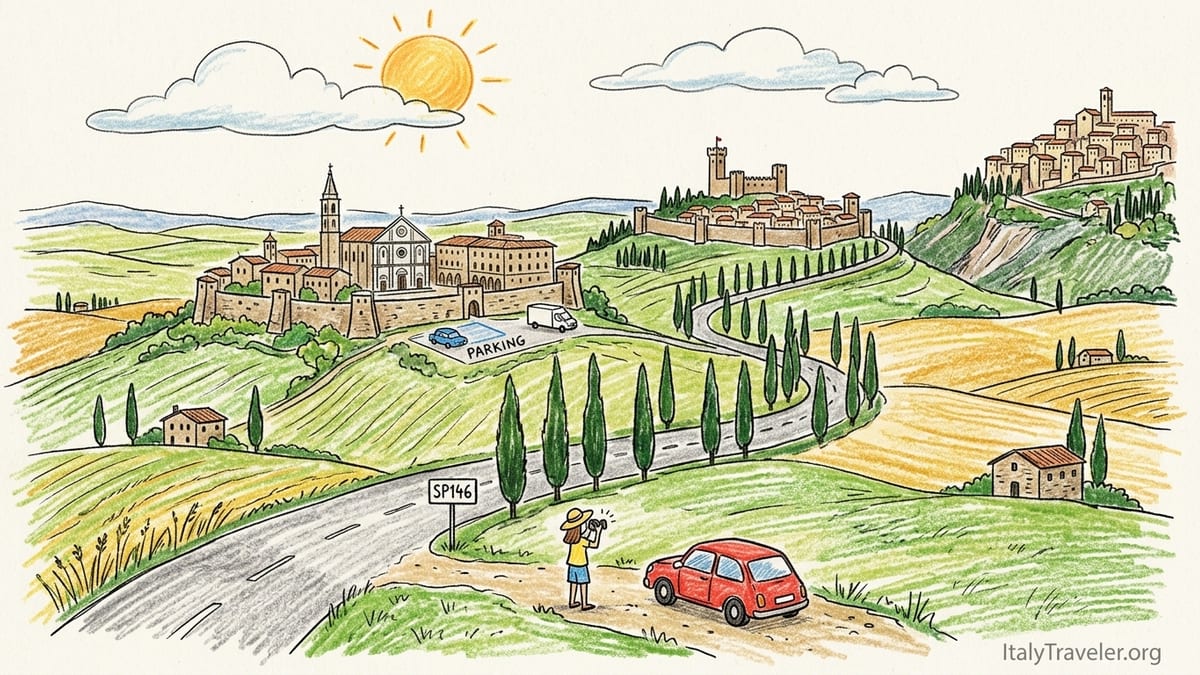
Driving into Pienza, the first lesson arrives early: you do not want to follow your navigation straight toward the historic center. The medieval streets are narrow, signed as limited traffic zones, and a wrong turn can mean a fine. Instead, I followed signs for the main public parking areas outside the walls. Just below the old town on the southern side are official pay-and-display lots that are used by day trippers and hotel guests alike, with clearly marked blue spaces. Recent local guidance described these as the correct place for visitors to leave the car and walk up into the center, and on arrival I found plenty of room in the morning.
Ticket machines in these lots listed current fees in the region of a couple of euros per hour, cheaper than parking in Siena or Florence but expensive enough that you count coins before wandering off. I fed the meter for four hours. That became my first concrete planning benchmark: four hours to explore Pienza on foot, enjoy the belvedere views along the town walls, photograph the countryside and sit down for a proper coffee and pastry before touching the car again.
From the parking lot, it is a short but definite uphill walk into town. The slope is manageable in flat sandals or sneakers, yet it is steep enough that you feel it on the return climb in the afternoon. This gradient is a recurring feature of Val d’Orcia hill towns. You are always either walking up or walking down, rarely flat. I made a mental note that anyone with limited mobility, or simply carrying too many bottles of wine, would want to factor this into timing and energy levels.
Driving the SP146: Scenic Pull-Offs and Photography Stops
Leaving Pienza around midday, I turned onto the SP146, the arterial road that runs west toward San Quirico d’Orcia and Montalcino and east toward Montepulciano. Modern tourism brochures often describe the drive from Pienza to Montepulciano as taking about 15 minutes. On paper that looks plausible: the distance is roughly 13 to 15 kilometers. In practice, if you care about photographs or simply want to soak in the views, it takes much longer because it is almost impossible not to pull over.
West of Pienza, the SP146 skirts some of the most photographed cypress-lined farm tracks in Italy. A widely shared local driving guide notes that the shoulders on this road are narrow in places and that informal parking spaces fill up quickly in high season. Pulling off safely became a constant judgment call. I watched for existing gravel lay-bys and small dirt entrances to farm tracks rather than stopping on the asphalt itself. Where a wider patch of gravel existed and a few cars were already lined up, I joined them, making sure all four wheels were off the roadway. Tractors and delivery trucks move quickly here, and one local rental car company’s guidance mentions that fines for unsafe stopping on these roads can be significant, on the order of several dozen euros depending on the infraction.
One of the best photo stops of my day was along a side road branching from the SP88 near Monticchiello, between Pienza and Montepulciano. Regional tourism boards have highlighted this “cypress road” as one of the classic Tuscan images, a sinuous lane that climbs with perfect S-curves through wheat fields, lined with dark vertical cypresses. To reach the familiar vantage point, I followed a short gravel track uphill from the main road and parked in a rough pull-off where a handful of vehicles could fit. The surface was dusty but solid in dry weather. Here the key learning was timing. By late morning in summer, sunlight falls harshly overhead and flattens the hills. The shots I took were pleasant, but when I returned close to sunset later in the day, the low light carved deep shadows into every fold of wheat and the photographs looked like the magazine spreads that had first inspired the trip.
The second striking stop lay west of Pienza, not far from San Quirico d’Orcia, where another compact pull-off allows a clear view across the UNESCO-listed basin of Val d’Orcia. Official visitor materials for the region mention this area as the archetypal landscape image of Tuscany, and it is easy to see why: lone farmhouses sitting on ridges, cypresses marching in single file, Monte Amiata hazy in the distance. Here I learned that lingering at a viewpoint has more value than collecting as many stops as possible. I spent twenty minutes simply watching how slowly the light shifted across the fields, which turned the drive from box-ticking into a quiet, absorbing experience.
Montalcino: Parking Outside the Walls and Tackling the Steep Streets
Montalcino rises high on its own ridge, visible from much of southern Val d’Orcia, and it feels every bit as vertical when you arrive by car. Approaching from the direction of San Quirico, I followed signs for the main parking zones just outside the walls. The municipal website lists several official car parks for visitors, including lots known locally as Spuntone, Collina d’Italia and Viale Strozzi, arranged in a ring around the historic center. On the ground, these appear as signed lots with blue-lined paid spaces, barrier arms and ticket machines. Electronic boards at the entrances displayed availability and current hourly tariffs.
I chose a surface lot below the fortress, roughly a five-minute uphill walk from the main piazza. Hourly prices posted at the meter were in the same range as Pienza, on the order of a couple of euros per hour, with daily caps in place. Paying for three hours felt like a reasonable starting point. What surprised me was how quickly those three hours disappeared once on foot. The climb from the parking lot up to the Rocca di Montalcino is short but steep, and from there the streets continue to wind upward in short, sharp ramps that make you very aware of the cobblestones underfoot.
Inside the walls, cars are effectively out of the equation for visitors. Local driving guides stress that the medieval lanes here are too narrow for typical rental cars, that navigation systems tend to mislead drivers into restricted or one-way streets, and that attempting to drive into the historic fabric is more likely to result in a fine or a long reverse than in a convenient parking spot. Walking is the only sensible solution. That means that where you park outside matters. Choosing a lot slightly farther out but near an elevator or a gentler approach street can be kinder on knees and lungs than the closest space directly below the steepest section of wall.
Lunch in Montalcino taught a second lesson in pacing. I found a small trattoria just off the main square serving pici al ragù and offering a glass of local Rosso di Montalcino by the glass at a fair price. Menu prices in summer 2026 hovered around 10 to 14 euros for a pasta plate and 5 to 8 euros for glasses of wine, broadly in line with other Tuscan hill towns. By the time I had finished coffee, almost two hours had gone, and I faced both the walk back down to the car and another drive ahead. It drove home the point that you cannot simply stack villages on a schedule in thirty-minute blocks. Each stop breathes according to its own rhythm, and meals stretch time in the best possible way.
Montepulciano: How Steep Is Too Steep and Where to Sleep
From Montalcino I retraced my way toward Pienza and then followed the SP146 east toward Montepulciano, passing once more through the classic rolling panorama and the side road for Monticchiello. Official tourism information often suggests that the section from Pienza to Montepulciano is a mere quarter of an hour by car. With no stops and gentle traffic that can be true. In my case, the drive took closer to forty-five minutes, simply because I stopped again for photographs and once at a farm shop selling pecorino and honey. In practical terms, this meant I did not roll into Montepulciano until late afternoon, when the upper town was catching the amber of early evening.
Montepulciano’s reputation for steep streets is well earned. Approaching from the south, I followed signs for parking areas such as the large pay lot along Viale di San Biagio, a spot that local driving guides recommend as a practical base. From there the way into the historic center climbs past the church of San Biagio and then winds steeply upward toward Piazza Grande. The walk is scenic, passing stone archways and wine-cellar doors, but it is not effortless. I met older visitors pausing to catch their breath on shaded ledges and families coaxing tired children up the last ramps. For anyone with limited mobility, it would be wise to look for accommodation closer to the top, perhaps a small hotel or guesthouse inside the walls, and plan to leave the car parked for the duration.
The parking arrangement in Montepulciano is similar to neighboring towns. Large signed lots outside the traffic-restricted old town charge hourly rates that, based on the machines I used, were again in the low single euros per hour, often with daily caps and night-time reductions. Where Montepulciano differs emotionally from Pienza and Montalcino is the sense of vertical drama. By the time I reached Piazza Grande, I felt as if I had walked up through layers of history. The reward is substantial: views from the town hall tower take in not only Val d’Orcia to the west but the Val di Chiana and distant Lake Trasimeno in other directions on clear days. Tickets to climb the tower are sold inside the civic building for a modest fee, and the stone staircases, though narrow, are well maintained.
If I were to choose one village to sleep in next time for a road trip built around these three towns, Montepulciano would be my base. Its size supports a wider range of restaurants and wine bars, and the evening atmosphere in the upper town, once day-trippers have driven away, feels like a real lived-in community. Importantly, starting and ending the day high on the ridge allows you to experience both sunrise and sunset light over the surrounding valleys without needing to drive at the sleepiest hours. I would plan to leave the car in an outer lot for the entirety of a two-night stay and explore on foot, using the road only for day trips out into the countryside.
Meals, Midday Heat and the Reality of Road Conditions
Road conditions on my August drive were generally good. The main provincial roads, including the SP146, SP88 and the approach sections of the SR2 Cassia, were surfaced in decent asphalt with clearly marked edges. Local driving guides that focus on Val d’Orcia emphasize that the roads are narrow in places and that some shoulders fall away abruptly into ditches or fields. That matched what I experienced when trying to find ad hoc photography stops. There are no formal scenic overlooks on many stretches, only occasional gravel inlets, entrance tracks to farmhouses and wider curves where a car or two can pull clear of the traffic. Using these responsibly felt like part of traveling kindly through a working agricultural landscape.
The other reality of summer road tripping here is the heat. By midday, temperatures in August across inland Tuscany often climb well above 30 degrees Celsius. That heat radiates off tarmac and stone walls, turning the short climbs into Pienza, Montalcino and Montepulciano into something more strenuous than their distances suggest. My original idea of visiting four or even five separate villages in one day evaporated by early afternoon. Each time I left the cooled interior of the car, climbed up from a parking lot and sat down for a meal, the heat slowed the pace. It is pleasant if you embrace shade and gelato, yet it is incompatible with an overly ambitious checklist.
Meals played a central role in structuring the day. In Pienza, a mid-morning stop for cappuccino and a slice of crostata at a bar just off Piazza Pio II cost around 4 to 6 euros and bought time to watch local life flow past: children playing under loggias, older residents greeting each other in the narrow lanes named Via dell’Amore and Via del Bacio. In Montalcino, lunch stretched to nearly two hours as I lingered over pici with ragù di cinta senese and a glass of Brunello. In Montepulciano, a simple early evening meal of tagliere di salumi and pecorino with a glass of Vino Nobile, followed by espresso, ran to roughly 20 to 25 euros per person at a mid-range enoteca. These numbers are typical for summer 2026 and help in planning: each real meal is not just food but a sizeable block of the day.
Fuel and facilities were another practical consideration. Away from the main towns, there are fewer petrol stations than an American driver might expect. Regional drive guides for Val d’Orcia advise topping up in larger centers like Siena, Montepulciano or Montalcino rather than assuming there will be a convenient station on a scenic back road. On my route, I passed one small independent station between Pienza and Montalcino and another near San Quirico, but both kept traditional opening hours with midday closures. The lesson was clear. On a landscape-driven road trip, you plan fuel and restroom stops deliberately rather than spontaneously.
How Many Towns Fit Into One Day Before It Feels Rushed
The original plan on paper had been ambitious: start in Pienza, visit Montalcino, loop via San Quirico d’Orcia and Bagno Vignoni, push across to Montepulciano and perhaps still dip into another village like Monticchiello. Some commercial itineraries suggest similar routes in a single long day from Siena or Florence, with time estimates that slot 45 or 60 minutes for each hill town. After driving it myself, I found those schedules to be technically possible but emotionally thin. By the time I parked for the final time in Montepulciano, I had visited three main towns and a handful of viewpoints, and even that felt on the edge of rushed.
Looking back, the natural daily rhythm emerged as two substantial villages plus unhurried time in the landscape between them. If I could rewind the day, I would perhaps devote the morning entirely to Pienza and the nearby cypress viewpoints, linger over lunch under the town’s terraces, then drive slowly to Montalcino for a mid-afternoon stroll and a pre-dinner glass of wine before returning to sleep in Montepulciano. That would mean accepting that Montepulciano itself deserved a full day before or after, rather than treating it as a late add-on squeezed into the margins of daylight.
From a timing standpoint, every extra town adds friction. Parking outside the walls, walking uphill into the center, orienting yourself to the plan of streets, finding a restroom and a café, then reversing the process back to the car takes at least an hour even if you do nothing “touristic” at all. When multiplied across Pienza, Montalcino and Montepulciano, you have already filled the day. It does not leave generous space for thermal baths in Bagno Vignoni, vineyard visits on the slopes of Montalcino, or extended photography missions chasing shifting sunlight.
The most valuable lesson from the drive was to let go of the idea that there is a fixed number of necessary towns to “do” Val d’Orcia. Official regional material emphasizes the landscape itself as the UNESCO-protected treasure, with Pienza, San Quirico d’Orcia, Montalcino and others acting as punctuation marks. Once I relaxed into that idea, it became easier to skip a highly promoted stop in favor of pulling into a lay-by, turning off the engine and listening to the valley hum under cicadas for half an hour.
The Takeaway
At the end of the day I coasted back toward Montepulciano’s outer parking lots in the blue hour, dust on the car and camera full of images that still did not quite match the emotional memory of the drive. Pienza had offered the most graceful introduction to Val d’Orcia, perched above the valley with its neat Renaissance streets and accessible views. Montalcino had delivered steep climbs and the deep pleasure of tasting Brunello in the town that made it famous. Montepulciano, high on its ridge, had claimed the role of the place I wanted to wake up in next time, when the valley is still wrapped in dawn mist and tractors are just beginning to move through the fields below.
In practical terms, the road trip taught me to treat driving here as part of the experience rather than just a way to connect a checklist of towns. The supposedly short hops between villages expand once you factor in scenic pull-offs, gravel tracks to cypress avenues, and the simple desire to stop for one more photograph. Parking outside each hill town works smoothly if you arrive early or are patient, but it always involves at least a modest uphill walk. Steep stone streets amplify the midday heat, and long, lingering meals are not optional extras but integral to the pleasure of the region. All of this means that a realistic day in Val d’Orcia includes fewer places on the map and more time in each one.
If I were planning again, I would sleep in Montepulciano, spend one full day looping through Pienza and the central valley, and dedicate a separate day to Montalcino and the vineyards that spread along its slopes. Val d’Orcia rewards unhurried travel. What I learned behind the wheel is that the most memorable moments were not the ones I had scheduled in advance, but the ones that appeared when I pulled off the road, cut the engine and finally let the valley’s quiet rise to meet me.
FAQ
Q1. How long does it really take to drive between Pienza and Montepulciano? In driving terms it can be about 15 to 20 minutes without stops, but allowing 40 to 60 minutes gives space for scenic pull-offs and photographs along the way.
Q2. Is parking easy in Pienza, Montalcino and Montepulciano? Each town has signed public car parks outside the historic walls with pay-and-display machines. Spaces are usually available early in the day, but in peak summer midday can be busy and you may need to circle or walk a little farther from the car.
Q3. How steep are the streets in these hill towns? All three towns involve noticeable uphill walking from the parking areas, with short but steep ramps on cobblestones. Most reasonably fit visitors manage them without difficulty, but anyone with limited mobility should allow extra time, use the gentler approach streets where available and consider staying in accommodation closer to the upper centers.
Q4. Can I drive into the historic centers of the villages? In practice visitors should plan not to. The old towns are covered by limited traffic zones, lanes are narrow and often one way, and fines for unauthorized entry are enforced. Parking outside the walls and continuing on foot is the simplest and least stressful option.
Q5. How many towns can I realistically visit in one day in Val d’Orcia? From direct experience, two main hill towns plus time for viewpoints between them makes for a full but enjoyable day. Trying to add a third significant stop risks turning the day into a rushed sequence of parking, climbing and quick glances.
Q6. What are road conditions like on the scenic drives? The main provincial roads are paved and generally in good condition, though often narrow, with limited shoulders. Scenic pull-offs tend to be small gravel lay-bys or farm entrances, so it is important to pull completely off the asphalt and avoid stopping on blind curves.
Q7. When is the best time of day for photography along the SP146 and nearby roads? Early morning and late afternoon into sunset offer the most atmospheric light, with long shadows that reveal the contours of the hills. Midday light in summer is harsh and flattens the landscape, so it is best used for lunch and town walks rather than serious photography.
Q8. How much should I budget for meals in these towns? In 2026 a coffee and pastry in a bar typically costs around 4 to 6 euros, a pasta dish in a simple trattoria about 10 to 14 euros, and a glass of local wine 5 to 8 euros. A relaxed evening meal with shared appetizers, main courses and wine often comes to 25 to 35 euros per person.
Q9. Is Montepulciano a good base for exploring Val d’Orcia? Yes, Montepulciano works well as an overnight base. It offers a wide range of accommodations and restaurants, dramatic views over surrounding valleys and relatively straightforward access by car to Pienza, Montalcino and the central Val d’Orcia landscape.
Q10. Do I need to worry about fuel and services along the route? Fuel stations and larger supermarkets are concentrated in towns like Montepulciano, Pienza, Montalcino and Siena. It is wise to start the day with a reasonably full tank and not rely on finding a station on quiet country roads, especially around midday when some small stations close for a lunch break.