


I have planned and replanned trips to Tuscany around seasons, often getting it wrong on the first try. My notebooks are full of memories of sweating up stone alleys in Siena in August, driving alone on empty roads near Pienza in early spring, and wandering a near-deserted Florence on a cold January evening. Over several visits I have experienced Tuscany in late spring, high summer and winter, and I have since researched the missing piece in my own calendar: the grape and olive harvest. What follows is an honest look at how the region actually feels by season, and how those changes affect everything from parking and restaurant reservations to whether you really want to climb another hill town staircase after lunch.
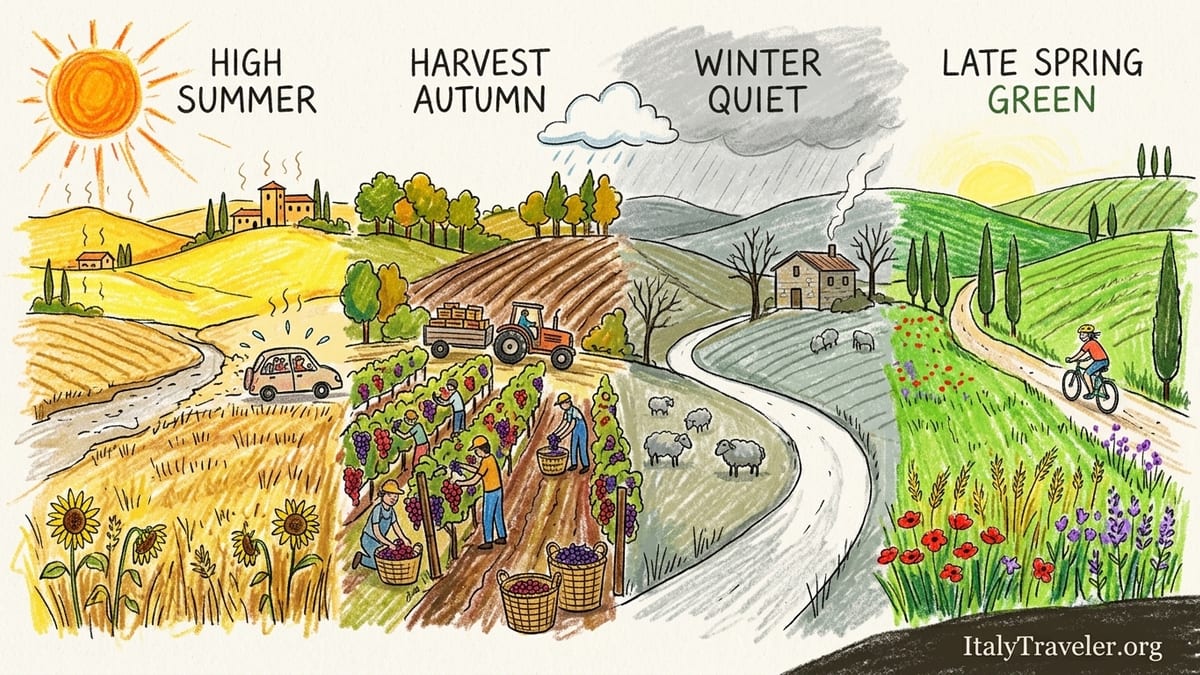
How Tuscany’s Seasons Really Feel on the Ground
On paper, Tuscany is described as having a temperate Mediterranean climate. In real life, that translates into hot, often very hot, summers in cities like Florence and Siena, cooler but still dry conditions in late spring and early autumn, and damp, sometimes chilly winters, especially in the hills. Weather records for Florence show average summer highs in the upper 80s Fahrenheit, with heat waves now frequently pushing daytime temperatures well above 95 degrees. In Siena, an inland hill town, August averages in the mid 70s to low 80s, but sunny afternoons can easily feel hotter in the exposed brick streets of the centro storico.
Seasonality in Tuscany is not just about air temperature. The landscape of Val d’Orcia and the Crete Senesi can look like a completely different region from one month to the next. In high summer, fields burn to pale gold and the river Orcia itself is often reduced to a shallow trickle, a reality acknowledged even in local tourism descriptions that mention it dries for much of the year and returns with autumn rain. By late spring, those same rolling hills are intensely green, with thick wheat and barley, and patches of wildflowers on the verges. Autumn trades the dry yellows for ploughed brown fields, vineyard rows heavy with fruit and, later, bare vines under low mist.
Those seasonal shifts also drive crowds and costs. July and August are peak periods for both heat and tourism, especially in Florence, Pisa and the main Chianti towns. Hotel prices rise, time-slot tickets for the Uffizi and the Accademia book out days or weeks ahead, and popular hill towns like San Gimignano can feel like continuous festivals of tour groups between 10 a.m. and 5 p.m. In contrast, January and February see lower rates and almost no queues, but also reduced opening hours, more shuttered agriturismi in the countryside, and a higher chance of grey skies over what you might have imagined as postcard hills.
Understanding this rhythm is essential because Tuscany promotes itself as a year-round destination, particularly in areas like Val d’Orcia. That label is technically true. You can visit any month of the year. The question is less "Can I go?" than "What kind of trip do I want, and in which places will that season help or hurt?" My own best trips have come when I aligned cities with cooler months and reserved the open-road driving for shoulder seasons, when rural Tuscany is alive but not baking.
Summer in Florence and Siena: The Beautiful, Exhausting Peak
My first summer visit to Florence taught me what heat really means in a stone city without much shade. By late June, mid-afternoon temperatures already felt oppressive in the narrow streets between Piazza del Duomo and the Uffizi. Heat radiated off the flagstones and ochre facades, and there were stretches along Via dei Calzaiuoli where even locals were hugging the building edges, chasing whatever strip of shadow they could find. Public transport was crowded and the air conditioning worked unevenly, so most of my sightseeing happened on foot. After an hour of walking between Santa Croce, the Duomo and the Arno, a simple task like climbing to Piazzale Michelangelo turned into a small endurance test.
In Siena in late August, the experience was similar, with one key difference: the hills. The medieval core is all slopes. Walking from the bus stop at the edge of town down to Piazza del Campo in the morning felt fine, even pleasant, in the shade. Walking back up in the mid-afternoon sun, past bricks still holding the heat of the day, was something else entirely. I remember stopping for water near the Fontebranda gate, looking up another steep lane and realizing that my plan to "just wander" was unrealistic in that kind of heat. Even fit travelers were pausing on stairways, and outdoor tables in direct sun sat empty while anything under an awning or umbrella filled first.
These summer city visits did have advantages. Restaurants were fully open, from simple trattorias near Mercato Centrale to more polished spots in Oltrarno where reservations were recommended but not impossible. Gelato shops stayed open late, and the long daylight stretched dinner and evening strolls across the Arno. Museum hours in summer often extended slightly into the evening, which helped. I booked timed entries for the Uffizi and Accademia a few days in advance and was glad I had, because walk-up tickets were scarce. Yet there were trade-offs: siesta-like pauses in the afternoon when it felt foolish to be anywhere other than a shaded cloister or an air-conditioned room, and a constant calculation about whether another ten-minute walk was worth the sweat.
Parking in summer Florence is something I now avoid entirely. On one trip, I rented a car for countryside days and naively drove back into the city to drop luggage at a central guesthouse before returning the car. Navigating the ZTL (limited traffic zone) with its cameras, one-way streets and scarce legal spaces in the heat, all while trying not to incur a fine, was a low point of that journey. In Siena, surface parking lots outside the walls were full by mid-morning in August. I ended up leaving the car in a multi-level lot at the edge of town and taking several escalators up into the historic center. It worked, but it meant planning around last entry times and a hot walk if I misjudged the route.
Late Spring and Early Autumn: My Sweet Spot for Cities and Driving
By contrast, my late May and late September trips felt like completely different regions. In Florence in late May, daytime highs hovered in the 70s, warm enough for café terraces but cool enough to walk from Santa Maria Novella to San Miniato al Monte without feeling wrung out. Even on sunnier days, I could climb the Duomo’s cupola and still feel ready to keep exploring after the descent. The city was busy but not gridlocked; I could book Uffizi tickets only a day or two ahead, find same-week tables at popular osterie, and comfortably walk to and from my hotel after dark.
The same held in Siena at the end of September, though here autumn had a clearer presence. The air felt crisper in the mornings, and mist sometimes hung in the low areas outside the walls. Walking from Piazza del Campo up to the Duomo in late afternoon light felt like a pleasure rather than a chore, even if I still arrived slightly out of breath at the top. Outdoor dining continued, but with more locals in light jackets and blankets appearing on some terrace chairs after sunset. Parking lots were still in use, but they filled more slowly, and turnover at restaurants seemed a bit more relaxed compared with August.
These shoulder seasons also shaped how I used a rental car. In late May, I based near Pienza and drove through Val d’Orcia on days that alternated clouds and sun. The roads between San Quirico d’Orcia, Bagno Vignoni and Monticchiello were alive but not clogged. I encountered cyclists, a few motorhomes and the occasional coach bus near popular photo stops, but I never sat in a queue of cars inching toward a village gate, which I had experienced on an August day trip near San Gimignano. Pulling off at a legal lay-by to photograph cypress-lined driveways or the famous rolling fields felt easier when the verges were not baking and there was not a line of vehicles behind me.
In early autumn, I repeated a similar loop around Montepulciano and Montalcino. Here the fields had turned more golden-brown, with some already ploughed for winter. It was not yet the grape harvest at the specific vineyards I passed, but there was visible vineyard activity: workers inspecting rows, small tractors moving between plots, netting going up to protect ripening grapes. Wineries and agriturismi were open and responsive to same-week tasting requests, yet there was space in the car parks and room to breathe on the terraces. For me, these conditions made late May and late September the best compromise between live agricultural landscapes, manageable driving and walkable cities.
High Summer in the Countryside: Dry Hills, Busy Roads
While my city experiences in summer were the most intense, driving in rural Tuscany in July and August had its own particular character. On a July trip based near San Gimignano and later in Chianti, the countryside looked cinematic at first glance, all bleached fields and dark green cypress lines. But step out of the car and you felt what that beauty cost: grass on the verges was brittle underfoot, dust rose easily from vineyard access tracks, and the late afternoon sun remained high and fierce until well past 6 p.m. Roadside parking near viewpoints offered exposure, with cars turning into small ovens between photo stops.
Traffic also told a seasonal story. Around San Gimignano and Volterra, the main approach roads from Florence and Siena filled with rental cars by late morning. Drivers slowed noticeably whenever they saw a promising lane of cypress or a hilltop farmhouse, sometimes braking unpredictably to pull into gravel pockets. By the time I reached the hill town car parks, they were usually near capacity and charging higher day rates than in shoulder season. Satellite villages and small towns like Certaldo Alto and Casole d’Elsa absorbed some of the overflow, but even these had busy piazzas and booked-up restaurants in peak weeks.
Restaurant availability in the countryside in high summer varied. In the most famous spots, such as agriturismi near Panzano or wineries that appear frequently in guidebooks, dinner reservations were essential and sometimes needed several days of lead time. Farmhouse stays typically offered a set dinner menu a few nights per week, which helped avoid nighttime driving on dark, winding roads after wine tastings, but those dinners filled with in-house guests. Lunchtime remained more flexible, with vineyards offering simple plates of pecorino, salumi and bruschetta alongside tastings. The challenge was more about beating the heat than finding a seat. Outdoor terraces were popular, but unshaded tables at midday were understandably ignored, and everyone chased pergolas and loggias.
Walking in hill towns on these same days underlined how exposed these places can be. In smaller Val d’Orcia villages during an August visit, I remember stepping from the air-conditioned car into a wave of heat on the main square, then climbing short but steep lanes to reach belvedere viewpoints. Even short strolls between churches, shops and cafés felt longer. Shadow was scarce on ridgeline streets, and stone benches were warm to the touch. I found myself timing town visits for early morning and after 5 p.m., and retreating to shaded gardens or my accommodation in the middle of the day. It was clear that while high summer shows off the postcard-yellow hills, it requires significant adaptation if you want to move around on foot.
Harvest Season: A Researched Window into September and October
I have not yet managed to be in Tuscany during the heart of the grape and olive harvest, so this section draws on current local sources, winery descriptions and regional tourism information rather than firsthand experience. Official regional tourism sites describe the vendemmia, or grape harvest, as taking place mainly from early September through October, with exact dates decided vineyard by vineyard depending on altitude, grape variety and that year’s weather. Coastal vineyards and those at lower elevations tend to start earlier, sometimes in late August, while Sangiovese and other later-ripening grapes in higher inland areas can be picked into October.
During these weeks, vineyards become working landscapes. Wineries that normally focus on quiet tastings turn into more active farms, with tractors moving crates, teams picking by hand and cellar doors actively receiving fruit. Some estates advertise harvest experiences that let visitors walk the rows, watch or occasionally help with picking, and follow grapes into the pressing and fermentation stages. Regional guides note that this is also when many small towns host wine festivals, harvest dinners and food fairs that celebrate not just wine, but also the start of the olive harvest, truffles, mushrooms, chestnuts and new-season pecorino.
Practically, harvest season appears to split the difference between peak summer and winter. Daytime temperatures in much of Tuscany often sit in the high 60s to mid 70s Fahrenheit in late September and early October, which is comfortable for both walking and driving, and significantly kinder for hill towns than July and August. Crowds thin in cities like Florence compared with August, yet popular countryside areas such as Chianti Classico and Val d’Orcia remain busy because harvest is precisely what many travelers come to see. Accommodation near famous wine villages can book out well in advance, and agriturismi close to scenic vineyards may charge near-peak rates for this period.
The harvest also influences countryside driving. Travelers report more agricultural vehicles on the roads, including slow-moving tractors hauling grapes. Some vineyard access lanes and minor roads can be busier at certain times of day. At the same time, evenings in villages and farmhouses take on a different atmosphere, with seasonal dishes like pici pasta with wild boar ragù, grilled meats with new olive oil and tastings of freshly pressed grape juice or partially fermented must. For those willing to plan ahead and accept a bit of rural traffic, harvest season seems to offer perhaps the richest agricultural experience of Tuscany, even if it no longer comes with empty roads or low prices.
Winter and the Quiet Months: Cities In Their Own Light
Winter in Tuscany often surprises travelers who expect a mild, sunny escape. My January stay in Florence and a February visit that touched Siena and the nearby hills showed a colder, damper region than brochures suggest. In Florence, daytime highs often hovered in the 40s and low 50s Fahrenheit, with a raw feeling when wind came down the Arno. The streets around Santa Croce and Piazza della Signoria were still alive, especially on weekends, but the tourist crowds were dramatically smaller. I walked into the Duomo without queuing and booked same-day visits to major museums. Shorter opening hours in some smaller museums required checking schedules, and some rooftop terraces were closed, but the upside was a city that felt more like itself, with locals using the streets and cafés as much as visitors.
In Siena in February, the cold settled more sharply. The hilltop position meant wind on the exposed streets and viewpoints. The brick of the Campo and the façade of the Duomo looked magnificent under thin winter light, but sitting outdoors for a coffee was only realistic if the café offered heaters or blankets. Many restaurants remained open, especially those that serve locals year-round, but a few tourist-focused spots near main sights were temporarily closed or on limited hours. Parking outside the walls was easier to find than in any other season, and driving into and out of the city felt almost relaxed compared with my summer memories.
Outside the cities, winter required lower expectations. In the Val d’Orcia, the landscape in February felt stripped back. Fields alternated between bare earth and short, muted grass. On misty mornings, the famous cypress-lined ridges appeared and disappeared behind low cloud. It was atmospheric, but not the lush green or golden rolling tapestry many visitors picture. Some agriturismi were closed completely, especially smaller, family-run operations that use winter for rest and maintenance. Others ran at reduced capacity, opening only parts of the property or limiting restaurant service to weekends. When I did stay at a farmhouse near Pienza in late winter, evenings were more about fireside dinners and early nights than long sunset drives.
The trade-off was cost and calm. Hotel and apartment prices in Florence and Siena were the lowest I have personally paid, and I found last-minute deals on well-located rooms that would have been far beyond my budget in May or September. Parking garages in Florence still charged standard urban rates, but they were not under the same pressure as in peak months. In the countryside, I had entire stretches of road to myself for long periods, and the small towns of San Quirico d’Orcia, Monticchiello and Bagno Vignoni felt more like local communities than tourist showcases. For travelers prioritizing museums, food and quiet over sunbathing or pool time, winter in Tuscany can work very well, provided you accept shorter days and a subdued landscape.
Val d’Orcia Across the Year: One Landscape, Four Faces
Val d’Orcia is officially promoted as a year-round destination, and after seeing it in different seasons I understand why and also why that phrase can mislead. In late spring, usually May into early June, the valley looks almost impossibly green. Hills between Pienza, San Quirico and Montalcino are thick with grain crops, scattered with red poppies and wildflowers. The air is comfortable, and the mix of new growth and still-snow-touched distant peaks can make photography feel like cheating. Driving the ridge roads in this period, I could stop at signed lay-bys, step out into mild air and spend long minutes just looking without feeling baked or chilled.
By late summer, the same routes told a different story. When I returned in August, many fields had been harvested, leaving patterns of stubble and hay bales. The green concentrated around vineyards and irrigated gardens, while open hills turned many shades of yellow. Light reflected off the dry soil, and heat built visibly throughout the day. The Orcia riverbed below looked narrow and slow. Parking at scenic stops meant stepping onto hot gravel, and short walks from car parks up to viewpoints required a hat, water and a realistic sense of one’s heat tolerance. The valley was undeniably photogenic, but it felt far less gentle than it had in spring.
In researched accounts of autumn and local tourism descriptions, Val d’Orcia in September and October occupies a third identity. The harvest brings more human activity into the frame: workers in vineyards, smoke from pruned branches, small festivals in piazzas. Fields shift from yellow to freshly ploughed brown, and vineyards change color as leaves turn gold and red. The light softens as the sun sits lower in the sky, giving the hills texture even in mid-afternoon. Roads remain active, partly because this is when serious photographers and wine-focused travelers arrive, but the air is more forgiving for walks between viewpoints, and the visual contrast between vines, olive groves and bare fields is at its richest.
Winter, finally, strips Val d’Orcia to its structural lines. My February drives showed empty fields, a few hardy sheep, and isolated farmhouses sitting against pale skies. The cypress alleys that draw visitors year-round were still there, but the spaces between them were more monochrome. Morning fog pooled in valleys and sometimes hung all day, obscuring long views but creating striking, minimal scenes of lone trees and silhouettes. Villages like Pienza and San Quirico felt calm, with more closed shutters at midday, but essential services, bakeries and local bars remained open. As a traveler, I appreciated the ease of walking stone streets without heat, yet I understood how someone arriving with only Instagram images of summer might feel underwhelmed. Val d’Orcia is indeed a year-round destination, but each quarter offers a genuinely different experience rather than just a temperature change.
What Worked Best For Me: Matching Season to Itinerary
Looking back across these trips, certain patterns stand out. Florence and Siena rewarded me most in late spring and winter. In late May, I could combine substantial walking days with long outdoor evenings, access museums without feeling suffocated in queues, and eat outdoors without battling extreme heat or cold. In January and February, I lost terrace life but gained short lines, lower prices and city centers that felt less like stage sets. High summer brought late sunsets and lively streets, but the physical effort and constant search for shade made city days more tiring than rewarding.
For countryside driving, my clear favorites were late spring and early autumn. In May, the roads of Val d’Orcia and Chianti offered manageable traffic, vivid landscapes and comfortable temperatures for short hikes and town explorations. In late September, I encountered more signs of agricultural work, warmer colors and still-mild weather, with slightly higher prices but still-acceptable crowd levels. High summer drives did deliver iconic golden views, yet parking, heat and traffic near famous villages combined to make them less relaxing. Winter drives, finally, gave me solitude and low stress on the roads, but a quieter, more limited range of open rural accommodations and restaurants.
If I had to design an ideal two-week itinerary based on my experiences, I would place three to four nights in Florence in late May or late September, followed by five or six nights in Val d’Orcia or Chianti during the same shoulder window, then perhaps end with a night or two in Siena. I would avoid keeping a car in Florence, collecting it only when leaving the city, and I would time hill-town visits for morning and late afternoon. For travelers particularly drawn to the idea of harvest, I would recommend planning well ahead for September or early October, staying at agriturismi that clearly state they remain open and active in that period and accepting that roads may be busy with both other visitors and tractors.
Ultimately, the “best time” to visit Tuscany depends less on abstract climate charts and more on what you want your days to look like. If your dream is long museum visits and empty churches, winter suits you. If you want vivid green hills and moderate heat, late spring is the prize. If you want to see grapes coming off the vines and taste new olive oil, early autumn is your window, even if prices and traffic reflect that. My own missteps in August taught me that a postcard landscape can come with very human limits, and that the same piazza, hill road or vineyard lane can feel like a different place entirely in another month.
The Takeaway
Tuscany really is a year-round destination, but not in the simplistic sense that every month delivers the same experience. My own trips across seasons have shown me three broad truths. First, summer in cities like Florence and Siena can be beautiful but physically demanding, with temperatures and crowds that turn casual strolls into serious exertion and make driving or parking near historic centers more stress than it is worth. Second, late spring and early autumn, especially May, late September and early October, offer the most balanced conditions for combining cities, countryside driving and time in places like Val d’Orcia, where landscapes and agricultural activity are both on display. Third, winter strips the region back to its essentials, reducing services and soft scenery but rewarding those who value quiet streets, short queues and introspective landscapes.
If you are planning your first visit, consider being slightly selfish about the season. Choose months that match your heat tolerance, your willingness to drive narrow roads in the dark and your priorities among food, wine, art and landscape. If you can stand a jacket and shorter days, you may find more of the Tuscany you imagine in March, April, May, late September or October than in the height of summer. And if the harvest fascinates you, accept that you will be sharing it with both residents and many other travelers who have learned, as I did, that timing in Tuscany is not a detail. It is the frame through which the whole trip is seen.
FAQ
Q1. Is July too hot to visit Florence and Siena?
For many travelers, yes. Daytime highs often climb into the 90s Fahrenheit, streets hold the heat and shade is limited, so long walking days can be very tiring.
Q2. When is the best time to see Val d’Orcia looking green?
Late April through early June is usually best for green hills and wildflowers, before the main grain harvest dries the fields to yellow later in summer.
Q3. If I want to experience the grape harvest, which months should I target?
Plan for September and early October. Exact dates vary each year and by vineyard, so check with specific wineries or agriturismi before you book.
Q4. Do agriturismi in the Tuscan countryside stay open in winter?
Some do, but many close or reduce operations between November and March. It is important to confirm winter opening dates and on-site dining before reserving.
Q5. Is it a good idea to keep a rental car while staying in Florence?
Usually not. Central Florence has strict traffic zones, scarce parking and potential fines. It is simpler to collect a rental car only when leaving the city.
Q6. Which season offers the best balance of weather and smaller crowds?
Late May and late September into early October generally provide comfortable temperatures, active landscapes and more manageable visitor numbers than high summer.
Q7. Will restaurants be open if I visit in January or February?
In Florence and Siena, many restaurants operate year-round, although some may close for short breaks. In smaller hill towns, more seasonal places shut or keep limited hours.
Q8. Is driving in Tuscany difficult for first-time visitors?
Main roads are straightforward, but narrow rural lanes, tight village streets and summer traffic can be challenging. Shoulder seasons with cooler weather are often less stressful for new drivers.
Q9. Can I visit hill towns comfortably in August?
You can, but expect heat on exposed slopes and busy car parks. Plan walks for early morning and late afternoon, and be prepared to rest indoors during the hottest hours.
Q10. How far in advance should I book for harvest season stays?
For popular areas like Chianti and Val d’Orcia in September and early October, booking several months ahead is wise, especially for agriturismi on working vineyards.