

I went to southern Tuscany with one simple goal: to spend as much time as possible in hot mineral water. That led me to two of the region’s most famous thermal destinations, Saturnia and Bagno Vignoni. On paper they both promise warm springs and hilltown views, but the reality on the ground could not be more different. After soaking, shivering, queuing, and floating in both, here is what I actually found when I compared them side by side.
Setting the Scene: Resort Pools vs Storybook Village
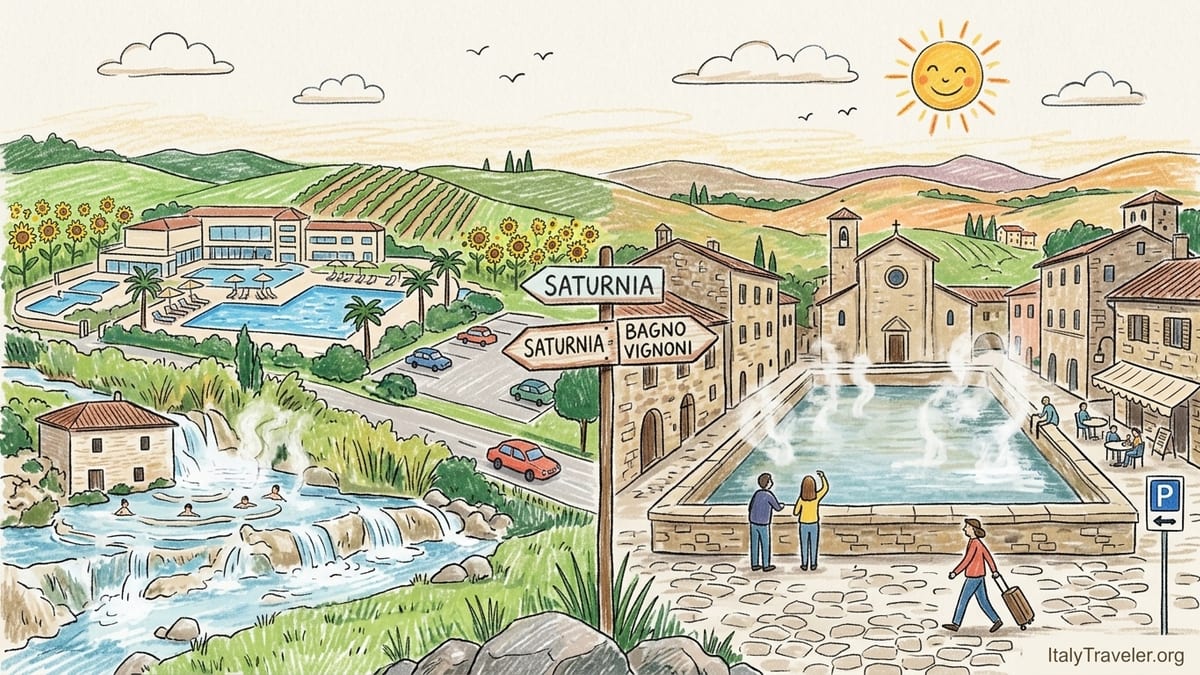
My first real thermal shock came at Saturnia. Driving through the countryside, sunflowers and vineyards gave way to a surprisingly large complex: Terme di Saturnia, with hotel, golf course, and its separate Hot Spring Pools park, plus the famous free Cascate del Mulino waterfalls just down the road. It felt like a purpose-built thermal destination, with clear signs for parking and a steady stream of cars even on a weekday morning.
Bagno Vignoni, by contrast, looks like it has barely changed since the Middle Ages. Instead of a car park in front of turnstiles, you enter a tiny stone village in the Val d’Orcia, its central square entirely taken up by a steaming rectangular pool framed by stone buildings and the church of San Giovanni Battista. You can see the hot water rising in the middle of the piazza, but you cannot get in. That water now feeds the adjacent spa hotels and wellness facilities where bathing is allowed.
This fundamental difference shapes the whole experience. Saturnia gives you two main ways to bathe: the free Cascate del Mulino, open all day and night, and the paid Terme di Saturnia resort with its landscaped thermal pools that stay open year-round, with seasonal hours typically running from about 9:30 in the morning to late afternoon or early evening depending on the time of year. Bagno Vignoni, on the other hand, offers no public soaking in the central pool or the old Parco dei Mulini below the village; instead you choose between hotel spas such as Albergo Le Terme and La Posta Hotel & Thermal Spa, buying a day access or a time-limited pass that includes use of their pools and wellness areas.
If your dream is a wild-feeling hot river under the stars, Saturnia delivers. If you want to sit in hot water with one of the most cinematic piazzas in Italy as your backdrop, then Bagno Vignoni does that through its spa terraces and indoor pools rather than through the “village pool” itself.
Parking and Arrival: Ease vs Village Logistics
From a driver’s point of view, Saturnia is straightforward. At the Terme di Saturnia Hot Spring Pools park there is ample free parking directly in front of the entrance. When I arrived just after opening, around 9:30, I could choose a spot close to the gate; by late morning the lot was significantly fuller, but I still saw people finding spaces without circling for long. Signage is clear and the resort lists its parking as free and on-site, which matched my experience.
Cascate del Mulino, the free waterfalls about a five-minute drive from the resort, has a more improvised feel. There is an unpaved parking area right by the cascades and additional roadside parking along the access road. In low season I found a place fairly easily, but in warmer months and on weekends cars were lined along the verge and a few campervans had clearly settled in for the day. There was no charge when I visited, but enforcement signs asked drivers not to block the road or park on fragile ground, and local authorities have periodically tightened rules, so I would not be surprised to see more active monitoring on peak summer days.
Bagno Vignoni requires more planning. The village is car-free in its central square area, so you park in one of several public lots on the outskirts and walk in. I used the main parking area just above the village; it was free when I visited, though in high season some sections may be ticketed. From there it is a short downhill stroll of about five to ten minutes into the square. If you have a reservation at Albergo Le Terme or La Posta, staff can advise on where to leave your car; overnight guests may have designated spaces, while day spa visitors normally use the public lots.
Arriving with luggage felt slightly awkward in Bagno Vignoni because I had to wheel my suitcase over cobblestones through a square full of people taking photos of the steaming pool. At Saturnia, in contrast, moving from car to check-in desk was as simple as a modern resort: asphalt underfoot and luggage trolleys available inside.
Water Temperature, Smell and Overall Feel
At Saturnia, everything starts with the spring that bubbles up at around 37.5 degrees Celsius. In practice the pools feel like a warm bath: hot enough to comfortably sit still in March and April, pleasantly warm but not scalding in late May and June. Close to the main spring source inside the resort you feel the heat most clearly, while pools farther away and the cascades down at Mulino are slightly cooler, especially on windy days or in the evening.
The water has a noticeable sulfur smell. At the resort pools it is clearly present but balanced by the open air; after a few minutes my nose stopped paying attention. At Cascate del Mulino, where the water flows rapidly over travertine terraces, the smell is sharper, especially when you first get out and your swimsuit and hair start cooling in the breeze. I would not describe it as overpowering, but anyone extremely sensitive to sulfur will notice it.
What struck me most in Saturnia’s water was its softness. Running my hand over my arm, my skin felt almost slippery while I was in the pool, a common sensation in highly mineralized springs. When I first stood under one of the resort’s waterfalls, the pounding water combined with that slick feel gave a brief vertigo, as if my feet might slide out from under me. Once I adjusted, it became my favorite part of the resort area, especially in cooler weather when the steam rose visibly from the pool surface.
Bagno Vignoni’s water emerges hotter, around 49 degrees Celsius at the source, but by the time it reaches spa pools such as those at Albergo Le Terme it is cooled and mixed to become comfortably warm rather than scalding. In the hotel pools where I soaked, the temperature felt similar to Saturnia’s closer basins, sitting somewhere around typical hot-tub warmth. The sulfur scent was present but slightly gentler than at the open cascades in Saturnia, perhaps because the bathing areas are smaller and more controlled, with good water turnover and less turbulent flow than at a free waterfall.
Changing Facilities, Towels and Lockers
Terme di Saturnia’s resort pools feel like a fully equipped day spa. After paying for entry at the Hot Spring Pools reception, I received a bracelet to access the changing area and lockers. The changing rooms are gendered, with individual cabins for changing clothes, showers with temperature control, and rows of standard electronic lockers. I found them clean, with staff making frequent rounds, particularly in the showers where wet floors can quickly become slippery.
The resort strongly prefers a white dress code for towels and bathrobes. If you arrive with a patterned beach towel like I did, nobody will stop you, but the setting clearly nudges you toward their rental “wellness kit,” which usually includes bathrobe and towel for an extra fee. On a previous tariff sheet the rental price was listed at around 6 euros for a robe and towel; current prices are available at the resort, but in my case the supplement was in that general range. I chose to rent, primarily because walking between pools and the bar in a white robe made me feel less like the only outsider in holiday-color beach gear.
At Cascate del Mulino, you are completely on your own. There are no official changing rooms or staffed lockers right by the falls themselves. Some people changed in their cars, others wrapped in towels behind trees or used quickly improvised cover beside the stone building near the cascades. I wore my swimsuit under my clothes and stripped down by my car, which felt the least awkward option. For valuables, there are no secure lockers provided; I brought only what I was comfortable leaving in the car and kept my car key in a waterproof pouch around my neck while I soaked.
In Bagno Vignoni’s spa hotels, the experience is closer to Saturnia’s resort than to its wild waterfalls, but with each property’s particular style. At Albergo Le Terme I checked in at the front desk, received a spa kit with towel, bathrobe and slippers included in the day access price, and was shown to the changing area. Individual lockers, usually with a simple key or bracelet, are standard and an armadietto or similar locker is normally part of the package in local descriptions. In my case, I appreciated not having to think about bringing my own towel or flip-flops; it was all folded neatly in the provided bag, which made the whole experience feel more curated and less DIY than Saturnia’s free cascades.
Crowds, Cleanliness and Atmosphere
Crowding is where Saturnia and Bagno Vignoni diverge most dramatically. At the Terme di Saturnia resort pools, numbers are controlled by paid admission and online reservations are now recommended, especially at weekends and holidays. When I visited on a weekday in shoulder season, there were enough people for a relaxed buzz but still plenty of space to float without bumping elbows. Staff were visible on pool decks and in the bar area, and the whole place felt tidy, with fallen leaves and stray towels quickly removed.
At Cascate del Mulino, crowd patterns follow the sun and social media. When I arrived just after dawn one morning, there were already a dozen people, most with cameras, staking out spots in the upper pools. By late morning, tour minibuses had arrived and almost every natural basin hosted a cluster of bathers. The water itself remains constantly refreshed because it flows swiftly from pool to pool, but the rocks can get muddy at the edges, and litter sometimes appears near the parking area, despite local efforts and signage encouraging visitors to take everything away with them. I did notice plastic water bottles and snack wrappers in the bushes on a busier day, although volunteers were collecting some of it later in the afternoon.
Bagno Vignoni’s spa facilities are significantly more controlled. In the hotel spa where I spent an afternoon, admissions were limited both by the size of the hotel and by the need to book a slot in advance, especially for evening sessions. This meant that even during popular hours the main pool never felt packed. The water remained visually clear, and staff discreetly enforced simple rules like showering before entering pools and keeping glass away from the water edge. The atmosphere was hushed: more couples and small groups speaking quietly than big gatherings. The absence of children in certain sessions, particularly in premium evening entries, contributed to a calm, almost retreat-like feel.
Outside, Bagno Vignoni’s central square is another matter. Day-tripping crowds can be substantial, with people leaning over the edge of the steaming central pool for photos and filling cafe terraces, but since this is not a bathing area, the impact on your soak is indirect. It does, however, change the mood when you step out of a peaceful spa to find selfie sticks and tour groups just beyond the doorway.
Paid vs Free Access: What You Actually Spend
Saturnia gives you the full spectrum from zero-cost soaking to structured spa day. Cascate del Mulino is completely free to enter and open around the clock, with no tickets or reservations. My only expenses there were parking-related (in my case, none), food from the simple bar a short walk away, and fuel to get there. It is one of the rare experiences in Tuscany where you can sit in hot mineral water for hours without spending anything on entrance fees.
At Terme di Saturnia’s resort pools, there is a clear day-spa model. Current price lists for the Hot Spring Pools and the more exclusive Club show several options, often splitting access into morning, afternoon, full-day and sometimes evening entries. Recent examples from official materials and partner price lists suggest that a basic adult day entry to the Hot Spring Pools commonly falls in the ballpark of a few dozen euros, with higher-priced Club admissions that include closer access to the spring and quieter relaxation areas. Exact figures change seasonally and are best checked at booking, but in my visits I paid an amount in that general range and found the facilities justified the cost for a full day of use.
Bagno Vignoni has no equivalent of the free Cascate del Mulino. If you want to bathe, you pay. For Albergo Le Terme and similar facilities, recent Italian-language guides and hotel materials indicate that day spa packages tend to start roughly in the range of about 40 to 55 euros per person for daytime entries, with some evening-only formulas costing less for a shorter stay. Those prices often include towel, bathrobe, slippers and access to pools and certain wellness areas, which does soften the blow compared with Saturnia’s resort, where towels and robes cost extra if you do not bring your own.
On balance, Saturnia can be the cheaper overall choice if you are comfortable with a rustic experience at the free cascades. If you prefer structured facilities with guaranteed showers, lockers and spa-like quiet, then Saturnia’s resort and Bagno Vignoni’s hotel spas end up in a similar general price tier, though Bagno Vignoni often bundles more extras, while Saturnia offers more space and more aquatic variety for the price.
How Long I Actually Wanted to Stay
At Cascate del Mulino, the theoretical answer is “forever,” but the practical one is about two to three hours per session. After ninety minutes shifting between different travertine basins, the combination of heat, current and crouched positions on uneven rock started to make me restless. In cooler weather I could stay a bit longer; in high summer, even with the warm water, the strong sun and lack of shade made me seek a break by mid-morning. The absence of comfortable dry lounging areas, aside from whatever towel you spread on rocks or grass, also cut my stay shorter than at the resort.
In the Terme di Saturnia resort pools, I comfortably spent almost an entire day. With multiple pools at slightly different temperatures, waterfalls to stand under, a snack bar and restaurant for lunch, and sun loungers for reading between dips, I only left because closing time approached. The controlled water temperature, consistent around 37.5 degrees Celsius, meant I never experienced the sudden chill that often chases you out of outdoor pools in early spring.
In Bagno Vignoni, my ideal timeframe was somewhere between the two. In one hotel spa I booked a four-hour afternoon slot and found it almost perfect. I alternated between the main outdoor pool overlooking the countryside, a smaller indoor pool, and rest areas with loungers. The hotter source water, cooled before reaching the pools, meant I needed regular breaks to avoid feeling sluggish, but the presence of quiet relaxation rooms meant those breaks were enjoyable. If I had been staying at the hotel, I could imagine stretching this rhythm over an entire day, including a midday walk through the village and a long lunch.
In all three cases, I noticed that my initial plan to “pop in for a quick soak” underestimated how time bends in hot water. Give yourself more hours than you think you need, especially if you are driving and want to fully warm up, cool down and rehydrate before getting back behind the wheel.
Choosing Between Saturnia and Bagno Vignoni
If you have to choose only one, start with what kind of thermal experience matters more to you: wild and photogenic, or curated and quietly luxurious. For a first-time visitor seeking that iconic image of milky blue terraces in open countryside, Saturnia’s Cascate del Mulino is hard to beat. You park a short distance away, pick your way over smooth white rock, slide into one of the natural basins and watch the sun rise or set over Maremma hills while hot mineral water flows around you. There is nothing like hearing the rush of the falls and feeling the current tug at your legs while stars emerge overhead.
However, that magic comes with crowds, slippery surfaces, a sharp sulfur smell and absolutely no infrastructure beyond a simple bar and basic toilets nearby. If you dislike changing in a parking lot, or if you are traveling with people who need solid handrails and non-slip surfaces, you may find Saturnia’s free side more stressful than relaxing. In that case, booking a day at Terme di Saturnia’s resort pools gives you the same spring water, similar views and far better accessibility, at a price closer to a city spa day.
Bagno Vignoni, by contrast, feels almost tailor-made for travelers who want intimacy, controlled numbers and village charm. You lose the drama of waterfalls and gain the slow theatre of watching steam drift up from the central piazza while you soak in a terrace pool nearby. The fact that bathing is only permitted in regulated spa facilities means you always have showers, lockers and staff on hand, but you give up the spontaneity of a completely free soak. It is an excellent choice if your Tuscany itinerary already includes Pienza, Montalcino or Montepulciano, since Bagno Vignoni sits conveniently among them and can anchor a slower day between more intense sightseeing.
In my own ranking, Saturnia wins for unforgettable visuals and the sheer joy of moving between wild cascades and a polished resort fed by the same source. Bagno Vignoni wins for atmosphere and the feeling of stepping into a small, self-contained world where everything revolves quietly around hot water. Given the chance, I would happily return to both, but for different moods and different seasons.
FAQ
Q1. Can you still bathe in the big central pool in Bagno Vignoni’s square?
Bathing is not allowed in the central pool or in the old channels below the village. To soak in Bagno Vignoni’s thermal water you need to use an authorised spa or hotel facility that draws from the same spring.
Q2. Is Cascate del Mulino in Saturnia really free, and is it open all year?
Yes, access to Cascate del Mulino is free and not ticketed, and the cascades are accessible throughout the year. There are no official closing hours, though local authorities may occasionally restrict access during extreme weather or for maintenance.
Q3. What are the current opening times for the Terme di Saturnia resort pools?
The Hot Spring Pools at Terme di Saturnia are open year-round, with recent schedules showing hours from about 9:30 in the morning until early evening, typically around 7 pm in warmer months and earlier in winter. Exact times are seasonal and posted by the resort.
Q4. Do I need to book ahead for Bagno Vignoni’s spa hotels?
Advance booking is strongly recommended. Spa facilities at Albergo Le Terme and La Posta often limit numbers per time slot, especially for evening or weekend sessions, and walk-in visitors can find popular time bands fully booked.
Q5. How strong is the sulfur smell at Saturnia and Bagno Vignoni?
Both springs have a noticeable sulfur scent. At Saturnia’s cascades the smell is sharper in the open air, while inside Bagno Vignoni’s spa pools it tends to feel milder. Most visitors quickly get used to it, but very smell-sensitive travelers should be prepared.
Q6. Are towels and lockers included in the price at these thermal baths?
At Terme di Saturnia’s resort, entry includes the pools and basic changing facilities with lockers, but towels and bathrobes generally cost extra unless specified in a package. At Bagno Vignoni’s spa hotels, day passes often include a kit with towel, bathrobe, slippers and a locker, reflected in the higher base price.
Q7. Which place is better if I am on a tight budget?
If budget is the top concern and you are comfortable with a rustic setup, Cascate del Mulino in Saturnia is the clear winner, since entrance is free and you can limit spending to snacks and parking. Bagno Vignoni does not offer a free bathing area, so you should plan for a paid spa visit there.
Q8. Can children visit Saturnia and Bagno Vignoni thermal baths?
Families with children do visit both, but policies differ by facility. Cascate del Mulino has no lifeguards and uneven, slippery rocks, so close supervision is essential. Terme di Saturnia and the Bagno Vignoni spa hotels may have specific rules or quiet zones, so it is wise to check age policies and any dedicated family hours when booking.
Q9. How long should I plan for a visit to each place?
For Cascate del Mulino, allow two to three hours including changing and a rest. For Terme di Saturnia’s resort pools or a Bagno Vignoni spa hotel, a half day to a full day works well, giving you time to alternate soaking, cooling down and eating without rushing.
Q10. If I only have one day, should I choose Saturnia or Bagno Vignoni?
If you want a dramatic, natural-feeling soak with the option of a polished spa nearby, choose Saturnia and combine the free cascades with a few hours at the resort pools. If you prefer a quieter, more intimate spa day in a postcard-perfect village and do not mind paying for access, spend your day in Bagno Vignoni and its spa facilities.