


I arrived in Tuscany assuming the region would feel like an extended version of Florence: crowded lanes, gallery queues, and selfie sticks in every piazza. Instead, the trip only really became the Tuscany I had imagined once I left Florence behind, traded museum tickets for a rental car key, and started threading through Chianti and the Val d’Orcia. The shift from city to countryside was not just about scenery. It changed how I moved, ate, planned my days, and even how I understood Tuscany itself as a patchwork of distinct territories rather than one single destination.
Starting in Florence: Beautiful, Brilliant and a Little Suffocating
My base in Florence was a mid-range hotel just north of Santa Maria Novella station, within an easy 10-minute walk of the platforms and about 15 minutes from the Duomo. It was perfect for arriving by train from Rome and for early-morning departures, but it also meant I was squarely inside Florence’s Zona a Traffico Limitato, the ZTL ring that wraps the historic center. Florence’s ZTL is camera-enforced and runs most of the day, with fines that can easily run over 80 euros per unauthorized entry, billed weeks later. I had read about it in passing but, at that point, it still felt theoretical.
My first three days were the classic Florence program: Uffizi, Accademia, and aimless wandering across Ponte Vecchio to the Oltrarno. The new requirement to pre-book the Uffizi and Accademia in high season was very real. On my mid-October visit, walk-up tickets were technically possible on weekdays, but the official booking office near the Uffizi was still steering people toward timed slots and advising to avoid weekend visits if schedules were flexible. I booked the Uffizi for 8:15 a.m. and the Accademia for late afternoon on a different day, which smoothed the crowds but locked my days into rigid shapes.
Meals in Florence tended to be scheduled and strategic. My best dinner was at a small trattoria in the Santa Croce area, where a plate of tagliatelle with wild boar ragù and a glass of Chianti Classico cost a little under 20 euros. But I queued 25 minutes for a table and ate in a room buzzing with fellow travelers trading tips about “doing Tuscany” by train. Florence was beautiful, but the rhythm started to feel like a checklist. I found myself staring at a framed black-rooster Chianti Classico label on the wall and realizing that most of the wines I was drinking were made in landscapes I had never actually seen.
The moment that pushed me toward the countryside came on a Sunday afternoon in Piazza della Signoria. I watched a coach group being shepherded under umbrellas while a guide announced that, tomorrow, they would “see Tuscany” with a half-day bus trip that combined Pisa, San Gimignano, and a wine tasting, all in roughly nine hours. Somehow, that sounded more exhausting than the Uffizi. I decided instead to piece together my own route, even if it meant wrestling with rental agencies, regional trains, and those dreaded ZTL zones.
South to Siena by Train: My First Lesson in Fragmented Tuscany
I left Florence for Siena by regional train from Santa Maria Novella, taking a morning service that took just under 1 hour 30 minutes with a change at Empoli. Tickets on Trenitalia’s regional services were around 10–15 euros booked close to departure, and trains ran roughly every hour during the day. The ride itself was unremarkable in scenery compared to what came later, but it taught me my first real lesson about Tuscany: distances on a map mean less than the boundaries between distinct territories.
When I stepped out of Siena station, I was nowhere near the medieval city I recognized from photographs. The station sits in a modern district down the hill, connected to the historic center by a series of escalators and elevators. The trip up took about 15 minutes, including waiting time. I had assumed I would step off the train into an old-stone postcard. Instead, I passed through a shopping center, then rode escalators up through concrete galleries before finally emerging near Porta Camollia and walking into the walled city.
In Siena I stayed one night inside the walls, at a small guesthouse near Piazza del Campo. It was atmospheric and perfect for evening strolls, but the location came with a catch: cars were practically useless inside city gates. Like Florence, Siena operates a ZTL system in its historic center, designed to keep through traffic out. I had naively planned to pick up a rental car in Siena’s center the next morning and simply “head into the countryside.” On arrival, the guesthouse owner gently corrected me. Rental offices are generally clustered near the station and the ring roads, outside the most restricted zones, precisely because driving into the old city is so restricted.
In the evening, I walked to the Duomo complex to ask about visiting hours for the cathedral and its museum the next day, planning to fit in a quick look before getting the car. Autumn opening hours for the Duomo, baptistery, and museum typically ran from mid-morning to late afternoon, with last entry about an hour before closing. Combined tickets were available, but guided roof tours only ran in specific seasons and with fixed time slots that would have anchored me in Siena longer than I wanted. I made a choice that surprised me at the time: I skipped the roof and the museum and kept the visit to a focused hour inside the cathedral, saving daylight for the roads beyond Siena’s walls.
Picking Up the Car and Meeting Tuscany’s ZTL Reality
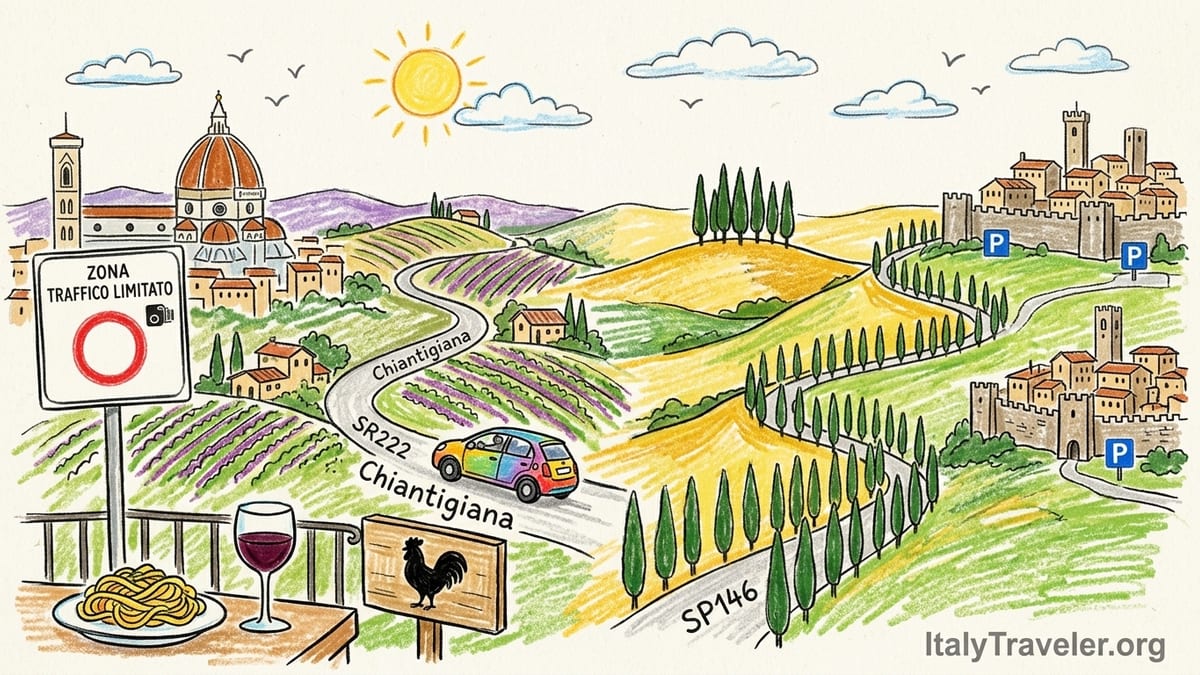
The next morning I rolled my suitcase back down through Siena’s escalators, crossed the road to a rental office near the station, and picked up a compact car. Daily rates in October for a small manual hatchback, booked a few weeks in advance, were in the range of 60–80 euros, plus mandatory insurance and a deposit on my credit card. What I remember more than the paperwork, though, was the rental agent’s warning: “Do not follow the GPS into any ZTL. If it tells you to go through a gate into the center, ignore it.” He pointed out the ZTL warning signs on a small laminated card: white circle, red border, “Zona Traffico Limitato,” often with lists of hours and camera icons underneath.
Within an hour I understood why the warning was necessary. My first task was simple: drive from the rental lot to a supermarket on the outskirts to stock up, then continue toward Chianti on the Siena ring road. Instead, I missed a slip road, the GPS recalculated, and I found myself descending toward one of Siena’s gates, with a ZTL sign ahead and no easy place to turn around. I stopped just before the camera, hazards on, and watched locals slide past me in the permitted lane. A driver behind me leaned on his horn; another gestured firmly to reverse. I backed up slowly, heart pounding, and ducked into a side street to reorient.
That near-miss changed my driving behavior for the rest of the trip. Before entering any Tuscan town of any size, I stopped on the outskirts, checked for ZTL maps on the municipal tourism board websites or signs on the approach roads, and looked specifically for blue “P” parking symbols with lot names like “Il Campo” in Siena or “Parcheggio Duomo” in smaller hill towns. The pattern became familiar: official long-stay car parks outside the historic core, tickets taken at barriers, payment at machines before exit, and then a walk of 5 to 15 minutes into town. It added effort, but it also brought a small sense of relief. As long as I stayed out of the zones monitored by cameras, my license plate would not be quietly recorded for fines weeks after I had flown home.
I also underestimated how much time driving would add to my days. Outside the major highways such as the A1 or the RA3 Florence–Siena connector, Tuscan roads are slower than they look on the map. Speeds shift constantly between 50 and 70 kilometers per hour, with tight curves, tractors, and cyclists sharing the lanes. At first I treated distances like train times. Florence to Siena by fast road is roughly an hour. On scenic provincial routes it can stretch far longer, particularly when you pull over for photos or get stuck behind a delivery van winding through yet another cypress-lined curve.
Discovering Chianti on the SR222: The Tuscany I Had Imagined
From Siena I finally pointed the car toward Chianti, taking the SR222, also called the Chiantigiana, north into the hills. Official tourism material describes the SR222 as the main road through the Chianti Classico zone between Florence and Siena, running roughly 60 to 70 kilometers and passing places like Castellina in Chianti, Radda, and Greve. Along this stretch there are no ZTL cameras on the open road, and it is toll-free, which immediately made driving feel simpler compared with city navigation.
My first base in the countryside was a family-run agriturismo outside Castellina in Chianti. Reaching it required leaving the SR222 for a narrow lane between vineyards, paved but only one car wide in places. The farmhouse sat on a ridge, with a gravel courtyard and a pool looking across rows of Sangiovese vines. My room was simple and cool, with stone floors, a small kitchenette, and shuttered windows that I could swing open in the morning to cockerel calls instead of scooter horns. I paid around 110 euros per night, breakfast included, which in October felt like remarkable value compared with Florence’s city-center hotels.
What surprised me most here was not the scenery but the pace. Days were framed by when the light felt right rather than by ticket times. I drove short stretches of the SR222 between Castellina and Radda, pulling into lay-by viewpoints or roadside wineries advertising tastings. Many offered informal walk-in tastings with a fee per flight, often around 15–25 euros to sample three or four Chianti Classico wines, sometimes paired with bread and olive oil produced on-site. I quickly learned to ask about spitting or shared tastings, then space driving with long, late lunches or walks in the village to stay within safe limits. In several wineries, staff mentioned they often recommended guests either appoint a dedicated non-driving taster or join minibus tours rather than mix full tastings and driving.
Eating in Chianti felt like the opposite of Florence’s queue-and-turnover rhythm. One afternoon in Panzano, I arrived at a small osteria at 2:15 p.m., expecting to be turned away after kitchen closing. Instead, the owner waved me in, set me at a terrace table overlooking the hills, and served a simple plate of pici pasta with tomato and pecorino, followed by grilled sausages and a glass of house red. With coffee, the bill came to roughly 25 euros. There was no line, no sense of rush, just the occasional cyclist collapsing at neighboring tables to refill water bottles before tackling another climb.
The only downside to my Chianti days was that I had not scheduled enough of them. I had allotted just two nights at the agriturismo, thinking Chianti would be a pleasant interlude before “the real countryside” of the Val d’Orcia. In practice, I barely scratched the surface of the small hamlets and side roads, and I left with a mental list of places that deserved more time: a path near Radda signed for an easy vineyard hike, a signpost for the Via Romea trail linking Siena and Florence, and a handful of wineries I had driven past at closing time. If I could redo the trip, I would plan at least three to four nights split between two different Chianti villages, using them as bases for slow loops rather than a quick pass-through.
Val d’Orcia: Backroads, Hill Towns and a Different Kind of Stillness
Leaving Chianti, I made my most inefficient decision of the whole trip. Instead of driving directly from Castellina toward the Val d’Orcia, I looped back toward Siena to meet a friend arriving by bus, then doubled back across the same ground on the RA3 and smaller regional roads. It meant an unnecessary two hours of extra driving and several euros in fuel, all to accommodate my original assumption that “meeting in Siena is easiest” because it looked central on the map. On the ground, Tuscany is less a hub-and-spoke around Siena or Florence and more a cluster of overlapping valleys and ridges, each with their own roads and travel logic.
We eventually based ourselves near Montepulciano, on the southeastern edge of the Val d’Orcia area. Official descriptions of the Val d’Orcia define it as a broad valley along the Orcia river between Montalcino and Montepulciano, dotted with towns like Pienza, San Quirico d’Orcia, and Castiglione d’Orcia. In practice, the experience of driving there felt like gliding through an architect’s drawing of Tuscany: long curves lined with cypresses, farmhouses balanced on hilltops, fields fading from green to gold in late afternoon light.
Our rental was a restored stone farmhouse about a 10-minute drive from Montepulciano along the SP146, the scenic road that also connects Pienza and San Quirico. The house was part of a working farm, with a handful of apartments, a shared pool, and a small wine cellar where the owner offered evening tastings of Vino Nobile di Montepulciano, priced around 10–15 euros for a flight with local cheese. From the terrace we could see Montepulciano stacked up like a stone ship on the hill, its church towers catching the last light, while below, the road traced a silver line toward Pienza.
Here, the car was freedom. We drove the SP146 in both directions, parking in official lots outside each town. In Montepulciano, signs directed us to a multi-level parking area a short climb from Porta al Prato. In Pienza, we used a pay-and-display lot on the edge of town, feeding coins into a machine that printed a ticket to leave on the dashboard. Parking rates varied, but in most smaller towns we paid around 1–2 euros per hour, with clear signage about maximum stays. Unlike the cities, there were no ZTL cameras lurking just beyond the gates, as long as we respected the parking zones and did not attempt to slip into resident-only streets.
Days settled into a gentle pattern. Mornings were for one town: a slow coffee in Montepulciano’s main piazza, wandering through tiny wine cellars built into the old walls, or following narrow lanes in Pienza out to viewpoints over the rolling fields. Afternoons were often for aimless drives: detouring to Bagno Vignoni to watch steam rise from the central hot-spring pool, or looping past the famous solitary cypress cluster near San Quirico. We rarely checked opening hours except for churches and small museums, many of which operated on schedules such as 10 a.m. to 1 p.m., then 3:30 p.m. to 6 p.m., with shorter winter hours. If we missed them, the town itself felt like enough.
Pisa, Lucca and the Cost of Rushing Back to the Cities
Part of me wanted to stay in the Val d’Orcia indefinitely, but I had wedged Pisa and Lucca into my itinerary as a two-day add-on before flying out of Florence. On paper, this looked easy: drive north on the A1 and then west, drop the car near Pisa, see the Leaning Tower, and spend a night in Lucca before looping back. In practice, shifting from the slow backroads to the more trafficked corridors felt abrupt, and it highlighted once again how separate each Tuscan sub-region feels.
Approaching Pisa, we followed signs for parking areas around the Campo dei Miracoli, where the tower and cathedral rise. Several large pay lots ring the complex, some privately managed with attendants and flat day rates, others municipal with ticket machines charging by the hour. We chose a paved lot about a 10-minute walk from the tower, paying a rate posted at the entrance that worked out to roughly 2 euros per hour. As we walked toward the tower, coaches disgorged day-trippers from Florence and cruise ships, and we found ourselves in the densest crowd since the Uffizi.
Entry to climb the Leaning Tower is strictly timed and controlled. Ticket prices and time slots are clearly listed at the onsite ticket office and on the official booking channels, and same-day availability can be limited, especially in summer. When we arrived in mid-October, late afternoon climbs were still available but with a gap of nearly two hours before our slot. We opted instead for a combined ticket to the cathedral and neighboring monuments, visited in under an hour, and then retreated. It felt worth seeing once, but it also confirmed something I had been suspecting: high-profile monuments consume attention and time in a way that leaves little room for the slower pleasures of Tuscany.
Lucca, on the other hand, won me over immediately. The city’s intact Renaissance walls have been turned into a pedestrian and cycling promenade, and most of the historic center operates under a ZTL designed to keep traffic out. Once again we parked outside, this time in a long-stay lot just beyond one of the gates, for a rate similar to Pisa’s. Walking through the gate and up to the tree-lined walls, we watched locals commute by bicycle and families stroll in the late light. Even after dark, Lucca felt less pressured than Florence, with trattorias around Piazza dell’Anfiteatro serving hearty soups and farro salads without queues snaking out the door.
If I had the trip to plan again, I would drop Pisa entirely and give Lucca at least one more night, possibly using it as a base for exploring the hills north of the city or the Garfagnana region. Trying to “fit in” Pisa because it felt obligatory meant more time on highways and less in the landscapes that had drawn me to Tuscany in the first place.
What I Assumed Wrong and What I Would Do Differently
Looking back, many of my early assumptions about Tuscany revolved around convenience and centrality. I imagined Florence as a hub from which I could radiate outward on half-day trips, perhaps to Siena one day, Pisa the next, and the Val d’Orcia as a scenic detour. Instead, the reality was that each of these places works best when treated as its own destination. Florence is a major art city with its own rhythm, Siena a distinct chapter with Palio traditions and a different urban scale, Chianti a wine region arranged along ridgelines, and the Val d’Orcia a rural landscape that invites slow days rather than quick snapshots.
I also underestimated the learning curve around ZTL rules and parking, assuming they would be intuitive or that GPS apps would steer me clearly. In reality, ZTL boundaries are designed for locals who know exactly which streets are permitted, and navigation apps do not always flag them prominently enough. The most useful habit I developed was to think in terms of where to park, not where to drive. Before entering any town, I searched for the official parking areas outside the historic center, followed the blue “P” signs, and accepted a short walk as the cost of keeping my record clean.
My third mistake was treating scenic driving days as transfers rather than experiences. I originally plotted routes based on how quickly I could get from point A to point B. Once I drove sections of the SR222 through Chianti and the SP146 across the Val d’Orcia, it became obvious that the road itself is the attraction. Distances that might be knocked out in two hours on a highway could comfortably fill an entire day when allowing for stops, tastings, photos, and simply sitting on a low wall watching the light crawl across the fields.
If I were planning the same trip now, I would structure it around three or four bases instead of many short stays: a few nights in Florence without a car, three or four nights divided between two villages in Chianti, four nights in a farmhouse near Pienza or Montepulciano, and two or more nights in Lucca at the end. I would book major museum tickets in Florence in advance, but leave the countryside days loose, reserving only my accommodations and perhaps one or two special winery visits where pre-booking is required.
The Takeaway
Leaving Florence behind changed my relationship with Tuscany in ways I did not anticipate. In Florence I moved according to ticket slots, tram schedules, and restaurant reservations. In Chianti and the Val d’Orcia, I moved according to light and appetite, adjusting plans when a side road looked particularly inviting or when a sign for fresh pecorino pulled us into a farmhouse courtyard. The shift was not just from city to countryside, but from consumption to participation.
The trip also made it clear to me how fragmented Tuscany really is, in the best possible sense. Official tourist information and regional guides are often organized by zones that mirror what I felt on the ground: Florence as its own chapter, Chianti as another, the Val d’Orcia as yet another, with Siena, Pisa, Lucca, and the coastal areas functioning as distinct micro-worlds. Trying to do all of them at once, or reducing “Tuscany” to a single bus tour, misses the point.
The most enduring images I carried home were not the famous ones. They were smaller moments that only emerged after I slowed down: watching mist lift off the vineyards at dawn from my agriturismo terrace, tasting new-season olive oil poured straight from a stainless-steel tank in a Chianti cellar, driving a dirt side road above the Val d’Orcia at golden hour with the windows down and the radio faint. None of that appears on a museum ticket, yet those were the scenes that finally matched the Tuscany I had imagined before the trip.
If your own itinerary currently tilts heavily toward Florence and a few famous monuments, I would encourage you to rebalance it. Give yourself time not only to see Tuscany but to inhabit a small corner of it for a while, whether that means three extra nights in Chianti, a farmhouse in the Val d’Orcia, or even lingering in Lucca’s quiet lanes. Once you cross that invisible line between checking Tuscany off a list and letting it set the pace, the region reveals itself as a series of interlocking stories rather than a single headline destination.
FAQ
Q1. Do I need a car to enjoy Tuscany beyond Florence?
It is possible to visit Siena, Pisa and Lucca by train or bus from Florence, but having a car opens up much more of Chianti and the Val d’Orcia, where public transport is limited and infrequent. If you want to stay on farms, visit small wineries, or explore minor hill towns, a rental car makes the experience far easier.
Q2. How can I avoid fines from ZTL zones when driving?
Before entering any historic town, look for ZTL signs, park in clearly marked public car parks outside the center, and walk in. Do not rely solely on GPS routes. Rental agencies often provide basic ZTL information, but it is worth checking municipal tourism sites or roadside maps to understand where cameras are located and where visitors are allowed to drive.
Q3. Is it better to base in one place or move around?
I found it more rewarding to choose a few bases and stay multiple nights in each rather than changing hotels every day. Staying in Florence without a car, then moving to an agriturismo in Chianti and another near Pienza or Montepulciano, allowed me to explore in loops rather than constantly packing and unpacking. Fewer moves left more time for spontaneous stops.
Q4. When should I book museum tickets in Florence?
For the Uffizi and Accademia it is wise to reserve timed tickets in advance, especially from spring through early autumn and on weekends. Early morning or late afternoon slots are typically less crowded than mid-day. Once you leave Florence, you can usually be more flexible, as many smaller churches and museums outside the major cities sell tickets on the spot.
Q5. How expensive is parking in Tuscan towns?
In most smaller hill towns like Pienza, Montepulciano or Castellina in Chianti, official lots outside the center usually charge around 1 to 2 euros per hour. Larger cities such as Florence, Siena and Pisa can be more expensive and have complex rules, so it is worth checking rates and payment methods on signage when you enter a car park.
Q6. Can I visit wineries without joining a tour?
Many wineries in Chianti and around Montepulciano and Montalcino welcome individual visitors for tastings, though some require or strongly encourage reservations, especially for full cellar tours or lunch pairings. Tasting flights often cost around 15 to 25 euros. If you plan to taste several wines, consider arranging a driver or joining a small-group tour.
Q7. How much driving time should I allow between regions?
Travel times on scenic provincial roads are longer than they look on a map. While highways can connect Florence and Siena in about an hour, a slow drive along the SR222 through Chianti or the SP146 across the Val d’Orcia can easily fill half a day once you factor in stops. Building in generous buffers makes the journey part of the pleasure rather than a stressful transfer.
Q8. Is Pisa worth including if time is limited?
If you have a strong desire to see the Leaning Tower, Pisa can be visited on a focused half day. However, if your time in Tuscany is short and you are more interested in landscapes and quieter towns, you may find it more rewarding to skip Pisa and allocate that time to Lucca, Chianti or the Val d’Orcia instead.
Q9. What is the best season to experience the Tuscan countryside?
Spring and autumn are particularly appealing, with milder temperatures and, outside peak holiday weeks, somewhat lighter crowds than high summer. Vineyards in Chianti and fields in the Val d’Orcia change color with the seasons, so April to early June and late September to October offer especially atmospheric light and landscapes.
Q10. How many days should I spend outside Florence?
If your overall trip allows it, planning at least five to seven nights beyond Florence gives you enough time to experience both a wine region like Chianti and a rural landscape such as the Val d’Orcia. Even adding three nights in the countryside to a city-focused itinerary can significantly change how you experience Tuscany.