


I have lost count of how many times I have been to Tuscany, but I can count on one hand the experiences I would pay to repeat, exactly as I did them, without changing a thing. These are not abstract “top 10” ideas. They are days I actually lived, tickets I bought with my own money, wines I tasted, roads I drove and lines I stood in, right down to what it cost and how far ahead I booked. If you want a trip that feels like Tuscany rather than a checklist of famous names, these are the moments I would build it around.
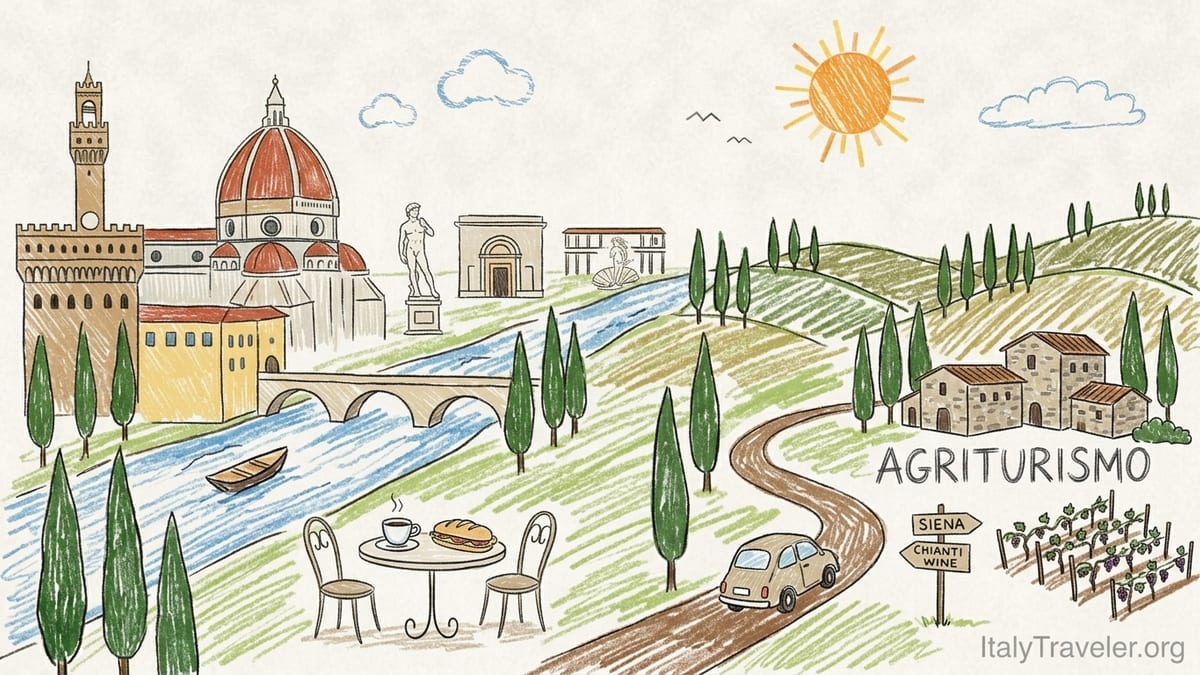
Seeing Renaissance Masterpieces in Florence Without Burning Out
On my last trip I finally admitted I could not “do” all of Florence’s art in one go, so I designed a single focused art day I would happily repeat. I booked morning tickets for the Accademia Gallery, then a late afternoon slot for the Uffizi, with a long break in between for espresso, a panino and simply sitting by the Arno watching the city move. In October 2026 a full price Accademia ticket costs about 20 euros plus a 4 euro booking fee, and a standard Uffizi ticket is around 30 euros, more if there is a major temporary exhibition. I reserved both several weeks ahead on the official channels and printed nothing, just showed the barcodes on my phone at the doors.
At the Accademia I spent just over an hour, and if you are a first timer that is about right. I entered on a timed ticket, walked straight past the same day line and went almost directly into the gallery where Michelangelo’s David stands under the skylight. I circled him slowly three times, watched how the light picks out the veins in the marble, then doubled back to the unfinished Prisoners, where you see the figures half trapped in stone. The rest of the museum held my attention for another half hour at a comfortable pace. I was back on the street in about 75 minutes, surprised at how calm the visit felt compared with stories of chaos.
The surprise was how much the break between museums mattered. I used the late morning for a coffee standing at the bar and a slow wander through Florence’s streets, then an extended lunch. Only at around 16:00 did I head for the Uffizi, where my named ticket time meant I joined a short security queue and was inside in about 20 minutes. I gave myself three hours there and still did not see everything, but I saw what I came for: Botticelli’s “Birth of Venus” and “Primavera,” a progression of Madonnas that shows how painting changed across centuries, and a quiet moment in the top floor corridor looking out at Brunelleschi’s dome.
Would I pay to do this again? Absolutely, but only in this split format. In 2026 the combined cost for both museums with reservation fees runs to roughly 54 to 60 euros per person, which is not nothing. The value, for me, came from accepting I did not have to extract every possible cent from the ticket by rushing. If you want to repeat the experience, book at least three to six weeks ahead for peak months, buy timed entry from official sources, and build your day around two concentrated bursts of art with real rest in between. That balance of depth and breathing space is what I would replicate.
Walking Siena Until the Contrade Feel Real
Siena was the Tuscan city that finally made me slow down on foot. I arrived on a Sunday afternoon, checked into a small guesthouse just inside the walls and decided to give the city an entire day of unscheduled wandering. I paid nothing for that day beyond coffee, gelato and an eventual ticket to climb the facciatone viewing platform by the Duomo, but the experience felt like one of the richest of my trips.
I started from Piazza del Campo just after breakfast, when the famous shell shaped square was filling slowly with delivery vans and school groups. Instead of immediately climbing the Torre del Mangia, I sat at the lower edge of the square with a cappuccino and watched how locals crossed the bricks on diagonal paths. Only after an unhurried half hour did I begin walking the radiating streets and, more importantly, the back lanes that loop around the contrade, the neighborhoods that race in the Palio. I passed fountains decorated with animals, flags hanging from windows, and small shrines set into corners. I had read about the contrade as a concept, but walking through them one by one made it tangible.
By late morning I reached the Duomo complex and decided to buy the combined ticket that included cathedral entry, the museum and the panoramic terrace. In 2026 this package costs around 20 euros in high season and slightly less at shoulder times. I spent about two and a half hours there, lingering in front of Nicola Pisano’s pulpit and the inlaid marble floor, then climbing to the viewing terrace where Siena’s tight swirl of terracotta roofs opens in every direction. No reservation was needed that day in May, but in peak summer it is wise to check if the time slots for the panoramic access require booking.
The single most surprising moment was late afternoon, when the tourist groups thinned and I found myself in a tiny bar watching a replay of the Palio on a television over the counter. A man in a contrada scarf started explaining the rivalries to me without being prompted, drawing diagrams on a napkin to show the track in the Campo. That conversation cost the price of a spritz and some cicchetti, maybe 8 to 10 euros, but it pulled the whole city into focus. I would pay the train fare from Florence and the Duomo ticket again in a heartbeat just for another day of walking the same loops until the streets start to make sense as someone’s home rather than a backdrop.
Driving the Chiantigiana and Tasting Wine in Chianti
The day I drove the Chiantigiana, the SR222 between Florence and Siena, felt like the road trip every postcard promises. I picked up a manual transmission compact car in Florence at about 9:00, paying roughly 70 euros for a one day rental including basic insurance, and set off south with no plan beyond a mid morning coffee, one structured winery visit and a sunset arrival near Siena. In total I spent a little over eight hours on the road, but only about three of those were active driving. The rest was composed of pullouts, small towns and tasting rooms.
I made my first stop in Greve in Chianti, parking just off the main piazza and paying a few euros at the meter for a couple of hours. After a walk around the arcades and a quick snack from a deli, I continued along the SR222, pulling over several times where the road curved around vineyards and olive groves. The heart of the day was a pre booked tour and tasting at a Chianti Classico estate just outside Castellina. In 2026, typical prices for these structured winery visits, with a cellar tour and tasting of three to five wines, are in the 25 to 50 euro per person range, with an average around the high 40s for more polished experiences that include food pairings. I paid 45 euros, which covered a guided walk through the production area, barrel room and aging cellar, followed by a seated tasting with a board of local pecorino, salumi and bruschetta.
I booked that tasting about two weeks ahead via email after checking the producer’s own site for options. The visit lasted roughly two hours from arrival to driving away, including time to wander the vines on my own. The surprise was how much the conversation during the tasting mattered. The host explained the differences between Chianti, Chianti Classico and the riserva and gran selezione bottlings, and when I casually mentioned a supermarket brand I had tried at home, she pulled out a map to show where that bulk wine likely came from. The tasting ended up being less about sipping and more about understanding how this region fits together.
Would I do this again and pay for it again? Yes, but I would keep one strict rule: only one serious tasting when I am responsible for the car keys. Italy’s drink driving limits are not generous, and even two full pours at midday can push you close if you are smaller or tired. On a repeat trip I would structure the day the same way, with scenic driving all morning, the main winery stop in mid afternoon followed by a long food heavy pause, and an overnight stay in or near Siena so I was not facing a late night return to Florence. The 45 euros for the tasting felt reasonable given the depth of the experience, and knowing that anchor time made the whole meandering drive feel intentional rather than aimless.
Slow Days in Val d’Orcia and a Hilltop Agriturismo
Of all my Tuscan days the ones I think about when work gets heavy are not the city days at all, but a pair of slow days based at an agriturismo in the Val d’Orcia. I booked a working farm a short drive outside Pienza, paying around 130 euros per night for a simple double room with breakfast in early June. The minimum stay was two nights, which turned out to be a blessing because it forced me to stop moving. I arrived on a late afternoon in a haze of golden light, parked next to a tractor and was shown to a room that smelled faintly of tufa stone and clean linen.
I dedicated the first full day purely to the countryside. After breakfast in the courtyard looking across to a stand of cypress trees, I drove into Pienza and parked just below the historic center, paying the municipal rate at the lot. I spent a couple of hours walking the town’s main street and the panoramic walk along the southern wall, then picked up bread, cheese and fruit for a picnic from a small grocery. Back at the agriturismo I asked permission to walk the farm track that wound down into the fields. I did not see another person for almost an hour, only a pair of farm dogs and the sound of wind in the wheat.
The second day followed a similar pattern, but this time with a detour to Bagno Vignoni for a soak in thermal water. The public hot pool in the center of the village is scenic but not for bathing, so I paid to enter a nearby spa complex that uses the same spring water. Entry was about 25 euros for a three hour session, which included access to outdoor pools and a simple locker room. I spent almost the entire three hours just drifting in the warm water looking back at the stone village. No reservation had been needed when I went in midweek shoulder season, but staff confirmed that weekends in high summer often sell out time slots and reservations are recommended.
What surprised me most here was how inexpensive the days felt relative to the value. Beyond the 130 euros per night for the agriturismo, my main costs were simple meals of pici pasta and house wine in small osterie, the spa entry and fuel for the car. Yet this was the part of the trip that most matched the mental image of Tuscany that had sent me there in the first place. I would absolutely book the same agriturismo model again: at least two nights on a working farm in Val d’Orcia, with one day fully unscheduled and another reserved for a thermal soak and a single hill town visit. It is the rare travel experience that holds up in memory exactly as it was.
Cycling the Walls of Lucca and a Quick Turn in Pisa
On one of my trips I set myself a simple goal: touch both Lucca and Pisa in a single day without feeling rushed. I caught an early regional train from Florence to Lucca, which cost just under 10 euros each way when booked close to departure, and arrived mid morning. The city’s intact Renaissance walls form an almost four kilometer ring around the old center, and I wanted to cycle them properly rather than just stroll a section. Inside the walls I rented a city bike from a shop near Porta San Pietro. The standard tariff was about 5 euros per hour, so I took the bike for two hours at a cost of roughly 10 euros, including a basic lock.
Riding the walls took about 25 minutes at an easy pace, but I did three full laps because the perspective kept changing. On one side the view opens to the Apuan Alps, on another you look down into shaded streets and gardens. Families pedaled past with children on tandems, locals used the path as a commuter route and elderly couples walked small dogs. I stopped several times just to sit on a bench and watch. The surprise was how flat and accessible the circuit felt. I had imagined climbs and hairpin turns, but in reality the walls are a broad, level promenade. After returning the bike I had time for a coffee in Piazza dell’Anfiteatro and a quick look inside the Duomo before walking back to the station.
From Lucca to Pisa the train ride was less than 30 minutes and cost only a few euros. In Pisa I walked straight from the main station toward the Campo dei Miracoli, about 20 to 25 minutes on foot. I had pre booked a timed ticket to climb the Leaning Tower about three weeks earlier and paid around 20 to 22 euros, which included access to the cathedral. Security at the tower entrance was airport style, and bags had to be checked into a free cloakroom. The climb itself took about 10 minutes up and similar down, with 15 minutes allowed at the top. The tilt is very noticeable underfoot and I found myself instinctively leaning in the opposite direction.
Would I repeat this exact Lucca plus Pisa combination? Yes, but only with the early start and with the tower pre booked. The total cost for the day, including trains, bike rental and tower ticket, came out somewhere around 50 to 60 euros before meals, and the time investment was roughly 10 to 11 hours door to door. The reward was a pair of very different Tuscan experiences in one coherent day: the relaxed local rhythm of Lucca’s walls and the concentrated spectacle of Pisa’s field of marble. If I were doing it again I might add an overnight in Lucca to enjoy the evening passeggiata, but even as a long day trip it is one I would gladly pay to repeat.
Why I Still Book Agriturismi Over Hotels
Across all my Tuscan trips the choice that has consistently paid off is booking agriturismi instead of standard hotels when I am outside the big cities. An agriturismo is, at its core, a working farm that offers lodging, often with only a handful of rooms or apartments. On my last circuit I stayed at three different ones in Chianti, Val d’Orcia and near Montepulciano, and each stay reshaped the trip. Nightly rates ranged from about 90 euros for a simple room in shoulder season up to around 150 euros for a larger apartment with a kitchen in high summer, breakfast sometimes included and sometimes available as an add on.
What I actually did at these properties would not sound like much in a brochure. I watched one sunset from a pool deck while swallows dipped over the vineyards, helped feed chickens one morning in return for very fresh eggs, and joined an impromptu communal dinner where the owners served their own wine and olive oil. One agriturismo near Radda in Chianti offered a short cellar visit and tasting of four estate wines to guests for 15 euros per person, a fraction of what larger commercial estates charge. The visit lasted about an hour and was as informative as any formal tour I have taken.
Reservations for agriturismi are essential, particularly from May through September. I usually book two to three months in advance for peak weekends, a bit less for weekdays in shoulder seasons. Many places require a minimum two or three night stay, which can shape your itinerary but also creates the kind of slowness that makes these stays valuable. What surprised me most is how often the owners offered small, unadvertised extras: a ride down to the local village on market day, a call to a cousin who ran a trattoria when the restaurant looked full, a suggestion for a walking loop across their property.
Would I pay to do agriturismo stays again instead of chasing hotel points? Unequivocally yes. The premium over a budget hotel on the roadside is often only 20 to 40 euros per night, and in exchange you gain space, local knowledge and a direct connection to the landscape that you cannot fake. If Tuscany to you means vineyards, stone farmhouses and early morning mist, building agriturismi into your route is the most reliable way I know to make that image real without booking packaged experiences.
The Takeaway
When I look back across my Tuscan trips, what stands out is not an exhaustive list of sights but a handful of well chosen days that felt complete. A split art day in Florence with the Accademia and Uffizi, a full wandering day in Siena, a slow drive along the Chiantigiana with one serious winery visit, unhurried time in Val d’Orcia with an agriturismo base and a simple day built around cycling Lucca’s walls and climbing Pisa’s tower. Each involved concrete choices about time, money and reservations, and each delivered enough depth that I would comfortably pay to have the same day again.
If you are planning your own trip, use these experiences less as instructions and more as a template. Give the big museums room to breathe instead of stacking them. Trade one frantic multi winery dash for a single, thoughtful tasting with conversation. Let at least one hill town day be structured by walking and small encounters rather than ticket times, and anchor part of your trip in a place where you can hear roosters and tractors in the morning instead of traffic. Tuscany is not short on famous names. The trick, I have learned, is choosing a small number of them and staying long enough for the region’s slower rhythms to register. Those are the parts you will want to repeat.
FAQ
Q1. How far in advance should I book Florence museum tickets?
For peak months between May and September I now aim for three to six weeks ahead for the Uffizi and Accademia, especially for mid morning or mid afternoon slots. Outside that window you can sometimes find last minute availability, but if seeing David or Botticelli is a priority I would not leave it to chance.
Q2. Is renting a car in Tuscany worth the cost?
For itineraries focused on Florence and other major cities a car is unnecessary and often a burden. Once you start adding Chianti, Val d’Orcia and small hill towns, a one or two day rental in the 60 to 90 euro per day range including basic insurance can unlock views and villages that buses do not reach easily. I only rent for the rural segments, then return the car before heading back into big cities.
Q3. How much should I budget for a Chianti winery visit?
For a structured tour and tasting at a winery along the Chiantigiana I usually assume around 30 to 50 euros per person. That typically covers a guided cellar visit and three to five wines, sometimes with bread, cheese or cold cuts. Simpler walk in tastings at smaller producers can cost less, while highly curated experiences with full lunches can cost more.
Q4. Do I need to reserve agriturismi months in advance?
If you are traveling in July or August, or over Italian holiday weekends, booking two to three months ahead is wise, particularly for properties with pools and views. In shoulder seasons like April, May, late September or October, I have had success booking three to six weeks out. Same week availability exists, but usually not at the more atmospheric places or for minimum stay requirements.
Q5. Can I visit Pisa and Lucca from Florence in one day by train?
Yes, and I have done it more than once. With an early start you can take a morning train to Lucca, enjoy a bike ride on the walls and a walk through the center, then continue by train to Pisa for an afternoon visit to the Leaning Tower and cathedral before returning to Florence in the evening. The key is pre booking the tower climb if you know you want it.
Q6. Are Siena and San Gimignano easy day trips without a car?
Siena works very well as a bus or train day trip from Florence, and I often pair transport in one direction with a different mode coming back just for variety. San Gimignano is more awkward, involving a train to Poggibonsi and then a bus, but still manageable. If you are nervous about multiple transfers, a small group tour that combines them can be a stress free alternative.
Q7. How expensive are thermal spa visits in Tuscany?
Paid spa complexes built around natural hot springs in Tuscany often charge in the 20 to 35 euro range for a basic half day or three hour entry, which gives access to pools and sometimes simple wellness facilities. You can reduce costs by bringing your own towel and flip flops where allowed, and by choosing midweek daytime slots rather than weekend evenings.
Q8. Is cycling Lucca’s walls suitable for kids and casual riders?
In my experience, yes. The ring on top of the walls is broad, flat and car free, with a mix of pedestrians and cyclists moving at relaxed speeds. Rental shops offer bikes with child seats, tandems and small frames. Helmets are usually optional but available. One or two leisurely laps with snack breaks can be an easy family friendly outing.
Q9. How many nights should I spend at an agriturismo?
I have tried one night, two nights and four nights, and would say two is an absolute minimum if you want any sense of place beyond arrival and departure. Three or four nights let you alternate full day excursions to nearby towns with simple on site days by the pool or on walking paths. That rhythm is what makes agriturismo stays feel restorative rather than like a rural themed hotel stop.
Q10. Is it realistic to see “all of Tuscany” in one week?
Not in any satisfying way. In a seven night trip I now limit myself to two or three bases at most, for example Florence, Siena and an agriturismo in Val d’Orcia. From those bases you can sample hill towns, vineyards, art and thermal waters without spending your whole holiday packing and unpacking. The goal is not to collect every famous name but to give a few places enough time to become memories you would want to revisit.