


On my last long trip to Tuscany, I decided to settle a question I am asked constantly: “Where should I base myself, Florence, Siena or the Val d’Orcia?” Instead of guessing, I did three separate stays in one itinerary: five nights in Florence, four in Siena and five on a countryside agriturismo in the Val d’Orcia. What follows is my firsthand experience of living in each base, with clearly marked researched details added where useful. Rather than declaring one universal winner, I will explain where each base shone for me for art, first-time sightseeing, road trips, wine tasting and slower romantic days.
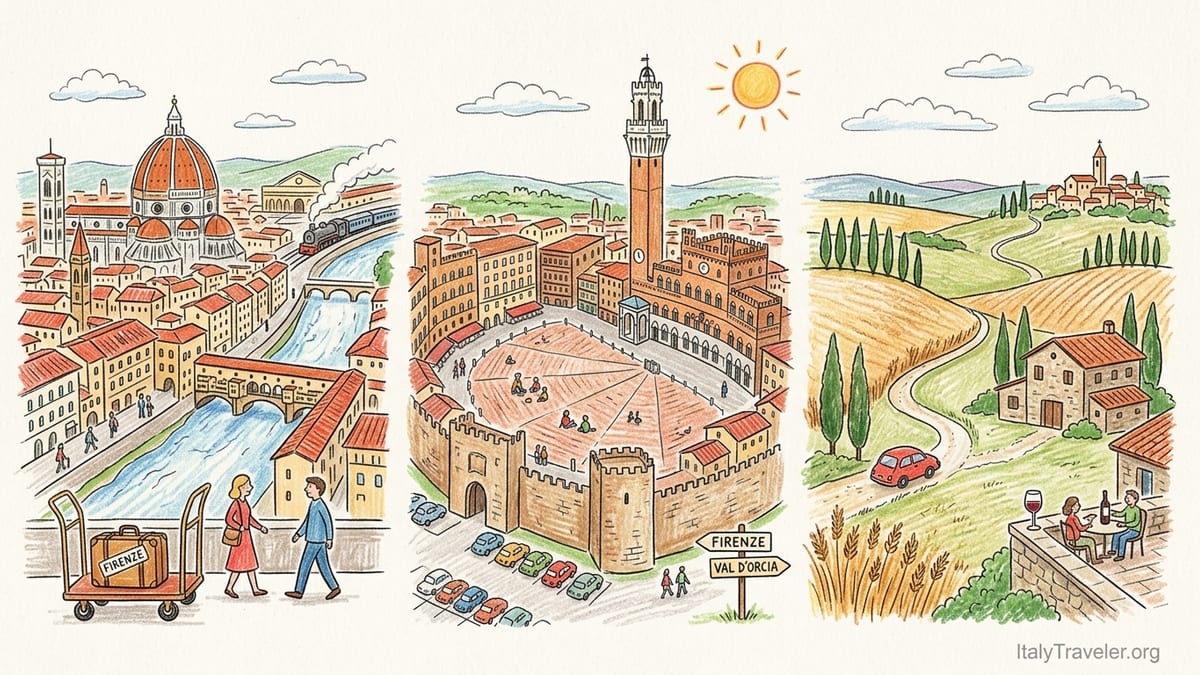
How I Structured My Tuscany Trip
I arrived by train into Florence and treated it as my big-city cultural immersion. I booked a midrange hotel about ten minutes’ walk from Santa Maria Novella station, in the streets between the station and the Duomo. This let me drag my suitcase on foot, walk to the Uffizi and Accademia, and still escape north easily by train for a day trip to Bologna. After five nights of museums and evening strolls along the Arno, I picked up a rental car at the edge of Florence’s historic center and drove south to Siena.
In Siena I stayed just outside the stone walls near Porta Camollia, a steep ten-minute walk above the station. My small hotel overlooked terracotta rooftops of the UNESCO-listed historic center and gave me quick access to Piazza del Campo for late dinners and people-watching, but I could still reach a paid parking lot in about eight minutes on foot when I needed the car. This four-night stay became my bridge between urban Florence and rural Val d’Orcia, with easier parking and quieter evenings than Florence, but still a strong sense of city life.
For the countryside portion, I based myself at a family-run agriturismo between Pienza and San Quirico d’Orcia. The farmhouse sat on a gravel lane surrounded by wheat fields and cypress-lined ridges recognizable from almost every photo you have ever seen of Tuscany. Mornings started with bells from a distant church and the sound of tractor engines in the valley, evenings ended with starry skies and a glass of red wine on a stone terrace. This stay required a car, but it turned the Val d’Orcia into my backyard rather than a rushed day trip.
In the sections that follow I will describe my direct experience of each base. When I mention current prices or practical details I did not personally pay attention to at the time, I rely on recent research and label those figures as researched. My aim is that you can read this and say, “Given the way I travel, I can see which base fits me best,” rather than hunting for a one-size-fits-all verdict.
Hotel Costs and Overall Expense
In Florence, I felt the accommodation cost immediately. For my October stay, my simple but central three-star hotel near Santa Maria Novella cost just under 170 euros per night including breakfast. That is consistent with recent rate snapshots that place average advertised prices in Florence around the mid-100s per night for central hotels in 2026. (researched) Even basic rooms within a walk of the Duomo and Uffizi carried a premium, and I had to book months ahead to avoid much higher prices.
Siena felt noticeably gentler on my wallet. My room just outside the walls, still an easy stroll to Piazza del Campo, was about 135 euros per night in a restored townhouse with exposed beams and a view of tiled roofs. Looking now at typical listings for the historic center, I see many midrange options hovering between roughly 120 and 180 euros per night in shoulder season. (researched) On the ground, that matched my impression: Siena offered character-filled buildings and atmospheric stays similar to Florence but for a bit less money, especially if you were willing to be just beyond the absolute heart of the old town.
Val d’Orcia was the most variable. My agriturismo stay, booked almost a year ahead, came to about 190 euros per night for a large double room with breakfast, a shared pool and wide countryside views. Talking with the owners and comparing notes with other guests, I realized I was in the middle of the local range. Cozy farm stays with simpler rooms and fewer amenities can come in closer to 130–160 euros per night, while design-forward country estates can run several hundred euros per night, especially in high summer or at villas that require week-long bookings. (researched) For me, the extra expense felt justified by space, views and included breakfasts that were almost full meals.
Purely on accommodation cost, Siena was the best value for a walkable historic base, Florence was the most expensive but came bundled with world-class art and train convenience, and Val d’Orcia cost more per night but replaced city noise with open landscapes and farmhouse comfort.
Parking, Driving and Using Trains
My experience with cars differed sharply in each base. In Florence, I avoided driving within the historic center because of the ZTL, the restricted zone policed by cameras. Instead, I timed my rental pickup for the morning I left the city, choosing an office on the outer ring roads. During my stay I walked or used local buses. Researching later, I learned that central garages around the station and near the Duomo often charge around 30 to 35 euros per 24 hours, with some like Garage Europa advertising a full day at 35 euros and small private garages listing daily caps between roughly 30 and 50 euros depending on vehicle size. (researched) That confirmed my sense that keeping a car during the Florence segment would have burned through my budget without adding much freedom.
In Siena, I did keep the car, but parked outside the walls in signed lots. Walking back to my hotel in the evenings, I would pass lines of cars facing city gates, all paying for the privilege of being close to the center but not within the medieval core. Daily caps varied among lots, but I typically paid under 25 euros for a full day, and sometimes less when leaving after dinner. (researched) The trade-off was a ten to fifteen minute uphill or downhill walk between parking and hotel. Once I accepted that mini workout, it was manageable, and I appreciated being able to drive out early to smaller hill towns without navigating a big-city ring road.
In the Val d’Orcia, the car flipped from nuisance to necessity. My agriturismo had free gravel parking right by the farmhouse, and driving became part of the pleasure. I remember the feel of the steering wheel under my hands as I wound along the road between San Quirico and Pienza at golden hour, stopping in improvised pullouts just to stare at cypress-lined ridges. Public transport in this region is sparse and slow, so basing here without a car would have felt very limiting. (researched) My only parking costs were in small town lots, which were usually a few euros for an hour or two or sometimes free in shoulder season.
For train access, Florence won easily. My five-minute walk to Santa Maria Novella opened the whole country. I used a regional train to Lucca for a day, hopping on an early departure and stepping off inside Lucca’s walls barely an hour and a half later. Fast trains toward Rome and Venice also start from this station, which makes Florence ideal if you want to pair Tuscany with other cities. Siena’s station is downhill from the historic center and connected by escalators and buses. I took a regional train to Chiusi one day, but schedules were less frequent and slower than from Florence. From the Val d’Orcia, I essentially forgot trains existed until I drove back toward Rome.
Restaurants, Nightlife and Evening Atmosphere
Some of my strongest memories from Florence involve walking home after dinner. One night, after a plate of tagliatelle with wild boar and a glass of Chianti in a trattoria near Piazza della Signoria, I stepped out to find the streets still pulsing with life around 11 pm. Street musicians clustered on the edges of the piazza, and there was a slow stream of visitors licking gelato near the Palazzo Vecchio. I crossed the Ponte Vecchio at night and watched jewelry shop shutters gleam in the lamplight. That buzz was constant: Florence’s bars around Santa Croce and Oltrarno stayed open late, and even midweek, I could always find a wine bar or cafe still serving.
My restaurant choices in Florence were almost overwhelming. In the space of a few blocks I could find a crowded panini shop, a sleek enoteca pouring Super Tuscans by the glass, and classic trattorie serving bistecca alla fiorentina big enough to share. Prices reflected the city’s popularity, with many sit-down dinners for two drifting into the 60 to 90 euro range including wine and dessert, depending on how fancy I went. (researched) I also made good use of casual options like market stalls in and around Mercato Centrale, where a plate of fresh pasta or a slice of pizza cost far less than a full restaurant meal.
Siena’s evenings were softer but still social. I kept gravitating to Piazza del Campo, where, after dark, couples and groups of friends sat directly on the sloped brick pavement, talking and watching the Torre del Mangia rise against the night sky. I remember returning to my hotel along narrow backstreets around 10:30 pm after a late dinner of pici all’aglione and grilled lamb. Much of the crowd had thinned, and the soundscape had shrunk to footsteps and the occasional laughter from a bar near the main square. Siena has wine bars and a student presence thanks to its university, but overall nightlife felt lower-key than Florence.
In the Val d’Orcia, evenings ran on farm time. At my agriturismo, dinners started around 7:30 or 8 pm in a stone-walled dining room. The owner’s family served whatever was cooking that day: ribollita, roast pork, vegetables from their own fields, plus their house red. Conversation spilled across long tables, but by 11 pm the property was dark apart from lanterns and the Milky Way overhead. On a couple of nights I drove to Pienza or Montalcino for dinner instead. After parking in small lots outside the walls, I wandered quiet lanes lit by warm streetlights, then drove home on nearly empty roads, following the silhouette of cypress trees against the sky.
If you want vibrant nightlife with many bar options, Florence is the clear winner. If your ideal evening is a late but calm dinner followed by a quiet stroll through medieval streets, Siena was my favorite. If you want to swap nightlife for stars, slow conversation and early bedtimes, Val d’Orcia is unmatched.
Sightseeing, Art and Day Trips
For art and headline sightseeing, Florence is still the heavyweight. On my museum days, I woke early and walked from my hotel to the Accademia to see Michelangelo’s David when the doors opened. Afterward I grabbed a coffee, then drifted toward the Duomo to climb the dome, before a slow afternoon in the Uffizi amid Botticelli and Caravaggio. That kind of day would be impossible as a simple day trip if you were based far outside the city. Being able to walk five or ten minutes back to my room for a nap between museums was an underrated luxury. For a first visit to Tuscany focused on art, I would always suggest at least a few nights in Florence as a base.
Siena’s cultural hit list is smaller but intensely atmospheric. The first time I stepped into Piazza del Campo and saw the shell-shaped square open below the Palazzo Pubblico, I understood why this historic center is recognized as a UNESCO World Heritage Site. Inside the cathedral, the black-and-white striped columns and intricate marble floors held me for over an hour. The scale is more intimate than Florence, which made it possible to see several key sights in a relaxed single day and then spend extra time simply wandering contrade, the traditional neighborhoods that still define the city’s identity.
From Siena, my favorite day trips were to smaller hill towns: Monteriggioni with its complete ring of walls, and San Gimignano with its many towers, both reachable in under an hour by car. Basing in Siena instead of Florence cut my driving times to these places and put me closer to the southern half of Tuscany. For wine lovers, Siena is also a natural jumping-off point toward Montalcino and Montepulciano, though the drives become truly scenic once you enter the Val d’Orcia area.
The Val d’Orcia turned day trips into gentle drives rather than logistical puzzles. Most mornings I had no strict plan: I might wake to mist drifting through the valley, linger over breakfast, then drive fifteen minutes to Pienza for pecorino tastings, or half an hour to Bagno Vignoni to soak my feet near the steaming medieval pool. Montalcino, with its fortress and Brunello tasting rooms, sat about forty minutes from my agriturismo, and I spent an entire afternoon sampling wines in town before returning to my farmhouse kitchen for a simple dinner of bread, cold cuts and salad. Basing here meant I never felt compelled to race anywhere; the landscape itself became the attraction.
Atmosphere, Pace and Romantic Feel
Each base had a distinct emotional tone. Florence felt energetic, cultured and occasionally crowded. Walking back to my hotel one evening along Via dei Calzaiuoli, I threaded between tour groups, street performers and locals in work clothes heading home. I loved the feeling that there was always something happening, whether a temporary art exhibition, a fashion event or simply the nightly promenade along the Arno. For a couple who enjoys busy cities and wants dinners, bars and cultural events at their doorstep, Florence has an urban romance anchored in history.
Siena’s romance came from scale. The historic center is large enough to get a little lost, but small enough that, after a couple of days, I knew which corner would reveal the striped cathedral façade, which slope led toward Piazza del Campo, and where the quiet backstreets were for an after-dinner stroll. On one night, a light rain fell as I left a trattoria. The wet stones reflected the lanterns along the narrow street, and for ten minutes I saw no other pedestrians at all. That sense of medieval streets briefly to yourself is rare in Florence’s core. For me, Siena struck a sweet spot: historic, atmospheric, but not as intensively touristed as Florence.
In the Val d’Orcia, the romance was rural and slower. I remember waking up before sunrise one morning, stepping outside and seeing low fog floating in the valley, with just the tips of distant hills emerging like islands. Apart from birds and the rustle of wind in cypress trees, it was silent. My partner and I made coffee in the shared kitchen and sat on the terrace wrapped in jackets, saying very little. There is a particular form of intimacy that comes from having almost nothing to do except watch the light change over fields and share long meals made from local ingredients. For honeymooners or couples in need of a reset, that countryside quiet is hard to beat.
If your idea of romance involves museums and theater followed by a cocktail bar, I would lean to Florence. If it is medieval squares, lingering glasses of wine and fewer crowds, Siena worked best for me. If it is privacy, views and unhurried days, the Val d’Orcia is where my mind still goes when I think of “romantic Tuscany.”
Which Base I Preferred for Different Trip Styles
For art and big-name culture, Florence was my clear favorite. Being able to pop into the Bargello on a rainy afternoon or revisit a favorite room in the Uffizi without a two-hour train ride felt luxurious. If it were my own first time in Tuscany, I would probably spend at least three or four nights in Florence, even if I planned to add other bases, simply to give those museums and churches the attention they deserve.
For a first-time Tuscany trip overall, though, I would not recommend choosing only Florence. My own trip felt balanced because I also had time in Siena and the countryside. If you have ten nights, something like three nights in Florence, three in Siena and four in the Val d’Orcia would give a satisfying mix of city, small town and rural landscapes. Siena makes a great stepping stone that introduces you to Tuscan hill town life without sacrificing too many urban conveniences.
For wine-focused travel and road trips, I personally preferred the Val d’Orcia as a base. Wineries around Montalcino, Montepulciano and the broader Orcia DOC area were reachable along low-traffic scenic roads, and many agriturismi either produce their own wine or have close relationships with local producers. Being able to buy a bottle directly from a farm and drink it on a terrace while looking at the vineyard that produced it is a different experience from tasting wine by the glass in a city enoteca. Siena came second for wine, because it sits at a reasonable driving distance from classic red wine areas, while Florence felt more about enotecas than vineyards.
For a slower, romantic stay, my personal winner was the Val d’Orcia. Those evenings under the stars, lack of traffic noise and shared farmhouse dinners linger in my memory more than any cocktail bar. Siena would be my second choice for couples wanting a slower base without renting a car, while Florence, for all its beauty, felt more like a stimulating city break than a place to fully switch off.
In the end, I did not find a single “best” base, only better matches for different styles: Florence for art and trains, Siena for small-city charm and balanced day trips, and Val d’Orcia for wine, driving and slowing down. The best choice for you depends on which of those priorities feels most important.
The Takeaway
Looking back on my three-part stay, I am glad I treated Florence, Siena and the Val d’Orcia as separate homes instead of trying to do everything from one base. Florence worked best when I leaned into its strengths as a compact cultural capital with powerful train links, walked everywhere and skipped the car. Siena shone when I embraced its hilltop setting, used parking lots outside the walls and allowed evenings to revolve around Piazza del Campo rather than a checklist of sights. The Val d’Orcia rewarded me for accepting slower mornings, longer drives and the quiet rhythms of rural life.
If you are planning your own trip, start with your non-negotiables. If you need easy trains and major art, include Florence. If you want medieval streets, a strong sense of place and slightly lower costs, give Siena real time, not just a rushed day trip. If your priorities are wine, photography, countryside walks and long conversations over dinner, carve out several nights in the Val d’Orcia rather than squeezing it into a single drive.
Most travelers do not have the luxury of spending two full weeks in Tuscany, so compromise is inevitable. But even with seven or eight nights, dividing your time between at least two of these bases can give you a much richer sense of the region. There is no universal winner. There is only the base that best fits the version of Tuscany you most want to experience right now.
FAQ
Q1. For a first trip to Tuscany, should I stay only in Florence?
For a short three or four night trip focused on museums and easy trains, Florence alone can work. With a week or more, I found it more satisfying to combine Florence with either Siena or the Val d’Orcia so I could experience both city culture and countryside landscapes.
Q2. Is it worth renting a car if I base in Florence?
From my experience, keeping a car while staying inside Florence was more hassle than help because of the restricted traffic zone and paid garages. I preferred to explore Florence on foot and by train, then pick up a car only when I left the city for Siena or the Val d’Orcia.
Q3. How many nights should I spend in Siena?
I spent four nights and felt that was a comfortable minimum. With two full days you can see the major sights and still have time for relaxed wandering and a day trip to another hill town. If you rush in and out in a single day, you miss the special evening atmosphere around Piazza del Campo.
Q4. Do I need a car to enjoy the Val d’Orcia?
Based on my stay, yes. While there are occasional buses, schedules are limited and stops are often outside small towns. Having a car turned the region into a web of easy half-day trips and made my agriturismo feel connected rather than isolated.
Q5. Which base is best if I care most about wine tasting?
For vineyard visits and scenic drives between wineries, I preferred staying in the Val d’Orcia, within reach of Montalcino and Montepulciano. Siena is a good alternative if you want some wine day trips while still enjoying a walkable historic city.
Q6. Are hotels cheaper in Siena than in Florence?
On my trip, similar-quality rooms in Siena’s historic center or just outside the walls were generally cheaper than equivalent central rooms in Florence. Recent price checks show Florence’s average asking rates running somewhat higher than Siena’s for comparable midrange hotels.
Q7. Can I visit all three bases in one week?
It is possible, but I would keep it to two bases with seven nights to avoid feeling rushed. If you are determined, something like three nights Florence, two Siena and two in the Val d’Orcia can work, but you will spend more time packing and transferring.
Q8. Which place felt safest walking back at night?
I personally felt comfortable walking back to my hotel at night in all three bases, sticking to lit central streets. Florence was the busiest late, Siena was quieter but still felt safe near the main square, and in the Val d’Orcia most of my evenings ended at the agriturismo itself.
Q9. If I travel by train only, is Siena or Val d’Orcia realistic as a base?
Siena can work with trains and buses, though connections are slower than from Florence and you may rely on regional buses for nearby towns. The Val d’Orcia is difficult without a car, and from my experience would be better as a guided tour or day trip if you cannot drive.
Q10. For a romantic honeymoon, which base would you repeat?
For my own taste, I would choose an agriturismo in the Val d’Orcia again for the views, quiet and long shared dinners. I would probably add two or three nights in Florence at the start or end of the trip for art and a celebratory city dinner, but the countryside felt most romantic overall.