

The day I finally left Florence for the Chianti hills, I wanted more than pretty vineyard photos. I wanted to actually understand what was in the glass when I ordered a Chianti Classico at dinner. So I booked a small-group tour along the Chiantigiana road between Florence and Siena, the same route Tuscany’s official tourism board promotes through Greve, Panzano and Castellina in Chianti. By the time I came back that evening, I had Sangiovese on my teeth, olive oil stains on my notebook, and a much clearer idea of how to choose between a private driver, a small-group trip and simply renting a car and following the Chianti Classico Wine and Olive Oil Trail on my own.
Getting Out of Florence and Onto the Chiantigiana
I started my day in Florence at 8:45 a.m., walking across the Arno to a small office near San Niccolò where our guide and minibus were waiting. I had deliberately chosen a small-group Chianti Classico tour limited to eight guests instead of one of the forty-seat coach excursions that line up near the main train station. Several Florence-based operators now focus on these smaller groups with a maximum of six to eight people and visit two or three working wineries rather than large tasting halls that handle busloads.
Our vehicle was a nine-seater Mercedes van, which matters more than you might think. The roads on the Chiantigiana, the SR222 that runs from Florence to Siena, are paved and well maintained but they curve constantly as they climb through the hills. Sitting higher up in a small van felt comfortable and, importantly, allowed us to turn onto narrower side roads toward family estates that bigger buses simply cannot reach. Our driver was also the guide, a licensed sommelier who could talk about soil types while negotiating hairpin bends without drama.
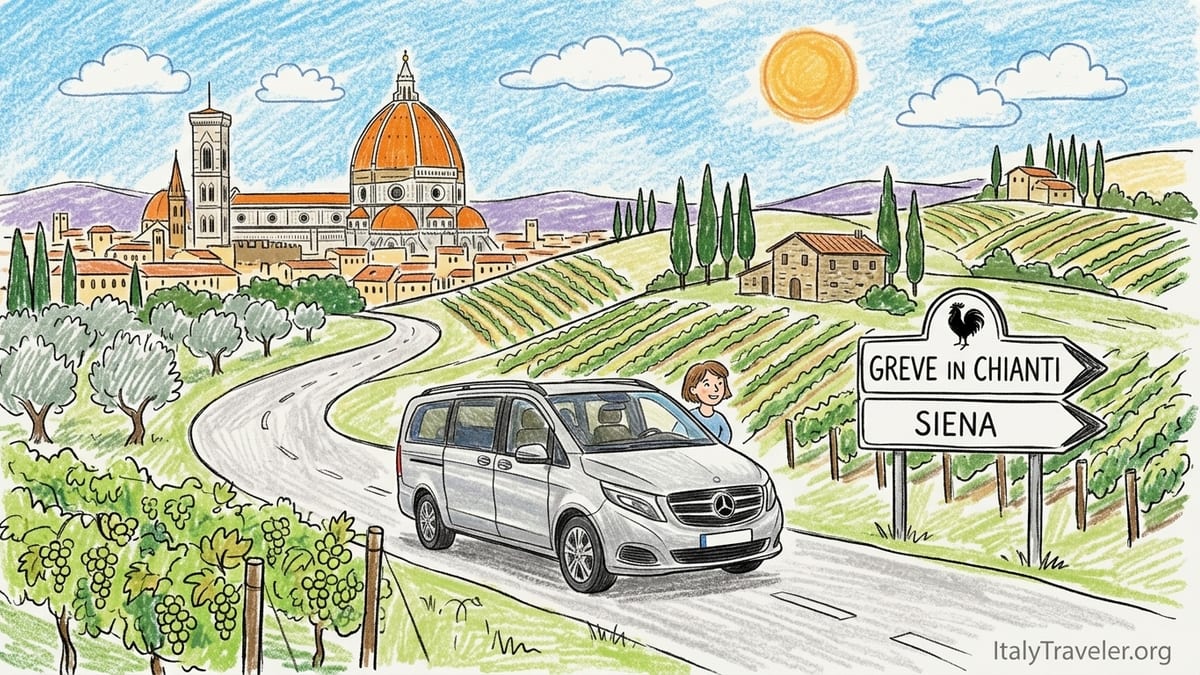
We left Florence heading south, joining the Chiantigiana beyond the suburban stretch. Within thirty minutes the scenery changed to textbook Tuscany: vineyards stitched into rolling hillsides, cypresses punctuating ridge lines, and stone farmhouses sitting above silvery bands of olive trees. Official Visit Tuscany itineraries describe the SR222 as the backbone of Chianti, stringing together Greve, Panzano, Castellina, Radda and Gaiole over roughly 70 kilometers. That description matched what I saw through the van window as we climbed toward our first stop in the Greve area.
One of the underrated benefits of not driving myself became obvious almost immediately. Our guide used the drive to sketch out what “Chianti Classico” actually means compared with bottles simply labeled “Chianti,” and how the black rooster emblem on the neck indicates the historic area between Florence and Siena. Having that context before we reached a cellar meant that the morning’s first tasting felt like a lesson that built on what I had just heard, rather than an isolated marketing speech.
First Stop: Greve and a Castle Above the Vines
Our first winery sat above the town of Greve in Chianti, the main village in the northern part of Chianti Classico. Greve appears in every official Chiantigiana itinerary, and for good reason. The town itself has an arcaded triangular piazza lined with enotecas and salumerie, and the hills above it hold some of the region’s most visited estates. We drove past a viewpoint looking down to the valley, then climbed a smaller road that wound through vineyards before reaching a stone complex with a medieval tower and panoramic terrace.
The visit began with a short tour through the grounds and historic cellars. These older Chianti estates like to emphasize continuity, and walking past large Slavonian oak casks and rows of barriques while hearing about a family that has grown Sangiovese here for generations can feel like theatre. What made this stop feel less staged was the guide’s willingness to answer detailed questions about yields, organic conversion, and how much of their production is actually bottled under Chianti Classico compared with other labels.
The first tasting took place in a large but atmospheric room overlooking the vineyards. We tried four wines: a basic Chianti Classico, a Chianti Classico Riserva, a more premium selection often positioned between Riserva and Gran Selezione, and a Super Tuscan that blended Sangiovese with international varieties. Pour sizes were modest but generous enough for proper evaluation, around 40 to 50 milliliters in each glass. Bread drizzled with the estate’s own extra virgin olive oil and a small board of local pecorino and finocchiona helped keep us upright.
Time-wise, the stop lasted about ninety minutes. It never felt rushed, though the shop section at the end made it clear that sales are important to keep these tours sustainable. Prices for bottles here started around 12 to 15 euros for the entry-level Chianti Classico and climbed considerably for single-vineyard and older vintages. Shipping options to the United States were explained efficiently, with approximate door-to-door costs quoted so nobody had to guess. If you are sensitive to sales pressure, know that you can simply thank them and walk back to the terrace; staff are used to some guests buying nothing at all.
Through Panzano and Lunch Among the Barrels
From Greve we rejoined the Chiantigiana and continued south toward Panzano in Chianti, about ten kilometers away. Panzano is smaller than Greve but sits on a ridge with expansive views in both directions, something you notice as soon as you climb from the parking area to the main square. Our tour allowed half an hour here, enough for a quick espresso, a look into the local butcher’s shop made famous by its owner, and a brief wander to a viewpoint over the Conca d’Oro, the golden basin of vineyards that curve beneath the town.
Compared with Greve, which feels like a small market town, Panzano has more of a hilltop village atmosphere. Independent travelers often linger here in the late afternoon for aperitivo, but on a structured tour the stop is intentionally short. That pacing makes sense if you want to fit in two wineries plus a village visit between Florence and Siena in one day. For me it struck the right balance: enough time to stretch my legs and get a sense of the place without losing the thread of the wine day.
Lunch took place at our second winery, not far from Panzano. This was a smaller, family-run estate with perhaps 20 hectares under vine, exactly the sort of producer that small-group tours can reach and bigger buses cannot. We sat at a long table in a former barrel room converted into a rustic dining space, with open brick arches and glimpses of the working cellar beyond. Platters of bruschetta with fresh tomato and olive oil arrived first, followed by a simple pasta al ragu, roast pork with rosemary potatoes, and a light dessert. Vegetarian and gluten-free plates appeared for those who had notified the operator at booking.
Here we tasted another four wines, poured more generously than at the first estate. The progression moved from a fresh IGT red through Chianti Classico, Chianti Classico Riserva and a more structured selection. The owner poured and spoke in Italian while our guide translated and added detail about how the wines differed from what we had tasted in the morning. Including a dessert wine and a small sample of the estate’s olive oil, we probably tried the equivalent of three to four full glasses over lunch, spread across two hours with plenty of food. I never felt rushed to finish a glass before the next wine appeared, which is not always the case on cheaper, more commercial tours.
Castellina, Siena and the Rhythm of the Day
After lunch we continued along the Chiantigiana toward Castellina in Chianti, one of the key names along both the SR222 and the official Chianti Classico Wine and Olive Oil Trail. The town’s stone streets and subterranean vaulted walkway along the old walls make it an appealing place to walk off some of the lunch calories. We had about fifty minutes here, just enough to stroll the main street, duck into a small enoteca for an extra tasting or coffee, and climb to a viewpoint over the surrounding vineyards and forests.
The pace by this point felt pleasantly slow. On some large-group day trips the afternoon can turn into a blur of photo stops and rushed tastings. With only eight of us to herd, our guide could adapt slightly to the mood. When everyone lingered on the viewpoint a little longer, he simply shifted the Siena arrival time back by ten minutes. That casual flexibility is one of the best arguments for choosing a small-group format over a rigid coach itinerary where every minute is scripted.
Technically, our tour advertised Florence to Chianti and back rather than Florence to Siena, but the route mirrored the classic Florence to Siena Chiantigiana drive, so the guide pointed out where one would turn if continuing south. He explained that some private-driver itineraries do exactly that, finishing with an early evening drop in Siena so guests can stay overnight rather than returning to Florence. Listening to him outline that option, while looking at road signs pointing to Siena, helped me imagine how I might plan a self-drive next time.
We arrived back in Florence a little after 6 p.m., about nine hours after departure. Total time actually spent tasting wine was perhaps four hours across the two estates, with the remainder divided between driving, village stops, cellar tours and lunch. That ratio felt ideal. I left pleasantly buzzed but far from drunk, with enough mental space to absorb information instead of just chasing the next pour.
Private Tour vs Small Group vs Self-Driving
Before this day, I had debated three options for experiencing Chianti: hiring a private driver-guide, booking a small-group tour like the one I chose, or renting a car and following the Chiantigiana at my own pace. Talking to guides, winery staff and fellow travelers along the way, and experiencing how the day actually flowed, clarified the trade-offs more than any brochure description could have.
Private driver-guides that specialize in Chianti typically charge a flat day rate, often somewhere in the low hundreds of euros for the vehicle and their time, not including tasting fees and lunch. Split between four people, that can work out to a per-person cost in the same range as quality small-group tours that bundle everything. The difference is control. With a private driver you pick the exact mix of big-name estates and tiny family properties, and you can linger in a village like Castellina or Panzano for as long as you like without watching the clock. This is particularly attractive if you already know specific wineries you want to visit or if you are traveling in a group with particular interests.
Small-group tours, usually capped between six and eight people, sit in the middle. Companies operating from Florence build relationships with wineries that welcome small numbers and offer more personal experiences. The per-person prices I found when researching, usually in the mid to high hundreds in total for a full day including transport, tastings and a proper lunch, reflect that curation. You surrender some control over the exact estates visited, but you gain the ease of not having to organize time slots, navigation or designated driving. For a first exploration of Chianti, that trade felt entirely worth it to me.
Self-driving is the most flexible on paper. Rental cars picked up in Florence or at the airport allow true spontaneity: pulling over for photos when the light on the vines is perfect, choosing a trattoria in a hamlet the tour buses skip, and following brown signs for “vendita diretta” to simple cellar doors you would never find otherwise. Yet visiting multiple wineries while driving yourself raises practical issues. Many estates require reservations for proper tours and tastings, parking in hill towns can be tight, and someone in the party needs to remain under the legal alcohol limit on roads filled with curves and occasional cyclists.
What my small-group day taught me was that these options are not mutually exclusive. Next time I visit, I will likely repeat a guided small-group Chianti Classico day early in the trip to refresh my knowledge and discover one or two new producers, then rent a car for a separate day of slow exploration, focusing more on villages and viewpoints than structured tastings. Travelers with a special celebration or a group of wine-obsessed friends might prefer to invest in one fully customized private day instead.
Inside the Glass: What I Actually Learned About Chianti
Beyond the scenery and the food, the most valuable part of the day was finally internalizing what the labels on a Chianti Classico bottle are trying to tell you. Repetition helps. Hearing a sommelier outline the basics in the van, then listening to two different winemakers explain their interpretations, made the information stick in a way that reading about it beforehand had not.
The key takeaway was that “Chianti Classico” refers to the historic production zone between Florence and Siena, with the black rooster emblem on the neck, and that these wines must follow certain rules about grape composition, aging and alcohol levels. Within that framework, standard Chianti Classico, Chianti Classico Riserva and more select bottlings represent increasing levels of structure and aging. Tasting these side by side at both wineries, with slightly different blends and barrel regimes, sharpened my sense of how producers choose to express their terroir.
Olive oil and food pairings played a quiet but important role. At both estates we dipped bread into new season extra virgin olive oil and then tasted the same Chianti again. The way the wine’s acidity cut through the oil and the salt of the pecorino cheese made it clear why Sangiovese has thrived alongside Tuscan cuisine. The lesson was simple but powerful: when ordering in Florence or Siena, think about dishes that have enough fat and richness for Chianti’s acidity and tannin to work with, not against.
I also came away with a more grounded sense of pricing. While I will not quote exact figures that shift with vintage and availability, it was clear that excellent everyday Chianti Classico often sits in a price band that feels accessible for a special weeknight bottle back home, while more age-worthy selections and single-vineyard wines climb into more serious territory. The guide’s advice to look for producers we had visited when browsing wine lists in Florence restaurants, instead of chasing only famous names, turned out to be sound over the following days.
How Commercial Did It Feel?
Many travelers worry that wine tours from Florence will feel like thinly disguised shopping trips. Parts of the experience are commercial by necessity. Wineries allocate staff time and pour multiple wines for groups, and tours need to cover those costs. Shops are prominent at both estates we visited, with curated shelves, shipping offers and well-rehearsed descriptions of special cuvées. There is a clear pathway from cellar to tasting room to cash register.
Yet on this small-group day the commercial element never overwhelmed the educational side. At our morning estate, for instance, the cellar tour focused more on production decisions than on promotional slogans. Questions about yields, fermentation temperatures or organic certification were answered without deflection. Only at the end were we gently reminded that purchases help support the estate and that shipping could simplify getting bottles home. Several people in the group bought one or two bottles each, a few ordered shipments, and a couple of us bought nothing. No one seemed to receive different treatment based on how much they spent.
The family-run winery at lunch felt even less sales driven. Here the owner poured with evident pride but spoke as much about weather challenges, replanting older vines and the reality of competing in export markets as about their top cuvée. Prices were written clearly on a simple printed sheet, and orders were taken casually between dessert and coffee. It felt more like visiting a neighbor than stepping into a polished tasting-room script.
From conversations with fellow travelers who had chosen different tours, a pattern emerged. Very low-priced full-day tours that promise multiple wineries, sightseeing stops and lunch at a bargain tend to rely more on larger, more commercial estates that can handle big groups all season. Mid-range and higher-end small-group operators, while not perfect, generally work with smaller properties that balance sales with storytelling. If you value a less commercial feel, it is worth investing a little more up front to avoid feeling like a captive audience for hard-selling practices.
The Takeaway
By the time I stepped off the van back in Florence, the Chiantigiana was no longer just a line on the map between Florence and Siena. It was a sequence of tangible experiences: walking under stone arcades in Greve, looking out over the Conca d’Oro from Panzano, tasting Sangiovese with lunch in a former barrel room, and watching late-afternoon light slip across the vineyards near Castellina. The day delivered the postcard views I had hoped for, but it also gave me enough structure and context to understand what I was drinking, without drowning the experience in jargon.
If you are choosing between a private driver, a small-group tour or renting a car to explore Chianti, consider starting with your priorities. If control over every stop and schedule matters most, and your budget comfortably accommodates it, a private driver-guide unlocks doors and allows you to shape the day minute by minute. If you want a curated introduction to Chianti Classico, with two or three meaningful winery visits, a proper lunch and logistics handled from Florence, a reputable small-group tour offers excellent value and a relaxed pace. If you crave maximum flexibility and are comfortable limiting your tastings, self-driving along the Chiantigiana opens space for slow coffee breaks in villages and unplanned photo stops.
What my day between Florence and Siena proved is that there is no single “right” way to experience Chianti, only a better match between your expectations and the format you choose. For a first-time visitor who wants both learning and pleasure, I would repeat the small-group route in a heartbeat, then build on that foundation with more independent exploring next time. Whatever you decide, give the region at least one unhurried day. Chianti reveals itself slowly, glass by glass, hillside by hillside, and that measured rhythm might be the region’s greatest luxury.
FAQ
Q1. Is it realistic to visit Chianti on a day trip from Florence?
Yes, it is very realistic. My small-group tour left Florence around 9 a.m., visited two wineries plus at least one village along the Chiantigiana, and returned a little after 6 p.m., which allowed enough time for tastings, lunch and short walks without feeling rushed.
Q2. How many wineries can you comfortably visit in one day between Florence and Siena?
Two wineries with a proper cellar tour and a sit-down tasting or lunch at one of them is comfortable. Adding a third stop is possible, but in my experience it risks turning the afternoon into a sequence of quick pours rather than relaxed conversations and learning.
Q3. Do I need to book winery visits in advance if I am self-driving?
For most estates in Chianti Classico, yes. Many wineries along the Chiantigiana and the Chianti Classico Wine and Olive Oil Trail require reservations for guided tours and structured tastings, especially in peak months from May to October, so contacting them ahead of time is important.
Q4. Is it worth paying extra for a small-group tour instead of a big coach trip?
In my experience, it is worth it if you care about atmosphere and depth. Small groups of six to eight people can visit family-run wineries and adjust the pacing slightly, while large coaches often rely on bigger, more commercial estates and follow tighter schedules with less flexibility.
Q5. Can I combine a Chianti wine day with sightseeing in Siena?
It is possible but can feel compressed. My day followed much of the Florence to Siena Chiantigiana route, and our guide explained that some private-driver itineraries end in Siena, but fitting two full winery visits and meaningful time in Siena into one day usually requires a private arrangement and an early start.
Q6. What should I eat with Chianti Classico during tastings?
Local foods work best. At the wineries we visited, Chianti was paired with pecorino cheese, cured meats, bruschetta with extra virgin olive oil, simple pastas with ragu and roasted meats, all of which balanced the wine’s acidity and tannins very well.
Q7. Is it safe to drive the Chiantigiana after tasting wine?
The road itself is well maintained but very winding, and local drink-driving limits apply. If you plan to self-drive, it is wise to spit or limit your intake at tastings and ensure one person remains clearly under the limit, or consider hiring a driver so everyone can participate fully.
Q8. Are Chianti wine tours suitable for solo travelers?
Yes. On my small-group tour several solo travelers joined, and the intimate group size made it easy to talk with others. Solo travelers often find small-group formats more sociable and less isolating than private drivers or self-driving alone.
Q9. When is the best time of year to take a Chianti wine tour?
Late spring and early autumn are particularly rewarding, with comfortable temperatures and vineyards either lush green or turning autumnal. Summer brings longer days but also more crowds, while winter offers a quieter, more cellar-focused experience with less vineyard activity.
Q10. Can I ship wine home from Chianti wineries?
Most wineries I visited or researched offered international shipping, including to the United States, with costs varying by quantity and destination. Staff typically explain approximate shipping prices during tastings, so you can decide whether to send a case or pack a bottle or two in your luggage.