

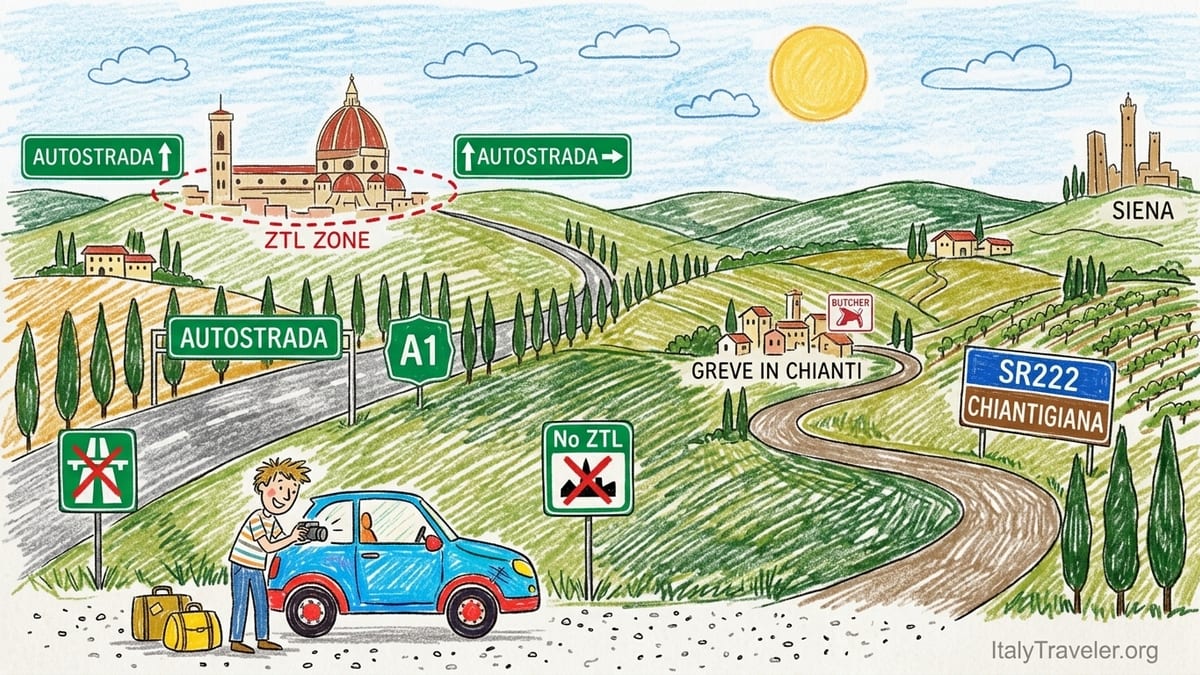
I picked up my rental car on the edge of Florence with a printed ZTL map in one hand and the Chiantigiana road marked in bright yellow on the other. Over five days I drove from Florence through the hills of Chianti to Siena and then on to the soft, rolling landscapes of the Val d’Orcia. This was not a theoretical itinerary planned from behind a desk. Every place described here was reached by a steering wheel I actually held, on roads I genuinely drove, with all the small wins, wrong turns, ticket worries and parking battles that come with driving in Tuscany for real.
Picking Up the Car in Florence Without Entering the ZTL
I landed at Florence Airport, Amerigo Vespucci, in the late morning and followed the rental car signs toward the shuttle area. At Florence the car hire companies are grouped together in an off-airport rental village reached by a short, free shuttle bus that leaves every few minutes from outside the arrivals terminal. The ride took under ten minutes even with light midday traffic and dropped me directly at a row of desks for the major brands. Inside, the counters for international firms like Hertz, Avis, Europcar and Sicily by Car were lined up side by side, which made it easy to compare car classes and walk to the right parking bay once the contract was signed.
My main concern before this trip was Florence’s Zona a Traffico Limitato, or ZTL, the restricted traffic zone that covers almost all of the historic center. Local authorities make it clear that you need explicit authorization to enter with a private car, and automatic cameras enforce the rules at the access gates. I did not want my Tuscan road trip to start with a ticket, so I chose to avoid the center completely. From the rental lot, I used the ring roads and clear green autostrada signs to head south toward the A1 motorway instead of following any navigation that tried to route me through the old town.
At the rental counter, the agent warned me again about ZTL rules in Florence and in hill towns across Tuscany. She pointed out that the number plate of my car was already in the system and any unauthorized entry past a ZTL camera would trigger a fine that could arrive months later via the rental company. That was enough to convince me to set my navigation to "avoid tolls and restricted zones" before I even left the parking garage. Driving out of the airport area was straightforward, with wide lanes, clear roundabouts and no medieval alleys in sight.
Before leaving the rental village, I also inspected the car more carefully than I usually would. On Tuscan country roads you often park on gravel verges or squeeze into tight village spaces, so I photographed every scratch on the bumpers and wheels. The fuel policy on my contract was full-to-full, which is common at Florence, and the tank was just over three quarters full in reality. I asked the staff to top it up to avoid any disagreement later and used the time to load offline maps for the Chianti region on my phone in case of patchy signal between vineyards.
Choosing Between the Autostrada and the Chiantigiana (SR222)
There are two main ways to drive south out of Florence toward Siena and the Val d’Orcia. The fastest is the A1 motorway, which runs down the spine of Italy with service areas, fuel stations and a steady flow of long-distance traffic. The more romantic route is the Chiantigiana, the SR222, which snakes from the outskirts of Florence through Strada in Chianti, Greve in Chianti, Panzano and on toward Castellina before eventually connecting to roads that feed into Siena. On paper the Chiantigiana is slower, but it is also the way you actually see the countryside instead of just skimming past sound barriers.
On my first driving day I compromised. I used a short stretch of the A1 simply to clear Florence’s busy urban edge, then exited toward Strada in Chianti to join the SR222. The moment I left the motorway the character of the drive changed. The lanes narrowed, the traffic lightened and the turns became more frequent and more interesting. Signposts clearly marked "Greve in Chianti" and "Chiantigiana". The climb grew steeper after passing through Strada, and the curves demanded more attention at the wheel. This was where the road trip started to feel like a journey and not a commute.
On another day later in the trip, when I needed to cover distance quickly between Siena and the fringes of Val d’Orcia, I tried more of the major roads. The Siena link roads and dual carriageways were efficient but forgettable. They worked when I was chasing daylight, yet I did not pull over for photos or wander into villages the way I did on the SR222. The contrast made it obvious why official tourism materials in Tuscany highlight the Chiantigiana specifically as a car itinerary. It is the difference between ticking destinations off a list and experiencing the landscape as a continuous, unfolding scene.
In terms of driving time, my first leg from the Florence airport area to Greve in Chianti via the SR222, with one brief stop in Strada to stretch my legs, took around an hour and a quarter. Staying entirely on the autostrada and faster roads could have shaved that to under an hour, but I would have lost the pleasure of cresting those first Chianti hills and seeing vineyards spill away from the asphalt. For a trip built around scenery, the Chiantigiana was clearly the better choice whenever I was not in a hurry.
Greve in Chianti and Panzano: First Real Stops in Wine Country
Greve in Chianti is the first town where you really feel that you have arrived in classic wine country. Approaching along the SR222, the road flattens slightly and skims past a well-stocked Coop supermarket on the right. I pulled in there not because it was charming but because it was practical. Inside I bought water, some fresh bread, local pecorino cheese and fruit that would serve as a simple car picnic over the next couple of days. The supermarket parking lot was easy to navigate, free when I visited, and significantly calmer than circling for a spot in the old piazza.
After shopping I followed signs into the center of Greve, aiming for the main square, Piazza Matteotti. On my visit, a weekday in late spring, the square was partly set up for a small local event, and sections were coned off. Street parking around the piazza was a mix of blue painted spaces for paid parking and white lines for residents or other categories. I found a spot on a side street a short walk away and fed a few coins into a pay-and-display meter. The ticket printed with my end time, and I placed it carefully on the dashboard. Leaving the car there felt safe because the area was busy but not chaotic, and I made a mental note of a nearby landmark, an old butcher shop, to find my way back.
Wandering under the porticoes of Piazza Matteotti, I finally felt off the clock. Under the arcades were wine shops offering tastings, deli counters with cured meats and a few cafes with outdoor tables. I limited myself to a glass of Chianti Classico with lunch instead of a full tasting flight, conscious that I still had a stretch of the SR222 and the climb to Panzano ahead. It was a good reminder that Tuscany’s wine roads are for driving, not drifting between tastings behind the wheel. If you want to visit several wineries in a day, a hired driver or a local taxi is a better idea than pushing the edges of safe blood alcohol levels.
The drive from Greve to Panzano is short on the map but one of the more enjoyable sections of the Chiantigiana. The road begins to wind more assertively as it climbs, and open views over terraced vineyards appear around many corners. It took me about fifteen minutes to reach the outskirts of Panzano from Greve without any stops. In Panzano itself I followed brown tourist signs toward the historic center and quickly realized that parking was loosely spread along the approach roads and small squares. I eventually left the car in a small, unmarked gravel area that was already dotted with other vehicles, near a viewpoint looking out over the Conca d’Oro valley.
From that makeshift car park it was a steep but rewarding walk up into Panzano’s stone lanes. I found a simple trattoria with a terrace and had a late lunch looking out across the hills I had just driven. I remember checking my watch and being surprised at how long the Greve stop had stretched. Including shopping, coffee and lunch, I had easily spent three hours between the two towns even though the pure driving time was under half an hour. It was my first lesson that a Tuscan road trip measured only in kilometers misses half of what makes it special.
Into Siena: Navigating City Traffic, ZTL and Parking Garages
Leaving Panzano, I continued south on the SR222 past rows of cypress trees and olive groves, eventually passing near Castellina in Chianti and then joining roads that lead toward Siena. As I approached the city, the traffic density increased and the road became more complex with roundabouts, direction signs for various gates and mentions of a ZTL for the historic center. After my earlier briefing in Florence, I had no desire to test Siena’s cameras either. I set my navigation specifically to one of the structured car parks recommended by the local tourism authorities rather than trying to follow signs for "centro" and risk slipping through a restricted gate by mistake.
On my first arrival I aimed for the Parcheggio Santa Caterina, which sits outside the medieval walls on the Fontebranda side of Siena. It is a multi-level, paid car park connected to the upper city by a set of escalators that climb impressively up toward the brick skyline. The approach involved one or two tight turns and ramps, but it was clearly marked and felt less stressful than weaving through unknown surface streets. I took a paper ticket at the automatic barrier, found a spot on an intermediate level and noted the section letter before heading to the escalators. Once at the top, I emerged just a short walk from the heart of the old town.
On a later visit I tried the Stadio Fortezza car park near the Medici Fortress instead. This lot offers a large number of spaces beside the city’s old fortress complex and the modern stadium, and it felt like a good compromise between access and cost. From there it was an easy, mostly level walk along the Lizza gardens into the historic center. Both garages charged hourly rates that, while not cheap, seemed fair for a city that strictly limits on-street parking in order to preserve the character of its historic squares. Paying was straightforward at automated machines that accepted cards and cash before I drove back out.
Driving inside Siena’s walls without a permit remained firmly off-limits in my mind. Many of the beautiful spots in the old town, such as the Piazza del Campo and the Duomo area, are within the ZTL and in some cases inside pedestrian zones where only residents, taxis and delivery vehicles can circulate. I was happy to leave the car resting in the garage and explore on foot. The walk from Santa Caterina or Stadio Fortezza into the center took between ten and fifteen minutes at a gentle pace, and I was rewarded with narrow lanes, glimpses into courtyards and sudden views of the Campo that I would have missed from behind a windshield.
By choosing parking garages on both visits, I never once had to inch the car past crowds in a medieval street or worry that a sudden ZTL sign would appear too late for me to react. The extra walking felt like part of the experience and helped balance out hours of sitting while driving through the countryside. When I finally exited Siena to continue toward the Val d’Orcia, I simply retraced my route to the ring road, following clear signs for the main roads that fan out toward the south.
From Siena to the Val d’Orcia: Secondary Roads and Quiet Fuel Stops
South of Siena the landscapes begin to open up into the classic rolling forms that so often appear on postcards of Tuscany. When planning my route toward the Val d’Orcia, I again faced the choice between sticking with faster main roads or dipping onto smaller secondary routes to thread through the countryside. Over two driving days I tried both styles, using a primary road for one leg when clouds threatened rain and switching to quieter lanes for others when the weather cleared and the afternoon light returned.
Leaving Siena, I headed first toward the direction of Asciano on a relatively fast regional road, then branched off toward the low hills that signal the start of the Val d’Orcia area. From there I worked my way toward Pienza, Montalcino and later to Montepulciano using a network of country roads whose numbers I checked on my map but quickly forgot once the scenery took over. These were generally well paved but narrower than the SR222, with frequent curves and occasional blind summits. Tractors and local drivers appeared without warning, and more than once I pulled into a lay-by to let a resident who knew the road by heart pass me safely.
Fuel had been on my mind since leaving Florence, especially after hearing that some of the smaller hill towns have limited opening hours for manned service stations. To avoid stress, I adopted a simple rule of never letting the tank fall below half full in rural areas. On one long afternoon between Siena and Pienza, I pulled into a modern roadside fuel station on a regional route that offered self-service pumps and a small cafe. Paying at the pump with a card was intuitive despite the Italian instructions. I selected the green petrol nozzle, matched it to the same fuel type listed on the rental contract, and filled until the meter clicked off close to my half-tank goal.
The difference between driving these secondary roads and the more built-up links near Siena was immediate. On the smaller lanes I passed lone stone farmhouses framed by tall cypress rows, isolated chapels on ridges and fields patterned with plowed lines or young green shoots. I stopped more often, pulling completely off the asphalt onto gravel verges where other cars had obviously paused before me. Each time I shut the engine off I noticed how quiet it was, with only wind and distant farm machinery audible. These repeated pauses added time to my days, yet each one produced photographs and memories I would not trade for a few extra kilometers covered.
In terms of pure driving time, a direct push from Siena to Pienza, then onward to Montalcino and finally to Montepulciano in a single day would have been possible. Distances between the towns are measured in dozens of kilometers, not hundreds. In practice, because I stopped for fuel, for coffee in small roadside bars and for photographs on ridgelines, my progress was deliberately slow. One afternoon loop between Siena and Pienza that could have taken a little over an hour on more direct roads turned into a leisurely three hours door to door. That felt exactly right for this kind of trip.
Parking and Exploring in Pienza, Montalcino and Montepulciano
Hill towns like Pienza, Montalcino and Montepulciano are as beautiful as they are impractical for modern cars. In each case I parked outside the oldest part of town in dedicated car parks or signed roadside bays, then walked in through one of the gates. Pienza was my first stop. Approaching from the northwest, I followed signs for parking areas near the walls and chose an open-air lot a short walk from the historic center. The spaces were clearly demarcated, and a pay machine at the entrance handled tickets. From there a gentle uphill stroll along the edge of the walls brought me to the main street and to the stunning viewpoint over the Val d’Orcia from the town’s panoramic terrace.
In Montalcino I arrived by ascending a winding road that curled up toward the fortress. The town appeared gradually rather than all at once. Car parks sit on terraces below the core of the historic center, and I tucked into a bay where other travelers’ vehicles were lined neatly beneath a low stone wall. Here the climb on foot was steeper, with a short but sharp walk up to the fortress and the streets around the central square. The reward was a commanding view back over the road I had taken, with vineyards radiating out in every direction and the promise of Brunello wine in the cellars lining the lanes.
Montepulciano was my final major stop in the Val d’Orcia area. By the time I reached it, late afternoon light had begun to lean warm against the brick and stone facades. Once again I parked outside the inner core, this time in a mixed surface lot that combined asphalt and gravel, backing my car in carefully to leave enough room for neighbors to swing doors open. Walking up into Montepulciano required more climbing than in Pienza but less than in Montalcino. The streets spiraled upward, revealing tucked-away churches, cantinas and artisan shops until I finally stepped out into a piazza near the summit with views across a broad valley.
Across all three towns the pattern repeated. I avoided any signs indicating a ZTL or resident-only zones, even if that meant carrying my camera and a light bag a bit farther on foot. I paid close attention to parking time limits and ticket display requirements. When meters accepted cards, I used them to avoid scrambling for coins. When they only took cash, I overpaid slightly to buy peace of mind. Not once did I feel it was worth nudging the car closer into the labyrinth of old streets. The spaces on the edge were near enough, and the short walk helped shift my mindset from driver back to pedestrian each time.
Driving Realities: Detours Worth Taking, and Those I Skipped
During planning I had sketched several possible detours off the main Florence to Siena and Val d’Orcia line. Some were recommended in guidebooks or tourism brochures, others appeared when I zoomed in on maps and noticed interesting symbols or road numbers. Once I was actually on the ground, I found that not all of them made sense in real time. The limitations of daylight, my own attention span and the rhythm of food and coffee stops meant I had to choose which side roads to explore and which to leave for a future trip.
One of the most rewarding small detours came just south of Greve, where a minor road branched off toward a ridge lined with cypress trees I had seen in photographs. The lane was paved but narrow, with just enough width for two cars to pass slowly. It led to a cluster of farmhouses and a tiny chapel. I made sure to pull fully off the asphalt into a gravel pocket before walking back a short distance on foot to frame a line of trees against the sky. The whole diversion, from turn-off to return, added only twenty minutes to my day but provided some of my favorite images of the trip.
Another worthwhile deviation occurred between Siena and the Val d’Orcia when I took an older road that paralleled a faster route for a short section. This secondary road twisted more aggressively and passed closer to farm buildings and fields. At one bend a dirt track led up to a lone farmhouse, and the main road offered a small lay-by right at the corner. I pulled in, cut the engine and watched a tractor move slowly across the opposite slope. There were no information boards, no crowds and no official viewpoints, just an everyday Tuscan scene that felt very far from the city.
Other potential detours I consciously declined. When my map suggested a gravel road down to an isolated chapel, I weighed the curiosity against the risk to a rental car’s tires and undercarriage and chose to admire it from afar with a zoom lens instead. I also skipped a longer loop that would have involved backtracking on the same narrow road in fading light. The temptation to "see everything" is strong, but I found it more satisfying to experience fewer places more calmly than to rush through dozens of coordinates with only a fleeting impression of each.
By the end of the trip, the detours that proved most valuable were those that were short in distance but rich in atmosphere. Anything that required more than an extra half hour of driving or that led onto unpaved surfaces went onto a mental list titled "next time" instead of the GPS. That way I kept both the itinerary and my stress levels manageable while still allowing room for surprises beyond the obvious stops in Greve, Panzano, Siena and the Val d’Orcia towns.
The Takeaway
Looking back, driving from Florence through Chianti to Siena and into the Val d’Orcia felt less like a linear transfer and more like a series of overlapping circles traced in slow motion on the map. Each leg Florence to Greve, Greve to Panzano, the run into Siena, the spread of routes through the Val d’Orcia was short on paper but dense with detail on the ground. Rental car pickup at Florence Airport worked smoothly as long as I respected the ZTL boundaries of the historic center and chose ring roads and autostrada access instead of being tempted by a faster-looking route through town.
The Chiantigiana, the SR222, more than justified its reputation as a scenic driving route by combining manageable distances with interesting curves, vineyard views and easy access to towns like Greve and Panzano. Parking required more thought as soon as medieval walls appeared on the horizon, but by targeting edge-of-town lots in places such as Siena, Pienza, Montalcino and Montepulciano, I avoided both fines and unnecessary tension. The contrast between the relative anonymity of major roads and the personality of secondary lanes and small detours confirmed that the slower line on the map is often the richer one when time and daylight allow.
Fuel stops, ZTL cameras, unfamiliar signage and the occasional tight maneuver into a parking bay were part of the reality, not obstacles that ruined the romance. By treating them as expected elements of driving in a historic, rural region, I was able to focus on the rewards: the quiet of early afternoon on a ridge road, the way Siena’s skyline rises beyond its walls, the first sip of coffee after a foggy morning stretch, and the satisfaction of seeing the road I had just driven laid out below a hilltop viewpoint. None of these moments appeared in the rental agreement or the navigation app, yet they are what I remember most vividly now.
For travelers considering a similar route, the most useful mindset is one of flexibility. Build your days around a handful of key stops like Greve, Panzano, Siena and one or two Val d’Orcia towns rather than around a rigid list of every picturesque village in the region. Leave space between them for the kinds of short, unplanned deviations that turn a well-known itinerary into something personal. If you give the roads, the weather and your own curiosity some say in the schedule, Tuscany will repay that trust with a road trip that feels genuinely your own rather than simply borrowed from someone else’s map.
FAQ
Q1. Is it better to pick up a rental car in central Florence or at the airport for this route?
From my experience it is easier and less stressful to pick up the car at Florence Airport, then use the ring roads and autostrada access to exit the city without entering the ZTL in the historic center. Central pickups can work if your accommodation handles ZTL permissions, but they leave less margin for error around restricted streets and cameras.
Q2. How much actual driving time should I allow between Florence and Greve in Chianti?
Starting from the Florence Airport rental area and joining the SR222 near Strada in Chianti, it took me about an hour and a quarter to reach Greve, including a short pause on the way. Driving more directly from southern Florence without stops could take under an hour, but I found that leaving extra time for photo breaks and traffic was more realistic.
Q3. Are the roads between Greve, Panzano and Siena difficult to drive for someone not used to Italian conditions?
The SR222 between Greve and Panzano is winding and includes climbs and descents, but the surface was good when I drove it and visibility was generally adequate. The main challenge is adjusting to narrower lanes and sharper curves than on typical highways. Taking it slowly, using lower gears on hills and being ready to let faster local drivers pass made the experience comfortable.
Q4. How did you handle parking in Siena without entering the ZTL?
I chose structured car parks on the edge of the historic center, specifically Santa Caterina on one visit and the Stadio Fortezza lot on another. I followed signs to these garages, took a ticket at the barrier and then used escalators or a short walk to reach the old town on foot. This avoided any risk of crossing into resident-only streets and kept the car safe while I explored.
Q5. Were fuel stops a problem in Chianti and the Val d’Orcia?
I did not have difficulty finding fuel, but I planned ahead and rarely let the tank fall below half full in rural areas. I used modern roadside stations on regional routes, paid by card at self-service pumps and always checked that the fuel type matched the rental contract. By topping up before entering more remote stretches, I avoided any anxiety about running low.
Q6. Did you find the scenic detours off the main route worth the extra time?
The short detours I took, such as a narrow lane near Greve that led to a ridge lined with cypress trees, were some of the most memorable parts of the trip and added only twenty or thirty minutes each. Longer diversions or those that required driving on unpaved roads seemed less worthwhile with a rental car, so I skipped them. In general, small paved side roads with clear re-entry to the main route provided the best balance of reward and safety.
Q7. How much walking was involved from the parking areas into hill towns like Pienza and Montalcino?
From the edge-of-town car parks I used, the walk into the centers typically ranged from five to fifteen minutes. Pienza involved a gentle incline, while Montalcino and Montepulciano required steeper but still manageable climbs. Good shoes and a light day bag helped. I viewed the walk as part of the experience and a welcome change from sitting in the car.
Q8. Did you feel comfortable driving alone, and would you recommend this route to solo travelers?
Yes, I felt comfortable driving alone on this route. Clear signage on major roads, the relatively short distances between towns and the presence of other travelers on main scenic routes all contributed to a sense of safety. I recommend solo drivers start with shorter legs on their first day, avoid night driving on unfamiliar country roads and keep offline maps or a backup navigation option on hand.
Q9. How did you avoid getting lost in the countryside without constantly checking your phone?
I relied on a mix of offline maps, occasional glances at the navigation screen during safe moments and traditional roadside signs pointing toward major towns like Greve, Siena or Montalcino. Before each leg I took a minute to note the next one or two road numbers and key junctions so I had a simple mental picture of the route. This reduced my dependence on constant digital guidance and made the drive feel more relaxed.
Q10. If you had one more day, where along this route would you spend it?
If I had an extra day, I would likely base myself either in or just outside Siena and use it for a slower loop through the Val d’Orcia, revisiting Pienza and exploring additional small roads in the surrounding countryside. That would allow more time to enjoy sunrise or sunset light on the hills and to linger longer over meals without watching the clock for the next drive.