


The week I decided to test Tuscany without a car, I bought a single Florence rail ticket and promised myself I would not touch an ignition key. No rental, no rides from friends, no sneaky transfer companies. Just Trenitalia regional trains, the occasional local bus, and my own willingness to haul a suitcase over cobblestones. By the end of that week, I had clear answers about where the rail network makes a car unnecessary and where you will still find yourself staring longingly at parked Fiats.
Starting From Florence: Tuscany’s Rail Heartbeat
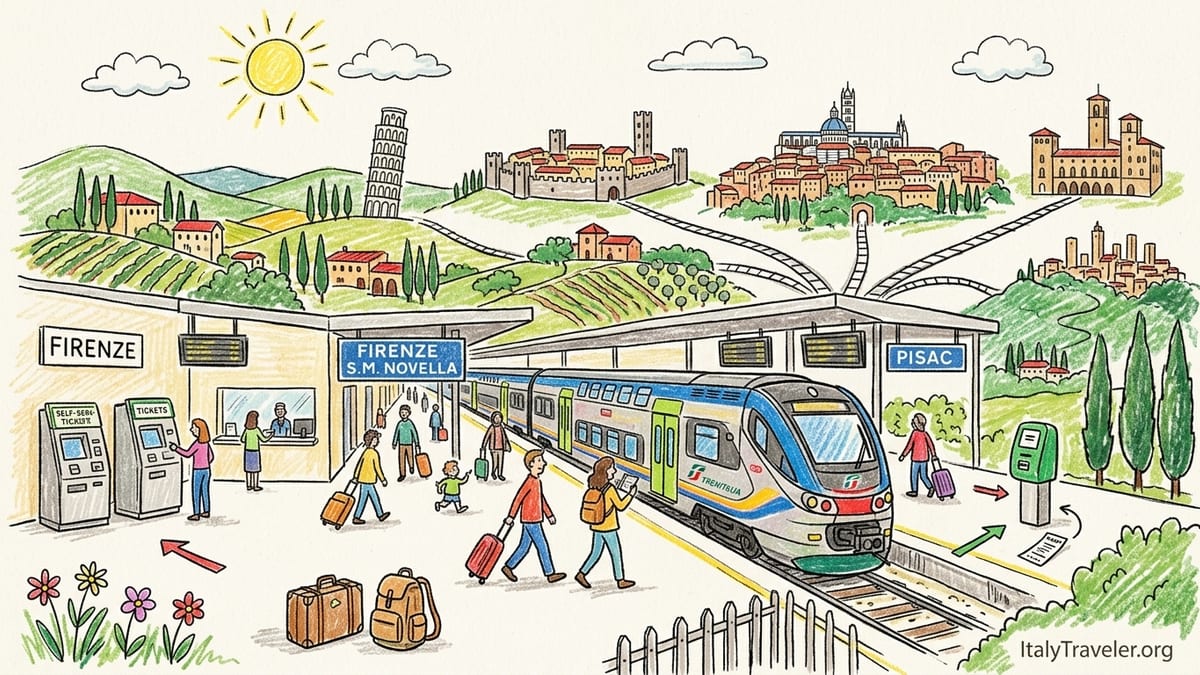
Every car-free trip I took in Tuscany began at Firenze Santa Maria Novella, the main station in the center of Florence. You step out of the concourse and you are already in the historic core, about a ten-minute walk from the Duomo. The central location is not a detail for train travelers, it is the superpower that makes car-free Tuscany plausible. You are not losing time shuttling in from an out-of-town terminal. Instead, you roll your bag off the platform and you are essentially downtown.
Inside the station I found the full ecosystem that powers a rail-based trip: staffed ticket counters, long rows of red Trenitalia self-service machines, small newsstands selling bus tickets, and clear departure boards above the main hall. There are 19 passenger platforms here, which sounds abstract until you are trying to figure out whether your regional train to Siena leaves from track 1A or 15. For first-time visitors, the platforms fanning out at ground level feel busy but manageable, especially compared with big-city terminals like Rome Termini or Milan Centrale.
Florence’s role as Tuscany’s rail hub is not just a slogan. From Santa Maria Novella I could watch a steady stream of regional trains depart toward Pisa and Livorno along one axis, and Lucca and Viareggio along another, while other lines pushed inland toward Siena, Arezzo, Cortona and Chiusi. On one late afternoon, the departure board showed a Regionale for Pisa Centrale, another for Siena via Empoli and Poggibonsi, and an Arezzo service all within about half an hour of each other. That spread of choices is exactly what makes a hub: if you commit to basing yourself in Florence, almost every classic Tuscan name on your list is reachable by rail.
The hub, though, is not just Santa Maria Novella. On the north side of the city, Firenze Rifredi and Firenze Campo di Marte catch some regional and long-distance services. More than once, I ended up on a train that skipped Santa Maria Novella entirely and stopped at Campo di Marte instead, which meant a short bus or taxi hop back into the center. For a car-free traveler, it pays to check carefully which Florence station your train actually uses, especially for evening arrivals when you do not want surprise extra transfers.
Buying Tickets: Machines, Apps and That Little Green Validate Stamp
On my first day I experimented with every ticket-buying channel I could, because how you buy matters more when you do not have a car to fall back on. At Santa Maria Novella the most straightforward option was the row of Trenitalia self-service machines. The interface offered an English menu, and a direct Florence to Pisa Centrale Regionale ticket in second class came up at around 9 to 10 euros for a one-way journey, matching what local visitor guides quote for that route. Payment worked with both chip-and-PIN cards and contactless, and tickets printed in seconds.
For regional journeys across Tuscany, the Trenitalia app turned out to be the most relaxed way to travel. I could buy a Regionale ticket from Florence to Siena or Arezzo on my phone the night before or even while drinking a quick espresso in the station. The price stayed the same whether I bought a week in advance or ten minutes before departure, which removed the pressure of hunting for rail passes or advance discounts. On busy commuter services, the app also spared me the ticket-office queues that can snake across the concourse at rush hour.
Paper tickets, however, come with a ritual that first-timers often miss. On my first Florence to Lucca run, I deliberately bought an old-fashioned paper ticket from the machine just to practice. Before boarding, you must insert that ticket into a small green or yellow validation machine at the edge of the platform. The device prints the date and time on the ticket, starting a validity window that usually lasts a few hours. On trains with frequent departures, this flexibility is a quiet advantage for a car-free traveler. If you miss the 09:10 Regionale to Pisa, you can normally use the same validated ticket on the 09:38 as long as you remain within that time window.
Digital tickets simplify this. The app-generated Regionale tickets I used already displayed date, train details, and a QR code, so there was no physical validation step. Conductors scanning tickets on board seemed entirely comfortable with a mix of phone screens and paper slips. In the entire week, I never saw a regional train “sell out” in the way that high-speed services can. There is no seat reservation on these trains, so capacity comes down to whether you find a spot to sit or stand, not whether the system will allow one more passenger.
Riding the Regionals: Comfort, Crowds and Luggage Reality
Once on board, the reality of traveling Tuscany without a car depends heavily on what kind of regional train arrives. On the Florence to Pisa and Florence to Lucca routes, many of the services I caught were double-deck Vivalto trains. Inside, they felt closer to intercity stock than “commuter rail” in other countries. Second class offered upholstered seats, decent legroom, overhead racks for smaller bags and dedicated luggage areas at the end of some carriages for larger suitcases. Toilets were available in most cars I used, though their cleanliness varied over the course of the day.
On the Florence to Siena line, the rolling stock was older on several of my departures. Single-level coaches with slightly worn upholstery, windows that sometimes rattled, and more limited luggage space near the doors. The comfort was still perfectly acceptable for a 90-minute ride, but I would not call it luxurious. For travelers with big checked-size suitcases, finding a secure corner could require a bit of improvisation, especially at peak commuting times when locals filled up the central aisles.
Taking luggage on and off the trains was more manageable than I had expected. Platform heights in major stations like Florence, Pisa Centrale and Arezzo often matched the train doors closely, so boarding involved a small step rather than a climb. In smaller stations such as Poggibonsi or Certaldo, I met the more traditional arrangement: lower platforms and two steeper steps into the carriage. With a single rolling suitcase and a backpack, this was fine, but I was grateful I had not overpacked. On one crowded Friday afternoon Regionale between Florence and Arezzo, the overhead racks were jammed with backpacks and small cases, and I ended up standing near my suitcase in the door area for the first twenty minutes.
The question of delays came up on nearly every day of my experiment. On my Florence to Siena trip, the Regionale departed about ten minutes late and arrived in Siena roughly fifteen minutes after its scheduled time. The Florence to Pisa service I used left on time and arrived only a few minutes behind. On another day, engineering works on the line south of Arezzo meant that my train toward the Val di Chiana was canceled beyond a certain station and replaced by a bus. Regional rail in Tuscany is far from perfect, but the pattern I observed was one of minor, predictable slippage rather than complete breakdown. For a day tripper, that means leaving some buffer time, especially if a final bus connection or a dinner reservation depends on a specific arrival.
Day Trips That Shine on Rails: Pisa, Lucca, Siena and Arezzo
When the rail network and your sightseeing plans line up, car-free Tuscany feels almost effortless. The clearest example was my Florence to Pisa and Lucca loop. From Santa Maria Novella I took a direct Regionale to Pisa Centrale in just under an hour, stepping off the train into a station that sits within walking distance of the city center. From there, pedestrian streets led me to the Leaning Tower and Piazza dei Miracoli in about twenty minutes on foot. I spent a few hours exploring, walked back to the station, and boarded another Regionale north to Lucca. That journey took around 25 to 30 minutes, and Lucca’s station is literally just outside the historic walls. Within five minutes I was walking through a gate into the car-free center.
On another day I pointed myself south toward Siena. Regionale trains run directly from Florence to Siena, and the run I took via Empoli and Poggibonsi lasted around an hour and a half. The journey showed a different side of Tuscany: vineyards and rolling hills glimpsed from a window seat. Siena’s station sits below the historic core, so the last stretch requires an escalator system and a bit of uphill walking to reach Piazza del Campo. Without a car I avoided city traffic and tricky medieval parking rules, trading them for an extra fifteen to twenty minutes of escalators and sidewalks. It felt like a good bargain.
Arezzo was a textbook regional success. The Regionale Veloce service I used covered the Florence to Arezzo run in roughly an hour. Arezzo’s station stands just outside the walled historic center, a simple ten-minute walk up a gentle slope. I could arrive mid-morning, visit the Piero della Francesca frescoes in the Basilica of San Francesco, wander the antiques district, and comfortably take an afternoon train back. The frequency of trains on this route meant I never felt locked into one timetable. If I wanted another hour for a late coffee on Corso Italia, there was always a later service.
Cortona provided a more complex but still manageable example. Trains from Florence serve Camucia Cortona and Terontola-Cortona, both of which are several kilometers from Cortona’s hilltop historic center. I chose Camucia because the train schedule fit my morning better. From the station, orange Autolinee Toscane buses and a few taxis were waiting out front, shuttling passengers up the hill. With a bus ride of roughly fifteen minutes, the rail-to-bus connection worked seamlessly. It demonstrated an important principle of car-free Tuscany: some of the famous hill towns are rail-adjacent rather than rail-served, and you should expect a short bus link for the final climb.
Where Trains Struggle: Hill Towns, Vineyards and the Gaps Between Lines
The downside of relying purely on trains in Tuscany becomes obvious as soon as you start plotting smaller hill towns and countryside stays. Places like San Gimignano, Montepulciano, Montalcino or Volterra do not sit on main rail lines. They are connected instead by a patchwork of regional buses and occasionally by replacement rail-bus services when track works intervene. I tested this limitation by targeting San Gimignano as a day trip from Florence using only public transport.
The rail portion went smoothly at first. I took a Regionale from Florence to Poggibonsi, which took about an hour. Poggibonsi is a functional town with a station that clearly acts as a hub for buses deeper into the countryside. Leaving the train, I followed signs to the bus bays and bought a ticket to San Gimignano from an Autolinee Toscane ticket window. The bus ride up to San Gimignano lasted roughly twenty-five minutes along winding roads. The scenery was exactly the Tuscan dream, but the timing was fragile. My bus connection involved a wait of about forty minutes on the outbound leg and longer in the afternoon when I returned. A small delay on my inbound train would have meant a scramble for the next bus and a significant hit to my sightseeing time.
Montepulciano and Montalcino looked even more complicated when I sketched them on a map. The main rail gateway for this corner of southern Tuscany is Chiusi-Chianciano Terme, which sits on the Florence to Rome line. From Florence, Regionale and Intercity trains can reach Chiusi in a bit more than an hour, making it seem surprisingly close on paper. The problem comes after you step off the train. To reach Montepulciano or Montalcino without a car, you must rely on local buses that do not run as frequently as the trunk rail routes. In some seasons, gaps of several hours appear between buses, which for a day trip can mean a very early start or a risky last bus back.
Stays in vineyards or agriturismi also tested the limits of car-free travel. Several properties I looked at around San Quirico d’Orcia and the Crete Senesi advertised “nearest station: Siena or Chiusi” but quietly assumed guests would arrive with a rental car. Without one, you are left negotiating with local taxi companies or pre-booking transfer services. I arranged one such taxi transfer from Chiusi to a countryside B&B as an experiment, and the quoted one-way price was significantly higher than my train fare from Florence. In these rural areas, the rail network delivers you to the edge of the experience but cannot take you directly into the postcard landscape.
The gaps between lines also become obvious if you try to hop laterally across Tuscany without dipping back into Florence. Moving from Lucca to Siena by public transport, for instance, required a change at Empoli and careful reading of timetables. The journey was fully doable by rail but took most of a morning by the time I reached Siena’s station. Had I been driving, I could have taken a more direct route across country in roughly half the time. Where the rail network radiates out from Florence, lateral moves are where its geometry works against you.
When Buses and Taxis Become Essential
Because I had committed to avoiding a rental car entirely, I treated buses and taxis as the extensions of the train network rather than optional extras. The bus operator Autolinee Toscane now runs the regional network, and its orange or white buses met my trains in several key hubs. Outside Lucca station, I saw buses heading toward Pisa Airport and smaller nearby towns. Outside Camucia Cortona, buses climbed the hill to Cortona itself. In Siena, urban buses linked the station with the old town on the hill above.
Buying bus tickets required more pre-planning than buying train tickets. In Florence, I could pick up urban bus tickets at newsstands marked with the Autolinee Toscane logo or at small tobacco shops. In smaller towns, some bus tickets were sold in bars or cafes near the station, which meant arriving with a few extra minutes to hunt for the right counter. On one occasion in Poggibonsi, I arrived to find that the ticket office had just closed for a midday break, and I had to buy a ticket directly from the driver at a slightly higher on-board fare.
Taxis entered the picture in two main situations. First, when I arrived in the evening in a town where the last useful bus up to the historic center had already left. This happened to me in Cortona when a late-afternoon train delay pushed my arrival past the last bus departure that synced comfortably with hotel check-in. The taxi rank outside the station had a couple of cars waiting, and the uphill ride cost noticeably more than any bus ticket that week but was still cheaper than renting a car for several days. Second, taxis became essential for countryside stays, where narrow lanes and scattered farmhouses make scheduled bus service unrealistic.
The combination of rail, bus and occasional taxi worked best when I built my day around the fixed bus timetables and treated the trains as the flexible backbone. Regionale trains in Tuscany, especially around Florence, Pisa and Arezzo, run often enough that a missed train usually meant a wait of 30 to 60 minutes, not half a day. Buses in rural areas did not offer that same comfort. On one afternoon in southern Tuscany, the last bus from a hill town down to the rail station left long before sunset. Missing it would have meant an unplanned taxi ride that cost more than my entire day’s rail travel.
Practical Lessons: How to Plan a Car-Free Tuscan Itinerary
After a week of constant experimentation, certain planning patterns emerged that made life easier without a car. The first was to treat Florence as the fixed base for most of the week. Sleeping in Florence allowed me to tap into early Regionale departures toward Pisa, Lucca, Siena and Arezzo and to return on late-evening trains that delivered me back into a walkable city center. It also simplified luggage. I could leave my main suitcase in my room and take only a daypack on most outings, sidestepping the hassle of dragging bags on and off multiple local buses.
For travelers keen on a multi-base trip, my own route worked better when I paired each rail hub with two or three easy excursions. Florence handled Pisa, Lucca and Arezzo beautifully. A short stay in Siena allowed access not only to Siena itself but also to San Gimignano via the rail-bus connection at Poggibonsi and to nearby villages on the Siena to Grosseto road using buses. Thinking in terms of hubs and spokes rather than a continuous loop made the timetable math far less stressful.
Time of day mattered. Early-morning Regionale trains were quieter and more punctual on the days I tested them, especially on routes used heavily by commuters into Florence. Midday services tended to be more crowded and slightly more delay-prone, particularly on Fridays and around holiday periods. When I planned day trips, I tried to depart before 09:00 and aimed to be on a homeward-bound train by late afternoon. That buffer absorbed minor timetable slippages and left room for a missed bus or a leisurely last gelato without anxiety.
Finally, I learned to accept that not every Tuscan dream fits neatly into a car-free week. Iconic countryside drives through the Val d’Orcia, winery-hopping itineraries that jump between remote estates, and spontaneous diversions down white gravel farm tracks remain solidly car territory. Instead of fighting that reality, I focused my car-free time on places that aligned with the network the region actually runs: compact cities with central stations, hill towns that advertise their bus connections, and valleys threaded by reliable rails.
The Takeaway
After a week of relying entirely on trains, buses and the occasional taxi, I came away convinced that a car-free trip through large parts of Tuscany is not only possible, it can be pleasantly low-stress. Tuscany’s rail network is built around Florence, with direct Regionale and Regionale Veloce services fanning out to Pisa, Livorno, Lucca, Siena, Arezzo, Cortona and Chiusi. If you design your route to follow those tracks, the experience feels logical, affordable and surprisingly efficient.
Where the rails begin to fray, life without a car grows more complicated. Classic hill towns like San Gimignano and Montepulciano, or rural wine-country stays around Montalcino and the Val d’Orcia, demand careful coordination with local buses or a willingness to budget for taxis. Connections are possible but not effortless, and day-trip windows can shrink if even one link in the chain runs late. These frustrations are not a failure of Tuscany so much as a reflection of a region whose charm often lies precisely in the spaces between the stations.
In practice, using trains instead of a car meant accepting a slightly narrower map in exchange for a calmer day. I did not worry about parking garages or ZTL restricted zones in medieval centers, and I stepped off trains directly into walkable, often traffic-free historic cores. Station cafes replaced highway rest stops, and the view from my window seat was a moving sampler of olive groves and tiled towns rather than the bumper of the car ahead.
If Tuscany for you means a handful of small cities, a few well-connected hill towns and long, unhurried walks once you arrive, planning around Florence’s rail hub is more than good enough. If your dream trip is a private villa miles down an unpaved lane, trains will never be the whole story. In my own car-free week, the network’s strengths and weaknesses became part of the narrative, and in many ways, that constraint made each successfully completed journey feel even more satisfying.
FAQ
Q1. Can I base myself in Florence and see Tuscany by train only?
Yes, if you focus on places well served by rail such as Pisa, Lucca, Siena, Arezzo, Cortona (via Camucia or Terontola) and Chiusi. From Florence Santa Maria Novella you can reach all of these on direct Regionale or Regionale Veloce trains, which makes Florence an excellent base for a car-free week.
Q2. How much should I expect to pay for regional train tickets in Tuscany?
On the routes I used in 2026, one-way second-class tickets for medium distances such as Florence to Pisa, Florence to Siena or Florence to Arezzo typically cost under 15 euros, often closer to 10 euros when bought as standard Regionale fares. Prices for shorter hops between nearby towns were lower, and I did not see large swings in cost based on how far in advance I purchased.
Q3. Do I need to reserve seats on Tuscan regional trains?
No. The regional trains I used in Tuscany did not offer seat reservations. Tickets allow you to board any train that fits the validity of your fare, and you simply find an available seat or stand if the train is crowded. This makes regional trains flexible, though it also means busy commuter services can be standing-room-only for part of the journey.
Q4. How do I validate my train ticket, and is it necessary with mobile tickets?
Paper regional tickets must be validated before boarding by inserting them into the small machines on or near the platforms, which print a date and time stamp. Mobile tickets purchased through the Trenitalia app during my trip did not require this separate step because they were already tied to a specific journey and displayed a QR code and validity information.
Q5. Are buses in Tuscany reliable enough to replace a car in hill towns?
In my experience, buses worked well for clearly defined connections, such as Poggibonsi to San Gimignano or Camucia to Cortona, but timetables were less forgiving than trains. Frequencies drop outside peak periods and in more rural zones, so a missed bus can mean a long wait or an expensive taxi. Buses are an important complement to trains but not a full substitute for a car in very remote areas.
Q6. Which Tuscan destinations were frustrating without a car?
Places like Montepulciano, Montalcino, much of the Val d’Orcia and scattered agriturismi in the countryside were difficult without a vehicle. Trains deliver you as far as gateways such as Chiusi or Siena, but from there onward you depend on infrequent buses or private transfers. For these areas, a rental car or a driver makes the logistics far more comfortable.
Q7. How bad are train delays on Tuscan regional routes?
During my week of travel I encountered several minor delays, usually between five and twenty minutes, and one route affected by engineering work where part of the journey was replaced by a bus. Serious disruptions were the exception rather than the rule, but I found it wise to build a buffer into my plans, especially for connections to buses or evening events.
Q8. Is it easy to manage luggage on Tuscan trains and at stations?
With a medium suitcase and a backpack, I managed comfortably. Major stations such as Florence, Pisa and Arezzo have relatively level platforms and elevators or escalators, while some smaller stations involve a few stairs and lower platforms. On board, newer double-deck trains had dedicated luggage areas and decent overhead racks, but older trains sometimes required creative use of corners near the doors.
Q9. Can I visit vineyards and stay in the countryside without renting a car?
It is possible but more complicated. Some wineries and agriturismi offer shuttle services from nearby stations or towns, and a handful are within walking distance of bus stops. However, many rural properties assume guests will arrive by car, and reaching them without one may involve costly taxi rides. For a heavily wine-focused or countryside-based trip, a car or private driver is still the most practical option.
Q10. For a first visit to Tuscany, would you recommend going car-free?
If your priorities are Florence, Pisa, Lucca, Siena, Arezzo and a couple of accessible hill towns, then yes, a car-free itinerary can work very well and keeps your days simpler. For a first-time visitor who mainly wants to explore cities, museums and easily reached old towns, using trains as the backbone of the trip can be both efficient and relaxing.