

I have split my time in Lombardy between big city apartments, lakeside guesthouses, vineyard agriturismi and mountain hotels, often on the same trip. Each base changes the rhythm of the journey completely. When friends ask where they should stay for their first visit to the region, the real question is usually not “Which place is prettiest?” but “Where will I actually enjoy waking up for three, five, seven or ten days without spending half my holiday on trains and buses?”
How I Approach Choosing a Base in Lombardy
On recent trips I have based myself for several nights in Milan, Varenna on Lake Como, Città Alta in Bergamo, a farmhouse among the Franciacorta vineyards near Iseo, and a family-run hotel in Bormio. I drove a rental car for some stretches and relied on Trenord regional trains and local buses for others. Those combinations changed how stressful or relaxing each stop felt, especially when dealing with luggage, parking and evening meals after long days out.
Rather than rank these destinations in the abstract, I pay attention to the small frictions that shape a stay. How far is it from the station to the hotel when you are pulling a 23 kilo suitcase in July heat or winter rain. Where you actually find a legal parking spot on a Saturday night. Whether it feels safe and lively enough at 10.30 pm to stroll out for gelato, or if everything shutters at 8 pm. How much a completely ordinary espresso or glass of wine costs at the bar on the corner. Those concrete details are ultimately what make a base work or not.
For this comparison I also looked up current transport options and restrictions as of late 2026. For example, the regional trains between Milan and Varenna on Lake Como usually take around an hour, but in recent years there have been periodic closures for Olympic-related works with replacement buses along sections of the Lecco to Colico line. I confirm train times and any disruptions during planning, then match that against how often I realistically want to commute from my base.
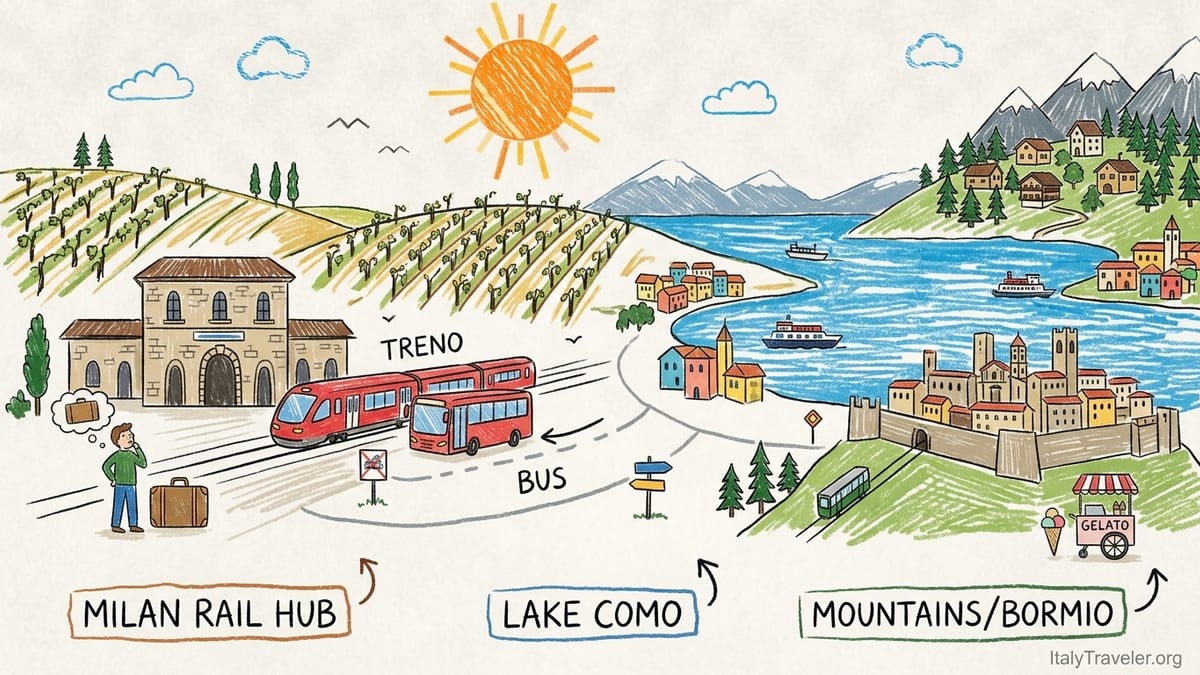
What follows is not a rigid itinerary but the tradeoffs I weigh between Milan for rail connections and urban sightseeing, Lake Como for the lake atmosphere, Bergamo for a compact historic city, Franciacorta and Lake Iseo for wine and countryside, and Bormio for mountains and thermal spas. I end each section with how I now use that place on different length trips, from a long weekend to ten days.
Milan: Best for Rail Connections and Big City Energy
Every longer Lombardy trip I have taken in the last decade has started or ended in Milan. The reason is brutally practical. Milan Centrale is the hub for high speed trains from Paris, Zurich, Venice, Florence, Rome and Naples, and it links directly to both Malpensa and Linate airports by train or shuttle bus. When I stay in Milan, I usually choose an apartment or hotel within a ten minute walk of Centrale or Porta Garibaldi so that I can roll my suitcase without using the metro after a flight or late arrival.
From Milan Centrale there are frequent regional trains to Bergamo and to the Lake Como area. Rail operators publish typical travel times on these routes around the one hour mark for Milan to Varenna on the eastern shore of Lake Como and for Milan to Bergamo. That means a day trip is perfectly feasible, but commuting back and forth every day starts to eat noticeable time. I find that if I am doing more than two or three day trips in a row, the novelty of passing through Centrale wears off and I wish I had moved my base.
Parking in central Milan is where the city punishes you for having a car. On one trip I collected a rental at Malpensa, drove to my hotel near Porta Venezia and circled for 25 minutes before finding a legal blue line spot that still required feeding a meter. Since then, if my trip involves a car, I either book a hotel with on site parking on the fringes of the center or I delay picking up the car until the day I leave Milan. Navigating limited traffic zones around the historic core is also an extra layer of stress after a long drive.
On the plus side, Milan is unbeatable for urban sightseeing and evening atmosphere. Even a simple hotel near Centrale puts you a short metro ride from the Duomo, Brera and Navigli. I can finish a day at the Pinacoteca di Brera, have an early aperitivo in a side street bar, then walk home via well lit boulevards still busy at 11 pm. Restaurant choice is wide at all price points: from standing at a pasticceria counter for a few euros in the morning to trattorie where a plate of risotto alla milanese and a glass of house wine still feel reasonably priced for a European financial capital. For a three day trip focused on art, fashion and first time sightseeing, I would stay entirely in Milan and do only one lake or Bergamo day trip.
Lake Como: The Lake Experience and the Cost of Transfers
When I want the classic Lombardy postcard of villages clinging to steep shores and ferries gliding past at sunset, I stay directly on Lake Como. My strongest stays have been in Varenna and Bellagio, using midsize family hotels and guesthouses a short walk from the ferry dock. The payoff of waking up to light on the water and going for an early lakeside walk before the day trippers arrive is significant compared with commuting in from Milan.
Getting from Milan Centrale to the eastern shore of Lake Como is usually straightforward. Regional trains run from Centrale to Varenna Esino with journeys quoted around one hour. In summer and on weekends those trains can be crowded, especially the mid morning departures that many tourists aim for. With heavy luggage I either book an earlier train or pay a little extra for first class if available, because the relative calm and extra space make a difference when you still have a lakeside uphill walk to your hotel.
Once at the lake the tradeoff becomes convenience versus cost and crowds. Accommodation directly on the water in Varenna, Bellagio or Como city is noticeably more expensive than in Milan or Bergamo, especially in June through September. I have paid more for a modest room with a partial lake view in Varenna than for a larger, more modern business hotel room in Milan. Car parking is another hidden cost. Many village hotels rely on small shared lots above town, and I have more than once had to leave the car a ten minute walk from the hotel and shuttle luggage up and down narrow alleys.
Ferries between Varenna, Bellagio and Menaggio form the backbone of lake transport, which makes life pleasant once you are settled. I often leave the car parked for the duration of my stay and rely on boats to bounce between villages. Queues at peak times in July and August can add thirty minutes or more, but if I am staying for several nights that matters less than if I were trying to race around the lake on a single day trip from Milan. For a five or seven day trip where relaxation is as important as sightseeing, I like to split time between Milan and a Lake Como base, leaving at least three nights on the lake itself.
Bergamo: A Smaller Historic City With Easy Rail Access
Bergamo has become my default alternative to staying the whole time in Milan when I want a smaller scale base but still need quick access to trains and an airport. The city is divided between the modern lower town and the walled Città Alta above. I have stayed in both, but for an atmospheric first visit I strongly prefer a small hotel or B&B within the walls, even if that means a climb or a short funicular ride from the station.
The rail link between Bergamo and Milan is one of the reasons the city works so well as a base. The regional operator publishes timetables showing multiple departures each hour on the Bergamo to Milano Centrale line with journey times around fifty minutes to an hour depending on the service. That means I can leave Bergamo after breakfast and be walking through the Galleria Vittorio Emanuele II before mid morning, or return from a full day in Milan in time for a late dinner beneath the arches of Piazza Vecchia.
Parking in Bergamo is less intimidating than Milan but still requires planning. The streets of Città Alta are largely restricted, so when I stayed at a small inn inside the walls I pre booked a space at a nearby public garage, rolled in, and then left the car there for the duration. The walk from the upper funicular station to most accommodations is short but paved in historic stone, which is rough on small suitcase wheels. In the lower town, hotels often have their own small lots or arrangements with nearby garages that are much cheaper than central Milan.
Evening atmosphere in Bergamo is a highlight. After day trippers leave, Città Alta feels like a lived in hill town with students, locals and visitors sharing the same bars and trattorie. I remember wandering out after 9 pm on a weeknight and still finding several osterie open, with outdoor tables under strings of lights and locals having one more quartino of Valcalepio. Lodging prices are generally lower than in Como’s most famous villages, so for a seven day trip where I want a mix of city and day trips to Milan or the lakes, I am increasingly tempted to base in Bergamo for at least four or five nights.
Franciacorta and Lake Iseo: Wine Country and Gentle Countryside
When I need quiet evenings and vineyard views more than monuments, I head for Franciacorta and the shores of Lake Iseo. The tourism board highlights how the region sits between Brescia and the southern tip of Lake Iseo with frequent rail connections along the Milan to Venice mainline that stop at towns like Rovato and Brescia, plus a regional railway running from Brescia through Iseo and up the valley. That rail skeleton means you can reach vineyard country without a car, although moving between wineries and farm stays still becomes easier with one.
On my last stay I used a small agriturismo in the hills above the lake as a base. With a car I could be at Lake Iseo’s ferry dock in about fifteen minutes, park in a paid lakeside lot, then take the boat to Monte Isola for walks and long lunches. In the evenings I would drive back through the vineyards, park inside the farmhouse gate, and have dinner on site or at a simple village trattoria. Parking stress all but disappeared compared with Milan or Como. The biggest concern was navigating narrow country lanes in the dark, which is a reason I avoid arriving late at night to a rural base.
Without a car, I have stayed in Iseo town itself. The train from Brescia rolls into Iseo station just a short walk from the lakefront promenade, meaning I could arrive with luggage, check into a hotel facing the piazza, and do everything on foot or by ferry. Wineries that partner with local tourism offices sometimes arrange transfers, but I find that even one or two tastings within walking distance of the lake feel like enough on a short stay. Food is wine driven but not precious, with plenty of simple bars where a glass of Franciacorta by the lake costs no more than a cocktail in central Milan.
Franciacorta and Lake Iseo are where I go to slow a trip down. For a five or seven day journey I am increasingly likely to spend two nights in Milan or Bergamo for arrivals, museums and shopping, then move to a Franciacorta agriturismo for three or four nights of lighter days built around walks, winery visits and the occasional ferry ride. For a ten day stay, this region pairs beautifully with a mountain segment in Bormio, since the drive between the Brescia area and the Valtellina valley is scenic and not especially complicated outside peak winter weekends.
Bormio: Mountains, Thermal Spas and Hidden Transfer Costs
Bormio is the base I choose when mountains and hot water take priority over everything else. The town sits high in the Valtellina, with ski slopes above and three thermal complexes drawing on the same naturally hot springs at around 38 degrees. The main spa complex in town publishes information about its pools, slides and wellness areas, and during peak periods it even restricts entry to timed tickets instead of full day passes. That tells you how popular the baths have become with both locals and visitors.
Reaching Bormio is where you pay for the alpine scenery. There is no direct train; the common pattern is to take a Trenord regional train from Milan to Tirano, then change to a bus that climbs the valley to Bormio, or to use direct coach links from Milan to Bormio that have been expanded in the run up to the 2026 Winter Olympics. Public transport authorities describe combinations such as Milan to Tirano by train in around two and a half hours, then a forty five minute to one hour bus up to Bormio. On one winter trip, door to door from Milan Centrale to my hotel near Bormio’s historic center took just over four hours including the transfer.
Once you have made that journey, the town itself is compact enough that you rarely need a car. I usually choose a hotel within a ten minute walk of the main via Roma, where I can access grocery stores, ski bus stops and evening bars without driving. Hotels either have small underground garages or rely on a mix of paid and free street parking. In shoulder seasons I have usually found street spaces within a block or two of my lodging, but around holiday periods and during major ski races those spots vanish and having a reserved garage space becomes worth the surcharge.
Evenings in Bormio are quieter than Milan or even Bergamo, but in a satisfying way if you lean into the rhythm. After an afternoon in the baths or on the slopes, I walk through narrow lanes lined with stone houses to simple restaurants that specialize in pizzoccheri, bresaola and robust local reds. Prices for a full two course dinner with wine are often lower than on Lake Como, in part because there is less luxury tourism pressure. For a three or five day mountain break tacked onto a longer Lombardy itinerary, Bormio works well as a second base after you have taken care of big city sightseeing elsewhere.
How I Choose for 3, 5, 7 and 10 Day Trips
When I plot out an actual trip, I start with length and arrival logistics. For a three day stay arriving into Milan Malpensa or by high speed train, I almost always stay entirely in Milan or split between Milan and Bergamo. That avoids losing half a day to reaching more distant bases like Bormio or Lake Iseo. I might spend two nights near Centrale to make airport and station transfers painless, plus one night in Bergamo Città Alta if my flight home leaves from nearby Orio al Serio airport.
With five days, I am willing to move once. A common pattern is three nights in Milan or Bergamo for museums, shopping and perhaps a Como day trip, followed by two nights either on Lake Como itself or amid the Franciacorta vineyards. Crucially, I avoid planning more than one long public transport transfer during those five days. Lugging bags on and off crowded regional trains and up cobbled alleys consumes more energy than you think when viewed on a map. One well timed mid trip move gives variety without leaving you checking timetables every morning.
For seven days, I like a triangle of bases. One version is two nights in Milan, three on Lake Como and two in Bergamo, using Bergamo as a softer landing after lake prices and crowds before flying out. Another is three nights in Bergamo, three in Franciacorta or Iseo and one final night near Milan Centrale to simplify an early train departure. In both cases I accept that one travel day will be mostly lost to transfers, and I plan it between heavier sightseeing days so that the inevitable delays and luggage hauling feel less frustrating.
On a ten day trip I finally consider adding Bormio. A realistic pattern could be two nights in Milan, three on Lake Como, three in Bormio and two in Franciacorta or Bergamo on the way back. That structure front loads the big city sights while energy is high, moves to the lake for a slower middle, then climbs to the mountains once I am fully in holiday mode. The final low key nights in wine or small city country give a buffer before long flights or train journeys home. Throughout, my choices are guided less by the desire to collect destinations and more by an honest respect for how long each transfer actually takes in practice.
The Takeaway
Choosing where to stay in Lombardy is less about finding one perfect base and more about accepting that each place excels at something different. Milan ties your trip neatly into the European rail and air network and gives you big city art, fashion and nightlife at the cost of higher hotel prices and parking headaches. Lake Como rewards you with magnetic scenery and ferry based days if you invest the time and money to sleep on its shores rather than commute from elsewhere.
Bergamo offers a sweet spot between the two, with enough urban life, real local atmosphere and strong rail links to Milan and the wider network that it can comfortably anchor an entire week. Franciacorta and Lake Iseo slow the tempo even further, trading blockbuster sights for vineyard views, lakeside promenades and relaxed drives between wineries. Bormio, finally, justifies its longer transfers with a blend of mountain air, hot springs and a compact historic center that invites you to switch your phone off and stay put.
When I look back on my strongest Lombardy trips, what stands out is not how many towns I managed to “do” but how grounded I felt in one or two well chosen bases. The mornings drinking coffee at the same bar in Bergamo, the familiar walk from the ferry dock up to my guesthouse in Varenna, the ritual of an evening soak at the baths in Bormio. Those rhythms only emerge when you stop racing the map. If you let travel time, luggage logistics and evening atmosphere guide your decisions alongside scenery and bucket list sights, Lombardy offers an unusually rich set of bases to assemble a trip that feels tailored to how you actually like to travel.
FAQ
Q1. Is it realistic to stay in Milan and day trip to Lake Como and Bergamo?
Yes, for a short visit. From Milan Centrale, regional trains to Bergamo and to the eastern side of Lake Como are usually around an hour each way, so one or two day trips work well. For more than that, I find the repeated transfers tiring and prefer at least a couple of nights actually on the lake or in Bergamo.
Q2. Do I need a car to enjoy Franciacorta and Lake Iseo?
No, but it changes the experience. You can reach Iseo or towns on the Milan to Venice line by train and enjoy the lakefront fully on foot and by ferry. However, many wineries and agriturismi sit in the hills, so with a car it is easier to move between tastings and rural accommodations, especially in the evening when buses are infrequent.
Q3. How crowded are the Milan to Lake Como trains with luggage?
In peak season and on weekends, the direct regional trains from Milan to Varenna or other Lake Como stops can be crowded, especially mid morning. With large suitcases I prefer earlier departures, allow extra time on the platform to board near luggage racks, and consider paying for first class if it is only a small supplement to gain a quieter carriage.
Q4. Is Bergamo cheaper than staying on Lake Como?
In my experience, yes. Mid range rooms in Bergamo, even in the historic Città Alta, often cost less than comparable accommodation in Varenna, Bellagio or central Como, particularly in summer. Restaurant prices also feel closer to ordinary northern Italian city levels rather than resort territory, which helps stretch a week long budget.
Q5. How difficult is parking in Bormio and the mountains?
Parking in Bormio itself is easier than in Milan or the lake villages, but during winter holidays and major ski events on the nearby slopes, central spaces and small hotel garages fill quickly. I always confirm whether my accommodation has a reserved spot and factor that cost into my budget, especially if I plan to arrive late in the day when free street parking is scarce.
Q6. Where would you stay for a three day Lombardy city break?
For three days I would base entirely in Milan if my priority is big museums and shopping, or in Bergamo if I want a smaller scale historic setting. From either city, one well chosen day trip, for example to Lake Como or to a nearby town, feels achievable without spending too much time on trains.
Q7. How many bases make sense for a seven day Lombardy trip?
Seven days is where two or at most three bases make sense. I like a combination such as Milan plus Lake Como, or Bergamo plus Franciacorta and a night back in Milan. Adding more bases often means losing too many daylight hours to transfers, check ins and check outs instead of actually enjoying each place.
Q8. Is Bormio worth the long transfer for non skiers?
Yes if you enjoy mountain scenery and hot springs. Even outside ski season, Bormio offers thermal baths, hiking and a relaxed historic center. The four or so hours from Milan by train and bus are a commitment, so I would only include Bormio on trips of at least five to seven days where I can spend three nights there.
Q9. Can I visit wineries in Franciacorta without driving?
You can visit some. Staying in Iseo or a town with a station gives you access to a few wineries reachable by taxi, bicycle or on foot if they are close enough. Some estates offer transfers by prior arrangement. For more flexibility and to reach smaller producers in the hills, however, having a car or hiring a driver for a day makes it much easier.
Q10. How do hotel prices compare between Milan and the lake towns?
Standard business style hotels in Milan can be surprisingly good value outside major fairs, while small lakeside hotels in Varenna or Bellagio command higher prices for their setting, especially in summer. I often pay more per night on Lake Como than in Milan for a room of similar size, which is one reason I limit my lakeside stay to a few nights within a longer trip.