


I thought I knew Lake Como. I had seen the classic postcard of Bellagio from every angle and read more ferry “survival guides” than I care to admit. It was only when I spent a full summer day riding the boats between Bellagio, Varenna, Menaggio and Cadenabbia that the system finally made sense. Along the way I learned exactly how the tickets work, when queues become a problem, which villages deserve more time and how easy it really is to fit multiple stops into one day.
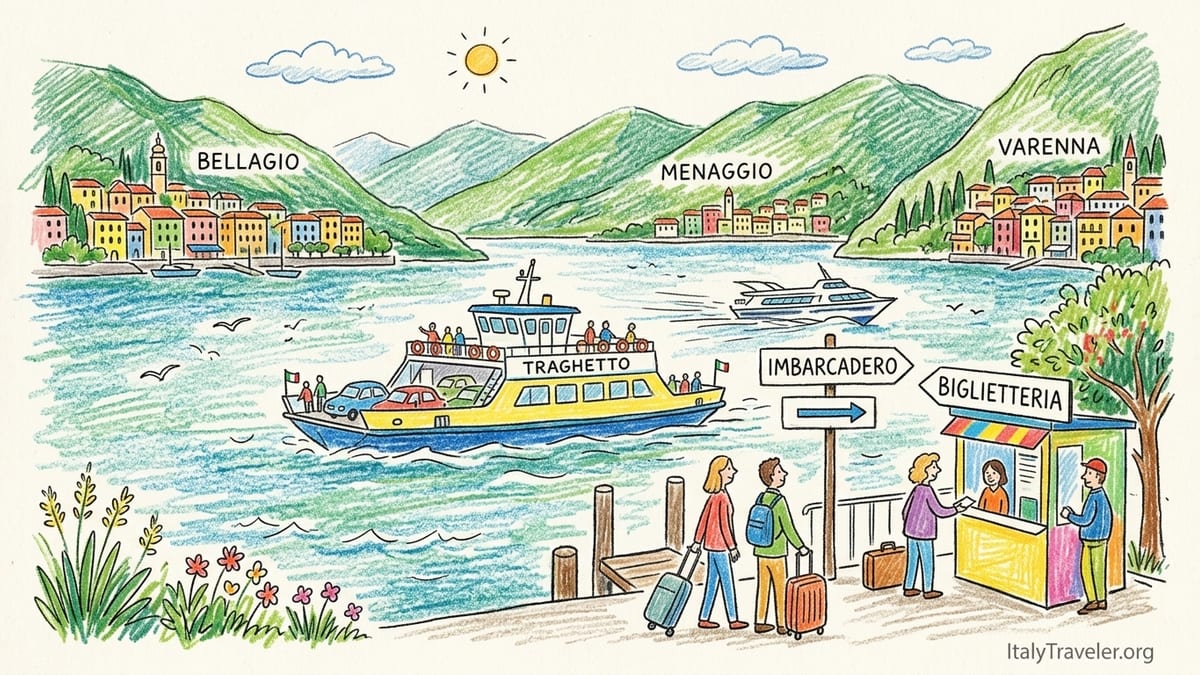
Understanding the Lake Como Ferry Network Before You Go
The public ferries on Lake Como are run by Navigazione Laghi, the state operator that has been moving people around the lake for more than a century. On today’s network there are essentially three types of boats that most visitors casually call “ferries.” There are the ordinary passenger boats, the faster hydrofoils that require a supplement, and the car ferries, called traghetti, which also accept foot passengers and shuttle almost constantly around the so‑called mid‑lake triangle of Bellagio, Varenna, Menaggio and Cadenabbia.
For this trip I focused on the central triangle, which now has its own dedicated timetable and very regular summer service linking Bellagio, Cadenabbia, Varenna and Menaggio. In 2026 the operator publishes seasonal timetables, so frequencies and first and last departures change between winter, spring and the busier summer period. Journey times on the ferry crossings themselves are short. On the current schedules Bellagio to Varenna takes about 15 minutes, Bellagio to Menaggio roughly the same, and Bellagio to Cadenabbia around 10 minutes, which means you can hop across the lake quickly once you are in the middle section.
The other key piece is the Como to Bellagio excursion ticket, which is very popular in high season. For the 2026 summer timetable, Navigazione Laghi sells an adult Como–Bellagio excursion at 24 euros return, valid on the designated ordinary route up the western shore to Bellagio. That price is clearly listed by the operator and is separate from any central‑lake passes. In practice, most people either arrive in the triangle using this excursion from Como, or come in by train to Varenna‑Esino and walk down to the pier, then use local ferry tickets between the villages.
Because timetables are seasonal, I checked the official summer PDFs as well as the live notices. During my visit in late summer, the central ferry timetable in force ran to early October, with frequent daytime connections and later evening runs slightly reduced. The important lesson was that I could not rely on a schedule screenshot from a blog post. I had to match my travel date to the specific timetable in force that season.
Starting in Varenna: Arriving by Train and Boarding the First Ferry
I chose to base myself in Varenna for the day, arriving on an early regional train at Varenna‑Esino station just after 8:00 in the morning. From the platform it is about a 10‑minute downhill walk to the lakeside, a route that is clearly signed to “imbarcadero” and used by streams of travelers wheeling suitcases. By 8:20 I was standing in front of the Navigazione ticket office, which sits a few steps back from the dock and opens in time for the first busy departures.
At that hour on a sunny August weekday there was already a short queue of perhaps ten people for tickets to Bellagio and Menaggio. Over several days on the lake I had seen how quickly this can change. On Easter weekend locals reported lines snaking almost up to the main road above the pier, with people waiting one to two hours for a boat in the late afternoon. On my particular morning, though, it was calm. Within about five minutes I reached the window, asked in English for a day of central‑lake travel, and the clerk recommended a simple round‑trip Varenna to Bellagio ticket for a few euros each way, leaving maximum flexibility to buy extra crossings as I went.
One practical detail surprised me. Recent travelers had noted that at these smaller mid‑lake ticket offices staff sell only same‑day tickets and do not issue reservations for future dates. That matched what I saw at the window. Signs clearly explained that tickets were valid only on the date shown, and the clerk confirmed that if I wanted a central‑lake day pass or a pass including fast services, I would need to arrange that at larger offices such as Como. For a straightforward day between the four mid‑lake towns, single journeys and simple returns were enough.
The first boat I boarded was a mixed car and passenger ferry. Boarding as a foot passenger was extremely simple. An attendant checked my paper ticket, stamped it, and directed me to walk on behind the few vehicles waiting on the ramp. Because the crossing to Bellagio takes only about 15 minutes, most people stayed on the open decks or in the small upper saloon, which already offered the classic view of Bellagio’s peach‑and‑cream waterfront framed by mountains.
Bellagio by Boat: Queues, Tickets and the Como Excursion
Bellagio is the most famous of the central villages and also the place where I encountered the longest queues of the day. The ferry pier is right next to the main promenade, with the Navigazione ticket office set to one side and clearly marked by the blue and white logo. By the time I docked around 9:00 there were perhaps twenty people in line for onward tickets, including some day trippers queuing for the Como–Bellagio excursion back down the lake.
I headed straight into the ticket office to ask about that excursion, since it has become a standard way to see the scenery between Como and the triangle. The clerk showed a printed notice explaining that for summer 2026 the official Como–Bellagio excursion costs 24 euros return for adults and 12 euros for children aged 4 to 11. Departures operate daily between July and early October, with specific outbound and return times listed on the current timetable. Crucially, the excursion is tied to ordinary services, not the faster hydrofoils, and spaces can fill at peak hours in high season.
On previous weekends in Como I had seen lines forming long before the ticket office opened for the morning excursion. Locals described arriving around 7:30, well before opening, to secure places on the earliest boat, while other travelers found that on certain Sundays even walking up ten minutes before departure was enough because that particular run did not fill. The pattern is not entirely predictable, which is why the operator and local tourism offices strongly advise allowing extra time to buy tickets for the Como–Bellagio run, especially in July and August.
Within Bellagio itself, getting on and off central‑lake ferries felt straightforward despite the crowds. There are separate boarding lanes for the car ferries and the passenger‑only boats. Electronic boards display the next departures to Varenna, Menaggio and Cadenabbia, and announcements are made in Italian and English. When my mid‑morning car ferry to Menaggio arrived, the foot passengers were held briefly in a fenced area while vehicles drove off, then we walked on in one group. Even with a queue of around fifty people, boarding took just a few minutes.
Menaggio and Cadenabbia: Short Crossings and Easy Transfers
From Bellagio to Menaggio I chose another car ferry, partly because I wanted the open‑deck views and partly because these services were showing the most frequent departures in the summer schedule. The crossing lasted barely a quarter of an hour. I spent most of it pressed happily to the rail watching the villas slide by and the green hills rising behind Menaggio’s pastel houses. Inside, there were bench seats under cover and a small bar counter serving coffee, cold drinks and pre‑packed snacks, but on a dry day almost everyone gravitated to the sun.
Arriving in Menaggio, the routine repeated in reverse. Vehicles rolled off first, then foot passengers streamed down onto the small square by the pier, where another Navigazione ticket office and simple waiting area serve people heading to Varenna, Bellagio and Cadenabbia. Menaggio itself is compact, with the lakeside piazza and main promenade just steps from the dock, so there is no time lost in transfers. I was able to walk the waterfront, cut up one street into the old town, grab an espresso at a bar facing the square and still be back in line for the next boat within an hour.
The hop from Menaggio to Cadenabbia is even shorter and can be combined with a visit to Villa Carlotta, the famous villa and gardens just a short walk from the Cadenabbia ferry landing. On my afternoon crossing the wait at Menaggio’s pier was under ten minutes because services were running every 20 to 30 minutes. Foot passengers boarded via a side gangway while only a handful of cars and scooters lined up on the ramp. The lake can be choppy when the afternoon breeze picks up, but the heavy, flat‑bottomed car ferries handle this gently, and there was no noticeable delay on my sailing.
What struck me most about these mid‑lake transfers was how forgiving they were. Even when I missed a boat by a minute or two, the next departure was never far away in the summer timetable. Journey times of 10 to 15 minutes meant that I spent more time in the villages than on the water, despite taking six separate crossings during the day. If you are used to island ferries where a missed departure strands you for hours, the Lake Como triangle feels almost like an urban metro service in comparison.
How Busy Do the Ferries Get and When to Avoid the Worst Queues
Lake Como’s ferries can feel very different depending on the season, the day of the week and even the time of day. Over conversations with local residents and repeat visitors, as well as what I saw with my own eyes, a rough pattern emerged. Early mornings before about 9:00 are generally calm at the central‑lake piers, even in peak season. Mid‑morning to early afternoon brings waves of day trippers from Milan, with the busiest periods centered around 11:00 to 15:00. Late afternoon, especially on holidays and long weekends, can see some of the longest queues as everyone tries to leave Bellagio or Varenna at once.
The most dramatic congestion I heard about in 2026 happened in Varenna over Easter weekend, when queues for tickets stretched almost back to the lakeside road and people waited for multiple boats. While this was an extreme case, photographs shared at the time show just how easily the small piers can be overwhelmed. On my own summer weekday visits I never waited more than one sailing, but lines of 30 to 60 people were common at Bellagio and Varenna between late morning and mid‑afternoon.
A practical workaround is to buy tickets as early in the day as possible and to avoid planning a tight connection with an evening train. Travelers staying in Varenna, for example, often want the late afternoon boat back from Bellagio in order to catch trains to Milan. Locals suggest allowing at least one extra sailing’s margin in case you find yourself at the back of a full departure. Another way to smooth things is to base yourself in one of the central villages overnight and use early morning crossings, which tend to be blissfully empty even in high season.
Weather and lake conditions can trigger last‑minute changes. When I checked the live notices for summer 2026, there were updates about load limits on some ferries due to low water levels and occasional service restrictions. The official advice is always to verify the timetable close to your travel date and to treat timings on unofficial summaries as approximate. During my day on the water, everything ran within a few minutes of the posted times, but I always recommend building in a buffer, especially if you aim to connect with a long‑distance train at the end of the day.
Can You See Bellagio, Varenna and Menaggio in One Day Without Rushing?
Before this trip I often read ambitious itineraries suggesting that you can race from Como to Bellagio, then on to Varenna, then Menaggio and perhaps even Villa del Balbianello, all in one day. After actually doing a full day in the central triangle, my view is more cautious. Yes, it is entirely possible to stand in all three main villages in a single day. The crossings are short, and the summer timetable is frequent. The question is whether that day feels enjoyable or rushed.
My own route started in Varenna, continued to Bellagio, moved on to Menaggio, then Cadenabbia and finally back to Varenna. I spent roughly two hours in Varenna in the early morning, three hours in Bellagio through lunchtime, just under ninety minutes in Menaggio and around an hour in Cadenabbia with a walk toward Villa Carlotta. Even with this relatively measured pace, I still felt a small but definite time pressure in Bellagio, where the lanes climbing up from the waterfront are dense with boutiques, churches, viewpoints and cafes. It would be easy to spend a full day there without ever stepping on a boat.
Varenna, with its romantic lakeside promenade and the possibility of walking up to Castello di Vezio, also rewards a slower approach. Menaggio, by contrast, feels a little more relaxed and residential, with a broad waterfront, playgrounds and easy strolls rather than a long checklist of sights. Cadenabbia itself is primarily a gateway for Villa Carlotta rather than a destination, although the views across to Bellagio from the lakeshore there are among the best on the lake.
If I were to compress everything into a single day again, I would adjust my expectations. Rather than trying to “do” all four stops plus a villa, I would choose two main villages and treat the third as a short wander between ferries. On my trip the highlights that truly deserved longer were Varenna and Bellagio. Menaggio worked well as a pleasant lunch or gelato stop, and Cadenabbia was essentially my access point to the western shore gardens.
The Itinerary I Would Use Next Time
With the benefit of hindsight, if I had one full summer day based in the central area, I would pick an itinerary that leans into mornings and evenings rather than the busiest midday crossings. Starting again in Varenna, I would catch a mid‑morning ferry to Bellagio after a quiet breakfast by the water. That still takes advantage of the 15‑minute hop without plunging straight into the peak queues that build closer to lunch hour. In Bellagio I would commit at least four hours, wandering the upper lanes, visiting the gardens at Villa Melzi or simply lingering on the waterfront terrace of a bar as boats come and go.
In the mid‑afternoon I would aim for a relatively quiet crossing from Bellagio to Menaggio, accepting that boats between about 14:00 and 17:00 can still be busy but that the crowds often thin slightly as day trippers spread out. In Menaggio I would limit myself to an hour or so, enough to walk the promenade, duck into the church on the main square and perhaps have a drink under the plane trees. From there, depending on energy levels, I might either return directly to Varenna, or make a quick there‑and‑back hop to Cadenabbia to catch the view toward Bellagio in the later light.
Travelers coming from Como on the official Como–Bellagio excursion at 24 euros return need to be even more deliberate. The boat from Como to Bellagio alone can take around two hours each way on the ordinary service, which consumes much of the day. If I were doing that route, I would treat Bellagio as my main stop, possibly crossing to Varenna once if time allowed, then returning to Bellagio in good time for the boat back to Como. Trying to combine Como, Bellagio, Varenna and Menaggio in one excursion day tends to leave each place feeling like a box ticked rather than a town experienced.
Another strategy I would adopt next time is to buy any necessary tickets as early as possible, especially for journeys that matter for onward travel. In Varenna, for example, I would buy my evening return ticket to Bellagio or Menaggio first thing in the morning after checking the timetable at the pier, which reduces stress later in the day when lines at the office grow. Where day passes for the central zone make sense, I would still choose to speak directly with the clerk at a Navigazione office rather than relying solely on online tools, because staff are best placed to explain current validity and limitations.
Practical Tips for Buying Tickets and Choosing Seats
One of the questions I went to Lake Como with was whether it is worth ordering ferry tickets online in advance. After several days using the system in 2026, my answer for most central‑lake travelers is that in‑person purchases work perfectly well. On the Navigazione Laghi website there is now an online ticketing section, and for some routes it is possible to buy a digital ticket valid on a given day. However, locals repeatedly emphasized that on the mid‑lake triangle most people simply walk up and buy same‑day paper tickets at the office or, if the office is closed, on board from the conductor for a small supplement.
In Varenna, Bellagio and Menaggio, the ticket windows usually open before the first busy departures of the morning and stay open through the core of the day, with lunch breaks varying by season. Signs in both Italian and English set out the rules, including the fact that many smaller offices will not sell tickets dated for future days. Payment is straightforward. I watched people use cash and standard bank cards at the windows. On board, where tickets are sold in exceptional cases, conductors accepted cash and printed simple receipts.
Seating on the central ferries is informal. There are no reservations or seat numbers. Once on board you can sit wherever you like as long as you do not block doorways or areas reserved for crew. On the larger car ferries, I gravitated toward the open side decks for panoramic views and photographs, then ducked into the covered saloon when the sun became harsh. On the smaller passenger‑only boats, which can fill more tightly at peak times, it helped to board early and head to the far end of the cabin to find quieter corners.
Finally, I learned to accept that ferries might run a few minutes late and that boarding sometimes took longer than the timetable implied, especially when staff had to juggle vehicles and large tour groups. None of my crossings were seriously delayed, but I would not schedule a train departure at Varenna‑Esino less than 45 minutes after a planned ferry arrival in high season. With that margin, the relaxed rhythm of boats and villages never tipped over into stress.
The Takeaway
Spending a full day exploring Bellagio, Varenna, Menaggio and Cadenabbia by boat turned Lake Como from a glossy image into a lived landscape. I came away with a clearer sense of how the ferry network actually works in 2026, from the 24 euro Como–Bellagio excursion and the seasonal timetables to the reality of queues at the little mid‑lake piers. I learned that while schedules look clinical on paper, the experience on the water depends as much on the time of day and your own flexibility as on departure numbers.
If you are dreaming of a single perfect day on Lake Como, my advice is to build around the central triangle instead of trying to cover every famous spot. Give Bellagio and Varenna the time they deserve, treat Menaggio as a gentle pause rather than a checklist, and use Cadenabbia for its vistas and villa access. Buy tickets early, check the official timetable for your exact travel dates, and avoid the most popular mid‑afternoon crossings when you can. Above all, remember that the greatest luxury on Lake Como’s ferries is not the seat by the rail, but the freedom to linger an extra hour in a place that unexpectedly captures your heart.
FAQ
Q1. Do I need to book Lake Como ferry tickets in advance for Bellagio, Varenna and Menaggio?
In most cases you do not need to book in advance for the central‑lake ferries. Tickets are typically bought on the day at the Navigazione ticket offices in Bellagio, Varenna, Menaggio and Cadenabbia. For very popular routes, such as the Como–Bellagio excursion in peak summer, it is wise to arrive early at the ticket office since places can fill at busy times, but for short triangle hops most travelers simply walk up and buy a same‑day ticket.
Q2. How much does the Como–Bellagio excursion cost in 2026?
For the 2026 summer timetable the official Como–Bellagio excursion operated by Navigazione Laghi costs 24 euros return for adults and 12 euros for children aged 4 to 11. This price applies to the designated excursion on ordinary boats between Como and Bellagio during the published summer period, with schedules changing seasonally. Always check the current information from the operator for your exact travel date.
Q3. How long do ferry crossings take between Bellagio, Varenna, Menaggio and Cadenabbia?
The mid‑lake triangle crossings are short. Typical journey times are about 15 minutes between Bellagio and Varenna, about 15 minutes between Bellagio and Menaggio, and roughly 10 minutes between Bellagio and Cadenabbia. These times can vary slightly by route and boat type, but in practice you will spend only a small portion of your day on the water when moving between these four villages.
Q4. Are queues really that bad on Lake Como ferries in summer?
Queues can become long at peak times, especially in Bellagio and Varenna during summer weekends and holidays. Early mornings are usually quieter, while late morning to mid‑afternoon often brings heavier crowds. On exceptionally busy days there have been reports of people waiting through more than one departure. Planning key crossings outside the busiest hours and buying tickets early in the day significantly reduces the risk of long waits.
Q5. Can I visit Bellagio, Varenna and Menaggio in one day without rushing?
You can physically visit all three in one day thanks to the short crossings and frequent summer timetable, but it can feel rushed if you try to see everything. Many travelers find that giving more time to Bellagio and Varenna, and treating Menaggio as a shorter stop, makes the day more enjoyable. If you are also traveling from and back to Como on the same day, it is usually better to focus on one or two central villages.
Q6. What is the best village to base myself in for ferry travel?
Varenna and Bellagio are the most popular bases for using the ferry network, largely because they have frequent connections to the other central‑lake villages and, in Varenna’s case, direct train access to Milan. Menaggio is a pleasant alternative with good links and a slightly quieter feel. Your choice may come down to accommodation options and whether you prefer easy rail access or being at the very center of the triangle.
Q7. Can I buy a day pass for unlimited ferry travel on Lake Como?
Navigazione Laghi offers various zone tickets and passes, including options that cover unlimited ordinary travel within specific areas of the lake for a calendar day. Availability and prices change with seasons and promotions, and conditions around fast services and special excursions can differ. For the most accurate information, check the current tariff tables or ask directly at a Navigazione ticket office when you arrive.
Q8. Are the car ferries different from the passenger boats for visitors on foot?
Car ferries, or traghetti, are designed to carry vehicles as well as passengers, but they also welcome people on foot and can be very convenient for short mid‑lake hops. For foot passengers the main difference is the layout: there are open decks above the vehicle ramp and simple indoor seating rather than the more enclosed cabins you find on some passenger‑only boats. Tickets and prices for foot passengers are handled in the same way as on the other ferries.
Q9. How early should I arrive for my Lake Como ferry?
For central‑lake crossings outside peak holidays, arriving 15 to 20 minutes before departure is usually sufficient if you already have a ticket. If you still need to buy a ticket at the window, giving yourself 30 minutes is safer, particularly in Bellagio and Varenna. For the Como–Bellagio excursion or for travel on very busy summer weekends, many travelers choose to arrive even earlier, especially for the first departures of the day.
Q10. What happens if my ferry is delayed and I have a train to catch?
Ferries can run a few minutes late due to boarding times, lake conditions or operational issues, although major delays on the central triangle are relatively uncommon. If you have a fixed train from Varenna‑Esino or Como, it is sensible to plan a buffer of at least 45 minutes to an hour between your scheduled ferry arrival and train departure, particularly in busy months. This margin allows for short delays and gives you time to walk from the pier to the station without stress.