


The first breath of air at Bormio’s thermal baths is always the same: thin, cold, and carrying a faint sulphur note from the mountain. On my most recent trip I split my time between QC Terme Bagni Vecchi and QC Terme Bagni Nuovi, soaking in the same naturally hot springs that have been feeding this valley for centuries while watching snow slide down the flanks of the Stelvio. What follows is a ground-level account of how the experience actually feels, from the moment you book a slot to the instant you reluctantly hand back your robe at the end of the day.
Booking Bormio’s Thermal Baths Today
I booked both Bagni Vecchi and Bagni Nuovi online a few weeks before arriving in Bormio, which in peak winter and during holiday periods has become less a suggestion and more a necessity. Bagni Vecchi in particular is smaller and sells out more quickly, with weekend slots often gone several days in advance according to recent visitor reports and the warning banners that now pop up during the booking flow. Bagni Nuovi, attached to the QC Grand Hotel Bagni Nuovi, has a larger outdoor park and slightly more availability, but for both I watched the time slots fill in real time as I hesitated over dates.
The booking system today works on fixed entry windows. I chose late-morning starts on back-to-back days, which gave me the sense of lingering as long as possible without running into closing time. During winter, standard adult entry is typically priced in the range of many Italian destination spas, with a clear premium on weekend and evening sessions. Bormio’s municipal Bormio Terme, in town, publishes time-unlimited access in the high-thirties euro range during the 2026 Olympic period, and QC’s historic complexes tend to sit higher than that, which matched what I found during my search.
On both websites I could add extras like an aperitivo plate or a couple’s massage, but I kept it simple and stuck to the basic spa path. Crucially, the booking confirmations spelled out that entry includes towel, robe and spa slippers, so I knew I could travel light. They also highlighted age rules: Bagni Vecchi in particular has long operated with an adults-only policy, which matched the quiet, low-key atmosphere I would find later inside.
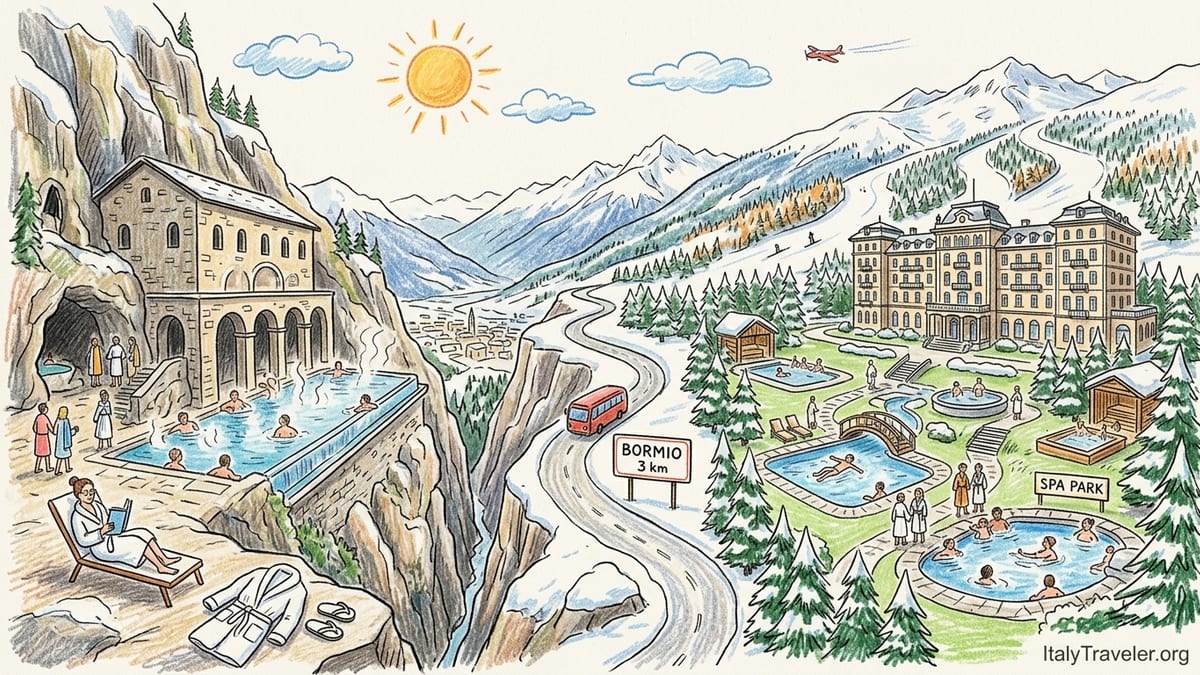
Because the valley is compact, I based myself in Bormio town and used public buses and short taxi hops to reach the baths. Bagni Vecchi sits about 3 kilometers up the road toward the Stelvio Pass, perched above the gorge, while Bagni Nuovi spreads out below in a park-like setting closer to the valley floor. The difference in setting would become one of the clearest contrasts between the two experiences.
Arriving and Checking In: First Impressions
My morning at Bagni Vecchi began with a short, winding ride from Bormio along the road that climbs toward Passo dello Stelvio. The spa is tucked into the mountainside above the Braulio gorge, and you feel that vertical drop as soon as you step out of the car: the air cool, the stone walls beaded with moisture, the valley opening beneath the parking area. Inside, check-in was surprisingly informal. Staff scanned my booking QR code, handed over a wristband that doubled as locker key, and pointed me down a corridor toward the changing rooms, reminding me in a matter-of-fact tone that mobile phones are not allowed in the water areas.
The reception hall here still feels like an old mountain hotel rather than a polished destination resort. Ceilings are lower, passages are carved into rock and old masonry, and there is a subtle smell of minerals that never entirely fades. Compared with QC’s glossy city properties, Bagni Vecchi embraces its age, right down to the uneven stone steps between areas. Recent guest comments about small, sometimes crowded changing rooms came to mind, and in truth they are compact. I had to wait a minute for a free bench, and hairdryers were limited, but this felt like a practical inconvenience rather than a deal-breaker.
Bagni Nuovi the next day felt like arriving somewhere much grander. The QC Grand Hotel Bagni Nuovi is a full belle époque hotel, and the spa reception is integrated into that world. The lobby is higher, lighter, and lined with armchairs; a glimpse through the glass doors reveals steaming pools punctuating a manicured park. The check-in process was more or less identical, but the scale different: more staff behind the desk, clearer signage for different entrances, and separate queues for hotel guests and day visitors. Even before changing, it was clear that Bagni Nuovi would be about variety and open-air space, while Bagni Vecchi had been about caverns, grottoes and history.
In both places, the staff set expectations right away: they quietly suggested a rough route through the facilities, reminded guests to shower before entering any pool, and pointed to clocks that help you time your sessions in hotter rooms. There was no sales pressure, no intrusive upselling; once banded and robed, you are left to discover the thermal maze at your own pace.
Robes, Changing Rooms and That First Step Into Warm Water
The changing experience at Bagni Vecchi is intimate, almost cramped. After swiping my wristband to open a narrow locker, I found a neatly folded white robe and towel, plus plastic spa sandals. Everything smelled freshly laundered, even if the space around me was busy. The layout splits lockers on one level and showers and toilets on another, connected by a small stair. That separation confirms reports I had read beforehand and does mean a bit of back-and-forth. I slipped into a simple swimsuit, wrapped myself in the thick robe, and immediately felt the welcome weight and warmth against the chill of the stone corridors.
From the changing area you emerge directly into the heart of the historic baths. There is no dramatic, theatrical reveal. Instead, you walk along a rock-cut passage that branches off to cave pools and steam-filled vaults, a gradual immersion into the Roman side of the complex. I left my towel on a heated rack, hung my robe on one of the pegs outside a grotto, and stepped into my first pool of the day: a dim, vaulted space fed by a narrow cascade of water that, according to Lombardy tourism materials, emerges from the mountain at roughly 37 to 40 degrees Celsius. The temperature felt like a perfect, enveloping bath: warm enough that your skin tingles as you slide in, but never so hot you want to climb back out after a few minutes.
At Bagni Nuovi the changing rooms are larger and more modern, with more generous rows of lockers and direct indoor access to several pools. The robe here was similar weight, though the sandals felt new, still a bit stiff underfoot. Within a few steps of the locker area you can access covered walkways that lead outside, which is especially welcome when the air temperature hovers around freezing. Both spas operate on the same principle: you leave your robe hanging near each zone and move from water to water with only your body exposed to the air for a few seconds at a time. Even in January, that flash of cold between pools is bracing rather than unpleasant, precisely because you know a natural hot spring is waiting on the other side of the door.
If you are sensitive to organization, it is worth noting that Bagni Vecchi’s changing zones can feel overwhelmed at busy times. Reviews in the last year mention queues for showers and hairdryers, and I saw that starting to build in mid-afternoon. Bagni Nuovi, by contrast, handled similar guest numbers more smoothly thanks to better separated wet and dry zones. In both locations, though, once you are past the lockers the experience shifts decisively to warm stone, water and mountain views.
Inside the Water: Grottoes, Infinity Tubs and Alpine Air
The true magic of Bagni Vecchi reveals itself not in the changing rooms but in the way the spaces lead you from enclosed, almost secret places into a sudden burst of altitude and air. After sampling one of the Roman-style pools and a dry, scented sauna set into an old vaulted room, I followed a corridor signed for the famous infinity pool. It threads along the rock, past the so-called “Sweating Grotto,” where humid thermal air forms a natural steam room, and then suddenly opens onto a balcony of water that seems to hang over the valley.
Stepping into that infinity pool is one of those travel moments that stays with you. The shock is not temperature; the water is again in that 37 to 40 degree band that Bormio is known for, enough to fog the air around you with gentle steam. The shock is visual. Straight ahead, Bormio town lies far below, its church towers tiny, while beyond it the white line of the Stelvio road cuts across the opposite slopes. In winter, snow coats everything except the dark cones of larches. I slid along the stone ledge until my arms were resting on the edge and simply stayed there, alternating between watching the distant ski lifts move and letting my eyes close behind drifting clouds of steam.
Elsewhere inside Bagni Vecchi, the pools are smaller and more introspective. Narrow basins tucked into rock cavities, a circular bath under a domed ceiling lit by candles, a series of hot and cold footbaths. The theme is always intimacy. Even when the spa is busy, voices drop to whispers. You hear water dripping from the rock and the occasional faint laugh from outside when someone braces for the cold plunge. I rarely felt crowded in the water itself, though moving between zones sometimes required a short wait on the stairs as people negotiated the narrow passages.
Bagni Nuovi turned that inward feeling inside out. Here the starring role belongs to the park, a terraced hillside packed with pools, tubs, whirlpools, wooden saunas hidden in the trees and lounging chairs dug into the snow. I started indoors, easing into a long, shallow pool that snakes along a glass wall. At one end, a water gate opens so you can float under and suddenly find yourself outside, shoulders deep in hot water while snowflakes land and melt on your face. A couple nearby clinked plastic water glasses, the only sound above the soft churn of jets.
From there I walked, wrapped in my robe, between outdoor basins set at slightly different temperatures. Some are near-body temperature, almost like floating in a warm alpine lake, others noticeably hotter although still within the broad 36 to 41 degree band that local tourism boards and technical sheets describe for Bormio’s springs. One pool sits high on the slope with views up-valley toward the snowfields; another nestles among firs with little wooden bridges. Saunas here range from glass-fronted cabins that frame the view like a postcard to low, rustic huts buried in snow, where you emerge glowing and then step carefully into a cold immersion tub.
Crowds, Atmosphere and When to Go
Visiting in deep winter, with Bormio’s ski season in full swing, meant accepting that neither spa would be empty. Still, the way crowds felt in each place differed. Bagni Vecchi attracts more couples and small groups of friends who are, like I was, drawn by the history and the cliff-edge infinity pool. Because the complex is carved into the hillside, space is more constrained. Midday, especially on a Saturday, the changing rooms and the corridor leading to the main baths can feel congested. In the water, though, I usually shared each pool with only a handful of others. The strongest sense of crowding came when a fresh wave of arrivals reached the infinity bath and everyone wanted that front-row ledge for a while.
At Bagni Nuovi, the more expansive layout diluted the sense of busyness, but in popular spots like the largest outdoor pool closest to the hotel, the atmosphere could verge on social. Groups chatted in Italian, German and English, and selfie attempts increased whenever a fresh curtain of snow started to fall. Quiet corners still existed. A small circular pool half-hidden behind shrubs became my personal favorite escape, especially late in the afternoon when the light flattened and most guests drifted back toward the indoor zones.
Locals and repeat visitors often recommend weekdays outside of Italian public holidays for the most relaxed experiences, and that matched what I saw. On a midweek afternoon, Bagni Vecchi settled into a near-meditative quiet from about 2 to 4 p.m., once the initial wave of morning visitors had left and before the evening crowd arrived. The same pattern held at Bagni Nuovi. In shoulder seasons like late autumn and early spring, when the ski slopes are closed but temperatures are still low, reports suggest even calmer conditions. The constant, in any season, is the water temperature. Whether snowbanks reach the pool edges or wildflowers line the paths, the springs themselves keep flowing at that familiar, body-calming range.
If you are hoping for a child-free environment, Bagni Vecchi’s adult focus will be the safer bet. If you are traveling with older teenagers or simply enjoy a livelier, more resort-like mood, Bagni Nuovi’s larger footprint and varied spaces might be more comfortable. Either way, booking earlier in the day and aiming for non-weekend dates remains the most reliable crowd-avoidance strategy.
Food, Breaks and How Long You Will Want to Stay
On both days I planned for a long, slow visit and that turned out to be the right instinct. My Bagni Vecchi session began around 10 a.m. and I did not feel remotely ready to leave until 3 p.m., by which point my skin had turned pleasantly soft and my mind had shed all sense of slope schedules or dinner reservations. Inside, there is a café-style area where you can wrap yourself in your robe and sit down for a light lunch or snack. The offer leans toward simple dishes and finger food: focaccia slices, salads, small desserts, plus fruit-infused waters and hot herbal teas included at self-service stations. Prices were in line with other Italian spa cafés, clearly displayed at the counter.
I punctuated my Bagni Vecchi circuit with two breaks. The first was an early tea stop after an hour in grottoes and saunas, the second a more substantial pause around 1 p.m. when I ordered a plate with local cheeses and bresaola, the air-dried beef for which Valtellina is famous. Sitting by a window in my damp hair and robe, looking out at the bright stripe of snow moving down the valley, felt both slightly surreal and entirely natural in a place that has been dedicated to thermal bathing since antiquity.
At Bagni Nuovi, food plays a slightly bigger role. The main building includes a bar area with sweet and savory options, and the spa regularly promotes aperitivo-style experiences, especially in the late afternoon and evening. On my visit I skipped any formal add-ons and simply ordered a coffee and a small pastry mid-morning, then a bowl of simple soup and bread early in the afternoon. Eating lightly suited the rhythm of moving in and out of warm water. Hydration stations dotted around the park made it easy to keep drinking water, which feels essential once you realize how warm, at around 37 to 40 degrees, the pools actually are.
As for how long you may want to stay, the honest answer is “longer than you booked.” At both spas I reached a similar pattern. The first two hours were exploratory, trying every grotto or pool I could find. The next hour or two became more selective, as I cycled among a handful of favorites, often ending up in the same corner of the infinity pool at Bagni Vecchi or the same hillside tub at Bagni Nuovi, watching clouds slide across the ridge. By hour four I felt deeply relaxed but not drained, and could easily have stretched to closing time if other plans had not pulled me away.
Bagni Vecchi vs Bagni Nuovi: A Firsthand Comparison
Experiencing Bagni Vecchi and Bagni Nuovi on consecutive days clarified how distinct they feel despite drawing on the same family of springs rising from Monte Reit. The water chemistry and temperatures are shared, flowing naturally warm in that mid- to high-thirties Celsius band highlighted by regional tourism boards and technical documentation. What differs is everything wrapped around it: architecture, atmosphere, spatial layout and even how you experience the surrounding mountains.
Bagni Vecchi is for travelers who are moved by history, texture and a sense of place. Inside its grottoes the rock feels close and time compressed. As you soak in the so-called Roman baths or sit quietly in the sweating cave, you are very aware that warm water has been flowing here, and people bathing in it, for many centuries. The most iconic element, the cliff-edge infinity pool, puts you in direct dialogue with the dramatic contours of the valley. You look down more than out. The trade-offs are real: tighter changing spaces, more stairs, and at busy times a slightly chaotic flow between zones.
Bagni Nuovi, by contrast, feels like a contemporary alpine wellness park infused with classic hotel elegance. Here the focus shifts from interior history to exterior variety. You wander between a large range of pools and saunas laid out across terraces, with panoramic views not only down to Bormio but also up toward the peaks that cradle the valley. The look is manicured: sculpted lawns in summer, carefully cleared paths in winter. For many visitors, especially those staying in the Grand Hotel, this is a place to spend almost an entire day, drifting between water, loungers and occasional drinks.
In practical terms, someone debating between the two might think of Bagni Vecchi as a more contemplative, perhaps slightly more intense experience that rewards those who love unique, slightly imperfect historic spaces. Bagni Nuovi caters more naturally to those who want choice, space and a polished resort feel. On a first trip, if I had to pick only one, I would still lean toward Bagni Vecchi for its one-of-a-kind location and intimate atmosphere. Having now visited both, my ideal Bormio stay pairs a half day at Bagni Vecchi for its history and infinity edge with a full lazy day at Bagni Nuovi for its open-air park.
What unites them, beyond the shared operator and springs, is the way they let you experience hot water and cold mountain air in direct contact. Standing up from a steaming pool into lightly falling snow, then slipping back under until only your face is exposed, is the image that still surfaces in my mind when I think of Bormio. It is a simple sensation, yet one that anchors the whole trip, whether your robe hangs in a cliffside grotto or beside a manicured hotel lawn.
The Takeaway
Bormio’s thermal baths do not rely on spectacle so much as on the consistent pleasure of naturally warm water meeting high alpine weather. Lombardy’s tourism offices like to point out that the springs emerge at around 37 to 40 degrees Celsius even as the surrounding peaks remain snow-covered, and on the ground that contrast is what you feel most vividly. In Bagni Vecchi the experience is anchored in stone, history and a single unforgettable infinity pool. In Bagni Nuovi it plays out across a hillside of pools and saunas, shaded by trees in summer and rimmed with snow in winter.
From a traveler’s point of view, what matters is that both are genuinely easy to integrate into a wider northern Italy itinerary. Bormio combines serious skiing and hiking with this quietly luxurious thermal culture, and it does so in a way that still feels rooted in a small mountain town of just a few thousand residents rather than an anonymous resort strip. Prices today reflect their status as destination spas, yet the core experience remains straightforward: you check in, shrug on a robe, step into water that has been flowing hot from the mountain since long before any of us, and let time simplify itself to a rotation between pools, rest and the changing light on the peaks.
For me, leaving each day was the hardest part. At Bagni Vecchi, I took one last look from the infinity edge down to Bormio, reluctant to surrender the perspective of hanging between cliff and sky. At Bagni Nuovi, I lingered on a lounger until the last possible moment, robe wrapped tight, watching steam rise in columns over the terraces as the first stars appeared. Those closing images are as integral to the experience as any individual pool or sauna. They are the reason that, planning my next return to Lombardy, I find myself once again checking Bagni Vecchi and Bagni Nuovi availability before I have even booked my flights.
FAQ
Q1. Do I need to book Bagni Vecchi and Bagni Nuovi in advance?
Yes. Both spas now use timed entry slots and weekends in particular often sell out several days ahead, so booking online before you arrive in Bormio is strongly recommended.
Q2. How hot is the water in Bormio’s thermal baths?
The springs that feed Bagni Vecchi and Bagni Nuovi emerge from Monte Reit at roughly 37 to 40 degrees Celsius, so the pools feel like a consistently warm bath even in snowy weather.
Q3. Can I visit Bagni Vecchi or Bagni Nuovi with children?
Bagni Vecchi is generally oriented toward adults and has operated with age limits, while Bagni Nuovi and the in-town Bormio Terme are more family-friendly. Always check current age policies when booking, as rules can change.
Q4. How long should I plan to stay at the thermal baths?
Most visitors find that three to five hours allows enough time to explore pools, saunas and relaxation areas without rushing, and it is easy to spend longer if you add meals or treatments.
Q5. What should I bring with me to the spas?
Bring a swimsuit and any personal toiletries you like. Entry typically includes a robe, towel and spa sandals, and both complexes provide showers and basic amenities in the changing rooms.
Q6. Are the thermal baths crowded?
Crowding depends heavily on timing. Winter weekends and holidays are busier, especially in changing areas, while midweek visits outside peak periods usually feel calmer, with plenty of space in most pools.
Q7. Which is better for views, Bagni Vecchi or Bagni Nuovi?
Bagni Vecchi offers a dramatic cliff-edge infinity pool looking directly down over Bormio and the valley, while Bagni Nuovi provides more varied hillside vistas across its many outdoor pools and saunas.
Q8. Is food available inside the thermal complexes?
Yes. Both Bagni Vecchi and Bagni Nuovi have café or bar areas where you can eat in your robe, offering light dishes, snacks, desserts and drinks, along with complimentary water and herbal teas.
Q9. Can I visit both Bagni Vecchi and Bagni Nuovi on the same day?
It is physically possible but not ideal. Each complex easily fills several hours, and most travelers prefer to dedicate at least half a day to each on separate days to avoid feeling rushed.
Q10. Are the Bormio thermal baths open in winter when it snows?
Yes. The baths are designed to operate in snowy conditions, and many guests consider winter the most atmospheric time to visit, with hot pools steaming beneath snow-covered peaks.