


I thought I knew the Duomo di Milano before I set foot on its rooftop. I had stood in Piazza del Duomo several times, taken the postcard photos, and walked through the forest of columns inside. But it was not until I booked a rooftop ticket and threaded my way between the marble pinnacles that the cathedral finally felt three-dimensional, like a city I could actually wander. Here is exactly how that visit played out, and what I would do differently next time now that I have navigated the ticket options, the queues and the crowds among the spires.
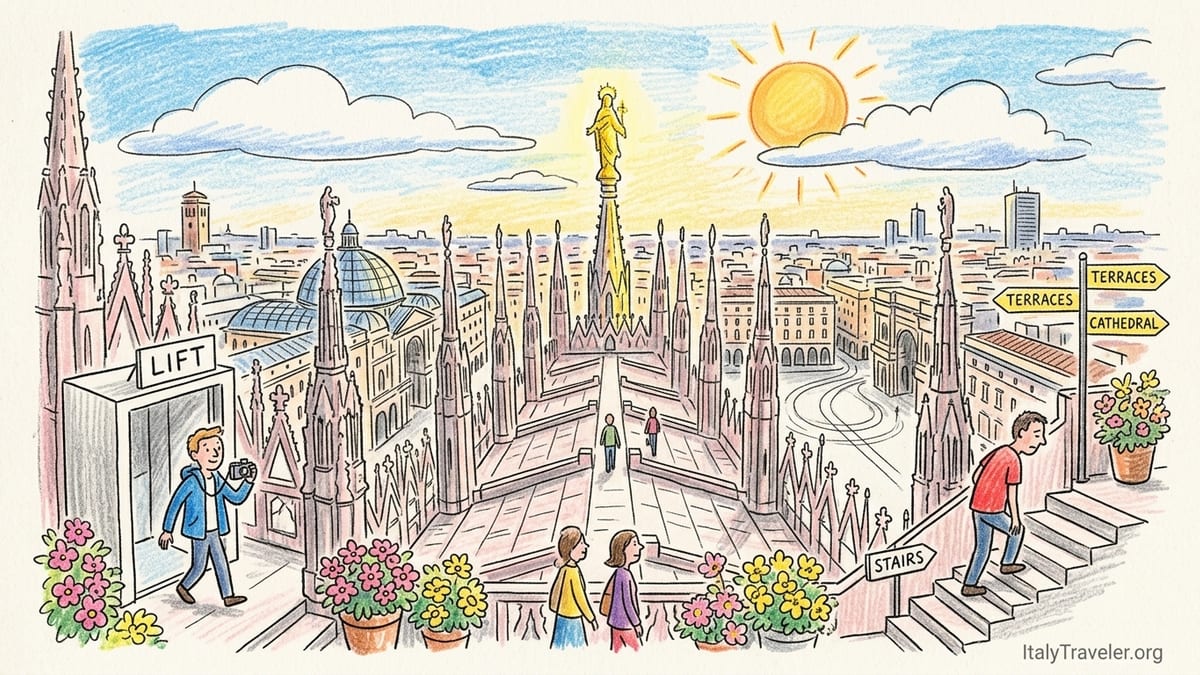
When I Went Up: Booking, Timing and First Impressions
My most recent rooftop visit was in late June 2026, right at the start of the extended summer opening period that runs on selected dates and on Thursday evenings between 11 June and 10 September. I booked a Combo Lift ticket on the official Duomo sales channel two days in advance, choosing a 5:30 p.m. entry slot so that I would still be on the terraces as the light softened over Milan but off again before the late musical evening crowd arrived. The Combo Lift ticket, which combines the cathedral interior with the rooftop by lift plus the Duomo Museum and San Gottardo, was priced at 26 euros full fare, in line with the tariff set by the Veneranda Fabbrica del Duomo from April 2025 onward.
I had agonized over whether to pay more for the lift. A terraces-only lift ticket is cheaper than the full combo and a stairs-only option is cheaper again, but once I factored in that the combo would let me move from rooftop straight into the cathedral without rejoining the exterior queue, the four-euro difference between stairs and lift felt like good value. Earlier in 2026, guide-style sites and the Duomo’s own access updates all confirmed that the price gap between lift and stairs remained small but meaningful, with the lift version clustered around the mid-20-euro mark for the combined ticket while the stairs option sat closer to 22 euros.
Because I was visiting during the popular early evening slot, I arrived in Piazza del Duomo roughly 30 minutes before the time printed on my ticket. The square was busy but not crushed, with small tour groups mustering under guide flags and a short security queue snaking in front of the rooftop entrance on the north side of the cathedral. Even from the line, the terraces were visible above, a lacework of pink-grey Candoglia marble spires glowing a little in the late-afternoon sun. The entire setup looked both orderly and slightly intimidating, like an airport boarding gate perched on top of a Gothic cliff.
Emotionally, the first surprise was how quickly the rooftop visit felt different from standing in the square. Down below, the Duomo reads as a facade, a carved wall. As soon as I committed to the rooftop ticket and queued under the sign for the terraces by lift, it became clear I was committing not just to a view but to exploring the building’s skin from the inside out.
Lift Versus Stairs: What I Actually Chose and How It Felt
On this visit, I deliberately chose the lift, because I wanted to compare it to an earlier stairs-only ascent I had done several summers ago. Having both experiences back-to-back, separated by a few years but under the same ticket system, changed my view entirely. When I took the stairs previously, I had paid slightly less and climbed from ground level up a narrow stone staircase that twisted along the flank of the cathedral, emerging on the lowest terrace level a bit short of breath and with a slow-moving queue both ahead and behind me. The climb itself felt like about ten stories of stairs, with no particular payoff along the way beyond small slit windows and the satisfaction of earning the view.
The lift experience in 2026 was far more efficient. After my ticket was scanned and I passed through the metal detector, I was funneled into a small waiting area where staff batched visitors into elevator loads. The main public lift rises only to the first terrace level, roughly 30 meters above the square, so even with a lift ticket you still climb a final run of stone steps to move up to the higher terraces once you are on the roof. That climb felt like another five or six floors, broken into shorter segments that zigzag between statues and flying buttresses. It is not step-free, but the lift neatly removes what I would estimate as two thirds of the overall ascent.
Most importantly, the lift preserved my energy for exploring once I reached the open-air sections. On my earlier all-stairs visit, I distinctly remember tackling the final staircase to the upper terrace already tired, which meant I lingered less and sought out benches instead of lines of sight. In 2026, taking the lift meant I arrived on the first terrace fresh, able to weave slowly along the parapets, duck into small side corridors between spires and climb the upper level without worrying whether my legs would resent me the next day.
Descending, both visits were essentially the same. Regardless of whether I had used the stairs or lift to ascend, Duomo staff directed everyone down via staircases, a rule that was confirmed in current rooftop guides and in the cathedral’s own published access notes. That matters because it means even a lift ticket is not a way to avoid stairs altogether. On my June 2026 visit, the descent was steady but never claustrophobic; the stairwell is narrow and spirals in places, but staff held people at the top to prevent bottle-necks from forming. Knowing the descent is unavoidable is another reason I now consider paying a modest premium for the lift ascent a sensible compromise, especially for anyone prone to knee issues or heat fatigue.
Security, Queues and How Crowded It Really Was
The security setup for the rooftop in 2026 felt slightly more streamlined than on my previous visit, but the core steps were the same. At the base of the cathedral, before reaching either the stairs or the lift entrance, every visitor passed through a metal detector and bag screening point. Small daypacks, compact cameras and water bottles were fine; larger luggage and bulky camera gear were refused and had to be stored elsewhere. Signs reiterated the cathedral’s modest dress code covering shoulders and knees, as already noted in up-to-date ticket guides, and staff did turn away one visitor in a cropped top, politely but firmly, until she covered up with a scarf.
With a 5:30 p.m. time slot, my total wait from joining the terrace queue to stepping into the lift was about 20 minutes. The first 10 minutes were outside in the open air, queuing by ticket type under signs for lift and stairs; the second 10 were inside the checkpoint and lift lobby area. Friends who visited closer to midday in spring 2026 reported significantly longer waits, up to 40 minutes even with pre-booked entry slots, which felt consistent with the Duomo’s general advice and with anecdotal reports on traveler forums that mornings between 9 and 10 and late afternoon after 4 are the calmest.
Once on the terraces, the crowding ebbed and flowed depending on where I stood. The initial landing area on the first terrace, where visitors arrive from the lift and from the stairway, was packed with people snapping the classic shot looking west along the nave pinnacles towards the square. However, simply walking a couple of minutes along the north side walkway quickly thinned things out. The upper central terrace was busier again, especially around the tight spots where everyone wanted the same skyline view, but there was still space to pause and frame photos without jostling.
By the time I started my descent, just after 7 p.m., staff were already preparing for the separate evening event window that runs on summer Thursdays between mid June and early September. For those Serate d’Incanto evenings, the Duomo’s own programme confirms live music til 10 p.m., with the last lift ascent earlier, and tickets for the rooftop with musical accompaniment starting around 20 euros for lift access. That meant my regular daytime ticket overlapped slightly with the evening atmosphere without being part of it, a logistical detail worth noting if you want either to lean into the event vibe or avoid it.
Weather, Footwear and the Reality of Walking on Marble
Arriving in late June, I had warm, bright conditions: around 28 degrees Celsius at street level with almost no breeze. Up on the terraces, the temperature felt a few degrees hotter because the pale marble reflects the sun and there is limited shade. I wore lightweight trainers with good grip and was glad I had. The Duomo’s marble is not polished-slick, but some sections of the rooftop slopes are gently angled, and you move along narrow walkways between drainage channels and carved edges. On a previous September visit after light rain, several patches remained damp and slightly slippery, especially in shadowed corners between flying buttresses.
Even on a dry evening like mine, I would not want to be up there in smooth-soled sandals or heels. Practical footwear is not an official requirement in the way that covered shoulders are, but once you are navigating tight corners with a low parapet on one side and a drop of several stories on the other, the advice that many ticket guides offer about wearing secure, closed shoes feels very concrete. I watched several visitors pause nervously at narrow points, gripping the handrail simply because their fashion sneakers or leather sandals did not feel especially stable on the stone.
Weather also affected how long I chose to stay. In perfect conditions, it would be easy to linger for two hours tracing every possible viewpoint. On my June 2026 visit, I spent around 75 minutes from the moment I stepped out of the lift to the point where I started heading down the staircase towards the cathedral interior. That included time to climb to the highest terrace, wait for clear shots of the golden Madonnina crowning the main spire, take a short break in one of the few shaded recesses and simply stand and watch planes drawing lines across the sky behind the skyline.
If you are visiting in peak summer heat, earlier in the day or during a heatwave, it might be wise to cut that time down a little. There is no cafe or kiosk on the terraces and no toilet; you are effectively committed to whatever you choose to carry up in your bag. The official guidance encourages bringing a small water bottle and sun protection, and after walking the terraces in late June sunlight I would upgrade that from suggestion to near necessity, especially for children and older visitors.
How Much Time to Allow and How the Visit Flows
Across both of my rooftop visits, one stairs-first and one lift-first, the time that felt “right” clustered around an hour to an hour and a half. For my June 2026 lift visit, I arrived at the square at 5 p.m., entered the queue around 5:05, reached the rooftop just before 5:30, and did not start my descent until a little after 6:40. I stepped into the cathedral interior at around 7, emerging back into the square roughly half an hour later after a self-guided loop at floor level. Door to door, the whole experience consumed about two and a half hours.
The flow of the visit is set up to be mostly one way. From the initial landing on the first terrace, staff encourage you to walk in a counterclockwise direction around the roof, with occasional short detours up to the central spine and highest point. There are a few narrow dead ends that require backtracking a few meters, but for the most part, you are always making slow, forward progress. That suits the design of the rooftop, which was created as a walkable architectural belt around the nave and transept. It also means that even when the terraces feel visually busy, people are constantly dispersing along the walkways instead of clumping in one or two zones.
During my stairs-only visit several years earlier, I lingered in more places, but part of that was simply to recover between sections of climbing. In 2026, using the lift made the time feel calmer. I could decide to pause for ten minutes at a particular corner where the view lined up the Duomo’s forest of spires with the glass dome of the Galleria Vittorio Emanuele II without worrying that I might run out of stamina before reaching the highest terrace. Leaving the rooftop for the cathedral floor also felt more seamless; once you commit to the descent, the staircase feeds you directly into the nave, where you scan your combo ticket again and are gently folded into the main flow of interior visitors.
If you plan to combine the rooftop with the museum and the archaeological area beneath the Duomo, I would suggest visiting the terraces first, then the interior, then the museum. The museum closes earlier and on my June 2026 day was shutting its doors at 7 p.m., which meant I left it for the following morning. Because the combo ticket is valid for one calendar day for each included element, you need to check the current opening hours listed by the Veneranda Fabbrica and arrange your order accordingly.
Guided Visit or Independent Exploration: What Added Real Value
On my first rooftop climb, I joined a small guided group booked through an external tour operator, who bundled the terraces and cathedral interior into a 90-minute experience. The guide was engaging and knowledgeable, pointing out restoration details, explaining the Candoglia marble supply chain that has funded the Duomo for centuries, and highlighting sculptures that would have meant little to me without context. However, the tour also moved faster than I would have liked, and ticket-in-hand prices for similar guided rooftop tours in 2026 were often double or more the official lift or combo tariff when booked directly.
For the June 2026 visit, I went independently with only the Duomo’s official app to provide commentary. Access updates published by the cathedral in 2025 confirmed that the app and video guide are available in multiple languages, and I found the rooftop sections of the content clear and compact. I could pause the audio to let a crowd thin out, rewind a section about a particular sculpture or skip pieces that did not interest me. That flexibility mattered more than the small extra insights that a live guide might have offered.
Would I ever pay for a guided experience again on the rooftop? Possibly, but only in very specific circumstances. The Thursday evening Serate d’Incanto events from 11 June to 10 September 2026 occasionally paired musical accompaniment with themed guided walks, and if I were visiting Milan for the first time during that window I would seriously consider booking that kind of curated evening. The combination of sunset light, live music and a guide framing the cathedral’s history in real time feels like a justifiable splurge for a special occasion or photography-focused trip.
For most travelers, my conclusion after doing both is that the official combo ticket plus the app offers the best balance between cost and depth. Paying for a third-party guided tour only felt worth it when the schedule or access included something I could not replicate alone, such as an after-hours slot or reserved central terrace time. For a daytime rooftop visit under normal conditions, I preferred the slower rhythm and self-determined pace of wandering on my own.
Which Ticket I Would Buy Next Time (And Who Should Choose What)
After two visits under the current pricing and access rules, I know exactly which ticket I would choose next time. I would buy the Combo Lift ticket again, directly from the official Duomo channel for 26 euros, and I would time my slot either for shortly after opening in the morning or, if visiting in summer, for late afternoon so that I could linger into the golden-hour light without merging fully into the evening events.
The reason is simple. The lift removes enough of the physical strain to keep the visit comfortable while still leaving you with the satisfying final climb to the highest terraces. The combo element unlocks the interior and museum without adding complexity to your day, and the direct descent from the rooftop staircase into the nave effectively skips the main cathedral security line once you have passed through the rooftop checkpoint. That is a meaningful advantage if you are visiting during a busy period or with children who do not tolerate multiple lines well.
If I were traveling with very budget-conscious friends who enjoy physical challenges and do not mind warmer conditions, I might steer them towards the Combo Stairs ticket at roughly 22 euros, pointing out the savings and making sure they are aware of the continuous stair descent at the end. For anyone with mobility concerns, breathing issues, or simply wanting to preserve their energy for the rest of the day, I would strongly recommend against a stairs-only ticket. The difference of around four euros between the two combo options is small compared to the overall cost of a Milan trip and can make the difference between a memorable experience and an exhausting one.
For repeat visitors who only care about the rooftop and have already explored the Duomo’s interior and museum, a terraces-only lift ticket could make sense, especially outside of the peak evening events season. Yet even then, I personally would lean towards the combo. The cathedral floor looks and feels different after you have walked its roof; seeing the stained glass from inside with fresh knowledge of where it sits in the overall structure is one of the quiet pleasures of a rooftop-first visit.
The Takeaway
Walking among the spires of the Duomo di Milano is not just another viewpoint to check off a list. It is a chance to inhabit the cathedral as its medieval builders once did, stepping along the roofline, brushing past statues at eye level and feeling the surface of the city tilt away beneath you. My June 2026 visit, anchored around a Combo Lift ticket and a late afternoon time slot, confirmed that the rooftop remains the single most rewarding way to understand the building, provided you approach it with realistic expectations about queues, stairs and weather.
If there is one lesson I would underline, it is to match your ticket choice to your body and your patience, not just your wallet. The small price difference between lift and stairs shapes the entire feel of the climb, and knowing that everyone descends by stairs anyway should factor into your decision. Likewise, be honest about how much time you want to spend in direct sun on pale stone, and plan your footwear, water and pacing accordingly.
Next time I find myself in Piazza del Duomo and the sky is clear, I will book the same Combo Lift ticket, arrive a little before my slot, and let myself drift again between the flying buttresses and pinnacles for an unhurried hour. I will save the premium guided experiences for a special evening with music when circumstances and budget align. What I will not do is skip the rooftop entirely. Once you have seen Milan from among the spires, looking up at the cathedral from the square below is never quite the same.
FAQ
Q1. Do Milan Duomo rooftop tickets always include access to the cathedral interior?
Not always. Combo tickets that mention both the Duomo and the terraces do include the interior, but a terraces-only ticket covers just the rooftop, so you need to check the product name and description carefully when buying.
Q2. How much do Milan Duomo rooftop tickets cost in 2026?
As of late 2026, official prices for the main combo products are around 26 euros for the Combo Lift ticket and 22 euros for the Combo Stairs ticket for adults, with reduced fares for certain age groups and categories; terraces-only tickets are a little cheaper than the combos.
Q3. Is the lift worth paying extra for, or should I just take the stairs?
In my experience, the lift is worth the small extra cost. It removes most of the steep ascent while still leaving some climbing, and since everyone must descend by stairs anyway, conserving energy on the way up makes the visit more enjoyable.
Q4. How long should I plan for a Duomo rooftop visit?
I would allow at least 90 minutes for the rooftop alone, including queuing, and about two and a half hours total if you combine the terraces with a walk through the cathedral interior on the same visit.
Q5. What should I wear on the rooftop in terms of dress code and footwear?
You need shoulders and knees covered to respect the cathedral’s dress code, and secure, closed shoes with good grip are strongly recommended because you will be walking on sloping marble surfaces and navigating staircases.
Q6. Are there evening rooftop visits with music or special events?
Yes. In summer 2026 the Duomo ran Thursday evening “Serate d’Incanto” events from 11 June to 10 September, with extended terrace hours, live music and lift-access tickets for those evenings starting at about 20 euros.
Q7. Can I avoid queues if I book a specific time slot online?
Booking a time slot online helps but does not eliminate queues entirely. You still pass through security and may wait for the lift, especially at busy times, but in my experience the total wait with a timed ticket was around 20 minutes in the late afternoon.
Q8. Is the rooftop suitable for people with mobility issues or fear of heights?
The lift reduces the climb, but there are still stairs, narrow walkways and some exposed-feeling sections, so anyone with serious mobility limitations or strong vertigo may find parts of the rooftop challenging.
Q9. Do I need a guided tour, or is the official app enough?
For most visitors the official Duomo app or audio guide provides enough information to appreciate the rooftop. Guided tours can add depth or special access, especially during evening events, but they are not essential for a rewarding visit.
Q10. Can I bring food, drink or large bags onto the terraces?
Small water bottles and modest daypacks are generally allowed after security screening, but picnics, large luggage and bulky camera gear are not; there are no cafes or toilets on the terraces, so plan accordingly before you go up.