


I had heard Franciacorta described as “Italy’s answer to Champagne,” but it was only when I spent a full day among Lombardy’s vineyards that the region stopped being a line in a wine list and became a real place in my mind. South of Lake Iseo, on gently sloping hills threaded by the Strada del Franciacorta wine route, more than a hundred cellars work roughly 3,150 hectares of vines throughout the year. I went to see what a Franciacorta wine tour actually feels like in practice, from arranging transport and choosing cellars to deciding how much to drink and whether paying extra for a driver is really worth it.
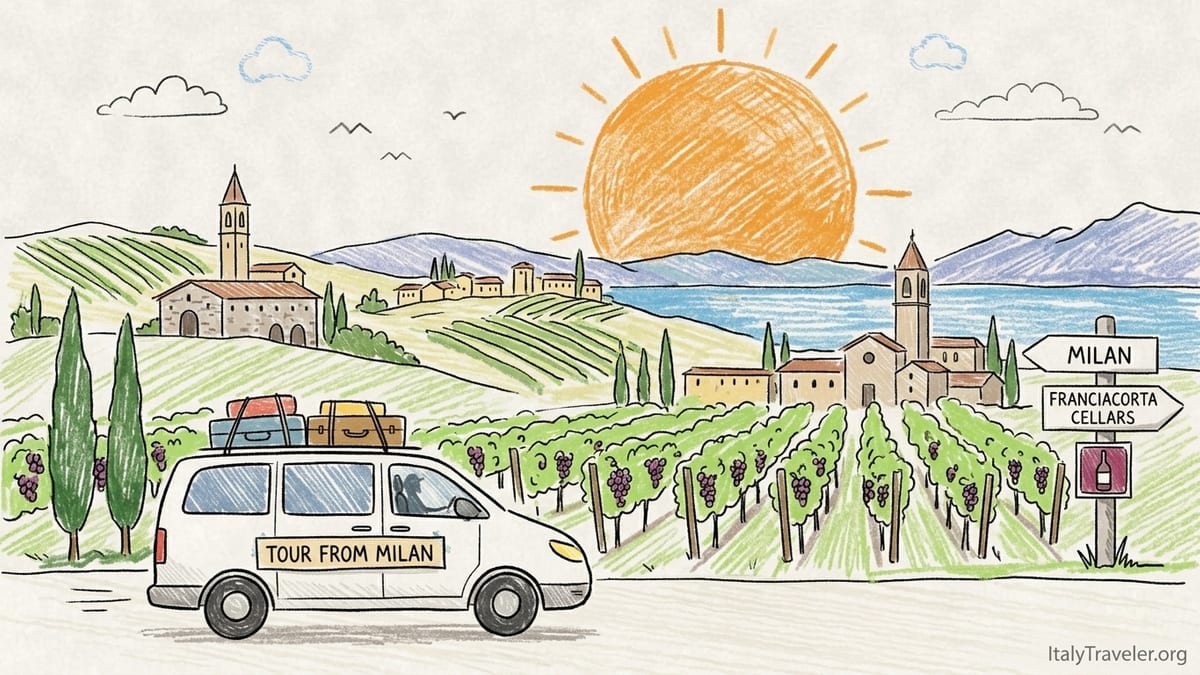
Planning the Day: Getting to Franciacorta Without Stress
My base was Milan, which is how many travelers first reach Franciacorta. Looking at the map, renting a car for the day seemed straightforward. The region sits roughly an hour to an hour and a half east of Milan by road, in the province of Brescia, with the wine zone fanning out south of Lake Iseo. Official Lombardy tourism and local agriturismi describe Franciacorta as a patchwork of 117 cellars and around 3,150 hectares of vineyards that can be visited all year, which made the idea of driving myself between them tempting. In reality, the combination of Italian drink-driving laws, unfamiliar country roads, and the sheer pleasure of drinking sparkling wine without calculating alcohol units pushed me toward a different solution.
I compared three main options: a fully guided small-group tour from Milan by minivan, an organized transfer to Franciacorta paired with independent cellar bookings, and the train to Brescia or Lake Iseo followed by local taxis. Small-group Franciacorta packages from Milan that visit two wineries with tastings and a long lunch beside the lake were typically priced in the 160 to 220 euro range per person when I checked, including transport, tastings, and food. That is not a budget outing, but once I added up a car rental for the day, motorway tolls, fuel, parking, and the cost of individual tastings and lunch, the gap narrowed more than I expected.
Local tourism material for Franciacorta emphasizes that the wine route is explorable year-round on foot or by bike, but those options are better for travelers already staying in the area. Coming in for the day from Milan, I wanted a simple, linear plan with someone else watching the clock and the road. I eventually chose a full-day small-group tour from Milan with two cellar visits and a three-course lunch at a restaurant on the southern shore of Lake Iseo. Crucially, the tour promised a dedicated driver and an English-speaking wine guide, which meant I could ask detailed questions about the production of Franciacorta without juggling navigation on my phone.
For those who want more independence, another workable option I researched was taking the train from Milan to Brescia, then using a pre-booked local driver or taxi to shuttle between one or two wineries. The Brescia area is part of the official Franciacorta production zone, and there are smaller stations closer to some villages, but timetables and transfer times make this better suited to seasoned travelers with some Italian and a flexible schedule. For a first, immersive day, the guided minivan format turned out to be the least stressful choice.
The Journey In: First Glimpses of the Vineyards
The tour began with an 8:30 a.m. pick-up near Milan’s city center. Our minivan held eight guests plus the driver-guide, which kept the atmosphere informal. Leaving the city, we joined the A4 motorway toward Brescia, passing industrial suburbs before the scenery softened. About an hour in, the first lines of vines appeared, running neatly up gentle morainic hills formed by ancient glaciers. Official descriptions of the area talk about “vineyards-gardens” overlooking the lake, which sounded like poetic marketing on paper but turned out to be quite literal. Many vineyards had manicured grass between the rows and olive trees or cypresses dotting the edges, so the landscape felt designed as well as agricultural.
Our guide used the road time well, giving us a concise introduction to Franciacorta. She explained that although wine has been made here for centuries, the modern Franciacorta DOCG for traditional-method sparkling wine is relatively young compared with Champagne, and that Chardonnay, Pinot Nero, and Pinot Bianco dominate the plantings. One detail that set expectations for the day was the clarification that Franciacorta is made with the same classic method as Champagne, with a second fermentation in the bottle and extended lees aging, not a quick tank process. That context helped later when we entered the cellars and saw stacked bottles resting for months or years.
The first surprise of the morning came as we left the motorway and wove into the heart of the wine route. Rather than one long valley, Franciacorta is a cluster of low hills, stone villages, and bell towers, with vineyards spilling almost to the front doors of houses. Between the vines, we caught glimpses of Lake Iseo’s northern blue strip. In early autumn, when I visited, the vines were just starting to shift from bright to slightly golden green, but the wine road is promoted as a year-round itinerary, and I could see how spring’s new growth or winter’s bare rows would be just as atmospheric in a different way.
Inside the First Cellar: Tour Structure, Tasting Size, and Food
Our first stop was a mid-sized Franciacorta estate that hosts regularly scheduled tours in English. Many wineries in the area use a similar pattern for visits: a walk by the vineyards, an introduction to the history and philosophy of the estate, a tour of the production facilities and underground cellar, then a tasting of two or three wines served with light local snacks. The visit we joined followed this structure closely and lasted about 90 minutes.
We began outside, under a pergola facing the vines, where the guide explained the soil mix of gravel and moraine and pointed out the different plots for Chardonnay and Pinot Nero. It was a clear day, and from the edge of the property we could see other estates’ vineyards rising in soft layers. Moving indoors, we walked through the press and stainless-steel tank area before descending to the cellars, where thousands of bottles rested neck-down in pupitres or stacked on modern cages, quietly undergoing their second fermentation and aging. Seeing the bottles in their cool, dim environment gave visual weight to the talk we had heard in the van.
The first tasting included three Franciacorta styles, poured at roughly 60 to 80 milliliters each. Collectively, this amounted to about two full glasses of wine over 30 to 40 minutes, a level that felt generous but compatible with a full-day tour. The line-up featured a non-vintage brut, a satèn made mostly from Chardonnay with softer pressure and a creamy texture, and a rosé with a higher proportion of Pinot Nero. Each glass came with a different explanation, and the guide struck a pragmatic balance between detail and accessibility, focusing on what we were likely to taste rather than reciting technical sheets.
Food at the first cellar was intentionally simple. On our visit, we had grissini, small wedges of aged Grana Padano, and a plate of local salami and cured meats to share. Some Franciacorta estates offer more elaborate food pairings at higher prices, including cold cuts, cheeses, or even full lunches, but for a morning visit this light selection worked. It also stopped the day from turning into a heavy eating marathon before our proper lunch by the lake.
Lunch by Lake Iseo and the Value of Having a Driver
Late morning, our driver took us from the first cellar toward Lake Iseo for lunch. This part of the day is offered by several tour operators in slightly different forms, but the concept is similar: you spend the central hours of the day at a restaurant in a lakeside town such as Iseo, Sarnico, or Sulzano, with a fixed menu that showcases local dishes and at least one glass of Franciacorta or a local still wine. Our group stopped in a small restaurant in Iseo, a short walk from the water.
The lunch included three courses: a starter of lake fish and salad, a main of homemade pasta with a light ragù, and a dessert of almond cake with mascarpone cream. A glass of Franciacorta brut was included, with the option to order more at a surcharge. Coffee came at the end, which our guide wisely suggested we take advantage of before the afternoon cellar. The quality of the food exceeded my expectations for a “tour menu” meal, which can sometimes be perfunctory. In this case it felt like the kind of lunch a local might choose for Sunday, hearty but not excessive.
It was at this point that I fully appreciated the value of having a driver. Between the morning tasting, a welcome glass of sparkling wine at lunch, and the knowledge that more wines were coming in the afternoon, the idea of getting behind the wheel felt unthinkable. Italy enforces drink-driving rules, and even if one stays strictly within legal limits, there is the question of comfort and safety on rural roads. The extra cost of a driver and guide, spread over a full day, started to feel less like a luxury and more like basic prudence. It also meant that everyone in the group, not just those without driving responsibilities, could participate equally in tastings and toasts.
Another point in favor of an organized driver was flexibility. When a brief rain shower arrived after lunch, our guide adjusted our departure time slightly to avoid a sudden tour-bus crush at the next cellar. Doing that independently would have required calling wineries, checking GPS routes, and potentially losing tasting time. Instead, we spent the extra quarters of an hour walking a short stretch of the lakeside promenade, watching ferries cross to Monte Isola, before climbing back into the van.
The Second Winery: Comparing Cellar Experiences and Guides
Our afternoon visit was to a different style of estate, slightly smaller, with a more intimate approach to hospitality. Many Franciacorta producers open their doors to visitors with advance booking, and the official Strada del Franciacorta wine route highlights both well-known and family-run names. On this tour, the contrast between the morning’s more polished operation and the afternoon’s quieter, almost domestic setting helped demonstrate the variety behind the region’s statistics.
The cellar tour here was shorter, around 45 minutes, but the guide went deeper into specific topics like dosage levels, the range of permitted residual sugars, and the influence of longer lees aging on texture. We walked directly among the riddling racks and discussed manual versus mechanical rotation of bottles, peering at the sediment line. The group was small enough that our questions could drive the conversation, and the guide was candid about production choices, such as why the estate had decided to focus on brut and extra brut styles rather than sweeter demi-sec wines.
The tasting consisted of two Franciacorta wines, poured in slightly larger servings than in the morning, with a combined volume of around two full glasses. Both were from recent vintages, one brut and one satèn, presented with taralli, local cheese, and a small bowl of green olives. This estate also offered the possibility to add a still Curtefranca white for a modest supplement, highlighting that the Franciacorta zone produces both sparkling and still wines, although the former gets most of the attention. I chose to stick with the included pairing to keep my palate reasonably fresh.
In terms of guide quality, both wineries provided knowledgeable, English-speaking hosts, but the styles differed. The morning guide assumed little prior knowledge and leaned on broader comparisons, occasionally referencing Champagne houses to make the concept of traditional-method sparkling more concrete. The afternoon guide assumed we had already absorbed the basics and framed his explanations through questions he hears from enthusiasts: aging times, vineyard altitude, organic practices. For a first-time visitor, this progression from foundational to more detailed information worked well and prevented repetition from becoming monotonous.
Scenery, Atmosphere, and Seasonality Along the Wine Route
Beyond the glasses in front of me, the visible, physical setting of Franciacorta was what anchored the day. Official tourism materials often describe the area as a “mosaic” of vineyards between lake and hills. Driving from cellar to cellar, that description felt accurate: one moment we were under a line of poplars with a glimpse of water ahead, the next we were passing stone farmhouses framed by rose bushes at the ends of vine rows, a traditional way to detect disease early. Even when the road dipped through more built-up zones near small towns, a turn would bring us back into parcels of vines laid out in almost geometric patterns.
Our guide mentioned that the wine road can be explored throughout the year, and after seeing the layout, I could imagine how different seasons would change the mood without diminishing the appeal. In spring, young leaves would wash the hillsides with bright green. Summer would bring denser foliage and, in August and early September, ripening clusters. My visit in early autumn meant slightly cooler air and vines beginning to soften in color, ideal for walking short stretches at winery properties. In winter, without foliage, the neatness of pruning and the lines of posts and wires would become the main graphic element, with the bonus of crisp views across to the snow-capped mountains on clear days.
The tour also confirmed that Franciacorta is as much a cultural and food destination as a purely wine-focused one. Along the route we passed Cistercian abbeys, small parish churches, and agriturismi advertising local specialties such as cured meats, cheeses, and dishes built around lake fish and polenta. The official promotional material for the region encourages combining tastings with walks or cycling rides, and I could see why. If I had been staying longer, adding a morning walk in the Torbiere del Sebino nature reserve or a gentle bike ride between villages would have given the day a different rhythm.
What surprised me most was how compact yet layered the region felt. On paper, 117 cellars and a few thousand hectares sounded like a large, potentially overwhelming destination. In person, distances between key points were modest, and our driver rarely spent more than 20 minutes at a time on the road between stops. That kept the focus on being in the landscape rather than watching it flash by from behind a windscreen.
Was the Driver Worth the Extra Cost, and What I Would Do Differently Next Time
By the time we returned to Milan in the early evening, after a sunset-tinged drive past fields and factories gradually turning back into city outskirts, I had formed a clear opinion about the value of the driver and guide. Yes, the cost of a full-day tour with transport, two cellar visits, tastings, and a proper lunch is higher than piecing together individual tastings on your own. But when I compared the package price with a realistic estimate for a rental car, motorway fees, fuel, separate tasting fees at two wineries, and lunch in a lakeside town, the difference narrowed substantially.
Add to that the ability to taste without counting sips, the relief of not navigating unfamiliar roads or parking, and the informational value of having a guide who could explain the region’s history and production methods in context, and the tour began to feel fairly priced rather than indulgent. If anything, the experience highlighted how paying for a driver consolidates many small stress points into a single, predictable expense. For travelers with limited time or those who are nervous about driving in Italy, that predictability alone can be worth a premium.
Thinking about what I would choose next time, several options appeal. After this structured introduction, I would be tempted to spend one or two nights in the region itself, perhaps at an agriturismo or a small country hotel, and then book cellar visits directly. Many wineries list tasting formats on their own materials, often offering a basic three-wine flight with cellar tour at a moderate price per person, and more elaborate vertical or food-pairing tastings at higher levels. Staying locally would remove the need for a long return drive and open up the possibility of exploring parts of the wine road by bike or on foot between appointments.
I would also consider tailoring the cellar mix more precisely to my interests. On this first day, the choice of estates was made for us, which is ideal when you are still learning the basics of Franciacorta styles. On a repeat visit, I might combine one larger, well-known producer that can show technical precision at scale with one very small, family-run estate experimenting with longer lees aging or lower dosage, to get a sharper sense of the range the region can offer. Either way, I would still plan for a driver on my main tasting day, whether arranged through a tour company or booked privately from my accommodation, because the freedom it gives is hard to replicate.
The Takeaway
Spending a day among Franciacorta’s vineyards shifted my perception of the region from an abstract rival to Champagne to a specific place of hills, lake views, and working cellars. I arrived expecting a polished, perhaps slightly formal experience built around premium sparkling wine. Instead, I found something more grounded: mid-sized and family estates opening their doors, guides who were happy to answer basic questions without condescension, and a landscape that felt neither overly manicured nor wild.
From a practical standpoint, the full-day tour format from Milan delivered what it promised. Transport in a comfortable minivan, a clear schedule, two distinct cellar experiences, a generous but manageable amount of tasting, and a proper lunch by Lake Iseo added up to a complete introduction. Having a driver was not simply a treat but a safety and comfort choice that let the day flow without calculation. Official Lombardy tourism emphasizes that Franciacorta can be enjoyed year-round, and after seeing the structure of the wine road and the density of wineries, I would be comfortable recommending it in any season, adjusting expectations for weather and vineyard appearance.
Most of all, the day taught me that Franciacorta rewards both guided introductions and slower, more self-directed exploration. For a first visit, a structured tour that balances education, scenery, and food is hard to beat. On a second or third trip, staying locally and building your own route between selected cellars, perhaps on foot or by bike for part of the way, would reveal additional layers. Either way, if you arrive with curiosity and leave space in your luggage, Franciacorta is likely to follow you home in both memories and bottles.
FAQ
Q1. How long does a typical Franciacorta wine tour from Milan take?
The full-day tour I joined lasted around 10 hours door to door, with departure from Milan around 8:30 a.m. and return close to 6:30 p.m., including two cellar visits, a lakeside lunch, and moderate driving times.
Q2. How many wineries can you realistically visit in one day?
With transport from Milan included, two wineries felt like the right number. That allowed time for proper cellar tours, tastings, and lunch without rushing or turning the day into a race between addresses.
Q3. Do you need to book Franciacorta cellar visits in advance?
Yes, advance booking is strongly recommended. Many cellars set specific start times for tours and tastings, and small estates may only accept visitors by appointment, especially outside peak summer periods.
Q4. How much wine do you actually drink on a guided tour?
On my tour, each cellar poured the equivalent of roughly two glasses of wine, spread across two or three tastings, plus a glass at lunch. That is enough to appreciate differences without overwhelming your palate, especially with food included.
Q5. Is hiring a driver or guided tour really worth the cost?
For a day that includes multiple tastings and rural driving, I found the cost worthwhile. Once car rental, fuel, tolls, parking, tastings, and lunch were considered, the price difference between going entirely solo and joining a quality small-group tour was smaller than expected.
Q6. What should you wear for a day in Franciacorta’s vineyards?
Comfortable shoes suitable for walking on gravel, packed earth, and cellar floors are essential. Temperatures can vary inside and outside, so layering with a light jacket or sweater works well, especially in spring and autumn.
Q7. Can you visit Franciacorta all year round?
Yes. The official wine route promotes year-round visits, with spring and autumn particularly pleasant for moderate temperatures. Winter offers clear views and quieter cellars, while summer brings lush vines but warmer weather.
Q8. Is Franciacorta suitable for travelers who are new to wine?
Very much so. Guides at both wineries on my tour were used to mixed-level groups and explained key concepts such as traditional-method sparkling and lees aging in clear, approachable terms without assuming technical knowledge.
Q9. How much free time do you usually have during a structured tour?
On my day, we had brief windows of free time at each winery for photos or purchases and around an hour and a half for lunch with a short walk by Lake Iseo. The schedule was structured but did not feel rushed.
Q10. What would you do differently on a second visit to Franciacorta?
On a return trip, I would likely stay one or two nights in the region, perhaps at an agriturismo, and book cellar visits directly, combining one larger estate with a smaller experimental producer, while still arranging local transport so no one needs to drive after tastings.