


I have based myself in all three of Lombardy’s big-name options: central Milan, one of the mid-lake towns on Lake Como, and Bergamo’s walled Città Alta. Across several trips between 2019 and 2025, I have paid the hotel bills myself, dragged a suitcase up Bergamo’s cobbled lanes, sprinted for late-night trams in Milan, and stood on Lake Como ferries watching the mountains turn pink at sunset. This article is rooted in those personal stays. Whenever I step away from first-hand experience, I clearly flag that I am relying on current research rather than my own nights on the ground.
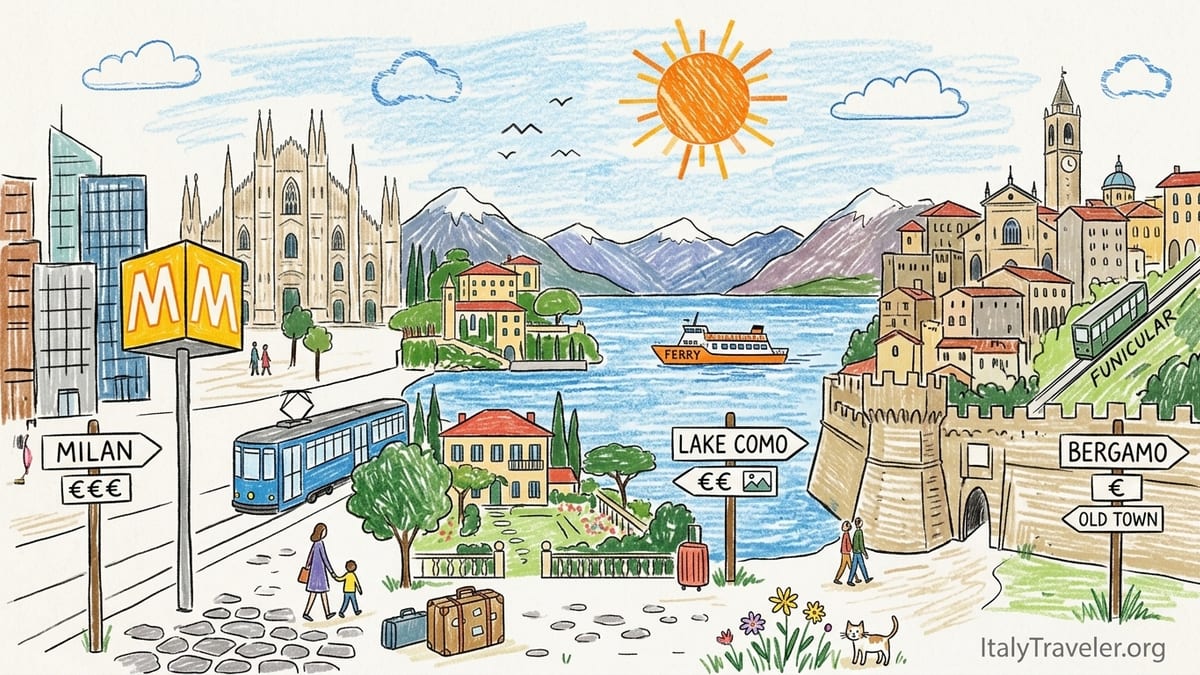
How My Three Lombardy Bases Actually Felt
My first Lombardy base was Milan, near Porta Venezia, on an early spring trip focused on galleries, food and nightlife. I booked a mid-range boutique hotel a few blocks from Corso Buenos Aires and paid roughly 180 euros per night for a small but sharp double room with breakfast, during a non-fair week. The moment I checked in and realized I could be in the Duomo area in about 10 minutes by metro, and walk to the Navigli canals in under half an hour, I understood why so many first-time visitors default to Milan. It felt like staying inside the transport map rather than traveling into it each day.
Lake Como was a completely different rhythm. On my most recent stay I based myself in a mid-lake town reachable by direct regional train from Milan and then a short ferry ride. I split my time between a family-run three-star hotel a few minutes uphill from the waterfront and a simple apartment near the ferry dock. In shoulder season, I paid in the range of 140 to 190 euros per night for lake-view doubles, breakfast included, which aligns with current guide estimates that mid-range lakefront hotels in the mid-lake area often sit roughly between 140 and 220 euros outside the absolute peak of July and August. This was money spent on views and silence more than on square meters or hotel amenities.
Bergamo’s Città Alta felt like a third way. I have stayed both in Città Bassa, near the train station, and up in the old town behind the Venetian walls. For a small guesthouse just inside the upper town, on a September weekend, I paid around 130 euros per night for a double. That tracks with current reports that boutique rooms in Città Alta often start in the 120 to 150 euro range outside big events, with some standout properties asking more. Walking out of the door straight onto stone alleys and eighteenth-century facades, I felt like I was already on an excursion, without sacrificing the possibility of taking a tram or bus down to the newer city in 10 to 15 minutes.
Across all three bases, what stood out most to me was not just cost but how my days began and ended. In Milan, mornings started with a quick espresso at a standing bar before plunging into metro tunnels. On Lake Como, they started with watching ferries nose into the dock while staff laid tables for lunch. In Bergamo’s Città Alta, they started with church bells and the sound of suitcases on cobbles as new arrivals stepped out of the funicular. That emotional texture matters as much as any price comparison when you choose your base.
What I Actually Paid: Hotels, Meals and Daily Costs
In Milan, my daily spend was the highest even before factoring in any designer shopping. On that Porta Venezia stay, I averaged about 180 euros per night for the room, 25 to 40 euros per person for sit-down dinners with wine in non-touristy osterie, and 2.20 euros per single metro or tram ride within the city zone. Research suggests that Milan’s average daily hotel rates have climbed in recent years, particularly around major events like Salone del Mobile, when citywide prices can spike far above what I saw. I deliberately avoided those weeks, and still found that anything under 150 euros per night within an easy metro ride of the center felt like a very good find.
On Lake Como, the hotel costs were comparable for lake-view properties, but the structure of my spending shifted. When I booked a three-star hotel in a mid-lake village in late May, I paid roughly 160 euros per night for a balcony room overlooking the water. Dinner at a lakeside trattoria generally came to 30 to 45 euros per person with a starter, pasta or fish main and a glass of local wine. My biggest daily extra, which research confirms is typical for the area, was transport: a mid-lake ferry day pass for walk-on passengers can easily add 15 to 30 euros per person to a day’s budget, depending on the route and current tariffs. That said, I usually replaced inner-city public transport with boats, so it felt like paying for both a view and a transfer.
Bergamo was noticeably cheaper for me overall. In Città Bassa, I once stayed at a modern budget chain hotel near the station for around 80 euros per night in early spring. In Città Alta on a later trip, my simple but atmospheric guesthouse at roughly 130 euros per night sat in the middle of the local range. An aperitivo in Piazza Vecchia, with a generous plate of snacks, routinely cost me around 8 to 10 euros, while sit-down dinners in traditional restaurants rarely crept beyond 35 euros per person unless I ordered multiple courses and a bottle of wine. Current budget breakdowns for Bergamo indicate that a thrifty traveler can keep daily costs to well under 100 euros excluding accommodation, which matches my experience of feeling “looser” with money there than in Milan while spending less.
If you are weighing pure value, my own ledger is clear. For city energy and top-tier sights, Milan justified its higher prices for a short, intensive stay. For scenery, Lake Como gave me fair value only once I accepted the higher room rates as my ticket to waking up on the water. For a longer stay with multiple day trips, Bergamo’s combination of livable prices and atmospheric setting stretched my budget the farthest.
Evenings, Atmosphere and How Late I Stayed Out
My latest nights were in Milan, and that was almost the point. On a Friday in Navigli, I remember leaving a canal-side bar after midnight and still finding the tram lines buzzing and the metro running frequently enough that I did not worry about being stranded. I walked part of the way back along the canal, then caught a late tram toward Porta Venezia with commuters and students still checking their phones. The city felt lived-in rather than staged for visitors. Even on weeknights, I could slip into a wine bar in Brera around 10:30 pm and find locals still ordering another round and small plates.
Lake Como, in contrast, wound down far earlier. In my mid-lake base, restaurants were generally quiet by 10:30 pm outside the peak summer weeks. On one trip in late September, I headed out after dinner hoping to find a bar with a little music. By 11 pm the waterfront was almost silent apart from couples walking dogs and the occasional clink of cutlery from a hotel restaurant finishing its last seating. I ended most evenings with a slow stroll along the promenade and an early night. It was deeply relaxing, but if I had been chasing nightlife I would have been disappointed.
Bergamo’s evenings sat somewhere in between. In Città Alta, I loved how the streets emptied of day-trippers and became a village again. One night at sunset, I walked the Venetian walls, watching the lights flick on down in the lower town and planes tracing lines in the sky toward Orio al Serio airport. Later I lingered over a glass of Valcalepio red in a wine bar just off Via Gombito. By 11 pm there were still small groups chatting at outdoor tables, but the vibe was intimate rather than energetic. Down in Città Bassa, especially around Via XX Settembre, the scene felt more like a typical Italian city evening, with bars and gelaterie open late, but still quieter than Milan.
From a personal standpoint, I preferred Milan as a base when I knew I wanted to be out late and have options. I never once worried about getting a taxi or a night tram back from Porta Romana after midnight. For a romantic trip, though, the quieter night soundtracks of Lake Como and Bergamo were a stronger fit. Sharing a late walk under the plane trees of a lakeside promenade, or pausing on Bergamo’s walls with the city spread out below, felt more intimate than any canal-side crowd in Milan.
Walkability, Public Transport and Day-Trip Logistics
All three bases work without a car, but in very different ways. Milan is the obvious transport hub. On my stays there, I routinely used the metro and suburban rail lines run by Trenord to reach places like Como, Pavia and Monza. A standard urban ticket within Milan currently costs around 2.20 euros for 90 minutes of travel, and I almost never waited more than a few minutes for a metro train in daytime. For airport runs, the Malpensa Express train from Cadorna and Centrale made getting in and out simple, even with luggage, and validated Milan as an efficient arrival and departure point.
Bergamo’s rail connections are more focused, but still practical. The regional train from Milan to Bergamo is officially priced at about 6 euros in second class, with a scheduled journey time of around 50 minutes from Milano Centrale according to Trenord’s latest information. Recent line works have meant some disruption and rail replacement segments between certain stations and Bergamo, so I now always check timetables and allow extra time. Once in Bergamo, the local ATB buses and the short funicular between Città Bassa and Città Alta made it easy for me to move between the two levels without hiking up in the heat every time.
Lake Como’s connectivity is shaped by the water. When I based myself in a mid-lake town, most of my “public transport” was via ferry. I often bought a day pass that allowed unlimited hops between the main mid-lake villages. The timetable was reliable on my visits, but I did encounter midday crowds in peak season, with lines snaking back from the dock and some boats filling up before everyone boarded. Research confirms that in late June and early September, the triangle of Bellagio, Varenna and Menaggio can feel particularly strained at midday. On the plus side, regional trains from Milan to the town of Como or to Varenna-Esino gave me a direct link between the lake and the wider Lombardy network without needing a car.
For day-trip potential, Milan and Bergamo both impressed me. From Milan I easily visited Lake Como for the day, hopping an early train to the town of Como, walking the waterfront, then riding the funicular to Brunate before returning in time for dinner back in the city. Another day, I took a train to Pavia to wander its cloisters and cathedral, and still made a late aperitivo in Porta Garibaldi. From Bergamo, I used buses and trains to explore smaller Lombard towns and vineyards at a gentler pace, and appreciated coming “home” to a base that felt more compact and manageable than Milan after a long excursion.
Sightseeing Highlights and Lake Access
In Milan, my days filled quickly with big-ticket sights. On one trip I devoted an entire day to the Duomo, its rooftop and the nearby Galleria, then walked over to Castello Sforzesco and on into Parco Sempione. Another day I combined a timed visit to see Leonardo’s Last Supper with the Pinacoteca di Brera and a browse around the design shops in the Brera district. I rarely needed more than 20 to 30 minutes of walking or a quick metro ride to move between major attractions. That concentration of sights within a relatively tight core makes Milan extremely efficient as a cultural base.
Lake Como’s “sightseeing” for me was about villas, gardens and constantly changing viewpoints. One of my favorite days there began with an early ferry from my mid-lake village to another town, where I visited a lakeside villa with terraced gardens. By mid-morning I was on the water again, crossing to a different shore and watching fishermen pull in small boats. In the afternoon I walked an easy lakeside path, dipping my feet in at a tiny pebble beach, and ended the day with a final ferry ride back as the mountains turned deep blue. Unlike Milan, I rarely ticked off named sights at a high rate. Instead I remember specific ferry crossings, a particular espresso on a quiet square, or the color of the lake under bright sun.
Bergamo offered a more traditional menu of monuments and museums, but in a compact and walkable package. The first time I rode the funicular up from Città Bassa and stepped into Città Alta’s Piazza Vecchia, it felt like walking into a stage set, in the best possible way. I spent hours wandering from the Basilica di Santa Maria Maggiore to the Cappella Colleoni and the Campanone tower, then circling out to the Venetian walls for broad views back over the lower city and the plains. Because the old town is relatively small, I could revisit favorite corners at different times of day. Walking the walls at sunset became a ritual, each time revealing new details of the skyline and the surrounding hills.
In terms of lake access, Milan and Bergamo cannot compete directly with Lake Como for obvious reasons. From Milan, though, I appreciated how easy it was to make a spontaneous lake day happen. One warm morning I decided at breakfast to go back to the water. By late morning I was on a boat leaving the town of Como’s pier, all orchestrated via a metro ride to the train station and a regional train. From Bergamo, reaching the lake took longer and required at least one change, so I tended to save Como days for when I based myself directly on the water or in Milan.
Crowds, Seasons and How Each Place Felt at Different Times
Milan felt big enough to absorb crowds on my visits, but its busiest pockets around the Duomo and Galleria could still feel intense in high season. I remember one June afternoon when the square in front of the cathedral was so packed that I retreated down side streets and ended up having lunch in a quiet trattoria a few blocks away. Away from the central axis, though, neighborhoods like Porta Romana, Isola and even parts of Navigli felt much calmer, even in summer. Milan’s size allowed me to step sideways from the heaviest flows of visitors without giving up the advantages of a major hub.
Lake Como’s mid-lake towns felt more fragile under pressure. On a sunny Saturday in late May, trying to board a mid-morning ferry in one of the triangle villages, I queued for almost 40 minutes among day-trippers from Milan and tour groups. The small lanes near the docks became solid rivers of people, and finding a quiet table for lunch required walking several streets uphill and away from the water. Research and conversations with local staff suggest that this has become common on peak weekends from late spring to early autumn. In shoulder seasons, especially on weekdays, I experienced a sweeter balance, with enough life for restaurants to feel open but enough space to move, photograph and simply watch the water.
Bergamo, despite its rising profile after the extension of Milan’s airport capacity and growing recognition of Città Alta, felt much less overwhelmed. Weekend afternoons saw coach groups and Italian families fill Piazza Vecchia and queue for gelato, but even then I could slip into back alleys and find myself almost alone within a few minutes. In the evenings, once day-trippers headed back to Milan or onward flights, Città Alta shifted into a quieter, more local gear. The lower town felt like an ordinary Italian city with students, commuters and families going about their routines rather than a pure tourist stage.
If you are sensitive to crowd levels, my experience suggests that Milan works well year-round so long as you choose your neighborhood and expect intense foot traffic only around its headline landmarks. Lake Como rewards visiting in shoulder months or on weekdays if your dates are flexible. Bergamo, at least for now, retains the calmest overall feel, particularly in the evenings, which made it my favorite base when I wanted to combine some sightseeing with a slower pace.
Which Base I Preferred for Different Types of Trip
For a short city break focused on museums, design, food and nightlife, Milan was my clear preference. Over three- and four-night stays, I loved being able to step from the Last Supper to contemporary art spaces, then straight into an aperitivo hour without worrying about train timetables back to another town. The density of restaurants and bars meant I could choose a different neighborhood mood each night, from Navigli’s canals to Brera’s polished streets. Paying a premium for accommodation felt worthwhile because almost every hour of the day could be filled without long transfers.
For a romantic trip, though, I would choose Lake Como first. Some of my strongest couple memories in Lombardy are tied to the lake: holding a paper cup of gelato on a bench while we waited for the evening ferry, sharing a carafe of local white wine as the last pink light faded behind the mountains, or taking a slow morning walk along the promenade before the day’s first boats arrived. The combination of water, mountains and small stone villages created a natural stage for intimacy in a way that Milan’s urban energy did not. Our hotel balcony, even in a modest three-star, felt more special than any city view.
For a first Lombardy visit, my honest recommendation based on experience is to consider splitting time rather than choosing a single base if you have at least five nights. Two or three nights in Milan give a strong introduction to the region’s capital and its transport network, making it easy to see major sights and maybe take a quick excursion. Adding two nights on Lake Como introduces the lake-and-mountain side of Lombardy without committing your whole trip to a slower pace. If I had to choose exactly one base for a first-timer, I would lean slightly toward Milan for its range and practicality, while clearly marking that this is a trade-off: you would be sacrificing waking up on the water for easier logistics.
For a slower stay, especially one lasting a week or more, Bergamo’s Città Alta was my personal favorite. I never felt like I was “using up” the town too fast. I could spend mornings working in a cafe in Città Bassa, ride the funicular up for an afternoon walk on the walls, then pick a different small restaurant each night without repeating myself too quickly. Day trips remained easy enough, but the lack of big-city intensity meant I returned each evening feeling rested rather than overstimulated. Importantly, Bergamo and Lake Como felt like genuinely different alternatives to Milan, not lesser versions of a city break. Città Alta’s hilltop layout and long defensive walls gave it a village-on-the-ridge character that Milan simply cannot match, while Lake Como’s ferry-linked villages created a rhythm of life centered on water instead of streets.
The Takeaway
After staying in all three, I do not have a single universal winner, and I would distrust any simple ranking that tried to crown one. Milan, Lake Como and Bergamo each framed my days and nights in distinct ways that suited different moods, budgets and travel goals. Milan excelled when I wanted density: of sights, of restaurants, of transport options, of late-night possibilities. Lake Como excelled when I wanted views, slower mornings and the simple pleasure of stepping onto a ferry instead of a tram. Bergamo excelled when I wanted atmosphere and history at a human scale, along with better value for longer stays.
If your priority is a concentrated city break packed with art, shopping and nightlife, and you can absorb higher accommodation costs, Milan is the most effective base from my own experience. If your priority is a romantic setting where your hotel balcony and evening walks do as much work as any formal sightseeing, a village on Lake Como’s mid-lake stretch is hard to beat, provided you can navigate ferry timetables and accept the price premium for lake views. If your priority is a slower, more balanced stay with good day-trip potential, reasonable prices and a strong sense of place, Bergamo, particularly Città Alta, deserves serious consideration.
The real question is not which city is “best,” but which version of Lombardy you want to wake up to. Skyscrapers and metro lines, ferry wakes and mountain silhouettes, or stone gates and ringing bells all tell different stories of the same region. Having lived each of them for several days at a time, I am glad I did not stop at just one.
FAQ
Q1. Is Milan, Lake Como or Bergamo cheapest as a base?
Milan has generally been the most expensive for me, especially for centrally located hotels, while Bergamo has offered the best overall value. Lake Como can match or exceed Milan’s hotel prices for lakefront rooms, but I found smaller costs like meals and coffee to be comparable across the three.
Q2. Which base works best without a car?
All three can work car-free, but in different ways. Milan is best for fast regional rail connections and city transport. Lake Como depends on ferries and a few key train stations, which worked well for me when I based in a mid-lake town. Bergamo combines a straightforward regional train link from Milan with local buses and a funicular between Città Bassa and Città Alta.
Q3. Is it realistic to stay in Milan and day-trip to Lake Como?
Yes. I have done this more than once by taking an early regional train from Milan to the town of Como or Varenna, spending the day on ferries and lakeside walks, then returning in the evening. It is a long but manageable day and avoids changing hotels, though you miss waking up on the lake itself.
Q4. How many nights should I spend on Lake Como?
From my experience, two or three nights is enough to explore a few mid-lake villages by ferry and visit at least one villa and garden without rushing. With four or five nights, you can slow down, repeat favorite ferries at quieter times, and work around any crowded midday sailings.
Q5. Is Bergamo worth a stay, or just a day trip from Milan?
Having done both, I feel Bergamo rewards at least one night, ideally two or three, especially in Città Alta. Staying overnight let me enjoy the old town after day-trippers left, walk the walls at sunset and in the early morning, and feel the upper city as a living neighborhood rather than just a backdrop.
Q6. Which base is best for a first visit to Lombardy?
If you must choose only one, I slightly favor Milan for a first visit because it concentrates many of the region’s big sights and offers easy day trips. That said, my ideal first-timer itinerary would split time between Milan and either Lake Como or Bergamo to experience both city energy and a smaller-scale setting.
Q7. How early do I need to book accommodation in each place?
In my own planning, I try to book Milan and Lake Como several months ahead for stays between May and September, especially for well-located or lake-view properties. Bergamo has given me more flexibility, and I have successfully booked decent Città Alta rooms a few weeks in advance outside major events, though earlier is always safer.
Q8. Is Lake Como too quiet at night compared with Milan?
Compared with Milan, yes, Lake Como’s mid-lake villages felt very quiet at night on my stays, especially outside peak summer. I usually found restaurants winding down by about 10:30 pm, and nightlife was limited to relaxed bars and hotel lounges. For many couples this is part of the appeal, but if you want late-night energy Milan is a better fit.
Q9. Does staying in Bergamo make airport transfers easier?
It can, particularly if you fly in or out of the Bergamo Orio al Serio airport. On one trip I appreciated the short transfer between Città Bassa and the airport by bus. However, if you are using Milan’s Malpensa or Linate airports, Milan itself usually provides more straightforward rail and bus connections.
Q10. Can I combine all three bases in a single trip?
Yes, and I have done versions of this. With about a week, you could spend three nights in Milan, two on Lake Como, and two in Bergamo, traveling between them by regional train and ferry. It makes for a varied itinerary that showcases Lombardy’s urban, lakeside and hilltop personalities without excessively long travel days.