


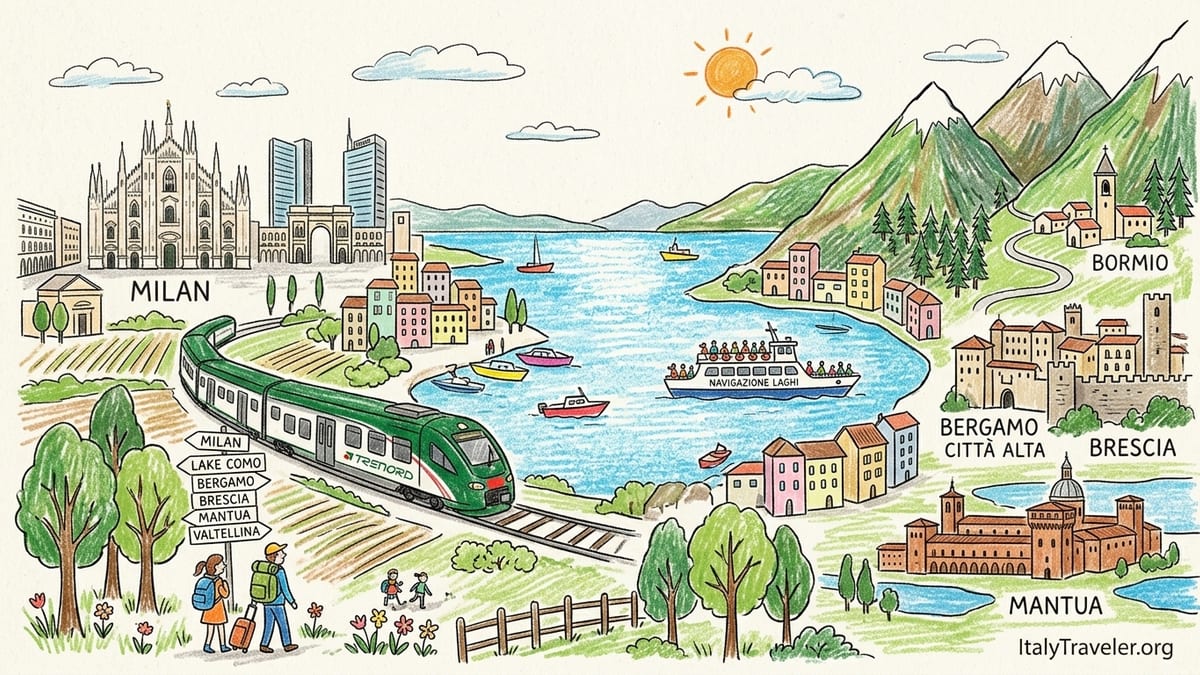
I arrived in Lombardy expecting a Milan city break with perhaps a token day trip to Lake Como. Instead, one week of trains, ferries and mountain roads taught me that the region is its own compact continent, stitched together by reliable public transport and wildly different landscapes. The further I traveled from the Duomo, the more the character of the trip shifted, until Milan felt like only one chapter in a much larger story of lakes, vineyards and Alpine valleys.
Starting in Milan: A City That Almost Trapped Me
My journey began in Milan, and I made the first of several planning mistakes before I had even left Centrale station. I booked four consecutive nights in a hotel near Porta Garibaldi, assuming Milan would be my base for everywhere else. On the map, Bergamo, Lake Como and even Valtellina looked close. On the ground, I quickly realised that using Milan as a hub for everything meant long days doubled back on themselves, with too many hours spent retracing the same tracks in and out of the city.
From Malpensa I took the Malpensa Express into Milano Cadorna, then transferred to the metro and finally walked to my hotel. That first evening was classic Milan: an aperitivo in Porta Garibaldi, a walk to the Duomo for a late view of the cathedral glowing under floodlights, and a simple dinner of risotto alla milanese and ossobuco in a trattoria that was packed until nearly midnight. Milan is absorbing and energetic, and it was tempting to sink into its neighborhoods and never leave.
The turning point came when I started checking train times for day trips. Regional Trenord trains from Milan to Bergamo and Lake Como run frequently, and the fares are relatively low compared with high speed trains, but almost everything requires you to start and finish your day at one of Milan’s big stations. Looking at the Trenord timetable for the Milan to Tirano route, for example, showed several direct regional services from Milano Centrale through Lecco and Sondrio to Tirano, with second class tickets listed at about 12.50 euro one way. That sounded straightforward until I imagined doing it out and back in a single day, then repeating that pattern for other destinations.
On my first full morning I still fell into the Milan-as-hub trap. I took a Trenord regional train from Milano Centrale to Varenna-Esino on Lake Como. The ride took around an hour, following the eastern shore of the lake after Lecco, and the scenery alone justified the trip. What I underestimated was how draining it would be to know that every new view meant an eventual backtrack to Milan rather than a step forward into a loop around the region. By my second day, I was already rethinking my fixed-base plan.
Lake Como by Train and Ferry: Beauty, Bottlenecks and Timetables
My first encounter with Lake Como was through the predictable but still breathtaking triangle of Varenna, Bellagio and Menaggio. From Varenna-Esino station I walked downhill for about 10 minutes to the lakefront, where signs point clearly to the ferry pier. Here I met Lombardy’s other essential transport network: the boats of Navigazione Laghi, the government-run ferry system that connects dozens of towns on the lake. The official ferry timetable for summer 2026 showed an intensive schedule between Como, Bellagio, Varenna and Colico from early morning into the evening, with both slow boats and hydrofoils on the main north-south route.
On that first day I made two tactical mistakes. I arrived at the pier in Varenna mid-morning without having checked which timetable applied to my exact dates, only that the summer schedule ran through early October. The board listed separate weekday and Sunday services, and I had to double-check that I was not misreading the columns. I then queued for tickets behind a crowd of day trippers who, like me, had not bought tickets online in advance. It was only when I reached the counter and asked for a same-day hop between Varenna, Bellagio and back that I learned the faster services sometimes sell out segments in peak hours, while the regular ferries accept more passengers but take longer.
The crossing from Varenna to Bellagio took around 15 minutes on a regular boat. The deck was packed with a mix of international visitors and Italian families, and I understood why some recent travelers described the system as confusing before they arrived in person. In reality, the boats are punctual and well signposted, but the printed PDF timetables use route numbers and symbols for weekends and holidays that can be daunting if you have just stepped off the train from Milan. My return to Varenna in late afternoon meant joining another dense queue, which snaked along the waterfront, while car ferries shuttled steadily between Bellagio, Menaggio and Varenna.
As scenic as it was, this day trip crystallised another lesson. I spent nearly two hours on trains between Milan and Varenna, another hour waiting and queuing for ferries, and only a few hours actually relaxing by the water. The lake was glorious, framed by steep, forested slopes and pastel villages, but the constant awareness of the last train back to Milan meant I could not fully settle. If I repeated the trip, I would cut at least one night from Milan and stay directly in Varenna or Bellagio so that the lake, not Milan, dictated my schedule.
Reset in Bergamo and Brescia: Leaving Milan Behind
My pivot away from a Milan-centered trip happened on day three, when I checked out of my hotel two nights earlier than planned and ate the cost of a non-refundable rate. It felt extravagant, but it also unlocked the rest of Lombardy. I boarded a Trenord regional train from Milano Centrale to Bergamo, an eastbound route that runs frequently and takes a little under an hour. The contrast when I stepped out of Bergamo station was immediate. Here, the hills were closer, the pace slower, and English seemed less dominant once I left the station area.
Instead of using Bergamo as just another day trip, I booked a modest hotel near the funicular to Città Alta, the walled upper town. That evening I rode the funicular up as the sun was setting and watched the city lights spread out below from the old Venetian walls. Dinner was a plate of casoncelli alla bergamasca in a small trattoria tucked into a stone alleyway, a dish of stuffed pasta with butter and sage that made me realise how quickly the food shifts once you leave Milan. The crowd was mostly local, and I heard conversations about school and work rather than the tourist logistics that dominated tables in central Milan.
The next morning I made a short but telling mistake. Tempted by photos I had seen of nearby Brescia, I tried to rush both cities in a single day. I boarded another Trenord regional train from Bergamo to Brescia, a trip that took just over an hour with a change along the way, and spent a fast-moving afternoon in Brescia’s historic center. The Roman ruins, the castle above town and the long arcaded squares deserved far more time than I allowed. By late afternoon I had to choose between staying overnight in Brescia and figuring out accommodation on the fly, or returning to Bergamo where my bag already sat in my room.
I chose to head back, effectively retracing my steps for no good reason other than hotel convenience. In hindsight, I should have treated Bergamo and Brescia as a one-way progression, sleeping one night in each instead of bouncing back and forth. That mistake, however, drove home one of Lombardy’s great strengths. Frequent regional trains connect many of these mid-size cities without requiring you to route every journey back through Milan. The key is to let the rail map guide your itinerary, rather than your initial hotel booking.
Lake Iseo and Franciacorta: A Quieter Side of Lombardy
From Brescia, the route into the vineyards of Franciacorta and the quieter waters of Lake Iseo became the next chapter. I took a regional train from Brescia toward the lake, where integrated tickets now combine bus and ferry services on Lake Iseo. Official information from Navigazione Lago d’Iseo and the Lombardy region confirmed that by mid-2026 there were coordinated timetables between trains, buses and ferries, with seasonal variations and a clear summer schedule in place between June and late August, plus separate autumn and winter timetables from late August onward.
The practical difference was striking. Unlike Lake Como, Lake Iseo felt less overwhelmed by day trippers, even in summer. At the Iseo town pier I studied the current timetable displayed by Navigazione Lago d’Iseo. Boats linked the main lakeside villages and Monte Isola, with more departures during peak months and a published winter schedule from October to March. A notice explained that bicycles and electric scooters were temporarily banned from disembarking at Monte Isola under a local ordinance, something that would be easy to miss if you relied only on old guidebooks. Another poster described new integrated bus plus boat tickets from October 2026, designed to make car-free travel to the lake easier.
Here, I finally slowed down. I stayed overnight in a small family-run pensione a few minutes’ walk from the ferry dock, rather than attempting another day trip from Brescia. An evening stroll along the promenade in Iseo felt very different from the aperitivo crowd in Milan. Locals lingered over spritz and plates of lake fish, and I could hear a steady mix of Italian, local dialect and only the occasional foreign language. Dinner was a simple grilled coregone, a local whitefish, with a carafe of Franciacorta from vineyards only a short drive away.
The following day I took a mid-morning ferry to Monte Isola. Crossing the lake on one of the small NLI boats underlined how different this experience was from my crowded Bellagio ferry. The boat was busy but not jammed, the crew called out stops in Italian, and hikers with walking poles were studying trail maps rather than snapping photos non-stop. I spent several hours climbing gently up through olive groves and small villages, then descended for a late lunch of lake fish and polenta at a trattoria overlooking the water. In retrospect, I wished I had added a full extra day here to explore the vineyards of Franciacorta by bicycle and to visit more of the small lakeside towns such as Lovere and Pisogne, which the timetable showed as regular stops but which I only glimpsed from the deck.
South to Mantua: Renaissance Calm and Fewer Crowds
Traveling south from Brescia and Lake Iseo to Mantua shifted the mood again. I took a regional train connection that routed via Cremona and then on to Mantua, passing fields and low farmhouses rather than mountains or lakes. Mantua, set among artificial lakes formed by the River Mincio, felt almost enclosed by water and Renaissance walls. It also felt significantly quieter than Milan or Como, despite its architectural importance and UNESCO-listed center.
I checked into a small hotel just off Piazza delle Erbe and immediately realised how much I had underestimated Mantua. My original plan had been to stay one night, use the city as a base to see the Palazzo Ducale and Palazzo Te, and then move on. In practice, the layered frescoes, courtyards and gardens of these palaces, combined with the lakeside walks around the city’s perimeter, could easily fill two full days. Entry to the Palazzo Ducale complex required advance reservations for certain sections during peak times, which I had not realised until I tried to book a same-day ticket and found several time slots already taken. I managed to secure a later entry in the afternoon, but it meant compressing my visit.
In Mantua, the absence of Alpine peaks or a famous lake allowed me to travel more slowly. I ate pumpkin-filled tortelli di zucca for dinner at a restaurant recommended by my hotel, surrounded mostly by Italian couples and families. Walking back through near-empty streets at 11 p.m. was a sharp contrast with the late-night energy of the Navigli in Milan. Yet even here, in a less overtly touristic city, regional trains provided an easy connection back toward Brescia and onward to Verona or Modena for those continuing across northern Italy. Mantua taught me that Lombardy’s southern plains have as much cultural depth as the Alpine valleys, and that it is worth surrendering at least one Milan night to experience them.
Into Valtellina and Bormio: Trains, Valleys and Mountain Weather
The final stage of my Lombardy loop led north into Valtellina, one of the region’s great Alpine valleys. I returned to Milan only briefly, using Milano Centrale as a true transit hub rather than a base. Early one morning I boarded a Trenord regional train from Milano Centrale bound for Tirano, following the route described on the official Trenord line information for Milan to Tirano. The train rolled out past Monza, climbed gently along the eastern arm of Lake Como near Lecco, and then wound up the Valtellina valley through Sondrio toward Tirano.
The full journey took around two and a half hours. Second class tickets on this route were advertised at about 12.50 euro, representing one of the best value long regional rides in northern Italy. The carriages filled steadily with commuters and vacationers, and I shared a table with a pair of hikers aiming for the same valley I was. At Tirano station, where the Trenord platforms sit next to the famous Bernina line that crosses into Switzerland, I transferred to a bus heading further into the mountains. During the winter sports season in early 2026, temporary shuttle buses had been added between Tirano and Bormio to serve Olympic events, but outside that period the regular regional buses link the towns along the valley floor.
The climb into Bormio along the state road revealed a very different Lombardy from anything I had seen near Milan. Vineyards that had clung to steep terraces lower in Valtellina gave way to pine forests and high meadows. By the time we reached Bormio, the air was several degrees cooler than in Milan, and clouds bunched around peaks even in summer. I checked into a small hotel near the historic center, where wooden balconies faced narrow cobbled streets, and immediately understood why people dedicate entire holidays to this area rather than treating it as a day trip.
Here my main planning error was underestimating mountain weather and travel times. I allotted only two nights in Bormio, assuming that would be enough for a soak in the thermal baths, a cable car ride and a short hike. On my one full day in town, low clouds closed over the upper slopes, and the higher lifts stopped running intermittently due to wind. I still walked through alpine pastures on a marked trail and enjoyed hot pizzoccheri, the buckwheat pasta typical of Valtellina, in a mountain hut, but views of the highest peaks never fully opened. If I were to repeat the trip, I would add at least one buffer day here, both for weather and simply to appreciate how different Bormio feels from Milan’s boulevards or Como’s promenades.
What I Would Do Differently: Routes, Bases and Time
Looking back at the shape of the trip, the biggest mistake was using Milan as a fixed anchor instead of just another stop. Lombardy’s rail and ferry networks are designed to support one-way travel across the region, and every time I ignored that, I lost hours to unnecessary backtracking. Dragging my luggage in and out of Milan for successive day trips meant passing through the same concourses and seeing the same departures boards repeatedly, when I could have been waking up by a lake or in a mountain town.
If I were planning the journey again, I would sketch a simple arc rather than a star-shaped set of excursions from Milan. One possible route would be to arrive in Milan and spend two nights there for the Duomo, Brera and Navigli, then move to Bergamo for one or two nights, continuing by train to Brescia and on to Lake Iseo with at least two nights between the lake and nearby Franciacorta. From there I would head down to Mantua for one or two nights, then return via Brescia or Verona to Milan for a brief stop before going north into Valtellina and Bormio for at least three nights. Each segment would rely on existing Trenord regional services and posted ferry timetables, rather than private transfers.
Another lesson was the importance of checking seasonal schedules on official sites rather than relying on generic advice. On Lake Como, the government-run Navigazione Laghi service updates its timetables multiple times a year, with a published summer schedule from early July to early October 2026 and different shoulder season timetables outside those dates. On Lake Iseo, Navigazione Lago d’Iseo publishes distinct spring, summer, autumn and winter timetables, along with notices about restrictions and integrated bus tickets. Having these PDFs saved on a phone and confirmed against the current date prevented me from missing last boats or misinterpreting Sunday services.
Finally, I would allocate more time in places that reveal Lombardy’s variety. One extra night in Iseo for the vineyards and lakeside towns, a second night in Mantua to absorb its palaces without rushing, and at least one more day in Bormio to hedge against mountain weather would all be worth shaving a day from Milan. The takeaway is not that Milan should be skipped. Rather, once you experience Bergamo’s hilltop walls at dusk, the calm of Monte Isola’s car-free lanes, and the sharp alpine air of Bormio after a long regional train ride, Milan begins to feel like the gateway to Lombardy instead of its center.
The Takeaway
Traveling across Lombardy by train, ferry and bus revealed a region that is far more layered than the usual Milan plus Lake Como pairing suggests. Official timetables, regional tickets and a willingness to change hotels more often than usual turned what could have been a series of rushed day trips into a loop that connected cities, lakes, vineyards and mountains. At each turn, the character of the journey changed so completely that it felt as if I had crossed a border rather than a provincial line.
What surprised me most was how manageable those transitions felt in practice. The regional Trenord network made it possible to go from the marble steps of the Duomo to the shores of Lake Iseo, from Renaissance courtyards in Mantua to alpine valleys in Valtellina, without renting a car. The ferry systems on Lake Como and Lake Iseo, while sometimes crowded and occasionally confusing on paper, ran to clear seasonal schedules that could be checked in advance. And every time I stepped away from Milan for more than a day trip, the crowds thinned, the food shifted toward local specialties, and the pace slowed enough to feel like a different kind of holiday.
If your image of Lombardy is limited to a fashion capital and a famous lake, consider using Milan as your starting point rather than your base. Stay in Bergamo’s fortified upper town, watch the sunset over Lake Iseo from a quiet promenade, sip Franciacorta near the very vines that produced it, and ride a regional train all the way into Valtellina before continuing by bus to Bormio. You will still return to Milan in the end, but you may find, as I did, that the strongest memories come from the places where you could not see the Duomo at all.
FAQ
Q1. Can I visit Lake Como, Lake Iseo and Bormio as day trips from Milan?
It is technically possible, thanks to frequent Trenord regional trains and seasonal ferry schedules, but it makes for very long days with a lot of backtracking. I found it far more rewarding to stay at least one or two nights by each lake and in Bormio so that early and late hours were spent on the water or in the mountains instead of on trains returning to Milan.
Q2. How reliable are the regional trains in Lombardy for this kind of itinerary?
On my trip the Trenord regional services between Milan, Bergamo, Brescia, Tirano and other cities were generally punctual, with minor delays similar to those in other European regions. The main thing is to check the current timetable and any strike notices on the official Trenord site before you travel, especially in peak season or on national strike days.
Q3. Do I need to book Lake Como or Lake Iseo ferries in advance?
For regular car and passenger ferries on Lake Como and Lake Iseo, I bought tickets on the day at the pier without reservations, although queues were long at mid-morning in Varenna and Bellagio. High speed hydrofoils on Lake Como and some special cruises can sell out sections in busy periods, so it is worth checking the Navigazione Laghi information for your exact dates. On Lake Iseo I was always able to board regular scheduled boats with a same-day ticket.
Q4. How much does the Milan to Tirano train cost, and is it worth it for Valtellina?
At the time of my trip, a second class Trenord ticket from Milano Centrale to Tirano was listed at about 12.50 euro one way for the direct regional service. Considering the journey takes around two and a half hours through lake and mountain scenery and forms the backbone of access into Valtellina and onwards by bus to Bormio, I found it excellent value and a highlight of the trip.
Q5. Is it better to rent a car for this route through Lombardy?
A car would offer more flexibility in rural areas and for reaching trailheads around Bormio, but I completed the entire route by public transport without major issues. Regional trains connected Milan with Bergamo, Brescia, Iseo and Tirano, while local buses and ferries filled the gaps. If you are comfortable reading timetables and planning around set departure times, car-free travel works very well here and avoids parking hassles in historic centers.
Q6. How far in advance should I book accommodation outside Milan?
In Milan and Lake Como I booked my hotels several months ahead for peak season and still saw prices rise as the dates approached. Around Lake Iseo, in Brescia and in Mantua I was able to find good options a few weeks in advance, though the best located small guesthouses can book out earlier on weekends. In Bormio and Valtellina, winter and peak summer periods fill quickly with hikers and skiers, so securing a room at least a couple of months in advance is wise for those times.
Q7. Are there major language barriers once I leave Milan?
In Milan, Lake Como and Bergamo many people working in hotels, restaurants and at major sights spoke good English. Around Lake Iseo, in smaller Franciacorta villages and in parts of Mantua and Bormio, I encountered more situations where only Italian was spoken. Basic Italian phrases and a translation app were enough to handle check-ins, restaurant orders and ticket purchases, and people were generally patient and helpful.
Q8. How did crowds compare between Milan, Lake Como and the other areas?
Milan’s center and the popular Lake Como triangle of Varenna, Bellagio and Menaggio were the most crowded, especially late morning to mid-afternoon in summer. Ferries there often had queues and busy decks. Bergamo’s Città Alta was lively but calmer in the evenings, while Brescia, Lake Iseo, Franciacorta villages and Mantua felt noticeably less crowded. Bormio drew a focused mix of hikers and spa visitors but never felt overwhelmed away from peak holiday weekends.
Q9. What were the biggest itinerary mistakes you would warn others about?
My main errors were booking too many nights in Milan as a base, trying to see both Bergamo and Brescia in a single rushed day, and underestimating how mountain weather might limit activities in Bormio. I would also avoid late afternoon ferries from Bellagio without checking the timetable first, as they can be crowded and leave little buffer for returning trains if you are not staying on the lake.
Q10. How many days would you recommend for a first-time Lombardy trip beyond Milan?
If you have a week, I would suggest two nights in Milan, one in Bergamo, two between Brescia and Lake Iseo with time in Franciacorta, one or two in Mantua, and at least two or three in Bormio and Valtellina. With more time you can add extra nights by the lakes or in the mountains, but even this basic loop offers a strong sense that Lombardy is a complete region of cities, lakes, vineyards and Alps, not just a set of day trips orbiting Milan.