

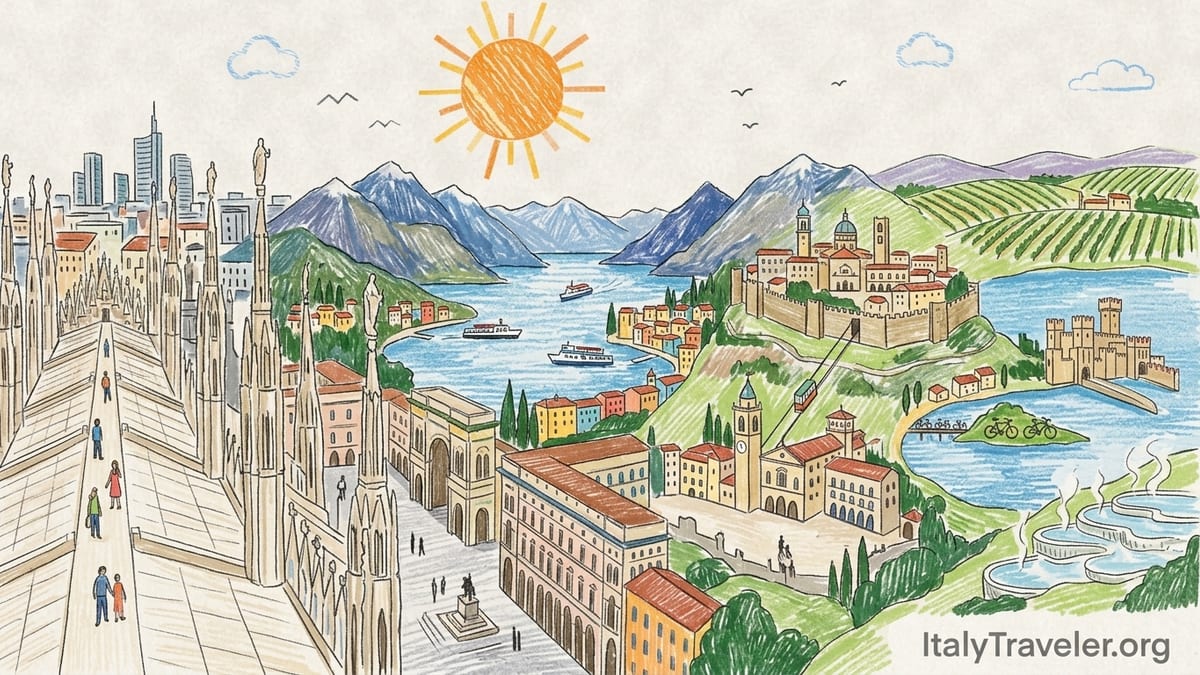
Lombardy is the Italian region I keep returning to, and over several trips I have gradually worked out which experiences genuinely justify precious vacation days. This is not a bucket list scraped from a map, but a short, honest list of things I have personally done, paid for, queued for, and, in most cases, would gladly repeat. From walking among the marble spires of Milan’s Duomo to soaking in hot mineral water in the high Alps, these are the Lombardy days that stayed with me long after my return flight.
Walking the Rooftops of Milan’s Duomo
The first time I went up to the rooftops of Milan’s Duomo, I expected a standard cathedral viewpoint. Instead I found myself walking along a pale forest of marble, eye to eye with statues and flying buttresses that usually disappear into the sky. I have repeated this experience twice, both in spring and autumn, and the feeling of stepping out onto the terraces above Piazza del Duomo has never faded. You see Milan’s modern towers to one side and a sea of terracotta roofs to the other, with the gilded Madonnina statue glinting above it all.
Most recently, in April 2025, I booked a Duomo rooftop ticket that included the terraces and access to the cathedral interior. Buying directly via the official channels, the rooftop by lift plus Duomo combo was priced in the high teens in euros for adults, with a few euros less if you opt for stairs only. That visit took me about two hours in total: roughly 45 to 60 minutes on the terraces themselves and another 45 minutes inside the cathedral and archaeological area. I went in the late afternoon, entering around 4 pm, which helped avoid the worst of the midday glare on the pale marble.
Crowds are real here. In peak months such as May and September, security lines in the square can add 20 to 30 minutes before you even reach the ticket office, especially late morning. On one midsummer trip it took me almost an hour from joining the queue in the piazza to actually stepping out onto the rooftop. The terraces never felt dangerously crowded, but certain photo spots near the Madonnina and on the higher levels created bottlenecks. Early morning openings and the last entry slot of the day have consistently felt the most pleasant to me, with room to pause and look at the stonework in detail.
Access is straightforward. I took the M1 or M3 metro lines to the Duomo stop, which places you right under the square, and walked up into the piazza. On one occasion I walked from Centrale station in about 30 minutes, but I would not recommend that if you are short on time or visiting in summer heat. In terms of whether I would repeat it, the answer is yes, although I now time it carefully. I would absolutely go again with someone visiting Milan for the first time, and I would aim for a weekday in shoulder season with prebooked tickets and a mid to late afternoon slot to balance light and crowd levels.
A Day on the Ferries of Lake Como
Lake Como is where Lombardy slows down. I have based myself in Varenna, Bellagio and Como itself, but my most rewarding days have always involved treating the public ferry network as a movable terrace rather than just transport. On my most recent full lake day in August 2026, I used a Navigazione Laghi day pass that covered the central basin towns such as Varenna, Bellagio, Menaggio and beyond. Purchased in person, adult day tickets for central lake routes were in the region of a few tens of euros, depending on the exact zone, which matched the official tariff grids verified that summer.
My typical day starts with an early ferry from Varenna to Bellagio, usually around 8.30 or 9 am, when the lake is still quiet and the light is soft. I then wander Bellagio’s steep lanes, grab a coffee on the Punta Spartivento side, and continue by boat to Menaggio or Tremezzo. Over the course of one particularly good day, I took six separate ferry legs, never spending more than 30 to 40 minutes on any one crossing. I averaged 45 to 60 minutes in each town, with a longer stop of two hours in Tremezzo to visit the gardens facing the water.
Crowds on Lake Como vary dramatically by time and season. On a sunny Saturday in July I queued 40 minutes in Varenna just to buy a ticket, then another 20 minutes to board the mid-morning ferry toward Bellagio. In contrast, a Tuesday in late October felt almost sleepy, with walk-up boarding and plenty of seats both inside and on deck. Some of the fast hydrofoil services require separate supplements and have limited deck space, so on repeat visits I have often preferred the slower ferries purely for the open-air experience, even though they add 15 to 20 minutes to longer routes.
Logistically, I have always reached Lake Como by train from Milan, arriving either at Como San Giovanni or Varenna-Esino. Tickets from Milano Centrale have stayed in the low double digits in euros return when booked as regional trains. From the Como station I walked downhill to the waterfront in under ten minutes, while in Varenna the short path from the station to the pier takes about five minutes along a paved sidewalk. Would I repeat a Lake Como ferry day? Unequivocally yes. I now structure it more carefully, buying a day pass early in the morning, avoiding peak midday crossings between Varenna and Bellagio, and allowing unscheduled stops whenever a village catches my eye from the water.
Exploring Bergamo Alta and the Venetian Walls
Bergamo divided my time more clearly between the modern lower town and the medieval upper town, known as Città Alta. Over two separate trips I devoted one full day primarily to the upper town, arriving mid-morning and staying until after sunset. My starting point was usually the funicular from the lower city, part of the local public transport network, with single rides priced at a couple of euros and covered by integrated tickets used on buses and trams. The short climb takes only a few minutes but feels like a transition into another era as the stone gates and towers of Città Alta slide into view.
Once in the upper town, I mostly walked. My route usually began around Piazza Vecchia, a compact square framed by the Palazzo della Ragione and arcades with cafes. I spent a good hour just wandering this central area, ducking into side alleys that opened onto hidden courtyards. On one visit, I joined a short guided walk that focused on the Venetian period, which had me tracing the outline of the old wells and grain storage buildings around the square while hearing how Bergamo functioned as an outpost of the Venetian Republic. The guide fee was in the range of 15 to 20 euros per person for a group tour lasting about 90 minutes.
The highlight for me, and the reason I would return, was walking along sections of the Venetian walls at golden hour. The defensive walls encircle the upper town for several kilometers, and although you are not on the battlements the whole way, there are extended stretches where a path runs along or beside them. From there I watched the light drop over the lower city and, on a clear evening, out toward the plains. One October evening I spent nearly two hours on this walk, stopping to sit on low stone benches and watch locals out walking dogs and children cycling.
Bergamo is easy to reach. I came in by regional train from Milan’s Centrale or Porta Garibaldi stations, with journey times just under an hour and ticket prices in the single digits in euros each way. From the train station, a bus took me up toward the funicular in around 15 minutes, and I used a 24 hour public transport ticket that included both bus and funicular rides for roughly the cost of two single journeys. In terms of crowds, weekends, especially Sunday afternoons, felt busy with day trippers, particularly around Piazza Vecchia, but I always found side streets that emptied quickly. I would absolutely revisit Bergamo Alta, ideally staying overnight in the upper town so that I could enjoy the walls early in the morning before the daytripper rush.
Franciacorta Wine Tasting Among the Vineyards
Compared with famous wine regions like Champagne or Chianti, Franciacorta still feels relatively low key, which is part of its appeal. I have spent one full day and one half day in this corner of Lombardy between Brescia and Lake Iseo, and both times I focused on sparkling wine estates reachable from the small towns dotted across the vineyards. On my most structured visit, I joined a pre-arranged full day tour departing from Brescia, which included two winery visits with tastings and a leisurely lunch in the countryside.
That tour, booked with a local operator in 2026 price lists, cost a little over 200 euros per person for a group of six, including transport, tastings and lunch over three courses with wine pairings. Standalone tastings at individual estates, which I tried on a separate self-driven visit, ranged from around 25 to 40 euros for a basic cellar tour and three to four wines, rising to 60 or more when food pairings or premium cuvées were included. At one well known estate I joined a bilingual group tour that lasted about 90 minutes, split between the vineyards and the underground cellars, followed by a tasting that stretched another hour.
Crowds in Franciacorta never felt overwhelming, but reservations mattered. On a sunny May Saturday, both estates I visited were running back to back tours from late morning through mid afternoon, and the tasting rooms were full. Midweek in September was noticeably calmer, with smaller groups and more time to ask detailed questions about dosage and aging. The atmosphere remains professional rather than boisterous, more about understanding the appellation and production methods than simply drinking as much as possible.
Reaching Franciacorta without a car is possible but requires some planning. On my guided day I took a morning regional train from Milan to Brescia, paying under 15 euros and arriving in about 45 minutes. The tour minivan met us near the station and handled all driving between estates and lunch. On my own, I rented a car from Brescia for the day, which gave me freedom to loop through villages such as Erbusco and Adro, but also meant I consciously limited how much I tasted. Would I repeat Franciacorta? Yes, but only with pre-booked visits. I would not recommend turning up spontaneously in high season and expecting cellar doors to accommodate you, and I would either book a driver or agree among a group that one person remains the designated driver for the day.
Lake Iseo and a Half Day on Monte Isola
Lake Iseo feels like a smaller, quieter cousin to Como and Garda, and Monte Isola, the island in its center, became one of my favorite slow days in Lombardy. I devoted a long afternoon and evening to the island, arriving from Brescia by train and then local bus to the lakeside town of Sulzano. From there I took the short public ferry across to Peschiera Maraglio on Monte Isola, a crossing that took less than ten minutes and cost only a few euros each way for a walk on passenger ticket.
My main goal was to walk and cycle. At the ferry dock I rented a bike from a small family run shop, paying under 20 euros for a half day rental that included a simple lock. The mostly flat road that circles the island is open to local vehicles and buses but is otherwise remarkably calm, as non resident cars are restricted. Riding the full loop took around two hours at an unhurried pace, including stops in small hamlets to buy gelato and sit on low stone walls at the water’s edge. I then spent another hour walking uphill on footpaths above Peschiera Maraglio, gaining enough height for broad views across the lake.
In terms of crowds, Monte Isola has grown more popular since the high profile art installation that once wrapped the lake in floating walkways, but it still felt gentle compared with Como. I visited once on a June Sunday and once on a midweek September day. Sundays brought noticeably more families promenading along the water, especially in the late afternoon, while weekdays were dominated by small hiking groups and cyclists. Even at its busiest, the island never felt overrun, and I was able to find quiet corners simply by walking five minutes away from the ferry terminal area.
Transport logistics are manageable. From Milan, I took a train to Brescia, then another regional train to Iseo, all on standard Trenord services, with total travel time of around 90 minutes and combined fares staying under 20 euros one way. From Iseo or Sulzano, ferries to Monte Isola run frequently in high season, usually every 20 to 30 minutes during the day. Would I repeat Monte Isola? Yes, particularly as a break in a longer Lombardy itinerary heavy on cities and palaces. I would aim for a shoulder season weekday, bring walking shoes and swimsuits, and plan to stay through sunset for the changing colors on the surrounding hills.
Mantua’s Gonzaga Palaces and Lakeside Walks
Mantua, or Mantova in Italian, added a very different cultural layer to my Lombardy trips. Unlike Bergamo’s hilltop fortifications, Mantua is defined by water and by the palaces of the Gonzaga family who ruled here for centuries. I devoted one long day to the city, arriving by morning train from Verona on one trip and by car from Milan on another, but in both cases the core of my time involved the Ducal Palace complex and the Palazzo Te.
On my more recent visit in 2025 I purchased a combined ticket that covered the Ducal Palace and related spaces. Pricing has tended to sit in the low to mid teens in euros for adults, with occasional reductions for special exhibitions or combined offers, and I spent nearly three hours inside. The route takes you through a sequence of frescoed rooms, chapels and inner courtyards, and it was the Camera degli Sposi, with its illusionistic ceilings, that held me longest. I joined a short timed entry group there and lingered, pressing against walls to let new visitors in while I craned my neck to examine details in the painted figures.
In the afternoon I walked out to Palazzo Te, a separate building on the edge of the historic core, devoting another two hours to its courtyards, grotesque frescoes and the famous Sala dei Giganti. Admission there has been priced in a similar band to the Ducal Palace, often a little under or over 15 euros depending on exhibitions. Compared with the morning’s palaces, Palazzo Te felt less crowded, particularly later in the day, and I was able to stand alone in some of the smaller rooms for several minutes at a time, absorbing the fresco cycles without the press of a tour group.
Mantua itself never felt as crowded as Milan or Lake Garda, though weekends with special events drew more visitors. Even then, the lakeside promenade that runs along the artificial lakes surrounding the city center offered breathing space. I took a slow 45 minute walk there before my late afternoon train, watching cormorants and rowing crews on the water. Railway connections from both Milan and Verona are straightforward, usually taking around one and a half hours with fares in the single digits or low double digits in euros. I would repeat Mantua’s palaces without hesitation, perhaps adding an overnight stay to see the city in early morning and evening light when excursion crowds thin out.
Lake Garda and a Day Split Between Ferries and Old Towns
Lake Garda is much larger than Como or Iseo, so each visit requires choosing a specific slice of shoreline. I have spent time on both the southern and northern ends, but my favorite Garda day so far combined ferry travel with walks in the old towns of Desenzano and Sirmione. On that day, I arrived in Desenzano by morning train from Milan, buying a regional ticket in the low double digits in euros and stepping off the train after about an hour. From there it was a ten minute walk downhill to the harbor and the Navigazione Laghi ticket office.
For that day I bought a lower lake day pass that allowed unlimited travel on ordinary ferry services between the main southern ports. In 2026 price lists confirmed by ferry guides, the adult version of this pass cost just over 20 euros, with discounted rates for children aged 4 to 14. I used it first for a short run to Sirmione, spending about 20 minutes on deck as we left Desenzano’s waterfront behind. Sirmione itself absorbed almost four hours, between exploring the Scaliger Castle, wandering the narrow lanes, and walking the footpath out toward the Roman ruins area on the tip of the peninsula.
Crowding is the defining feature of Sirmione in high season. On a July Saturday, I queued 25 minutes just to enter the castle, and the gelato shops along the main street saw lines snaking out their doors. Ferries arriving between late morning and mid afternoon disembarked full loads of passengers, and several midday ferries departed at or close to capacity, especially those heading back toward Desenzano and Peschiera. In contrast, an October weekday brought manageable crowds, easy seating on the ferries, and space to pause on the narrow sidewalks without feeling pushed along.
I broke up that day with quieter time back in Desenzano, where the evening passeggiata along the harbor and main square felt almost local compared with Sirmione’s cross section of tourists. I spent about two hours there before my evening train, sitting on low walls by the water and watching ferries glide in and out. Would I repeat Lake Garda in this way? Yes, but with adjustments. I would book castle tickets ahead where possible, favor shoulder season, and consider staying overnight so that I could explore Sirmione very early in the morning or after the last day ferries leave, when the town’s narrow peninsula feels more like the small lakeside community it still is beneath the crowds.
Thermal Bathing in Bormio’s Alpine Spas
Thermal bathing in Bormio, high in the Lombardy Alps, gave me one of the most purely relaxing days I have ever had in the region. I have visited twice, once in late winter and once in early autumn, and both times I split my day between an historic thermal complex perched above the town and a modern spa closer to the valley floor. My most recent visit focused on the historic baths above Bormio, accessed by a winding road or shuttle bus and set into the mountain with terraces that look out over the valley.
I booked a daytime entrance that, at 2026 prices on the official spa site, cost in the range of 60 to 80 euros per adult for a several hour session that included access to pools, saunas, steam rooms and relaxation areas. My total time there stretched to almost five hours. I cycled between outdoor stone pools filled with steaming mineral water, cave like passages carved into the rock, and quiet rooms with loungers and picture windows over the valley. In winter, snow dusted the surrounding peaks while I sat waist deep in hot water watching clouds slide past at eye level.
Crowding at Bormio’s spas shifts with seasons and time slots. Weekend afternoons in ski season were the busiest, with most loungers occupied and a low but constant background murmur of conversation. Early morning entries and late evening sessions felt markedly calmer. On my autumn visit, a midweek afternoon slot balanced enough atmosphere to feel sociable without any sense of overcrowding; I could usually find a quiet corner pool or empty steam room. Advance reservations were essential in both seasons, especially for specific time bands.
Reaching Bormio is part of the experience. I arrived by train from Milan to Tirano, then transferred to a regional bus for the climb up the valley, with total travel time of around four hours each way and combined fares in the few tens of euros. On another trip I rented a car in Milan and drove the roughly three and a half hours north, which gave me flexibility but demanded more attention in winter conditions. Would I repeat Bormio’s thermal bathing? Absolutely, although I would now always pair it with at least one night in town to avoid two long journeys in a single day. Bormio works best for me as a slow, restorative pause in an otherwise busy Italy itinerary.
The Takeaway
After several trips through Lombardy, these are the experiences I still think about and would willingly repeat with friends or family. Walking the marble forest of the Duomo rooftops, drifting between villages on Lake Como and Lake Garda, tracing Venetian and Gonzaga power in Bergamo and Mantua, lingering over méthode traditionnelle sparkling wines in Franciacorta, and soaking in Bormio’s mineral rich water all offer different facets of the same region. None of them are secrets, and several draw substantial crowds at certain times, but with realistic expectations, a bit of planning and a willingness to adjust for weather and season, each can still feel personal.
If anything connects them, it is the combination of tangible history and vivid present life. The Venetian walls in Bergamo are still evening promenades for locals, just as Sirmione’s castle is still a vantage point for watching ferries crisscross the lake below. The key is not to chase every town or attraction, but to choose a handful of these experiences, give each of them the better part of a day, and allow Lombardy enough time to unfold at its own pace.
FAQ
Q1. Is the Milan Duomo rooftop suitable for visitors who dislike heights?
The Duomo terraces feel solid underfoot and most areas have stone or metal barriers, but there are some narrow walkways and open views down to the piazza, so anyone very sensitive to heights may feel uneasy in certain sections.
Q2. How far in advance should I book Lake Como and Lake Garda ferry tickets?
For standard ferries on both lakes, I have usually bought tickets on the day of travel, but in July and August I try to purchase day passes early in the morning to avoid long lines and to secure spots on popular mid-morning crossings.
Q3. Can I visit Bergamo Alta, Mantua and Milan as day trips from a single base?
Yes, on my own trips I based in Milan and made separate day trips to Bergamo and Mantua by regional train, returning in the evening; it made for long but manageable days.
Q4. Do I need a car to enjoy Franciacorta and Lake Iseo?
For Franciacorta, I found a guided tour with transport very convenient, while Lake Iseo and Monte Isola were easy enough by train and ferry, so a car is helpful but not essential unless you want full flexibility.
Q5. When is the best season to combine these Lombardy experiences?
My most satisfying trips clustered in late April to early June and again in September to mid October, when ferries and palaces operated regular hours but temperatures and crowds were more manageable than in peak summer.
Q6. Are the thermal baths in Bormio family friendly?
Policies vary by spa, but during my visits most areas were geared toward quiet relaxation rather than play, so while older teenagers would likely be comfortable, younger children might find fewer dedicated facilities.
Q7. How expensive is Lombardy compared with other parts of Italy?
Milan and the main lakes are not cheap, especially for accommodation and dining in premium locations, but regional trains, public ferries and many palace and museum tickets remain reasonably priced compared with major cities elsewhere in Western Europe.
Q8. Can I swim in the lakes near the towns mentioned?
In summer I have swum at designated areas on Lake Como, Lake Garda and Lake Iseo, always choosing marked public beaches or lidos where water quality is monitored and access rules are clearly indicated.
Q9. Is it realistic to see both Lake Como and Lake Garda on the same Lombardy trip?
Yes, I have combined them on a single itinerary by staying several nights near Lake Como, returning through Milan and then adding a few nights on Lake Garda, but I would not try to do both lakes as rushed day trips from Milan.
Q10. Do I need to speak Italian to manage trains, ferries and tickets?
I speak only basic Italian and have managed fine using station machines, staffed ticket offices and posted ferry timetables; English was widely understood in tourist areas, though a few Italian phrases always helped smooth interactions.