


The first time I planned a “perfect” Lombardy itinerary, I obsessed over temperature charts and forgot to look at a single timetable. I arrived on Lake Como expecting summer-frequency ferries, only to discover the schedule had quietly slipped into its leaner autumn pattern. Later trips to Milan in a brutal July heatwave, to Franciacorta during a shifting harvest season, and to Bormio when the lifts were shutting for shoulder season finally taught me that in Lombardy, the best time to visit is not just about weather. It is about how lakes, cities and Alps actually run from week to week.
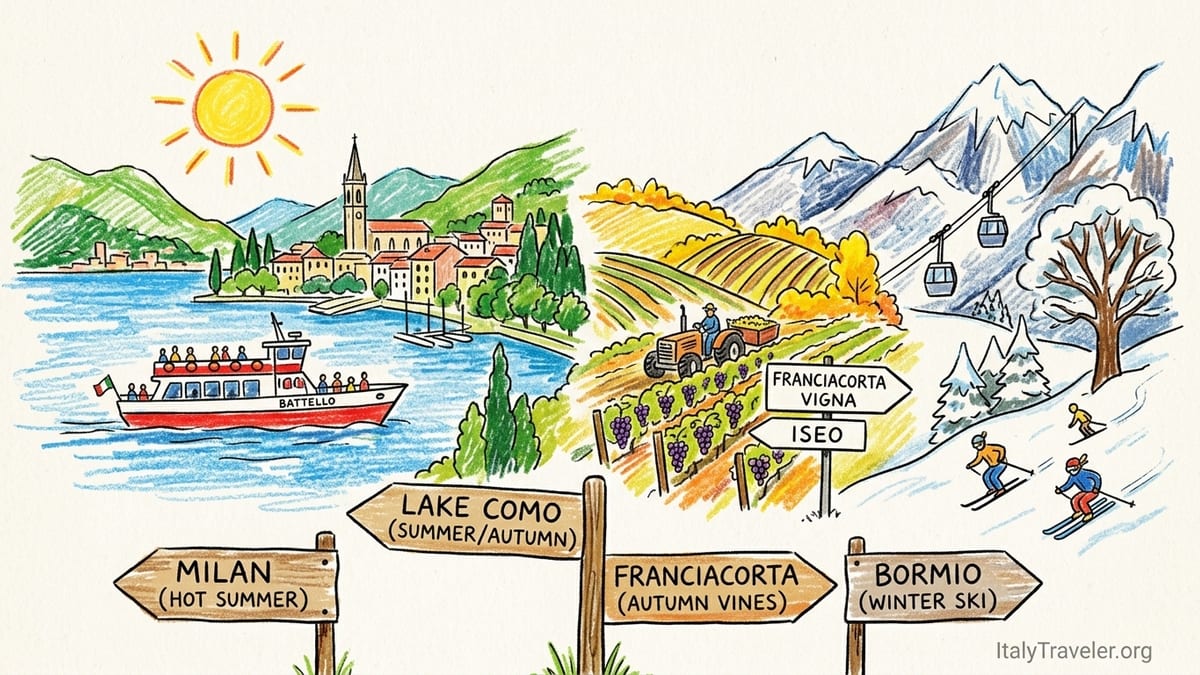
How I Experienced Lombardy by Season (and What I Researched)
My perspective on timing Lombardy trips comes from several visits spread over different seasons. I have personally experienced Milan and Lake Como in peak summer, including July and early September city stays and multiple hot days riding ferries between Como, Bellagio and Varenna. I have also spent late September and early October around Franciacorta and Iseo, when vineyards turn and harvest work is still visible in some parcels. In the mountains, I have stayed in Bormio and the upper Valtellina in winter and in late summer, encountering both ski-season logistics and the quieter hiking period when lift timetables contract.
There are gaps I have filled with careful research rather than first-hand stays. I have not spent a whole winter week on the lakes, and my Garda experience is limited to shoulder season rather than the absolute peak of August. For those periods, this article relies on current local tourism data and official operators rather than my own anecdotes. For example, information on Lake Garda’s ferry season and winds is based on recent guidance from local boat tour and tourism services, not my own boat trip log.
This mix matters because Lombardy is changing. Urban heat in Milan has become more intense and persistent, and vineyard harvests in Franciacorta have shifted earlier than in past decades, as local consortia now openly discuss. At the same time, lake navigation companies regularly adjust summer and autumn timetables, and mountain lift operators around Bormio adapt opening and closing dates to snow cover and demand. The result is a region that rewards travelers who think like locals, planning not only by month, but by the exact week or even the specific day services switch pattern.
With that in mind, what follows is both a diary of how these changes affected my own trips and a practical guide backed by current schedules and climate information. Where I describe something I did, I say so. Where I am relying on contemporary data for periods I have not personally experienced, I state that clearly so you can weigh the advice.
Summer in Milan and the Lakes: Heat, Crowds and Long Days
My first real shock in Lombardy was a July stay in Milan. On paper, average July highs around the low 30s Celsius looked manageable. On the ground, the urban heat island effect made it feel far hotter. Research by Italian and European climate institutes shows that Milan’s built-up areas routinely run several degrees warmer than surrounding countryside in summer, with high humidity and little nighttime cooling. Walking from Porta Venezia to the Duomo in the mid-afternoon, the stone pavements and facades turned the city into a slow oven. Air-conditioned metro lines were a relief, but station platforms felt thick with heat.
This affects how you use the city. On my July trip, I quickly abandoned the idea of a full-day walking tour. Instead, mornings before 10:30 became the window for outdoor sights like the rooftop terraces of the Duomo or the Navigli canals. From roughly 12:00 to 16:00, I retreated to museums such as the Pinacoteca di Brera, extended lunch in a trattoria, or my hotel room. Only after 18:00 did it become bearable again to stroll between Brera, the fashion quadrilateral and Porta Nuova. Travelers who assume they can sightsee all day in July or August as they might in spring risk burning out by day two.
By contrast, summer day trips to Lake Como felt more pleasant even on similarly hot days, thanks to the moderating effect of the water and breezes between the surrounding peaks. The drawback was volume. On a sunny Saturday in early August, the ferry pier in Como city was already a thick queue 30 minutes before departure for Bellagio. Fast hydrofoils between Como and mid-lake towns are popular and require a supplement, and in summer mornings I have seen midday departures sell out an hour in advance. The long daylight was wonderful. I could depart Como around 09:00, hop between Bellagio, Varenna and Menaggio all day, then catch a late boat back after dinner. But I had to treat ferry reservations like intercity trains rather than casual hop-on transport.
Lake Garda in high summer is an experience I know mainly from late June rather than peak August, complemented by current local tourism data. Garda has a milder, more temperate climate overall, with the lake often cooler than the air in summer, which tempers the worst heat. Local guides describe regular thermal winds that are strong in the late morning and afternoon, which sailors love, but which can make mid-lake crossings choppy in smaller boats. Full-frequency ferries and tourist services typically concentrate from roughly mid-May to early October, although the exact summer timetable start and end are set each year by the official navigation authority and can shift by several days.
Shoulder Season Surprises: When Timetables Quietly Change
If summer is all about heat and crowds, shoulder season is all about timetables. The most instructive example from my own travel log is Lake Como in early October. On a recent trip, I planned boat connections assuming that “summer” service would run until the end of the month, as many Mediterranean destinations do. In reality, the official Navigazione Laghi network that runs public ferries on Lakes Como, Garda and Maggiore had already announced that its 2026 summer timetable on Lake Como would end on 4 October. An autumn timetable begins on 5 October and runs only until early November, with fewer departures and some seasonal routes suspended.
The change itself is not the problem. In early October the lake felt calmer, with fewer tour groups queuing in Bellagio and more local commuters mixed among visitors. The issue is that the exact date of the switch matters. On 3 October, friends could still catch a late-evening fast service from Como back to Varenna after dinner. By 6 October, the last useful connection left much earlier, effectively shortening the usable day for long-distance day trips without an overnight stay. Schedules posted at piers make this clear, but many travelers rely on screenshots of older PDFs or blog posts that refer generically to “summer service” and find themselves stuck.
I have seen similar seasonal pivots around Lombardy’s other lakes. On Lake Iseo, the small but vital ferries that connect mainland towns like Sulzano to Monte Isola, Europe’s largest lake island, run to a beefed-up spring timetable from late March to mid-June, then a separate high season schedule in summer. When I visited in late September, the frequency was already lower. Missing a boat meant adding 40 minutes of waiting to a six-minute crossing. On Garda, publicly available guidance from local operators indicates that the busiest ferry pattern, with the densest network of car ferries and fast services, typically runs only until early October. After that, travel between towns such as Desenzano, Sirmione and Riva del Garda becomes less like urban public transport and more like planning around rural bus times.
The lesson I took away is simple but easy to ignore when you are staring at dreamy lake photos: build your itinerary around specific timetable dates, not only months. If you will be on Lake Como on 5 October 2026, you are not in “early autumn” in abstract terms. You are on the first day of the autumn ferry schedule, which immediately affects how early you need to start a Bellagio loop, or whether a same-day triangle Como–Varenna–Menaggio and back is realistic without a car.
Autumn in Franciacorta and Around Garda: Vines, Mists and Changing Harvests
My favorite time in Franciacorta, Lombardy’s sparkling wine region west of Lake Iseo, has been the transition from late September into early October. On recent trips in this window, the air cooled enough for long vineyard walks, but the days were still long enough for tastings and a late alfresco dinner in places like Erbusco or Iseo town. Some parcels were already harvested, with crates stacked by cellar doors, while others still had grapes on the vines. Local producers explained that harvest dates have moved earlier compared with older patterns, and that in some years picking begins in early or mid-August rather than September.
Recent communications from the Franciacorta consortium underline this trend. In 2026 the region recorded its earliest harvest start on record, a sign of how a warmer and more erratic growing season is prompting quicker decision-making in vineyards. In previous decades, historical overviews show that picking generally concentrated in the second half of August or even September. Now, even when the official harvest kickoff comes early, fieldwork and cellar activity still stretch well into October, which is when casual visitors are most likely to see both yellowing leaves and active wineries in the same day.
For travelers, the key practical difference between a late-August and an early-October visit to Franciacorta is not just whether grapes are still on the vines. In the heat of late August, some estates limit outdoor tastings in the afternoon because terraces are simply too hot and exposed. In my September visits, by contrast, I could comfortably cycle between vineyards in the late morning, enjoy an outdoor lunch in the village of Adro or along the Iseo lakeshore, then book a cellar tour in the cooler part of the afternoon. Prices for tastings stayed relatively stable, but availability changed. On harvest days, several wineries closed walk-in visits entirely, focusing staff on picking and pressing. In early October, more slots opened on short notice.
Around Lake Garda, local tourism offices describe autumn as a sweet spot for hiking the lower slopes above towns like Limone sul Garda or Malcesine, with mild temperatures and fewer crowded promenades than in summer. Winds remain important for sailors and windsurfers in this period, but cooler water and shorter days begin to limit late-afternoon outings. While I have personally visited Garda only on the cusp of summer, conversations with operators and up-to-date climate summaries suggest that by October, travelers need to pack light layers for evenings and accept that some strictly summer-focused services, such as certain seasonal beach clubs and high-frequency tourist boats, may already be winding down.
Bormio and Valtellina: Two Different Mountains Depending on the Month
Up in the Alps, the seasonal contrast is even starker. Bormio sits at the head of the Valtellina valley, surrounded by peaks that rise well over 3,000 meters. I have visited twice in winter, when the town is a classic Italian ski hub, and once in late summer, when the lifts begin to switch focus from hikers and mountain bikers back toward the coming snow season. The physical mountains are the same, but the traveler experience changes completely with the calendar.
In winter, Bormio’s ski area offers one of Italy’s biggest continuous vertical drops, from over 3,000 meters down to the town around 1,200 meters. A modern network of lifts connects pistes above Bormio with nearby Santa Caterina Valfurva and Cima Piazzi–San Colombano, all accessible on a common lift pass. During my winter stays, a free ski bus linked the areas with a timetable coordinated to the main lifts’ opening hours. Planning a day meant studying lift and bus times like a train schedule, especially if I wanted to start in Bormio, ski to Santa Caterina for lunch, and still catch the right bus back before evening.
Late summer was very different. Some lifts were still open for hikers and downhill riders on the Bormio Bike Park, but with reduced hours and weekly closures. Recent operating information from local tourism and lift companies shows, for example, that the bike park has been opening from mid-July with a weekly closing day, and that high-altitude glacier skiing on the Stelvio Pass typically concentrates from late May to early November but with interruptions and reduced lift operations in recent years. On my August visit, an afternoon thunderstorm shut several upper lifts for hours. A couple who arrived at the cabin station around 15:00 expecting to squeeze in a quick ride discovered the last descent had already been called off.
There is also a true off-season in Bormio. Between the end of summer lift operations and the full launch of the winter ski season, many mountain hotels and restaurants take a break for maintenance or staff rest. Official lift bulletins have shown periods when the entire ski area was listed as closed while “new winter season is loading.” My own autumn week in the valley coincided with this downtime. The thermal baths and some core restaurants in Bormio town stayed open, but the atmosphere was quiet. Above the tree line, fresh snow dusted the peaks, but not enough to open pistes. Without checking opening calendars in advance, a traveler might expect “Alps equals hiking” and find trail access limited by closed lifts and early snowfields.
The main practical point for visitors heading to the mountains from Milan or the lakes is that alpine logistics are the opposite of city and lake seasonality. The busiest period for ski lifts and high-mountain refuges is mid-winter, not summer. Shoulder seasons around late October and late April can be the least convenient times to visit if you are relying on lift infrastructure. Timing Bormio or Valtellina for either deep winter or settled summer weather, with shoulder weeks reserved for quiet spa time and valley walks, is usually the most efficient use of travel days.
What Changed for My Trips: Real-world Itinerary Adjustments
Looking back across several journeys, I can map specific itinerary decisions directly to the seasonal realities described above. On my second summer visit, having learned from a sweltering July in Milan, I shaved my city time down to two nights bookending the trip and shifted more days to the lakes and mountains. I kept big museum visits and shopping for Milan, where air conditioning and indoor spaces softened the heat, and I targeted Como and Garda for slow promenades and outdoor dining.
On Lake Como, the October timetable switch became more than an abstract planning detail. I had originally booked a single night in Como city with the idea of spending the next full day on the central lake and returning late that evening. Once I confirmed that autumn ferries after 5 October would run less often and finish earlier, I added a night in Varenna instead. That one change turned a stressful last-boat dash into a relaxed overnight, with time for a late drink by the water after most day-trippers had gone.
In Franciacorta, the shifting harvest calendar taught me to avoid expecting both peak vineyard color and active picking on a specific date. On one late September trip, I had imagined watching harvest teams snip bunches at midday while tasting in the shade. In practice, a heat spike meant picking started before sunrise and wrapped by mid-morning for that estate, and by the time I arrived vines were already bare. A winemaker explained that hotter seasons had compressed fieldwork into tighter windows. On a later trip I scheduled vineyard walks for early morning, then focused tastings on the afternoon, when cellars were calmer. I also booked visits in advance instead of assuming I could drop in during a busy harvest week.
Bormio forced perhaps the starkest reset. I once slotted a three-night mountain stop in late October between Milan and Venice, imagining crisp hikes by day and cozy alpine dinners at night. A week before departure, I checked live lift bulletins and discovered that the main ski area was closed pending winter opening and that several favorite rifugi were shut. I kept the booking but changed my expectations. Instead of high-ridge treks, I spent time in the thermal baths, walked along the valley floor between villages, and used the quiet to catch up on work from a cafe near the main square. It turned into a restorative low-key break, but only because I stopped trying to force a summer-style mountain program into a shoulder-season setting.
Choosing Your Best Time by Experience, Not Just Month
All of this leads to a more nuanced way to answer the “best time to visit Lombardy” question. Rather than naming a single magic month, it is more useful to match your priorities to how the region behaves in different seasons, and then crosscheck those ideas against concrete service dates. If your dream is sipping wine on a terrace overlooking golden vineyards and then taking a sunset ferry, late September to about the first week of October around Franciacorta and Lake Iseo can be ideal, provided you confirm that ferries and winery visit slots are still running to your needs.
For lake-hopping without winter chill, late May, June and the first half of September are often more forgiving than peak July or August. By this time, ferries on Como and Garda are usually on their fuller summer patterns, yet school holidays and the heaviest continental European vacation weeks are either not fully underway or beginning to ebb. Accommodation prices in lake towns such as Bellagio, Desenzano or Sirmione may still be high, but restaurant reservations are easier than in mid-August, and midday temperatures are hot without always tipping into the exhausting extremes of late July.
Travelers who are sensitive to heat but want Milan’s culture might consider April, May, late September or October, when city temperatures are milder and locals are still out in force in outdoor cafes. The trade-off is that in spring some mountain passes around Bormio and Valtellina remain closed from winter snow, which can make day trips into higher valleys more circuitous. In autumn, as discussed, you need to watch for the moment when ferry timetables and lift operations reduce, especially in the second half of October.
For skiers and snowboarders, the classic window from late December through early March remains the safest bet for Bormio and nearby resorts, balancing snow cover, open lifts and full services such as ski schools, rental shops and the free ski bus system that connects the three main ski areas in Alta Valtellina. Early-season openings in late November can offer quiet slopes but are more vulnerable to warm spells, while late-season skiing into April is heavily dependent on that particular winter’s snowfall and temperatures. In each case, the wise approach is to check live resort information a few weeks before your stay and be ready to pivot to spa and food-focused days in town if high pistes or certain lifts are not yet, or no longer, running.
FAQ
Q1. Is July or September better for visiting Milan and Lake Como together?
September is usually better if you want to walk more and sweat less. Milan’s July heat is intense due to urban heat island effects, while in early to mid-September temperatures are often a few degrees lower and evenings more comfortable. Ferries on Lake Como still run frequently in early September, but crowds begin to thin compared with August, giving you more flexibility with day trips.
Q2. How did the Lake Como timetable switch on 5 October 2026 actually affect travel?
When the official navigation system moved from its summer timetable, which ended on 4 October 2026, to the autumn schedule on 5 October, several routes saw reduced frequency and earlier last departures. Travelers who had planned late-evening returns from towns like Bellagio or Varenna to Como needed to leave earlier or add an overnight stay. The change showed that knowing the exact switch date is essential for realistic planning.
Q3. Can I still enjoy the lakes in winter, or is everything shut down?
Winter on the lakes is quieter but not dead. Core ferry routes usually continue with limited schedules, and lakeside towns like Como and Desenzano keep essential services, restaurants and hotels open. You lose the dense web of tourist boats and late-evening services, and some seasonal attractions close, but you gain calm promenades, lower accommodation prices and a more local feel.
Q4. When is the best time to see activity in Franciacorta’s vineyards?
If you want a good chance of seeing both grapes being processed and vines starting to change color, late September into early October is a strong choice. Harvest start dates have moved earlier in recent years, with some vintages beginning in early or mid-August, so you are not guaranteed to see picking. However, cellar work and post-harvest tasks continue into autumn, and many estates welcome visitors with tastings and tours during this period.
Q5. How does Lake Garda compare to Lake Como for summer weather?
Both lakes are warm in summer, but Garda’s larger size and regular thermal winds tend to moderate extremes and create excellent conditions for sailing and windsurfing. In practice, days on Garda can feel a touch breezier, especially in the northern part of the lake near Riva del Garda, while Como’s narrower arms can feel more enclosed. In both cases, expect strong sun and plan outdoor activities for mornings and late afternoons.
Q6. Is it worth visiting Bormio outside the ski season?
Yes, but you need to be clear about your priorities. In summer, Bormio offers hiking, cycling, a bike park and access to high-altitude scenery, with some lifts running to support these activities. In late spring and late autumn, lift operations can pause between seasons, turning the town into a quieter base for thermal baths, valley walks and food rather than big mountain adventures. Checking lift and pass status before you commit is crucial.
Q7. Are August crowds around the lakes really that bad?
August is the peak holiday month for much of Italy and Europe, so popular lake towns such as Bellagio, Sirmione and Desenzano can be extremely busy. Ferries fill up, lakeside promenades feel like continuous parades in the evening, and accommodation prices are at their highest. If you prefer a calmer atmosphere but still want summer weather and full services, June and early July or the first half of September usually offer a better balance.
Q8. How far in advance should I book ferries or lake activities?
For standard point-to-point public ferries, you usually buy tickets on the day, but in high season you should arrive at the pier at least 30 to 45 minutes before departure, especially for popular mid-lake routes. For specific experiences such as private boat tours on Garda or Como, peak-summer sunset cruises, or special dinner cruises, it is safer to book a few weeks ahead in July and August and at least several days ahead in shoulder season.
Q9. If I only have one week, should I prioritize lakes, cities or mountains?
With seven days, many travelers find a mix works best, for example two or three nights in Milan, three on a lake like Como or Garda, and two in the mountains around Bormio or in another alpine valley. If you are traveling in the hottest months and dislike heat, you might cut Milan to a quick overnight and spend more time at higher elevations or by the water. In cooler months, you can lean more heavily on city and wine country time.
Q10. How can I avoid being caught out by seasonal timetable changes?
The simplest strategy is to treat timetables like weather forecasts. About one month before your trip, and again a week before you travel, check the latest published schedules for ferries, lifts and any seasonal transport you plan to use. Note the exact validity dates, such as “until 4 October” or “from 5 October,” and adjust overnight stays or day-trip plans accordingly. Saving updated PDFs or screenshots on your phone and rechecking once you arrive can prevent last-minute surprises at the pier or lift station.