

Traveling across Lombardy without a car sounds romantic until you are jogging down a station underpass with a backpack, watching the tail lights of your missed train. Over several trips based in Milan, Como, Lecco and the central Lake Como towns, I set myself a rule: no rental cars, only public transport. Regional trains, suburban buses and Lake Como ferries became my everyday tools. The result was a trip that felt both deeply local and, at times, surprisingly awkward. Here is what I learned.
Figuring Out Lombardy Without a Car
My base for this experiment was Milan, where Lombardy’s rail network fans out in every direction. The regional operator Trenord runs the bulk of local trains in the region, with digital tickets and electronic passes now standard across the network from 2024 onward. That modernisation made it surprisingly easy to improvise day trips to Como, Lecco and Bergamo, as long as I had data on my phone and enough time to understand which line went where. The real test was what happened after the train, once I needed buses and ferries to reach lakeside villages and trailheads.
I discovered an important mental shift very early. In Lombardy, car free often means thinking in “corridors” rather than individual points. Milan to Como and Milan to Lecco are rail corridors that feel almost like commuter metro lines. Lake Como’s midlake triangle between Bellagio, Varenna, Menaggio and Cadenabbia is a corridor operated by the state ferry company, with short crossings that knit the three shores together. Around those spines, buses fill the gaps. Seeing the map this way helped me accept that some lonely valley or tiny hamlet simply would not fit into a car free trip, at least not without a punishing amount of waiting.
What surprised me was how normal public transport felt on busy routes. On weekday mornings the Milan to Como trains were full of commuters scrolling their phones, not tourists clutching guidebooks. The fast services towards Lecco were crowded with students and hikers with trekking poles. Using the same infrastructure as residents gave the trip a different texture to driving. Instead of hunting for parking in Bellagio, I was standing in line with local teenagers and delivery workers on the car ferry.
At the same time, the gaps were real. Late evening ferries did not always match the last regional trains. Some lakeside buses were infrequent, particularly on Sundays. There were times, especially when I was carrying luggage or trying to get to a trailhead early, when I would have happily traded the romance of car free travel for a small hatchback and the ability to leave whenever I wanted.
Buying Train Tickets and Navigating Platforms
The first hurdle in Lombardy without a car is understanding how to buy train tickets and what “regional” really means. Trenord has shifted heavily toward digital sales, which in practice meant that in 2026 I was almost always buying tickets either on the Trenord app or the English version of the Trenord website. Digital tickets open as QR codes on your phone, and for simple regional journeys they are usually valid for about six hours from activation, which gives some leeway if you miss an intended departure.
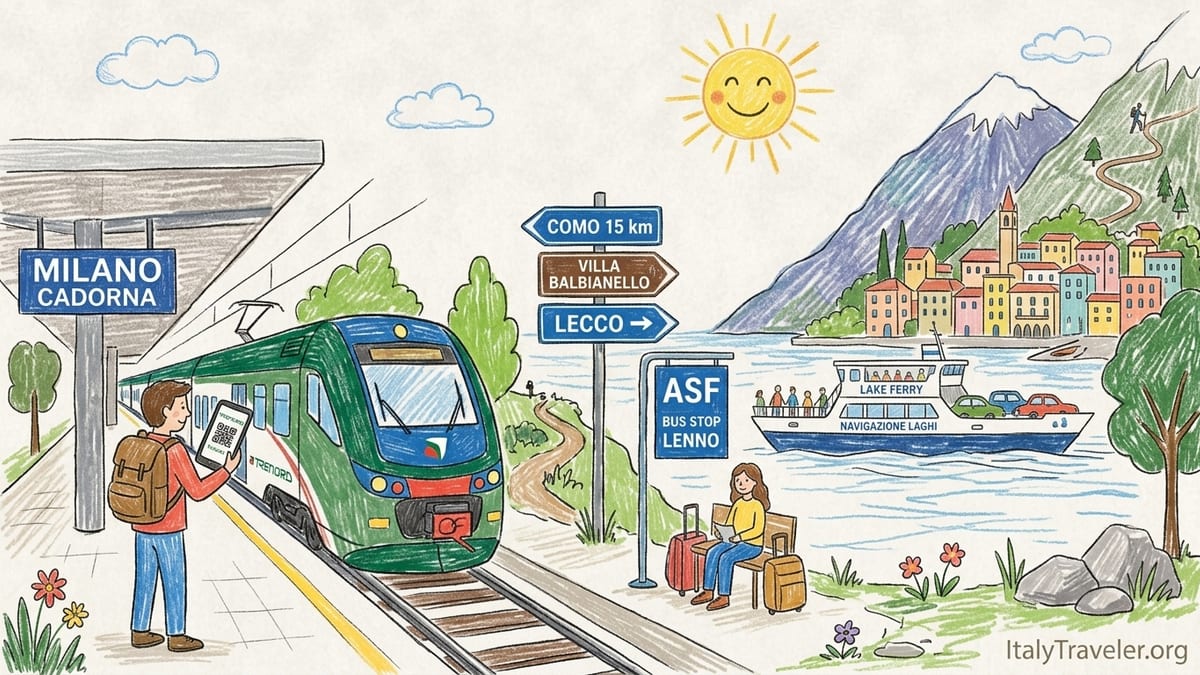
On the Milan to Como line, for instance, I bought a regional ticket from Milano Cadorna to Como Lago, the small station right by the waterfront. Payment was straightforward with a foreign credit card and I could see live departure boards inside the app. This became essential the day a signal failure around Saronno scrambled the timetable. Platforms switched at the last minute, and instead of relying only on the overhead screens in Cadorna I was checking my phone for the updated track number, then bounding down one set of stairs and up another along with dozens of commuters.
Paper tickets still exist in certain cases, especially for cross border journeys into Switzerland and for long distance Trenitalia services passing through Lombardy, but within the region the shift to electronic and rechargeable tickets is well under way. When I did buy a paper regional ticket from a self service machine at Milano Centrale for a train to Lecco, it came with a warning on the screen that I would need to validate it in a small green machine on the platform before boarding. That ritual of desperately hunting for a validator with a backpack on, a minute before departure, is something a digital ticket spares you from.
Luggage was more forgiving. Regional trains between Milan, Como and Lecco treat luggage simply as personal items, with no separate booking. Suitcases usually end up squeezed into the space near the doors or in the overhead racks. On one Saturday morning train from Milano Centrale to Varenna Esino, the carriage near the doors turned into a wall of wheeled suitcases as couples headed for Lake Como. I made the mistake of sitting deep inside the compartment; when my stop approached, I had to ask three different people to shuffle their bags so I could wrestle my backpack through.
Regional Trains: Milan, Como, Lecco and Beyond
The backbone of my car free Lombardy trip were the regional trains radiating from Milan. For Lake Como, there are two primary corridors. One runs from Milano Centrale to Varenna Esino and onward to Colico and the northern lake, with views of water and steep mountains as the line hugs the eastern shore. The other heads from either Milano Centrale or Milano Cadorna to Como, with some services terminating at Como Lago (especially convenient for the lakefront) and others at Como San Giovanni a short uphill walk from the water.
On a clear day, the morning train from Milano Centrale to Varenna Esino becomes an experience in itself. After Monza and Lecco the landscape tightens into a long fjordlike lake with tiny towns at the water’s edge. I boarded around 9:20, watched commuters peel off in Lecco, and by 10:20 was stepping onto the small platform at Varenna Esino. Here the romantic image collided with reality. The station sits above the town, and what looks like a short walk on a map is ten to fifteen minutes downhill along a road, with a steady line of fellow travelers wheeling suitcases towards the ferry pier.
Connections are slightly different from the Como side. One of my smoothest days began at Milano Cadorna with a mid morning Trenord train to Como Lago. I bought the ticket on the app while in line for coffee, walked onto the platform ten minutes before departure, and spent the 55 minute ride watching suburbs slide past. Como Lago station spills you almost directly onto the promenade, and city buses as well as the funicular to Brunate leave from stops a short walk away. For a car free traveler this is a nearly perfect transfer. I could leave Milan after breakfast and be on a mid lake ferry by lunchtime without stepping into a car or taxi.
Not every connection worked so well. Returning from the mountain town of Chiavenna down the line that runs through Colico and along the northern reaches of Lake Como, a delay of twenty minutes meant my intended connection at Colico towards Lecco evaporated on the departure board. The replacement train left almost an hour later, compressing my planned layover in Lecco into a rushed coffee at the station bar. It was an important reminder that although regional trains are frequent on the main axes, they are still subject to delays, and planning tight back to back connections can set you up for stress.
Lake Como Ferries: Freedom in the Central Triangle
On Lake Como itself, the moment you board a ferry it becomes obvious why many visitors manage happily without a car. The state run ferry company operates year round services, with an especially dense network in the central lake between Bellagio, Varenna, Menaggio and Cadenabbia. There are two broad types of boat. Passenger services include slow boats and faster hydrofoils that knit towns up and down the lake. Car ferries, known locally as “traghetti,” carry both vehicles and foot passengers but only serve a small set of ports, including the central triangle of Bellagio, Varenna, Menaggio and Cadenabbia.
On a warm June afternoon I arrived at Varenna Esino station with around twenty minutes to spare before the next car ferry to Bellagio. The walk from the station to the ferry pier took about ten minutes downhill, which felt fine with a backpack but would have been sweaty with a heavy suitcase in the midday sun. At the small ticket booth by the pier I bought a pedestrian ticket for the short crossing to Bellagio. Prices change with the annual timetable, so it is essential to consult the current Navigazione Laghi tables before your trip rather than relying on screenshots from previous years. What has remained consistent over recent schedules is the brisk frequency of these crossings in high season and the short journey times of around ten to fifteen minutes between the central triangle towns.
The reality of boarding was far from serene. On the Varenna to Bellagio ferry, pedestrians queue on one side of the ramp while cars and motorbikes roll on in front. In late morning lines for foot passengers snaked back into the square, and I saw at least one departure leave some people behind. Travelling without a car did at least spare me the stress of fitting my vehicle between camper vans and delivery trucks on the deck. I simply walked up the ramp once the crew lowered the chain, found a spot along the railing and watched Varenna’s pastel houses recede into the distance.
The ferries made it possible to string together several towns in a single day without any road traffic. One of my favourite loops involved taking the train from Milan to Varenna, ferry across to Bellagio for lunch, then a later ferry to Menaggio on the western shore for an afternoon stroll along the promenade. From Menaggio, buses run up and down the shore toward Cadenabbia and other villages, and there are ferries onward to Cadenabbia as well. With careful timing, I could be back on a fast boat towards Como in the late afternoon and on an evening train to Milan. The only catch was constant awareness of timetables and the sobering knowledge that the last central lake ferries at night might leave earlier than the last bars closed.
Buses Around the Lake: The Awkward Middle Layer
If trains are the backbone and ferries the magic ingredient, buses are the slightly awkward connective tissue of car free travel around Lake Como. On the western shore near Como, ASF Autolinee operates a web of urban and interurban routes that link the city with lakeside villages and inland towns. Services such as the long running C40 connect Como, Erba and Lecco, while other lines follow the western shore through places like Cernobbio, Argegno and Menaggio. The buses are entirely usable, but they impose their own rhythm on your day.
One morning I decided to move from Como to Lenno using only public transport. With luggage in tow, I wheeled my suitcase from Como Lago station to the nearby bus stops. The display showed the next westbound bus along the lake in about twenty minutes. Buying a ticket was the first small puzzle. In Como, ASF sells tickets through traditional tabacchi shops, at the main bus station and increasingly via contactless systems that let you tap a bank card at certain stops. I ended up buying a paper ticket at a kiosk, then validating it on board in a small yellow machine. As the bus wound its way along the narrow lakeside road, I found myself gripping the suitcase to stop it rolling in the aisle while cars inched past outside.
The buses shine when connecting ferry ports to hill towns or when lake services thin out. From Menaggio, for example, buses climb into the Val Menaggio and towards Porlezza, places the ferries never reach. Around Lecco and the eastern shore, other companies link Bellagio, the small villages along the coast and inland valleys. Yet frequencies can drop sharply in the middle of the day or on Sundays. More than once, arriving back in Menaggio from a ferry, I watched a bus towards my guesthouse pull away just as the boat docked, leaving a gap of nearly an hour until the next departure.
These are the moments when travelling without a car feels most restrictive. With a vehicle, a last minute change of plan such as staying longer over lunch in Tremezzo would carry few consequences. Without one, carefree spontaneity becomes a more calculated risk. I learned to look up the last buses for the day before even starting a hike, and when staying in smaller villages I opted for accommodation within easy walking distance of either a ferry pier or a bus stop with several lines.
Where Lombardy Worked Beautifully Without a Car
At its best, Lombardy is one of the easiest regions in Italy to travel by public transport. Milan acts as a hub, with multiple stations feeding different corridors: Centrale for long distance and many regional services, Cadorna for the lines towards Como Lago and the northern suburbs, Garibaldi for connections to the Valtellina and beyond. The ability to buy a Trenord ticket on an app, walk into a station perhaps ten minutes before departure and board a train that feels like an urban commuter service gives enormous flexibility.
Lake Como’s central basin amplified that sense of freedom. Once I established myself in a town like Varenna or Bellagio, the combination of short, frequent ferries and walkable historic centres meant I rarely thought about cars at all. In Bellagio I could leave my room after breakfast, stroll down to the pier and decide whether to ferry to Menaggio for a lakeside promenade or across to Varenna for an afternoon climbing old stone stairways. Crossing times of ten to fifteen minutes made it easy to treat the lake as a blue pedestrian plaza rather than a barrier.
Other parts of Lombardy were also very manageable without a car, especially for city breaks. Bergamo’s new and old towns are connected by funicular as well as local buses that integrate well with the regional trains. Brescia and its metro style line, combined with regular trains from Milan, made for another seamless car free day trip. What these cities share is a dense, reliable core network and a compact centre where walking takes over once you arrive.
In the mountains, trains could deliver me remarkably far. The line from Lecco up the eastern shore towards Colico opens access to hiking routes above towns like Varenna and Bellano, while another line from Milan towards Tirano takes you deep into the Valtellina. With early starts it was feasible to spend a full day in the Alps and return to Milan by evening, all on public transport. The trade off was that the last trains back set an immovable end time to the day, particularly outside the busiest months.
When I Wished I Had a Car
For all the moments of car free delight, there were days when I envied drivers sliding into small parking lots signed “solo per clienti.” The first was during an attempt to visit Villa del Balbianello from Varenna using only ferries and buses. I took a mid morning ferry to Menaggio, walked off with dozens of other passengers and joined a bus heading south along the western shore. By the time we reached Lenno, the bus was standing room only. After the walk out to the promontory and a leisurely tour of the villa, I misjudged the return. An earlier bus back towards Menaggio left five minutes before I reached the stop, and the next was not due for nearly an hour.
Standing in the shade watching private cars turn into driveways along the lake, it was hard not to imagine how much easier a short drive would have been, especially in heat. The return connection became a chain of small stresses. The bus arrived slightly late, the ferry from Menaggio towards Varenna was busy enough that not everyone got on, and I spent the crossing watching the clock to make sure I would still catch my regional train back towards Lecco.
Night travel was another sore point. On a warm evening in Bellagio I lingered over dinner, watching the sky turn deep blue over the lake. The last direct ferry back towards Varenna left earlier than my instincts suggested, and while later services existed, they sometimes required a change of boat or a walk across town to a different pier that car ferries used. Official timetables note that last departures in the central lake in high season often run until late evening, but they do not run all night, and shoulder season schedules can finish noticeably earlier. Taxi drivers in small towns are finite and often already engaged ferrying wedding parties back to hotels, so assuming you can pick up a ride at midnight is risky.
The most acute car envy arrived on a rainy Sunday when I wanted to explore small villages along the eastern branch towards Lecco. Ferry frequencies were trimmed compared with Saturday, and the bus that might have taken me to a trailhead ran only a handful of times that day. Faced with the choice of long waits at near empty stops or compressing my plans into a short stroll near the station, I chose the latter. On paper the region’s public transport covers vast ground. In practice, frequency matters as much as coverage, and weekends outside peak months reveal where the gaps still lie.
Planning, Timetables and Managing Missed Connections
Traveling Lombardy without a car rewarded planning. The most important rule I adopted was to check the latest timetables close to my travel date. Train schedules can change with seasonal adjustments, engineering works or staffing disruptions. Ferry timetables on Lake Como are famous for being published relatively late in the year, and for including different patterns for weekdays, weekends and shoulder seasons. For example, summer tables in recent years have run from early June through early October with dense central lake services, while spring and autumn can see slightly reduced frequencies.
For ferries in particular, I treated any online copy of a timetable as potentially out of date unless it came directly from the current season’s published leaflets. Before heading out for the day I checked the latest information on departure times between Bellagio, Varenna, Menaggio and Cadenabbia, and took a photo of the poster at the pier. This was not simply bureaucratic paranoia. On one occasion in Menaggio, a mid afternoon service to Varenna was temporarily cancelled due to a technical issue, and the replacement departure left around forty minutes later. Having the full list of sailings to hand made it easier to improvise with a coffee break rather than panic.
Missed or awkward connections were inevitable over a multi week trip. I missed a connecting bus in Como after a delayed train from Milan, and had to wait another thirty minutes at the bus stands near the lakefront. In Lecco, a regional train arrived on time but on a different platform than advertised, leading to a scramble through the underpass and a sharp reminder that Italian station announcements often presume some understanding of the language. Over time, I built in margins of error, especially when an evening regional train was my last realistic way back to Milan.
The other habit that helped was picking accommodation strategically. In Varenna I chose a guesthouse within ten minutes’ walk of both the train station and the ferry pier, so even if a ferry was running late I could still reach an evening train without resorting to taxis. In Como I stayed close to the lakefront bus hubs rather than up on the hillsides, accepting a less dramatic view in exchange for the ability to catch early morning services without a long downhill walk.
The Takeaway
Traveling Lombardy without a car proved not only possible, but deeply rewarding in the right places. The region’s regional trains, especially the corridors from Milan to Como, Lecco and Varenna, make car free access to famous landscapes straightforward. Lake Como’s ferries, particularly the dense web of crossings in the Bellagio, Varenna, Menaggio and Cadenabbia triangle, turn the lake into a floating transit system that rivals an urban metro in flexibility during high season. In cities like Bergamo and Brescia, integrated local networks make car free exploration almost trivial.
The trade offs appear on the fringes. Late night movements, Sunday excursions beyond the main corridors and trips to villas and trailheads tucked between ferry piers can become a puzzle of bus schedules and tight connections. Buses extend the reach of trains and boats but demand patience, especially when services thin out. There were moments, under a hot afternoon sun at a quiet lakeside stop, when I would have happily swapped my Trenord app and ferry tickets for a set of car keys.
Yet the constraints also shaped the trip’s character. Waiting on platforms and piers with commuters and shopkeepers, watching schoolchildren use the same ferries that carried me to grand villas, reminded me that Lombardy’s lakes and mountains function as lived in spaces, not just scenic backdrops. If you are willing to work within the rhythm of trains, ferries and buses, a car free journey through Lombardy reveals a region that is more connected, and more nuanced, than a quick drive along the shore roads suggests.
FAQ
Q1. Can I visit Lake Como as a day trip from Milan using only public transport?
You can. Regional trains from Milan reach Como or Varenna in about one to one and a half hours, and from there ferries link major towns such as Bellagio and Menaggio. With an early start and a planned route, you can comfortably see at least two central lake towns and return to Milan in the evening.
Q2. Do I need to buy my Lombardy train tickets in advance?
For regional Trenord services within Lombardy you usually do not need long term advance purchase. Buying on the day via the Trenord app or website is common and prices are fixed for most simple journeys. Advance booking matters more for long distance high speed trains run by other operators that pass through the region.
Q3. How easy is it to manage luggage on trains and ferries around Lake Como?
Luggage travels as part of your normal ticket on regional trains and ferries, with no separate booking. On busy weekend services, especially the Milan to Varenna trains and central lake ferries, space near doors can become crowded with suitcases. Choosing seats near exits and travelling slightly outside peak midday boats helps.
Q4. Are Lake Como ferry tickets included in any regional transport passes?
Lake Como ferries are operated by a separate company from the regional rail network. While some combined tourist passes occasionally appear, in general you buy ferry tickets separately at piers or onboard where allowed. Train passes such as regional cards typically do not cover boat travel, so budget for ferries as an extra cost.
Q5. How late do the central Lake Como ferries run at night?
In high summer the car ferries and some passenger services between Bellagio, Varenna, Menaggio and Cadenabbia can run until late evening, sometimes close to midnight. Outside peak months, and on certain days of the week, last departures can be significantly earlier. Always check the current timetable for your specific dates rather than relying on past years.
Q6. Is it realistic to stay in a small village without a car?
It can be, but it depends on the village. Towns directly served by both ferries and regular buses, such as Menaggio or Lenno, are convenient without a car. Very small hamlets higher up the slopes or along quieter stretches of shore may have limited bus service, especially on Sundays, which makes moving around harder if you rely only on public transport.
Q7. How do I buy bus tickets around Lake Como if I do not speak Italian?
On the western shore near Como, bus tickets are sold at tabacchi shops, kiosks near main stops, and increasingly through contactless validation at some stops or via company apps. Drivers can sell tickets on many routes, though paying with small change is appreciated. Basic English is often understood around the lake, but having your destination written down helps avoid confusion.
Q8. What happens if I miss a train connection in Lombardy?
With regional tickets that are valid for a block of hours, missing one departure usually means simply boarding the next train on the same route, as long as it is still within your validity window. If a delay on one train causes you to miss a later non flexible service, staff at main stations can advise on alternatives, but it is wise to leave generous buffers for last connections of the day.
Q9. Should I rent a car for visiting villas and hiking trails around Lake Como?
A car can make access to certain villas and remote trailheads simpler, particularly on days with limited bus service. However, many popular sites, including central lake villas and well known paths above Varenna, Bellagio and Menaggio, are reachable by a mix of ferries, walking and local buses. Renting a car is most helpful if your plans focus heavily on remote villages and flexible late evening returns.
Q10. Is travelling without a car in Lombardy suitable for families?
Families often do well on the main rail and ferry corridors, where step free access is increasingly common and journey times are short. Strollers and luggage fit on most regional trains and ferries, though busy services can feel crowded. The main challenge with children is the waiting time for buses in less frequent areas and late evening connections, so planning days around the most regular routes helps keep stress low.