


I planned my Lombardy road trip on paper first and it looked perfect: Milan, Lake Como, Bergamo, Franciacorta and Lake Iseo, Lake Garda, Mantua, with a tempting spur north into the Valtellina and Bormio. On the map it was a neat loop. On the road it became a lesson in tolls, traffic, limited‑traffic zones, mountain timing and the simple fact that you cannot do everything. What follows is the trip as I actually drove it, warts and all, and what I would cut if I were planning the same route again.
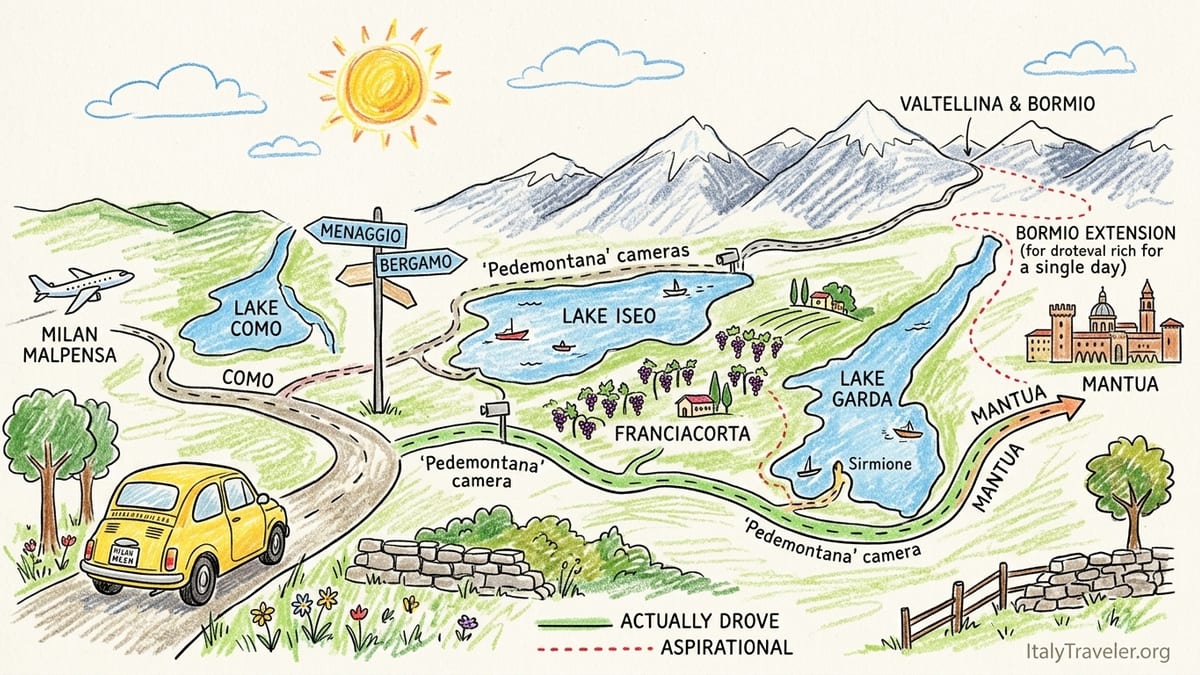
How I Planned the Route, and What I Actually Drove
I started and ended at Milan Malpensa Airport with a compact rental car, picking up around late morning. My planned loop ran Malpensa to Como, then along Lake Como’s western shore, across to Bergamo, down to Lake Iseo and the Franciacorta wine country, on to the southern shore of Lake Garda, then west to Mantua, and finally back up to Milan. I also pencilled in a northern extension into the Valtellina, as far as Bormio, to get a taste of the high Alps. Time, traffic and common sense meant some of this became aspirational rather than real, and I will be clear about each segment I truly drove.
From Malpensa I drove to Como, then Menaggio on Lake Como’s mid‑western shore, then cut east across the hills to Bergamo. From there I drove south to the southern shore of Lake Iseo near Sarnico, swung through the Franciacorta vineyards inland, then joined the A4 autostrada for the run to Desenzano del Garda. After Garda I drove to Mantua and from Mantua back to Milan, dropping the car at Milano Centrale area, not at the airport. On a separate long day I made the Valtellina extension from Bergamo via Lecco and Sondrio, up to Bormio and back to Bergamo, which I will describe as an optional bolt‑on rather than an organic part of the main loop.
The result was roughly 1,000 to 1,100 kilometres of driving over eight days, mixing motorways, lakefront corniches, vineyard backroads and high Alpine passes. I leaned on a mix of the A4 autostrada, regional roads along the lakes, and the toll‑camera Pedemontana network north of Milan, which uses a free‑flow system that reads your plate and bills via Telepass or later online payment. I also used trains and ferries when driving would have added nothing but stress, and that difference is at the heart of this route: knowing when a car unlocks Lombardy and when wheels just get in the way.
Before the trip I used official Italian motorway toll calculators and recent Autostrade service charters to sample tariffs per kilometre. From those I budgeted around 0.07 to 0.08 euro per kilometre in tolls for my small car on the mountain stretches and slightly less on the plains, which proved broadly accurate once I cross‑checked the receipts afterwards. For fuel, I used a conservative estimate based on current Lombardy pump prices and my car’s real‑world consumption of around 6 litres per 100 kilometres, knowing prices can nudge up or down between service areas and supermarket stations.
Milan to Lake Como: When the Car Was Not the Smart Choice
The first reality check came immediately. From Malpensa to Como, driving made sense. I followed the A8 towards Milan, then the A9 north towards Como, paying roughly 4 to 5 euros in tolls for that first stretch. Door to door, it took just under an hour in late morning with light traffic. Parking on the edge of Como near the stadium in a blue‑lined pay‑and‑display zone cost around 1.50 to 2 euros per hour, capped near 15 euros for the day, which matched the posted tariffs. This part of the drive was straightforward, with clear signage and no toll booths beyond the standard Italian barrier‑and‑ticket system.
Where the car felt wasted was the connection between Milan city and Lake Como. On a later day I needed to go from Como into central Milan to return the car. That run along the A9 and then ring roads into the city took about 90 minutes in afternoon traffic. Around Milan I had to respect the city’s large congestion‑control area, Area B, and the tighter Area C in the historic centre, which function as low‑emission and congestion zones with camera enforcement. With a rental car registered outside Italy, the risk of accidentally entering the wrong gate and finding a fine waiting weeks later felt very real. By contrast, the direct trains from Como S. Giovanni to Milano Centrale run frequently and take around 40 minutes, for about the cost of two hours of Milan parking.
After this I formed a rule: use the car to move between lakes and rural areas, and let trains handle the corridors into Milan. If I were to rerun the trip, I would still collect the car at Malpensa to reach Como easily, but I would avoid driving all the way into central Milan later. I would instead drop the car at a suburban or airport location and finish the trip by train. The car was an asset for reaching Menaggio, Bellagio by ferry, little hillside agriturismi and wineries, and later the Iseo and Garda hinterlands. It was a liability once the destination was simply “Milan city centre.”
Lake Como itself was a mix of joy and patience. The lakeside road from Como to Menaggio is one of the most scenic I have driven in Italy, but it is single carriageway, often barely wide enough for two vehicles to pass comfortably, and it threads through a string of villages with their own parking rules and, in some cases, small limited‑traffic zones at their cores. Afternoon traffic behind delivery vans and tourist buses meant my nominal 45‑minute drive up the western shore took closer to 75 minutes. Here a car lets you reach mid‑lake towns and trailheads that buses serve poorly, but you pay in concentration and white‑knuckle moments every time a coach swings toward you on a bend.
Lake Como to Bergamo: Crossing the Pedemontana and Hill Roads
From the mid‑lake area near Menaggio to Bergamo there are two broad choices: a straight run via Lecco and the A4 autostrada, or a more diagonal line on the Pedemontana network that skirts north of Milan. I tried both on different days. The fastest overall involved working down the eastern branch of the lake to Lecco, then joining the SS36 and eventually the A4 toward Bergamo. This kept the driving time to around two and a half hours including a coffee stop, but also meant more time on major arteries and a couple of toll segments.
The more interesting, and more instructive, route used the Pedemontana Lombarda, the A36 and its linked sections. This is a barrier‑free motorway that runs west–east along the foothills north of Milan, connecting the A9 from Como to the A4 towards Bergamo without having to dive into the Milan ring. Cameras record your number plate and you must settle the toll within a set period, either via Telepass, the official Pedemontana app, partner services or in person at payment points like the Punto Verde office near Mozzate. With my rental car I opted for the app, opening an account and registering the plate number on the same day.
On that stretch, driving from the Como area onto the Pedemontana and across toward Bergamo, my recorded tolls for a small vehicle added up to roughly 6 to 8 euros in total. Combined with fuel, that segment cost in the region of 15 to 18 euros. The benefit was a smooth dual carriageway, very light compared to the A4, and a psychologically peaceful way to cross Lombardy without grappling with the heavy truck traffic that can build up between Bergamo and Milan. It also saved around 20 to 30 minutes compared with stringing together smaller provincial roads under normal traffic, though accidents can erase that margin quickly.
Reaching Bergamo itself, the old town sits atop a hill while the newer Citta Bassa spreads on the plain. I chose a multi‑storey car park on the edge of the lower town, paying around 18 euros for 24 hours, and used the funicular to reach the historic upper city. Bergamo has its own limited‑traffic rules, particularly around Citta Alta, where cameras control access and some zones are residents‑only. Leaving the car below spared me the worry of accidentally turning into a prohibited lane on a tight corner after a long day’s drive. It is very possible to visit Bergamo by train alone, but without the car I would not have been able to combine it conveniently with my stays along Lake Iseo and in the countryside between.
Lake Iseo and Franciacorta: Where the Car Earned Its Keep
From Bergamo to Lake Iseo I drove south‑east on a mix of provincial roads, avoiding the autostrada since the distance is short. In mid‑morning it took a little under an hour to reach Sarnico on the southern tip of the lake, threading past industrial zones and small towns. Parking along the lakefront is, as on Como, a mosaic of blue and white spaces, with blue bays metered at around 1.50 euros per hour. Because I stayed overnight nearby, I sought out a guesthouse with on‑site parking, which removed a lot of friction.
Lake Iseo is smaller and feels less overwhelmed than Como, and this is where the car really paid off. I used it to circle part of the lake’s perimeter, stopping at viewpoints and small harbours, and then to dive inland into the Franciacorta wine region. Here the public transport options thin out dramatically. There are regional trains and a few buses, but wineries and agriturismo restaurants are scattered among vineyards on narrow lanes without pavements. Having a car meant I could book a late lunch at a farmhouse restaurant without having to puzzle out how to get a taxi back to a station. It also allowed me to time tastings conservatively, choosing one estate to visit, spitting more than I swallowed, and then returning to my accommodation by back roads.
Fuel and parking costs around Iseo and Franciacorta remained modest. Diesel and petrol at roadside stations were a little cheaper than on the autostrada service areas, by a few cents per litre. Toll costs between Bergamo, Iseo and the Franciacorta hills were effectively zero on the routes I chose, since I stuck to non‑autostrada roads. The trade‑off is slower progress: expect 50 kilometres to take about an hour. Without a car you could reach Iseo town or a couple of lakeside villages by train and boat, but you would miss the depth of the wine country and the ease of visiting a cluster of rural trattorie and sparkling wine cellars in a single day.
This is also the segment that convinced me to delete an early fantasy of adding Brescia’s city centre to the same day. The temptation to “just pop in” to a medium‑sized city because it is on the map between wine villages is very strong. In practice, finding city parking, understanding each new ZTL system and then doing the place justice eats hours. I chose to enjoy the lake and vineyards slowly instead, a decision the odometer and my shoulders both thanked me for.
Lake Garda and Mantua: Balancing Autostrada Speed and Historic‑Core Stress
From Franciacorta to Lake Garda, the main artery is the A4 autostrada, the east–west backbone across northern Italy. I joined it near Ospitaletto, set the cruise control a little under the posted speed, and settled into the rhythm of long‑distance trucks and holiday traffic. Tolls on this stretch, from the Iseo area to the Desenzano del Garda exit, came to around 3 to 4 euros for my car, based on the distance travelled and the 2026 tariffs per kilometre. It took about 40 minutes of actual motorway driving, plus time to reach and leave the ramps, turning the whole hop into roughly an hour.
Desenzano, Sirmione and Peschiera on the southern shore of Garda are magnets for weekend and summer crowds. Here the car was both a key and a burden. It allowed me to base myself at a slightly inland agriturismo with its own parking, under olive trees and away from the waterfront scrum, and then drive in early to town car parks before the day‑trippers flooded in. Municipal car parks charged between 1.80 and 2.50 euros per hour in peak season, with daily caps that crept toward 20 euros. By arriving before 9 a.m. I consistently found spaces, but after lunch queues formed at the barriers, with some drivers circling side streets in hope of a free white‑lined bay.
To avoid crawling along the congested lakefront road between towns, I leaned on ferries for some movements. For example, I left the car in a long‑stay lot at Desenzano and used the boat service across the lake to reach a mid‑lake village for a hike. Driving that instead would have meant over an hour of stop‑start traffic, while the boat took about 30 to 40 minutes in relaxed fashion. This was the clearest case where the car became unnecessary once I had reached a particular lake hub. My advice, based on that day, is to park once for the morning and let boats and your feet do the short‑range work.
From the southern Garda shore I drove on to Mantua, again using a mix of A4 and then smaller connecting roads south. Tolls for that leg came to roughly 4 to 5 euros, and the driving time was around 1 hour 15 minutes outside rush hour. Mantua’s renaissance core sits almost island‑like amid lakes and moats, and its traffic restrictions are strict. I chose accommodation outside the tightest ZTL, with private parking, and walked into the centre. The streets immediately around Piazza Sordello and the Ducal Palace are controlled by cameras, and I saw more than one confused visitor backing up awkwardly from a restricted lane. Here again the car’s role was to deliver me to the city’s edge and then get out of the way.
Valtellina and Bormio: A Rewarding but Heavy Northern Extension
The northern extension from the Lombard lakes up to the Alps is huge in distance and commitment compared with how inviting it looks on Google Maps. From Bergamo I drove north‑east via Lecco along the SS36, skirting the eastern flank of Lake Como, before turning into the Valtellina toward Sondrio and Bormio. This is a major route, part expressway and part mountain valley road, serving trucks as well as tourists. In kilometres it is not daunting, but in terms of driving time and concentration, it is a full day’s excursion if you intend to reach Bormio and return the same way without an overnight stop.
Leaving Bergamo mid‑morning, I reached Bormio in just under three and a half hours of continuous driving, including one short coffee and fuel break at a service area on the SS38. Fuel on this corridor ran a little higher than in the plains, perhaps 5 to 8 cents per litre more at some stations. The approach roads narrow and twist more as you climb the final kilometres to Bormio, though this is not yet the hairpin territory of the Stelvio Pass. I parked in a signed pay car park on the edge of the village centre, dropping coins into a meter that worked out to just under 2 euros per hour. Total toll costs for the round trip, mixing segments of SS36 built to motorway standard and free stretches, stayed under 10 euros for the day because much of the route is not full autostrada.
The rewards were snow‑streaked peaks even in the shoulder season, the brisk air of an Alpine spa town and the sense of having stepped into a different climate from the lakes below. Yet this was the piece of the itinerary that felt the most overreaching. Doing it as a there‑and‑back day meant seven hours behind the wheel, not counting stops, and left little margin for exploring side valleys or hot springs. If I were to integrate the Valtellina properly into this Lombardy loop, I would cut something else and plan at least one overnight in Bormio or a nearby village, splitting the driving into shorter chunks.
In terms of where a car is essential, the Valtellina still offers some rail options as far as Tirano and bus links up the valley, but frequencies and travel times move from “holiday flexible” into “logistical puzzle” once you go beyond the main line. To link wineries, cheese producers, hiking trailheads and hamlets with small guesthouses, you need your own wheels or a hired driver. That practicality is why the car belongs on this extension, but only if you truly have the days to give it.
Costs, Tolls, Fuel and ZTL Lessons from the Road
Looking back over receipts and notes, my total motorway toll spend for the main loop excluding the Bormio run sat in the 35 to 45 euro band for a small car. That covered the A8 and A9 around Malpensa and Como, sections of the A4 between the lakes and towards Mantua, and the lateral Pedemontana run north of Milan. The Bormio extension added under 10 euros more, thanks to the partial motorway status of the valley route. None of these figures are astronomical in isolation, but they mount quickly if you are hopping on for single exits rather than committing to longer legs.
Fuel over roughly 1,000 to 1,100 kilometres of mixed driving, at an average consumption of around 6 litres per 100 kilometres, worked out to a little over 60 litres. With pump prices around Lombardy hovering in the 1.80 to 1.90 euros per litre range over the period I drove, that meant a fuel bill in the rough neighbourhood of 110 to 120 euros. Topping up at supermarket‑linked stations in the plains trimmed a little off these totals compared with filling entirely on motorway services, which are consistently at the higher end.
Parking became the hidden line item. Full‑day stays in city or lakefront multi‑storeys in Como, Bergamo, Desenzano and Mantua typically ran between 15 and 20 euros per calendar day. Occasional hourly stints for viewpoints or short stops along the lakeside added a handful of euros each time. Over the whole journey, I spent something like 150 to 180 euros on parking, which means that parking competed with fuel and tolls as a major cost. Choosing accommodation with included or discounted parking made a clear difference, especially in Bergamo and around Garda.
As for ZTL and urban rules, my main lesson was preparation. Milan’s Area B and C, Bergamo’s hilltop zones and Mantua’s protected centre are all enforced by cameras rather than barriers. I avoided fines by parking outside these areas and walking or using funiculars and boats, but the potential for a stray wrong turn to trigger a ticket is real, especially when tired. A car is liberating on rural stretches but blunt in Italy’s historic cores, where streets were never meant for modern traffic. Every time I chose a park‑and‑walk strategy, I felt tension bleed away compared with navigating ever narrower streets in search of a legally available bay.
What I Would Cut from an Overambitious First Route
My paper plan was more crowded than the route I eventually acknowledged as realistic. In the first draft, I tried to combine Lake Como, Bergamo, Lake Iseo, Franciacorta, Brescia, Lake Garda, Verona, Mantua, Cremona and the Valtellina into a single loop of barely ten days, all by car. On the ground, the stops that brought the least added value relative to the driving and parking effort were the medium‑sized cities layered on top of an already rich lake and countryside set.
If I were advising a first‑time driver following in my tyre tracks, I would remove Verona and Cremona from this specific loop, keeping them for a dedicated city‑hopping trip by train. I personally did not drive those segments on this journey, and I am glad I resisted the temptation, because adding them would have meant more A4 miles and additional ZTL mazes that feel similar in challenge to Mantua and Bergamo’s old towns. Better to spend that time experiencing the lakes and wine roads in depth than repeating the park‑outside, walk‑in dance in yet another historic core.
I would also recommend reconsidering the Valtellina and Bormio if your trip is under ten days. I did that long day up and back because I had a particular interest in Alpine landscapes, but it skewed the balance of the journey towards driving hours. For many travellers, stopping in the foothills or exploring a single higher valley with an overnight might be a better way to sample the mountains without devoting an entire day to the wheel. A shorter side trip from Lake Como to a high village or alpine cable car base station could give a satisfying taste of elevation with much less investment.
Within the lakes themselves, I would narrow the focus to two major water bodies rather than three or four. On my route, Lake Como and Garda delivered very different moods, from steep narrow coves to broad, almost marine expanses, while Lake Iseo and Franciacorta offered a more local, intimate atmosphere. If pressed, I would suggest dropping either Garda or Como to free two nights for slower exploration around the remaining lakes. The driving between each is interesting but not so spectacular that you need to do every single one in a single arc.
FAQ
Q1. Is it worth renting a car for this Lombardy route if I am nervous about Italian driving?
The mix of autostrada, lake roads and mountain valleys can be challenging, but by basing your car use mostly outside big cities and avoiding ZTL zones, it remains manageable for confident, defensive drivers. If you are very anxious, consider combining trains for Milan and the largest cities with a shorter rental just for the lake and wine segments.
Q2. How much should I budget for tolls and fuel on a Milan–Lakes–Mantua loop?
On my roughly 1,000 to 1,100 kilometre loop I spent in the region of 45 to 55 euros on tolls, including the Bormio extension, and about 110 to 120 euros on fuel for a compact petrol car, with pump prices around 1.80 to 1.90 euros per litre. Your exact costs will vary with engine size, route choice and driving style.
Q3. Can I avoid the Pedemontana and its camera‑based toll system?
Yes, you can route entirely via the A4 and other traditional toll roads or even stick to slower provincial roads, but the Pedemontana saved me both time and stress moving between Como and Bergamo without dipping into Milan’s ring. If you are comfortable downloading the official app or using online payment within the deadline, it is a convenient corridor.
Q4. How bad is parking around Lake Como and Lake Garda in peak season?
In July and August, lakefront parking in hotspots like Como town, Bellagio approaches, Sirmione and Desenzano fills early. Arriving before mid‑morning and targeting larger signed car parks rather than searching side streets gave me the best results, but I still often paid close to 20 euros for a full day’s parking near the water.
Q5. Do I need a car for the Franciacorta wine region and Lake Iseo?
The car made a big difference here. While you can reach larger towns by train, many wineries, agriturismi and viewpoints sit on minor roads with thin or non‑existent public transport. With a car I could connect lake views, cellar visits and rural restaurants in a single day, something that would be awkward relying on buses and taxis alone.
Q6. How did you handle ZTL and congestion zones in Milan and other cities?
I treated them as no‑go areas for the car. In Milan, Bergamo and Mantua I parked outside the most restricted cores, checked local maps to make sure I was in legal zones, and then walked or used public transport into the centre. That strategy kept me out of camera‑enforced fines and reduced the stress of threading narrow streets in traffic.
Q7. Is the Valtellina and Bormio extension realistic as a day trip?
I did Bergamo to Bormio and back in one long day, with around seven hours of actual driving. It is realistic if you are determined and used to longer drives, but it leaves limited time for on‑the‑ground exploration. For most travellers I would suggest an overnight stay in the valley instead if you want to include it.
Q8. When did you find the car unnecessary and leave it parked?
In central Milan, within Bergamo’s Citta Alta, inside Mantua’s core and for short lake‑to‑lake movements once based in a town, I left the car and used trains, funiculars, ferries and my feet. In these places the density of sights and complexity of access rules made the car more burden than asset.
Q9. How much driving time per day felt comfortable on this route?
The days with two to three hours of net driving, split into morning and late afternoon hops, were the most enjoyable. Anything above four hours of wheel time began to push into “transit day” territory, where I felt I was looking at road markings more than landscapes.
Q10. What single change would most improve a first attempt at this itinerary?
Cutting at least one major city or lake from the loop and adding that time back into slower stays at the remaining stops would transform the experience. For example, focusing on Milan, Lake Iseo and Franciacorta, Lake Garda and Mantua, while leaving Verona, Cremona and the Valtellina for a future trip, would create a richer and less rushed journey.