


Central Italy is compact on the map but sprawling in its possibilities. Within a few hours you can move from the Vatican Museums to medieval hill towns, from vineyard-covered ridges to Adriatic beaches. The key to enjoying it without spending your holiday in traffic or on crowded trains is choosing the right base. This guide compares Rome, Florence, Siena, the Tuscan countryside, Umbria, the Marche coast and smaller towns, with concrete examples for first-time visitors, couples, families, luxury seekers and those planning road trips or train-based itineraries.
How to Choose the Right Base in Central Italy
Before picking a city or farmhouse, think in practical terms: how long you have, whether you will rent a car, and what you cannot leave Italy without seeing. Someone with five nights and no car will have a very different ideal base than a couple with two weeks and a rental waiting at Rome Fiumicino. As a rule of thumb, if you are relying on trains, your base should be Rome, Florence, or a town directly on a main rail line. If you are driving, you can open the map to Siena, Tuscan hills, Umbria or Marche and think in clusters rather than single cities.
Budget also matters. In Rome and Florence, a central but simple double room often starts around 180 to 250 euros per night in high season, while an agriturismo room in rural Tuscany or Umbria with pool and breakfast might start near 130 to 180 euros. Countryside villas with two bedrooms and a kitchen can make more financial sense for families than two hotel rooms in the historic center of Florence. For example, a family of four in July may find that a two-bedroom apartment on a working farm near Montepulciano costs about the same as a single midrange hotel room in central Rome.
Travel style is the final filter. First-timers who want Rome, Florence and maybe Pisa by train should prioritize walkable stations and historic centers. Food-focused couples might trade city museums for long lunches at vineyards in Chianti or Montefalco. Families with younger children often prefer agriturismi with pools and space to run around between sightseeing days. Once you are clear on these basics, choosing between Rome, Florence, Siena, countryside or coast becomes far easier.
Rome: Best for First Timers and Train-Based Trips
Rome is the strongest base in Central Italy for first-time visitors who are traveling mainly by train. The city has direct high-speed connections to Florence, Naples and Milan, and regional trains to Orvieto, Frascati and the Castelli Romani. For a classic first trip, staying in or near the historic center puts most major sights within a 20- to 25-minute walk. Around the Pantheon and Piazza Navona, small boutique hotels and guesthouses offer air-conditioned rooms in restored palazzi, often in the 250 to 400 euro range per night in peak months, with the advantage that you can walk to the Trevi Fountain or Piazza di Spagna early or late when the day-trippers are gone.
For travelers who prioritize value and transport, the Monti and Termini-adjacent areas are popular. Monti, just east of the Colosseum, mixes wine bars and trattorie with family-run hotels and apartments. You might find comfortable doubles starting around 170 to 220 euros in spring. From here it is about 10 minutes on foot to the Colosseum and roughly 20 minutes to the Roman Forum. Slightly farther out, neighborhoods like Prati near the Vatican or Testaccio across the Tiber offer a more local feel, with metro access and lower nightly rates. A modern hotel in Prati might start closer to 160 to 200 euros, and you will be on the same metro line as the Spanish Steps and Termini.
Rome also works as a hub for those nervous about driving. A couple staying four nights near Piazza Navona can take the train to Orvieto for a hill-town day trip, or to Tivoli by bus for Villa d’Este’s fountains, then return to the same hotel without moving luggage. Families may prefer apartments with kitchenettes around Campo de’ Fiori or Trastevere, where you can shop at outdoor markets and give children a quieter courtyard to retreat to after packed museum visits. If your main goal is to see Rome itself thoroughly and sample one or two nearby towns, there is little reason to move bases.
Florence and Siena: City Culture vs Small-Town Charm
Florence and Siena sit only about 75 kilometers apart but feel quite different as bases. Florence is a Renaissance city of museums and shopping streets, while Siena is a smaller medieval town with winding lanes and a dramatic central piazza. For travelers arriving by high-speed train from Rome or Milan and not renting a car, Florence is more straightforward. Santa Maria Novella station sits a 10- to 15-minute walk from the Duomo and many hotels, and frequent trains fan out to Pisa, Lucca, Bologna and the Tuscan coast. A couple could easily base in Florence for four nights, stay in a midrange hotel between the Duomo and the Arno River for around 200 to 260 euros per night, and day trip by train to Pisa and Lucca without ever using a car.
Within Florence, the most convenient areas for visitors are the historic center around the Duomo and Piazza della Signoria, the Santa Maria Novella district close to the station, and the Oltrarno just across the river. The historic center gives you maximum convenience and atmosphere: step outside and you are within minutes of the Uffizi and Ponte Vecchio. Santa Maria Novella offers slightly more modern hotels and easier station access, which is welcome if you are catching early trains. The Oltrarno suits those who like artisan workshops and a more local feel; you might stay in a guesthouse on a quiet side street 10 minutes from Palazzo Pitti and pay a little less than the same standard in the very heart of the city.
Siena, by contrast, is better suited to visitors with a rental car or those who want a slower rhythm. The town’s stone houses cluster around Piazza del Campo, and the lanes are steeper and quieter at night than Florence’s. Many travelers choose accommodation just outside the walls, perhaps a small hotel or agriturismo 5 to 10 minutes’ drive away, where nightly rates might range from 150 to 220 euros in shoulder season and include parking. From there you can drive to hill towns like Montalcino, Pienza and San Gimignano within about an hour, then come back to Siena for dinner on the piazza.
Families in particular appreciate Siena’s manageable size. A week-long stay in an apartment near the Campo lets children explore the traffic-free streets, and adults can take turns doing half-day drives into wine country while the others stay in town. For couples deciding between Florence and Siena as their only base, Florence wins for train connectivity and art museums, while Siena wins for atmosphere and easier access by car to classic Tuscan countryside.
Tuscan Countryside and Agriturismi: For Slow Travel and Road Trips
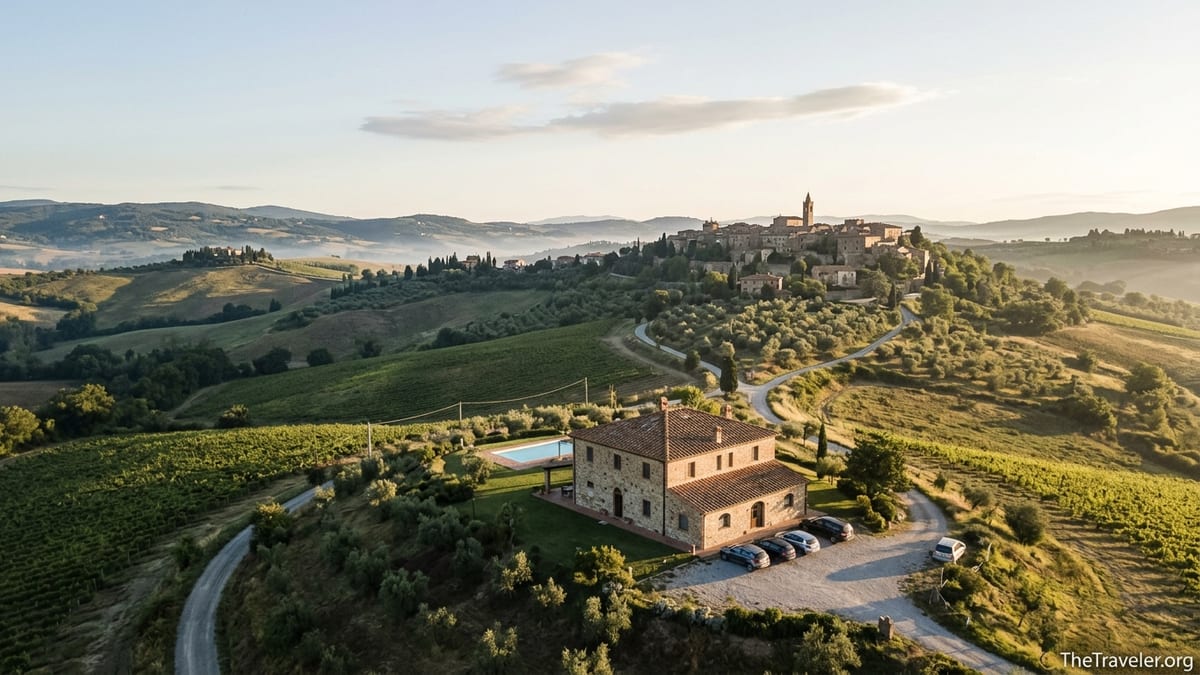
The Tuscan countryside sits at the heart of many Central Italy dreams, with cypress-lined driveways, vineyards and stone farmhouses converted into agriturismi. An agriturismo is typically a working farm that offers rooms or apartments, often with a pool, home-cooked dinners and tastings of their own wine or olive oil. In regions like Chianti, Val d’Orcia and the Maremma, you can expect peaceful landscapes and starry nights, but you almost always need a car. Public transport in these areas is sparse, with irregular buses and long walks from rural stops, so a rental car collected in Florence or Rome is a practical necessity for most travelers.
Chianti, the hilly area roughly between Florence and Siena, is particularly popular because it combines classic vineyard scenery with reasonable driving distances to both cities. An agriturismo just off the Chiantigiana road, for example near Castellina in Chianti or Radda, might offer double rooms from around 180 to 260 euros in May and September, rising in peak summer. In return you get terraces overlooking vineyards, a pool, and evenings where you walk from your room to a candlelit dinner of local pasta and estate wine. During the day, you can drive to Florence for a museum visit, or to Siena for a stroll on the Campo, each usually under an hour away.
Further south, the Val d’Orcia offers some of Tuscany’s most photographed landscapes, with wheat fields, lone cypress trees and towns such as Pienza, Montepulciano and Montalcino perched on ridges. Here agriturismi range from simple apartments on family farms to high-end wine estates that feel like small resorts, where rates can start near 220 euros and climb well above 400 euros per night for suites. This area suits travelers who prefer long scenic drives and lazy afternoons by the pool over frequent city visits. A week-long road trip might involve three nights near Pienza to explore the valley’s hot springs and small villages, then three nights further north near San Gimignano for day trips to Volterra and the Elsa River valley.
For travelers on tighter budgets, less famous corners of Tuscany such as the Maremma near Grosseto or the hills around Arezzo can offer better value. You might find a self-catering cottage on a farm 30 minutes from the sea for around 140 to 180 euros per night in shoulder season, allowing a mix of beach days and countryside drives. Wherever you choose, booking agriturismi early is key for high season, and checking details like how far the nearest town is, whether dinners are served on site, and if the access road is a gravel track or paved lane helps avoid surprises when you arrive after dark.
Umbria and Marche: Quieter Alternatives With Character
East of Tuscany, Umbria offers a greener, slightly less touristed countryside, while the Marche region stretches along the Adriatic coast with a blend of beaches and hill towns. For visitors who like the idea of Tuscany but want lower prices and fewer crowds in peak months, these regions can be ideal. Towns such as Assisi, Spello, Spoleto and Orvieto in Umbria are connected by regional trains and buses, though a car still makes exploring easier. A couple might stay in a stone townhouse in Spello for 140 to 190 euros per night in May, waking up to views of olive slopes instead of city streets.
Families often appreciate Umbria’s compact scale. Basing in a countryside agriturismo near Todi or Bevagna, you can drive to a different town each morning in 30 to 45 minutes, then return to your pool in the afternoon. These properties frequently offer cooking classes, farm visits and tastings suitable for all ages. Prices are often a bit lower than in comparable Tuscan estates. For example, an apartment sleeping four in a working farm near Montefalco might start near 180 to 220 euros per night in summer, with breakfast and access to walking trails included.
The Marche region suits travelers who want both sea and countryside without the full crowds of the better-known Italian Riviera. Towns such as Senigallia, Sirolo and Numana on the Conero coast offer sandy or pebbly beaches backed by hills, with inland drives to hill towns like Offagna or Urbino. You might stay in a small family-run hotel a block or two from the beach for 130 to 170 euros a night in June, then rent a car for a couple of days to explore the countryside. For couples, a renovated farmhouse in the hills above the coast can provide a peaceful base with sea views in the distance, at prices still below many Tuscan equivalents.
Logistics in Umbria and Marche are manageable but a bit less straightforward than in Tuscany’s core tourist corridors. Train frequencies are lower and some stations lie outside historic centers, requiring short bus rides or taxis. Travelers who like a light schedule and are comfortable with some driving enjoy these regions most. In return, you get quieter piazzas at sunset, restaurants where locals still dominate the tables, and wineries where tastings feel more like conversations than production lines.
Matching Bases to Different Types of Travelers
Central Italy’s strength is that almost every type of traveler can find a base that fits. For first-time visitors with about one week and no car, a common pattern is four nights in Rome and three nights in Florence. This allows enough time to see the major sights in each city and take one or two day trips by train, for example to Orvieto from Rome and to Pisa or Lucca from Florence. Staying near Termini in Rome and Santa Maria Novella in Florence keeps luggage rolling time short, which is helpful for those traveling with heavier bags or children.
Couples on a romantic trip often gravitate to a city-and-countryside mix. One popular option is to spend three nights in Florence’s Oltrarno district, then rent a car and move to an agriturismo in Chianti or Val d’Orcia for four or five nights. In Florence, they might choose a small boutique hotel in a Renaissance building for around 240 euros per night, then switch to a vineyard estate where dinners on the terrace and wine tastings are part of the stay. This pattern balances gallery visits and evening passeggiate with slow mornings on a terrace and sunset drives through vineyards.
Families benefit from space and flexibility. For those with school-age children, a practical strategy is to stay three nights in Rome near a park such as Villa Borghese for playground breaks, then a week in the countryside, perhaps in a two-bedroom apartment on a farm near Siena or Lake Trasimeno. With a kitchen and laundry, families can cut restaurant costs and pack lighter. Parents often report that children remember the pool, farm animals and making pizza during a cooking class as much as the Colosseum.
Luxury travelers and honeymooners will find high-end options in all of these areas, from five-star hotels overlooking Rome’s Spanish Steps to spa resorts in the Val d’Orcia or along the Conero coast. At this level, rates can easily exceed 600 euros per night in summer, but the experience typically includes private terraces, expansive spa facilities and concierge teams that can arrange private vineyard tours or after-hours museum visits. For these travelers, choosing a base may come down more to personal taste in scenery and design than to practicalities like parking or train connections.
The Takeaway
There is no single best base in Central Italy, only the best base for your particular trip. Rome and Florence excel for first-time itineraries built around trains and big-ticket sights. Siena and similar smaller towns lean into slower rhythms and easier access by car to the countryside. The Tuscan hills deliver the postcard landscapes many visitors dream of, especially when experienced from a well-chosen agriturismo, while Umbria and Marche offer a quieter, often better-value version of the same themes with their own distinct character.
Start by deciding whether you will drive or rely on public transport, then be honest about how you prefer to spend days on the road. Some travelers are happiest changing hotels every two nights to see as much as possible; others prefer to unpack once and explore in a lazy circle, returning to the same terrace each evening. In a region as compact and well connected as Central Italy, either approach can work. The important part is choosing a base that matches your pace, so that your memories center on sunlit piazzas and vineyard views rather than timetables and traffic.
FAQ
Q1. Is it better to stay in Rome or Florence for a first trip to Central Italy?
For a first trip focused on famous sights and easy trains, many travelers split time between both. If you must choose one, Rome offers more major attractions in a single city, while Florence provides a compact center and easier day trips to Tuscany.
Q2. Do I need a car to enjoy the Tuscan countryside and agriturismi?
You almost always need a car for a true countryside stay. Buses exist but are infrequent and rarely reach farmhouses directly, so a rental collected in Florence, Pisa or Rome gives you the freedom to reach vineyards, small villages and scenic viewpoints.
Q3. How many nights should I spend in an agriturismo?
Three nights is the minimum that feels worthwhile, giving you two full days to combine local outings with pool or terrace time. Many travelers find four to six nights ideal, using the agriturismo as a base for nearby hill towns and markets.
Q4. Is Siena a good base without a car?
Siena can work without a car for a short stay, as the historic center is walkable and buses link a few nearby destinations. However, to explore the surrounding countryside and smaller towns comfortably, a car makes Siena a far better base.
Q5. Are Umbria and Marche cheaper than Tuscany?
In general, similar standards of accommodation in Umbria and Marche cost slightly less than in the most popular parts of Tuscany, especially Chianti and Val d’Orcia. Prices still vary with season and location, but budget-conscious travelers often find better value there.
Q6. Where should families with children base themselves?
Families often enjoy splitting time between a city and countryside. For example, a few nights in Rome or Florence for museums and landmarks followed by a week in a child-friendly agriturismo with a pool near Siena, Lake Trasimeno or the Umbrian hills works well.
Q7. Is it realistic to do Tuscany as day trips from Florence or Rome?
From Florence, day trips to nearby Tuscan towns like Pisa, Lucca and Arezzo by train are straightforward. Reaching the classic rural landscapes and hill towns is possible on long day tours but feels rushed; staying at least a few nights in the countryside gives a far better experience.
Q8. What is a reasonable nightly budget for midrange accommodation?
In peak season, a centrally located midrange hotel room in Rome or Florence often runs 180 to 260 euros per night, while comparable countryside agriturismi might start around 150 to 220 euros. Shoulder seasons like April, May, September and October can be noticeably cheaper.
Q9. Is it safe to drive in Central Italy for visitors unused to European roads?
Most visitors adjust quickly. Highways are modern and well signed, though city centers are often restricted to local traffic and should be avoided. The main learning curve is on narrow rural roads and parking in historic towns, so renting a smaller car and planning daytime arrivals helps.
Q10. How far in advance should I book accommodation in Central Italy?
For travel in May, June, September and early October, booking key bases three to six months ahead is sensible, especially for popular agriturismi and small boutique hotels. For July and August, or if you have very specific properties in mind, starting even earlier increases your options.