


Few journeys feel as effortlessly cinematic as a road trip across central Italy. From the cypress-lined hills of Tuscany to the wild peaks of Abruzzo, driving your own car lets you slip away from the train lines and into country lanes, hill towns and family-run farmhouses. This guide focuses on the practical details that matter on the road: rental cars, tolls, ZTL zones, parking, scenic drives and realistic itineraries that loop through Tuscany, Umbria, Lazio, Marche and Abruzzo.
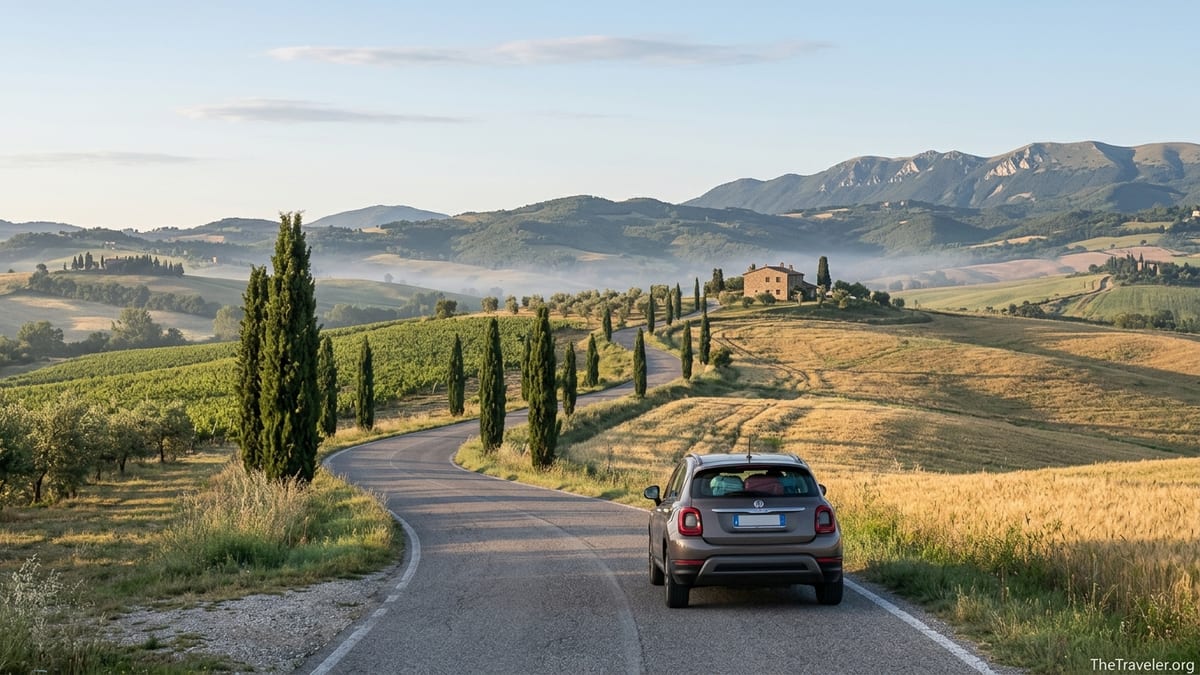
Planning Your Central Italy Road Trip
For most travelers, the easiest starting points are Rome Fiumicino, Pisa and Florence airports, all with large car rental hubs and quick access to major highways. A classic loop might start in Rome, head north through Lazio and Umbria into Tuscany, cut east across the Apennines into Marche and Abruzzo, then drop back to Rome. With detours, that loop can cover roughly 1,000 to 1,500 kilometers over 10 to 14 days, which keeps daily driving to a manageable two or three hours.
Central Italy’s appeal lies in the gaps between the big-name cities. Trains connect Rome, Florence and Bologna efficiently, but they cannot take you along the gravel "strade bianche" of the Val d’Orcia, up to little hill towns like Montefalco or into the high meadows below Gran Sasso in Abruzzo. A car lets you break up long drives with vineyard tastings outside Montalcino, a detour to soaking pools near Bagno Vignoni, or a lunch stop in a tiny place like Trevi that would be awkward to visit by bus.
When planning, balance ambition with realism. A day that looks simple on the map, such as Siena to Assisi, can easily stretch with photo stops, coffee in little piazzas and slower country roads. As a rule of thumb, try to keep point-to-point driving to under 250 kilometers per day on this kind of route, accepting that in rural Tuscany, Umbria and Abruzzo you will move slower than on the autostrada but see far more.
Season matters too. In July and August, traffic around Tuscan hotspots like San Gimignano and Pienza is heavier and parking fills quickly, while in late October the days are shorter and mountain roads in the Apennines can see early snow. For relaxed driving and easier parking, many road trippers favor late April to June and September to mid-October.
Rental Cars: What to Book and What It Costs
For a Central Italy road trip, a compact or intermediate hatchback is usually the sweet spot. Models similar to a Fiat 500X, Volkswagen Golf or Renault Captur give you enough power for mountain roads but stay small enough for medieval streets and tight parking bays. Unless you are traveling in a group of four adults with lots of luggage, avoid large SUVs and vans, which can be stressful on narrow village lanes and in parking garages with tight ramps.
Automatic transmission cars remain more expensive and in shorter supply than manual vehicles. It is common to see a manual compact in shoulder season at a major airport for roughly 30 to 45 euros per day, rising to around 60 to 80 euros per day or more in July and August for an automatic of similar size, depending on demand and how far in advance you book. Local agencies in smaller cities sometimes list lower base rates but may require higher deposits or sell add-ons aggressively at the counter.
When comparing offers, pay close attention to insurance, excess and deposit. Many Italian rentals include basic collision coverage with a relatively high excess, often in the range of 800 to 1,500 euros blocked on your card. You can reduce this excess by paying for the agency’s extra coverage at 15 to 30 euros per day, or you can rely on a credit card’s rental coverage if your bank provides it and you are comfortable with the paperwork in case of a claim. For a stress-free first trip, many travelers choose full coverage directly from the rental company, especially if they plan to park on the street in cities like Perugia or L’Aquila where minor scrapes are more likely.
Fuel type also matters. Petrol cars are more common in small categories, diesels tend to be more fuel-efficient on long highway stretches and may appear in larger vehicles. On a Rome to Abruzzo and back loop of about 700 to 900 kilometers, you might spend roughly 90 to 140 euros on fuel in a compact petrol car at typical 2026 prices, depending on your driving style and route. Most major service areas on the autostrade are open 24 hours and take international credit cards and widely used payment cards, while small village pumps sometimes close at lunchtime or evening but provide card-operated self-service pumps.
Tolls, Autostrade and Driving Rules in Central Italy
Italy’s main highways, the autostrade, are toll roads operated by several concession companies. On most routes you take a ticket when entering and pay when exiting based on distance, vehicle type and whether the section is classified as lowland or mountain. For a typical car on sections managed by major operators, the per-kilometer rate published for 2026 is around a few euro cents per kilometer, and recent service charters note toll tariffs increased by under 2 percent between 2024 and 2025. In practice, a Rome to Florence drive via the A1 can cost somewhere in the region of 20 to 30 euros in tolls one way, while shorter hops such as Florence to Arezzo or Orte to Orvieto cost noticeably less.
Payment is straightforward: look for lanes marked with a ticket and "Carte" or cash symbols when you exit. You can pay with cash or standard debit and credit cards in manned or automated lanes. Avoid the lanes signed "Telepass" only, which are for vehicles with an electronic pass. If you accidentally enter a Telepass lane, do not reverse; press the help button, explain that you are a tourist without a device and follow the operator’s instructions.
Speed limits are usually 130 km/h on autostrade in good conditions, 110 km/h on main divided roads, and 90 or 70 km/h on rural roads, dropping to 50 km/h in built-up areas unless signed otherwise. Fixed speed cameras are common, marked by orange or grey boxes and advance warning signs, and there are lots of average-speed (Tutor) sections on the A1 between Rome, Umbria and Florence. Fines can be issued long after your trip via the rental company, which will charge an administrative fee on top, so it pays to set cruise control at or just below the limit where available.
On smaller roads, expect local quirks. In the hills of Tuscany and Umbria, you may encounter tractors, cyclists and groups of motorbikes, especially on scenic routes like the Chiantigiana between Florence and Siena or the road between Montepulciano and Pienza. In Abruzzo’s Gran Sasso and Monti della Laga National Park, sheep flocks and guard dogs can occasionally block the way, and winter weather can close high passes. Build some slack into your itinerary and avoid planning dinner reservations too tightly around ambitious afternoon drives.
ZTL Zones, Parking and How to Avoid Fines
Almost every historic city and many smaller towns in Central Italy operate a ZTL, or restricted traffic zone, to limit vehicles in old centers. These zones are usually marked by a round sign with a red border and cameras at entry points. They often apply in Florence, Siena, Perugia, Orvieto, Viterbo, Ascoli Piceno and L’Aquila, among others. Rental cars are not automatically exempt, and if you drive under an active camera without authorization you can receive multiple fines, one for each entry.
The simplest strategy is to park outside ZTLs and walk or use local transport. Many towns provide signed "Parcheggio" lots right below the center or near escalators and elevators. In Orvieto, for example, visitors commonly leave their cars in the large lot near the funicular station at the base of the cliff and ride up into the historic core. In Perugia, multi-story car parks at the edge of the hill are connected to the center by escalators. Rates in such facilities tend to run around 1 to 2 euros per hour, capped daily, while smaller blue-lined street spaces are metered using pay-and-display machines or mobile payment apps.
If you have a hotel inside a ZTL, ask for explicit instructions and written confirmation. Many accommodations in places like Siena or Montepulciano can register your license plate with the municipality so you are allowed to enter for check-in or parking. This usually requires giving your plate number in advance and following a specified route. Never rely on typing the hotel name into a navigation app and blindly following it; apps do not always account accurately for ZTL boundaries and hours.
Street parking conventions vary by line color. White lines usually indicate free parking for everyone or residents, depending on local rules; blue lines are paid parking; yellow lines are reserved for special permits. Look for the nearby sign to confirm. In small villages across Tuscany and Umbria, it is common to find a gravel lot just outside the walls where locals leave their cars. In high season, arriving early in the morning in Pienza or San Gimignano can mean the difference between a simple park-and-stroll and circling for half an hour in the midday heat.
Scenic Roads and Hill Town Highlights
Central Italy’s true magic reveals itself when you leave the main highways. In Tuscany, the Val d’Orcia south of Siena is among the most photogenic landscapes in Europe, a UNESCO-listed cultural landscape of rolling wheat fields, solitary farmhouses and cypress tree lines. A classic drive links towns such as Montalcino, San Quirico d’Orcia, Pienza and Bagno Vignoni, threading along gently curving country roads where you will want to stop frequently at roadside lay-bys to take photos. Tourism boards and travel guides often suggest spending at least two days in this area alone to avoid rushing.
To the east, Umbria offers a quieter, greener version of similar scenery. Hill towns like Orvieto, Montefalco, Trevi and Spello rise above olive groves and vineyards, and the stretch between Assisi and Spoleto makes a particularly pleasant drive, with easy side trips into the Valle Umbra. For a mountain feel, the roads around Norcia and Castelluccio, on the edge of the Sibillini Mountains, open onto vast flowered plateaus in early summer, though access can be affected by roadworks or seismic repairs, so check local updates before heading up.
Lazio has its own under-the-radar scenic corridors. North of Rome, the Tuscia region around Viterbo, Sutri and Lake Bolsena mixes volcanic lakes with Etruscan sites and chestnut forests. A common detour for drivers heading between Rome and southern Tuscany is to stop at Civita di Bagnoregio, a crumbling hilltop village reached by a pedestrian bridge, parking in the lots outside the modern town and walking in.
Further east, the Apennine spine of Marche and Abruzzo brings wilder scenery. In Marche, the road into the Sibillini Mountains near towns like Visso and Amandola gives big views of peaks and deep valleys. Abruzzo’s Gran Sasso and Monti della Laga National Park is arguably the highlight for drivers, with routes such as the road up to Castel del Monte and Campo Imperatore, where the landscape opens into a broad high plateau often compared to a small-scale steppe. Small stone villages like Santo Stefano di Sessanio sit along the way, offering atmospheric overnight stays and hearty mountain food.
Where to Stay: Countryside Bases and Agriturismi
One of the biggest advantages of a road trip is the freedom to stay outside major cities in rural properties that are hard to reach without a car. In Tuscany and Umbria, agriturismi are working farms or rural estates that offer guest rooms or apartments, often with home-cooked dinners and views of vineyards and olive groves. Examples include stone farmhouses in the hills outside Montepulciano or family-run vineyards near Torgiano where you can park under the trees, swim in a pool overlooking the valley and drive five or ten minutes into town for gelato.
In Lazio’s Tuscia region, country inns near Lake Bolsena or in the woods outside Viterbo make excellent bases for exploring both northern Lazio and southern Tuscany by car. Many properties provide free parking and simple access to the main regional roads, so you can do a day trip to Orvieto or Pitigliano without fighting city traffic. Expect nightly rates in rural areas to be lower than in city centers, especially outside high summer and major holidays.
Marche and Abruzzo add a more rugged twist to the countryside experience. In the foothills of the Sibillini Mountains, for example, small B&Bs in restored stone houses often sit at the end of narrow lanes, with parking in the yard or along the roadside. In Abruzzo, accommodations in villages like Santo Stefano di Sessanio or in the valleys below Gran Sasso might be "albergo diffuso" setups, with rooms spread across several historic buildings. These almost always require a short walk from the nearest parking area through cobbled lanes, so packing lighter bags or an overnight backpack is practical.
For a smooth trip, choose a mix of two or three-night stays instead of moving every day. A sample pattern could be three nights near Pienza for southern Tuscany, two nights near Spoleto or Montefalco for Umbria, two nights in the countryside outside Viterbo or Bolsena in Lazio, two nights near Ascoli Piceno in Marche and three nights in or below Gran Sasso in Abruzzo. This approach reduces packing and unpacking and allows you to explore in relaxed loops from each base.
Suggested 10–12 Day Route Across Tuscany, Umbria, Lazio, Marche and Abruzzo
One practical loop begins and ends in Rome, avoiding the need for open-jaw flights. After collecting your rental car at Rome Fiumicino or Ciampino, drive north on the A1 and then smaller roads to the Tuscia area of northern Lazio. Spend the first night near Lake Bolsena or Viterbo, recovering from jet lag and exploring volcanic lakes and medieval villages with less pressure than a major city stop.
From there, continue into southern Tuscany for two or three nights around the Val d’Orcia. Use a base near Pienza, San Quirico d’Orcia or Montepulciano, and spend your days exploring nearby hill towns, wineries and the famous cypress-lined roads. On one day you might loop through Montalcino for a Brunello tasting, Bagno Vignoni for a stroll around its steaming central pool, and back through the Crete Senesi, returning to your agriturismo before dark.
Next, drive east into Umbria. Aim for two or three nights near Assisi, Spello or Spoleto. This segment could include a day visiting Assisi and then a slower drive through the Valle Umbra, stopping in Montefalco or Bevagna, and another day heading toward Norcia for mountain scenery, depending on current road conditions. From Umbria, angle slightly south toward Rieti or the hill country of northern Lazio for a one-night stop, or continue directly into southern Marche near Ascoli Piceno.
Finish the loop with two or three nights in Abruzzo, ideally in or near Gran Sasso and Monti della Laga National Park. A base near Castel del Monte or in the valleys around L’Aquila lets you explore Campo Imperatore’s high plateau, stone villages like Santo Stefano di Sessanio and viewpoints toward the Corno Grande peak. When it is time to return, the drive from L’Aquila back to Rome on the A24 typically takes around two hours in good traffic, allowing you to drop the car before an evening in the capital or a flight the next day.
The Takeaway
A road trip across central Italy is less about ticking off big cities and more about embracing the in-between: dusty farm tracks, tiny churches on hilltops, roadside espresso stops and long, hazy views from mountain passes. With some planning around rental cars, tolls, ZTL zones and parking, driving through Tuscany, Umbria, Lazio, Marche and Abruzzo becomes far less intimidating and far more rewarding.
Choose a modestly sized car, book early for summer, and favor countryside bases with easy parking over hotel rooms inside tight old towns. Learn to recognize ZTL signs, leave the autostrade behind whenever you can, and allow enough time for detours along the most beautiful stretches, from the Val d’Orcia’s rolling wheat fields to the high meadows of Gran Sasso. Done right, this loop through the heart of Italy delivers exactly what many travelers dream of: freedom, discovery and the pleasure of the open road framed by some of Europe’s most enduring landscapes.
FAQ
Q1. Do I really need a car to explore Tuscany, Umbria, Lazio, Marche and Abruzzo?
While you can visit major cities by train, a car is the only practical way to reach many hill towns, agriturismi and mountain areas, so it greatly expands what you can see.
Q2. What is the best size and type of car for a Central Italy road trip?
A compact or intermediate hatchback with enough luggage space, such as a Fiat 500X or similar, is usually ideal for narrow streets, tight parking and mountain roads.
Q3. How much should I budget for tolls on a 10–12 day road trip?
On a typical loop using the A1 and other autostrade for longer jumps, many travelers spend roughly 80 to 150 euros on tolls, depending on distance and route.
Q4. How can I avoid fines from ZTL zones in historic centers?
Always park outside historic centers, follow "Parcheggio" signs, and ask your hotel for detailed directions; enter ZTLs only if your license plate has been registered.
Q5. Is it difficult to find parking in popular hill towns?
In places like Pienza, San Gimignano or Assisi, parking fills up in late morning; arriving early or later in the day and using signed public lots makes things much easier.
Q6. When is the best time of year to drive through Central Italy?
Late April to June and September to mid-October usually offer pleasant weather, lighter traffic than peak summer and quieter experiences in hill towns and national parks.
Q7. Are mountain roads in Marche and Abruzzo safe for inexperienced drivers?
Most are paved and well signposted, but they can be narrow and winding; driving slowly, avoiding night-time mountain driving and checking weather conditions is important.
Q8. Do I need an International Driving Permit for Italy?
Many visitors from outside the European Union are required to carry an International Driving Permit along with their home license; check your country’s rules before travel.
Q9. Can I rent an automatic car easily in Central Italy?
Automatics are widely available at major airports and city locations, but they cost more and can sell out in summer, so booking well in advance is recommended.
Q10. Is it better to start my road trip in Rome, Florence or another city?
Rome and Florence are the most common gateways, but Pisa, Bologna or even Ancona can also work; the best choice depends on your flights and preferred loop.