


For a first trip to Italy, combining Rome, Florence and the Tuscan countryside gives you ancient history, Renaissance art and vineyard-dotted hillsides in a single sweep. The challenge is deciding how to split your time, whether to rely on Italy’s high-speed trains or rent a car, and which patch of Tuscany should be your base. This guide walks through a realistic one to two week itinerary, grounded in how people are traveling in 2026, so you can spend less time puzzling over maps and more time with a glass of Chianti in hand.
How Many Nights: A Realistic First-Trip Split
For a classic first visit focused on central Italy, a practical split is three to four nights in Rome, two to three nights in Florence, and three to four nights in the Tuscan countryside. In eight days, that might look like three nights in Rome, two in Florence and three in a rural base near Siena or in Chianti. With ten to twelve days, four nights in Rome, three in Florence and three to five in the countryside allows more time to slow down between major sights.
Travel planners and tour operators designing 2026 itineraries commonly use a similar balance. Many sample trips suggest three nights in Rome for the Colosseum, Roman Forum, Vatican Museums and a neighborhood like Trastevere, then a first-class high-speed train to Florence for two or three nights of Duomo, Uffizi and Ponte Vecchio, followed by several days based in vineyards or a hill town. That pattern is realistic for most travelers arriving from North America or the UK who are coping with jet lag and limited vacation time.
If your total trip is only one week, resist the urge to add Venice or the Amalfi Coast. Rome, Florence and a taste of Tuscany already mean at least three hotel changes and several intercity transfers. On a seven-night trip, something like three nights Rome, two nights Florence and two nights countryside keeps you moving but not rushed. If you prefer a slower pace and café lingering, shift one night from the countryside to Rome so you have four Rome, two Florence and one deep-dive day trip into Chianti.
With ten nights or more, you gain flexibility to add a second Tuscan base. For example, you might spend three nights in Chianti for wine-tasting and gentle walks, then two nights farther south in the Val d’Orcia near Pienza or Montepulciano for more dramatic scenery and different wines. That sort of two-base countryside stay works particularly well if you enjoy driving and do not mind packing the car once midway through the Tuscan segment.
Route Overview: Rome to Florence to the Tuscan Hills
Most first-time itineraries use Rome as the entry and exit point, then follow a straightforward northbound arc: Rome to Florence by train, Florence to the Tuscan countryside by rental car, then either back to Florence or directly to Rome for departure. This route minimizes backtracking while using the strengths of Italy’s transport network: trains between big cities, cars in rural areas.
Rome and Florence are connected by frequent high-speed Frecciarossa and Italo trains that usually take around 1 hour 30 to 1 hour 40 minutes city center to city center. On busy travel days, there can be dozens of departures, often as close as every 15 to 30 minutes at peak times. In practical terms, this means you can check out of your hotel near Rome’s Termini Station late morning, catch a midday train, and be walking into your Florence hotel by early afternoon without needing an airport transfer or security lines.
From Florence, your route into the countryside will depend on which part of Tuscany you choose. If you base in Chianti, many visitors pick up a rental car near Florence’s airport or at an office on the edge of the city and drive 45 to 75 minutes into the hills around towns like Greve in Chianti, Radda in Chianti or Castellina in Chianti. If you are heading farther south to Siena or the Val d’Orcia, travel time is typically 90 minutes to two hours from Florence by car, depending on exact location and stops.
On the return, you have two main options. You can drop the car at Florence’s airport and take a high-speed train back to Rome for your final night, or you can drive to a larger town with a rental office, return the car there and travel onward by train. Many 2026 itineraries now recommend avoiding driving into central Rome altogether because of restricted traffic zones and hectic city traffic, so ending the car portion in Florence or Siena and finishing the journey by rail is often the least stressful choice.
Trains Versus Rental Cars: What Works Where
Between Rome and Florence, the train is almost always the smart option. High-speed services cover the route in just over 90 minutes, and even standard economy fares bought in advance can often be found in the 20 to 40 euro range per person. You travel from central station to central station, avoid highway tolls and fuel costs, and skip parking challenges. For a couple, the total cost of two train tickets is usually lower than the combination of car rental, motorway tolls and city parking, especially once you add optional collision coverage or a second driver fee on a rental car.
In the Tuscan countryside, the equation flips. Trains and buses do exist, but they tend to radiate between larger towns rather than weaving through vineyards or climbing to isolated hilltop villages. To sample wineries around Montepulciano or Montalcino, or to detour to small hamlets and farm shops, a car gives you flexibility and saves time. In practice, many travelers who initially swear they will manage Tuscany only by bus and organized tours end up adding at least two or three rental days once they see how dispersed the villages and estates are.
Driving in Tuscany is typically more relaxed than driving in Rome or Naples, but there are important rules that can catch visitors. Historic centers in cities like Florence, Siena and Pisa are ringed by “Zona a Traffico Limitato” zones. Entering these restricted areas without a permit can trigger automatic camera fines that often arrive months after the trip and can be in the range of 80 to 150 euros per entry, plus an administrative fee from the rental company. Rental cars do not automatically have permission to enter these zones, so plan to park in clearly marked public lots outside the historic centers and walk in.
Given these trade-offs, a common pattern is to combine both modes. One example: arrive in Rome and take the train straight to Florence, using trains and your feet for two or three days. Then pick up a rental car at Florence’s airport, spend three or four nights in the countryside exploring wineries and back roads, and finally drop the car back in Florence before taking the train to Rome for your final three or four nights. This way you avoid city driving while still having freedom on the country lanes.
Choosing Your Tuscan Base: Chianti, Siena or Val d’Orcia
The heart of the decision about your countryside time is where to stay. For many first trips, the choice narrows to three areas: the Chianti Classico hills between Florence and Siena, the medieval city of Siena itself, or the softer, cinematic landscapes of the Val d’Orcia and southern Tuscany around Pienza, Montepulciano and Montalcino. Each gives a slightly different version of the Tuscan fantasy that appears on wine labels and calendars.
Chianti is the easiest countryside base to reach from Florence and one of the most practical for wine-focused stays. Towns like Greve in Chianti and Radda in Chianti are large enough to have several restaurants, enotecas and small supermarkets, but still compact and walkable. Many agriturismi and small hotels sit on ridge lines a short drive from these towns, surrounded by vineyards. From a base here, you can spend one day looping through the Chianti Classico villages, another day driving down to Siena, and a third mixing a long lunch at a winery with an evening stroll in your home village.
Siena is technically a city, but for travelers without a car it often functions as a countryside base. Regular buses connect Siena with Florence and some nearby villages, and within its medieval walls you can explore the shell-shaped Piazza del Campo, climb the Torre del Mangia or visit the striped Duomo without thinking about parking. If you lodge slightly outside the historic center, many properties include parking, which allows you to combine a car for daytime countryside drives with evenings spent on foot in town.
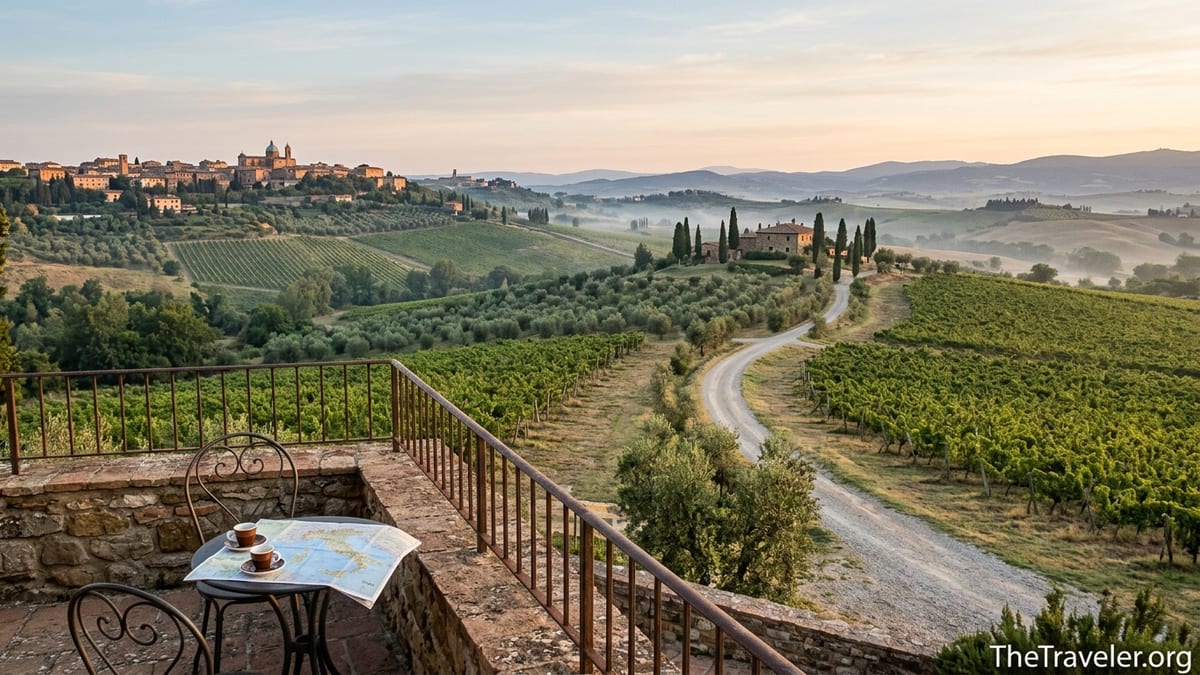
Farther south, the Val d’Orcia offers the most widely photographed version of Tuscany: cypress-lined lanes snaking toward stone farmhouses, lone chapels in wheat fields, and light that softens at the edges in late afternoon. Hill towns such as Pienza, Montepulciano and Montalcino are small enough that you might stroll from one side to the other in ten minutes, yet each has notable wines and local food specialties. Reaching this area requires more driving time, but many repeat visitors who have already seen Chianti and Siena choose to spend their full countryside segment here because of the combination of scenery and wine.
Where to Stay: Agriturismi, Wine Hotels and City Pads
In Rome and Florence, most first-timers choose centrally located hotels or apartments within walking distance of major sights. In 2026, mid-range double rooms in central Rome around neighborhoods like Monti, Trastevere or near Piazza Navona often fall in the range of 150 to 250 euros per night outside of peak holidays, with higher prices during spring and early autumn. Florence’s historic center is more compact, and similar mid-range hotels near the Duomo or Santa Croce can be slightly pricier at the height of the season, especially when major exhibitions or festivals are in town.
In the countryside, the signature stay is an agriturismo: a working farm or rural estate that offers guest rooms or apartments. A family-run agriturismo in Chianti with a pool and breakfast might price double rooms somewhere around 120 to 200 euros per night in shoulder season, rising in late June through early September. Many require a two or three night minimum stay and may offer optional dinners a few nights per week, served at communal tables with house wine and seasonal dishes like ribollita soup or pappardelle with wild boar ragu.
For travelers willing to spend more, dedicated wine hotels and small luxury resorts are scattered across Chianti and the Val d’Orcia. These properties often sit on large estates that produce their own labels of Chianti Classico, Brunello di Montalcino or Vino Nobile di Montepulciano, and may include a spa, cooking classes or private cellar tastings. A room in such a property can easily start around 300 euros per night and climb from there, especially for suites with valley views or private terraces.
Apartment rentals also remain popular for longer countryside stays, particularly for families or small groups. A two-bedroom farmhouse near Montepulciano with a kitchen, pool access and vineyard views might cost roughly 1,200 to 2,000 euros for a week in late spring, depending on amenities and proximity to a major town. For groups of six or more, entire villas with private pools are common, and weekly rates in high season can range from the low thousands into five figures for large, fully serviced properties.
Wine, Food and Day Trips from Your Tuscan Base
Once you are settled in the countryside, the question becomes how to structure your days so that winery visits, hill towns and long lunches blend without feeling rushed. Most estates, whether they produce Chianti Classico, Brunello di Montalcino or Vino Nobile di Montepulciano, now require or strongly prefer reservations for tastings, especially in peak months from May to October. A typical tasting with a short cellar tour might last 60 to 90 minutes and cost somewhere in the 15 to 30 euro range per person, sometimes waived with bottle purchases.
From Chianti, a classic day trip is a loop that connects Greve in Chianti, Castellina in Chianti and Radda in Chianti, with one or two estate visits in between. You might start with coffee in a village piazza, drive to a mid-morning tasting at a nearby winery, take a leisurely lunch featuring bistecca alla fiorentina or pecorino cheese, then end the afternoon with a walk along lanes lined with stone farmhouses and cypress trees. In harvest season, expect tractors on the roads and clusters of workers in the vines; in July and August, the hills feel quieter but warmer, making pools and shaded terraces especially welcome.
From a base around Siena or in the Val d’Orcia, favorite day trips include the triangular combination of Pienza, Montepulciano and Montalcino, each with its own character. In Pienza, visitors taste local pecorino cheeses and stroll streets with names that translate to “Street of Love” and “Street of Fortune.” Montepulciano offers underground cellars carved into the rock beneath Renaissance palazzi, where you might taste Vino Nobile surrounded by aging barrels. Montalcino focuses on Brunello, a powerful Sangiovese-based wine that rewards long aging and comes with price tags that reflect its international reputation; tasting here is as much about the fortress views and countryside drives as the pours themselves.
Even if you are not a dedicated wine enthusiast, these regions offer plenty of variety for non-drinkers and families. Hot spring towns like Bagno Vignoni, hiking trails through rolling hills, and simple picnics under olive trees all fit easily into a countryside day. If you prefer to avoid driving after tastings, consider booking a local driver for one day or joining a small-group tour from Florence or Siena that handles logistics and reservations while you concentrate on the food and scenery.
Practical Planning Tips for 2026 Travel
Central Italy remains one of Europe’s busiest regions for tourism, especially from April through June and September through early November. Booking accommodation and key museum entries several months ahead is increasingly important. For example, timed tickets for the Vatican Museums, the Colosseum archaeological area and Florence’s Uffizi Gallery can sell out on certain days weeks in advance. Buying these directly from official channels before you fly often means shorter queues and more predictable daily schedules.
Car rental availability in Florence and at regional airports can also tighten in peak periods. If your itinerary relies on having a vehicle for certain days, reserve early and read the rental terms for coverage, mileage and one-way drop fees. Picking up a car in Florence and returning it at the same location is usually cheaper than dropping it in a small town, and some companies charge noticeably more for automatic transmissions than manuals. If you are not comfortable with a manual gearbox, ensure your booking clearly specifies an automatic, and be prepared for a higher daily rate.
Budgeting for daily expenses, Italy sits in a middle band for European pricing. A sit-down lunch with a pasta course, glass of house wine and coffee in a non-touristy Tuscan town might run 15 to 25 euros per person, while dinner at a mid-range trattoria in Rome or Florence can range from 25 to 40 euros per person for antipasto, main and shared dessert, excluding premium wines. Espresso at the bar typically costs only a couple of euros, whereas cocktails on a rooftop terrace in Rome can easily cost three or four times that.
Finally, expect some seasonal nuances. In July and August, heat in Rome and Florence can be intense in the middle of the day, often encouraging early morning sightseeing and long afternoons in the shade or by a pool. In shoulder seasons like late March or early November, you may need a light jacket in the evenings and should bring layers for cooler countryside nights. Vineyards are typically most visually dramatic from late May through October, from lush green early in the season to golden and rust tones just after harvest.
The Takeaway
Combining Rome, Florence and the Tuscan countryside on a first trip offers a satisfying cross-section of Italy: ancient forums, masterworks of Renaissance art, and the quieter rhythms of wine country roads. A balanced itinerary of about ten days, with three or four nights in each of the two cities and three or four in a rural base, gives enough time to see headline sights without rushing through every meal.
By using trains between major hubs and a rental car only for the countryside portion, you can take advantage of Italy’s high-speed rail while still reaching the smaller hill towns and wineries that define so many Tuscan daydreams. Choosing a base in Chianti, Siena or the Val d’Orcia then shapes the flavor of your rural stay, whether that means tasting Brunello in a stone cellar, watching sunset over a valley of vines, or simply listening to cicadas outside your agriturismo window.
With thoughtful planning and realistic expectations about how many places you can comfortably fit, this central Italy route becomes less a checklist and more a well-paced journey. You will leave having seen the icons, yes, but also with sensory memories that stick: the echo of footsteps in a Roman alley at night, the smell of rosemary on a Tuscan hillside, and the feel of warm stone under your hand as you lean on a medieval wall and look out over vineyards.
FAQ
Q1. How many days do I need to combine Rome, Florence and Tuscany on a first trip?
Most travelers find that eight to ten days is a comfortable minimum to combine the three. That allows roughly three nights in Rome, two in Florence and three in the countryside on an eight-day trip, or four nights in Rome, three in Florence and three in Tuscany on a ten-day itinerary.
Q2. Should I start in Rome or Florence when I land in Italy?
Both orders work, but many visitors now take a direct train from Rome’s main airport or Termini Station to Florence first, so they can adjust to the time zone in a smaller, walkable city before tackling Rome’s scale. Others prefer to start in Rome to see the major sights right away and then slow down as they move north.
Q3. Is it better to rent a car for the whole trip or only for Tuscany?
For most first-timers, it is better to use trains between Rome and Florence and rent a car only for the countryside portion. Driving and parking in central Rome and Florence are stressful, and both cities have restricted traffic zones where fines are easy to incur. A shorter car rental focused on rural days gives flexibility where you need it most.
Q4. Can I visit the Tuscan countryside without renting a car?
Yes, but your options will be more limited. You can base yourself in a well-connected town like Siena and use buses and organized day tours to reach some villages and wineries. However, smaller hill towns and remote estates are far easier to visit with a car, so consider at least one or two rental days if you want the freedom to explore back roads.
Q5. Where is the best place in Tuscany to stay for wine tasting?
Chianti, particularly the area between Florence and Siena, is one of the best bases for wine tasting on a first trip. Towns like Greve in Chianti or Castellina in Chianti give easy access to multiple wineries within short drives. For more intense red wines and dramatic scenery, bases around Montepulciano or Montalcino in southern Tuscany are also excellent.
Q6. How far in advance should I book accommodation and train tickets?
For peak months like May, June, September and early October, it is sensible to book Rome and Florence hotels, key museum entries and Tuscan agriturismi several months in advance. High-speed train tickets between Rome and Florence are best purchased once your travel dates are fixed, often a few weeks to a few months ahead, especially if you want discounted fares or specific departure times.
Q7. Are winery tastings in Tuscany expensive?
Prices vary by estate and the level of experience, but a standard tasting with a brief tour commonly falls in the 15 to 30 euro range per person. More elaborate tastings paired with food or vertical samplings of older vintages cost more. Some wineries will waive or reduce the tasting fee if you purchase bottles to take home.
Q8. Is driving in Tuscany difficult for someone used to North American roads?
Most visitors who are comfortable driving at home manage fine in Tuscany. Roads are often narrower and more winding than North American highways, and village streets can be tight, but traffic is generally lighter in rural areas. The main challenge is avoiding restricted traffic zones in historic centers and being patient on small roads where farm vehicles or cyclists may slow the pace.
Q9. Which season is best for a Rome, Florence and Tuscany itinerary?
Late April through June and September through early October are usually the most pleasant times, with warm but not extreme temperatures and lively vineyards. July and August can be very hot in the cities, while late autumn and winter are quieter and cooler, with shorter daylight hours but fewer crowds and often lower prices.
Q10. Can I add Venice or the Amalfi Coast to this itinerary?
You can, but it is easy to overload a first trip. If you have fewer than ten days, focus on Rome, Florence and Tuscany for depth rather than breadth. With twelve to fourteen days or more, you could add three nights in Venice at the beginning or end of the trip, or two or three nights on the Amalfi Coast or in Naples, accepting that this will mean more train journeys and hotel changes.