


Central Italy is one of the easiest regions in Europe to explore by train. High speed lines knit together Rome and Florence in under two hours, while slower regional routes fan out to hill towns and wine country. Yet trains do not reach every picturesque village, and some of the best farm stays, vineyards and medieval hamlets sit far from the tracks. Planning a smart mix of rail and rental car can save you hours of frustration and hundreds of euros. This guide explains how to use trains as your backbone, when it is worth picking up a car, and how to link Rome, Florence, Arezzo, Orvieto, Perugia and other useful bases into one seamless itinerary.
Understanding Central Italy’s Rail Network
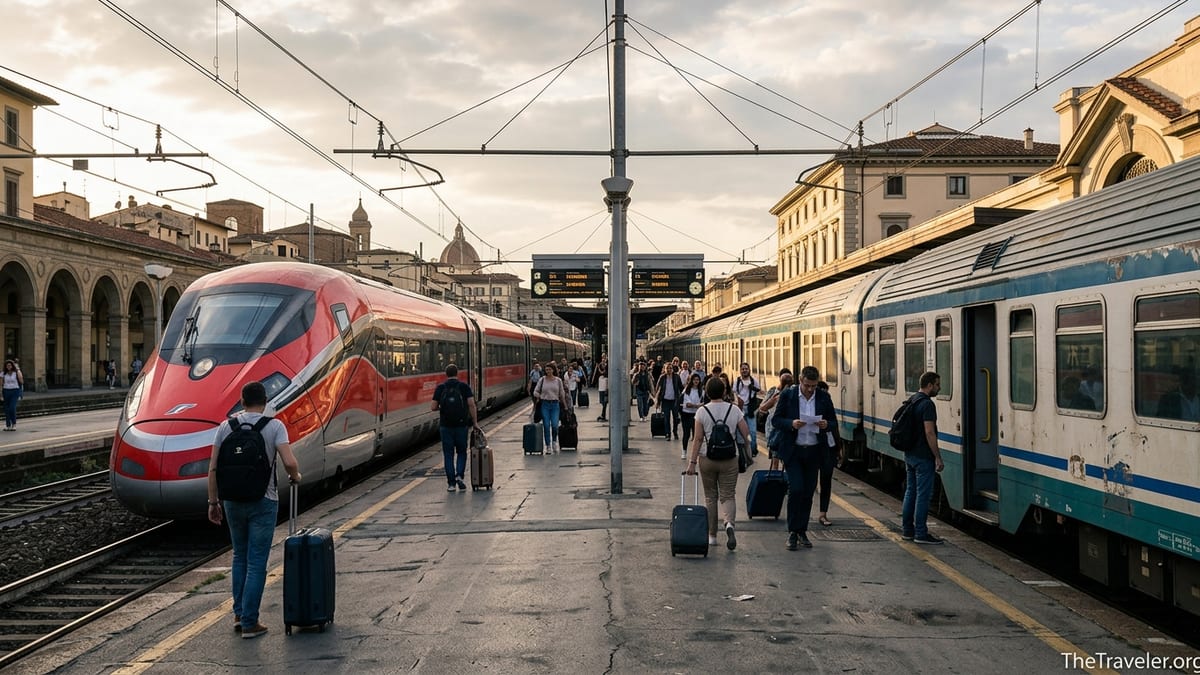
Central Italy is essentially built around one main north south spine: the high speed line between Rome and Florence, used by Trenitalia’s Frecciarossa and Frecciargento services and by private competitor Italo. These trains run at up to around 250 to 300 km/h on much of the route and typically cover the 260 kilometers between Roma Termini and Firenze Santa Maria Novella in about 1 hour 30 to 1 hour 40 minutes. On a busy weekday morning you might see a fast train roughly every 20 to 30 minutes, which makes it easy to keep plans flexible if you buy tickets in advance but choose a later departure time.
Parallel to the high speed corridor is the older "Linea Lenta" between Rome and Florence, used mainly by slower InterCity and regional services. These trains take roughly 3 hours between the cities and stop at intermediate stations such as Arezzo, Chiusi Chianciano Terme and Orvieto. For example, a typical Rome to Arezzo train can take as little as just over 1 hour on the fastest InterCity service or closer to 3 hours on a regional train with more stops. The trade off is price versus speed: a same day regional ticket from Rome to Arezzo can often start around the equivalent of 15 to 20 euros, while a last minute high speed ticket between Rome and Florence can easily exceed 50 or 60 euros in standard class.
Branching out from the spine, smaller lines reach into Umbria and southern Tuscany. Routes from Rome to Orvieto and to Chiusi act as gateways to wine regions around Montepulciano and Montalcino. Another important corridor links Florence with Perugia and Foligno via Terontola and Cortona, providing train access to cities such as Perugia and Assisi. However, these lines are more vulnerable to track work and slowdowns, especially in summer. In mid 2026, for example, the line between Perugia Ponte San Giovanni and Terontola faced several weeks of suspension for infrastructure upgrades, with replacement buses covering missing segments. Travelers in this region should always check schedules for their exact dates instead of assuming year round consistency.
Alongside Trenitalia, Italo runs competing high speed trains on the Rome Florence axis, usually calling at Roma Termini or Tiburtina and Firenze Santa Maria Novella. Italo does not operate regional services but can be a good value for fast hops if you book early. For a mid season afternoon departure from Rome to Florence, it is not unusual to find Italo base fares starting in the low 20s euros if purchased a month out, while the same train closer to departure can climb to 60 euros or more.
Best Base Cities: Rome, Florence, Arezzo, Orvieto and Perugia
When planning a rail focused trip, think in terms of bases rather than one night stays. Rome and Florence are obvious anchors, but medium sized cities like Arezzo, Orvieto and Perugia can dramatically cut your travel time and rental car expenses. They also profile the everyday Italy that many visitors miss when hopping only between capital sights.
Rome works best as your entry or exit point rather than a day trip base for the rest of Central Italy. Its two main stations, Termini and Tiburtina, put you on both high speed and regional lines. From Termini you can get to Florence in about an hour and a half on a Frecciarossa, to Orvieto in roughly 60 to 90 minutes on regional trains, and to Arezzo in roughly 1 to 3 hours depending on whether you choose InterCity or regional services. Rome is also the hub for airport connections. The dedicated Leonardo Express runs between Fiumicino Airport and Termini in about 32 minutes at a fixed price, while the FL1 commuter line links the airport with Tiburtina and Trastevere, handy if you stay outside the historic center.
Florence is an ideal base for Tuscany by train. Firenze Santa Maria Novella station sits a short walk from the Duomo and acts as the main gateway to regional services toward Lucca, Pisa, Siena, Arezzo and the Chianti area. Fast trains from Rome and Milan terminate here, which means you can wake up in Florence, enjoy a morning at the Uffizi, then be on an early afternoon regional train to Arezzo or a bus into Chianti vineyards without changing stations. A typical day trip example: catch a morning regional from Florence to Arezzo, spend the day exploring its medieval center and Piero della Francesca frescoes, then return on an evening train that takes about an hour.
Arezzo itself is increasingly popular as a quieter base. It sits on the main line between Rome and Florence, so you can reach either city without backtracking. It also connects to the Casentino Valley and to smaller Tuscan towns via regional trains and buses. Prices for accommodation and meals here are generally lower than in Florence, and the station is a short, mostly flat walk from the historic heart. For travelers planning to rent a car for just a few days in the countryside, Arezzo makes a useful handover point: you can arrive by train, pick up a car near the station for a loop through Cortona, Montepulciano and Val d’Orcia, then return the vehicle and continue north or south by rail.
Orvieto and Perugia are excellent jump off points for Umbria. Orvieto, perched atop a tufa cliff, has a train station at the base of the hill with a funicular up to the old town. Regional trains run here from Rome multiple times per day, usually taking about an hour to 90 minutes. Because the station is on the main Rome Florence line, you can also continue north to Chiusi or south to Rome without complication. Perugia, reached by trains from both Rome and Florence via Terontola or Foligno, sits slightly off the main spine but offers university energy, chocolate shops and access to Assisi and Lake Trasimeno. From the lower station, the minimetro or local buses take you up to the historic center.
High Speed vs Regional Trains: Which to Choose When
On most central Italian routes you will choose between high speed trains and regional or InterCity services. High speed trains such as Frecciarossa and Italo are reservation only, faster, and often significantly more expensive if booked at the last minute. Regional trains are slower, do not require reservations, and have fixed base fares that do not sell out, although you might find them crowded at commuter times or during summer weekends.
Consider a typical Rome to Florence journey. If you book a month ahead on a midweek afternoon, you might find a basic economy seat on a high speed train for around 25 to 35 euros in standard class. The same journey on a regional route, often requiring a change in cities like Arezzo or Chiusi, might cost closer to 20 euros but take nearly twice as long. Book that high speed ticket on the day of travel at the station ticket machine, and you can easily see prices jump to 50 to 70 euros per person, especially during holidays. For a couple traveling on a tight schedule with suitcases, the extra cost often buys a more comfortable, direct ride and an extra hour of sightseeing in Florence.
Regional trains shine when you need flexibility or are traveling shorter hops. A paper ticket from Rome to Orvieto bought at the station typically has a fixed price and can be used on any regional train for a certain window, often the same day or a set number of hours after validation. This means you can linger over coffee in Trastevere, head to Termini, and simply board the next regional service without worrying about a specific seat. Similarly, if you are day tripping from Florence to Arezzo, Chiusi, Cortona or even Perugia, a regional ticket allows you to choose your return time based on how much you like the town.
InterCity trains sit in between, especially along the older Florence Rome line. They are generally faster than stopping regional trains and require a reservation, but their fares are usually lower than high speed for the same distance. For instance, an InterCity from Rome to Arezzo can sometimes complete the journey in a little over an hour at a mid range price point between regional and Frecciarossa. These can be attractive if your primary goal is getting to a specific intermediate town without paying for a high speed ticket that would overshoot your destination.
Comfort considerations also matter. High speed trains offer air conditioned carriages, assigned seating, luggage racks at the end of each car and overhead storage, plus power outlets and quiet business class sections. Regional trains can vary from modern, clean double deckers with air conditioning to older single level sets with limited luggage space. On a hot July afternoon, that difference can feel significant. If you are traveling with children, elderly relatives or heavy suitcases, it is often worth paying extra for a fast, air conditioned service on main legs like Rome to Florence or Florence to Bologna, while using regional trains for cooler seasons or shorter hops.
Tickets, Platforms and Luggage in Practice
Buying tickets for central Italy’s trains is straightforward once you understand the main options. For high speed and InterCity services you can book on Trenitalia or Italo’s official sites, through apps such as Trainline, or directly at station ticket machines. For popular routes like Rome to Florence, booking even a week or two ahead typically unlocks cheaper fares. Many travelers report paying under 30 euros for a Frecciarossa ticket booked online in advance, compared with 60 to 75 euros bought on the day at the station during busy periods such as December holidays or August weekends.
Regional ticketing works differently. Prices are fixed by distance bands and do not change by date. You can purchase these tickets in advance or on the day, at machines or staffed ticket windows. If you have a traditional paper regional ticket, you must validate it before boarding using the small green or yellow machines near the platforms. Insert the ticket and wait for the audible stamp. Failing to validate can result in an on the spot fine even if you hold a valid ticket. Many modern regional tickets sold via apps or as print at home documents include a specific date and time window, making validation unnecessary, but it is always best to check the instructions shown when you buy.
At large stations like Roma Termini and Firenze Santa Maria Novella, train platforms, or binari, are displayed on overhead boards 10 to 20 minutes before departure. Your ticket lists the train category and number, such as Frecciarossa 9510 or Regionale Veloce 4097. Match this with the board rather than relying solely on the destination because some trains split or continue beyond your stop. When the platform is announced, follow signs to the correct binario, then check the carriage class markings on the train itself. In Florence, high speed trains to Rome and Naples typically use the lower numbered central platforms, while regional services to Siena or Arezzo may depart from outer tracks, so allow extra time to walk if you are changing trains.
Luggage is more manageable than many first time travelers expect, provided you pack with trains in mind. On Frecciarossa and Italo trains there are overhead racks suited to carry on suitcases, mid carriage shelves for medium bags and end of carriage racks for larger luggage. A typical traveler with a 65 liter checked sized suitcase and a carry on backpack can stow both in the end rack or split them between racks and overhead. On regional trains space can be tighter, and it is safer to keep bags where you can see them, such as overhead or in the gap between back to back seats. There is no separate luggage check in. You bring everything on board yourself and should be prepared to lift your suitcase up a couple of steps into the carriage.
Concrete examples help illustrate typical flows. Suppose you arrive at Rome Fiumicino around 9:00 and want to reach Florence that afternoon. One option is to take the Leonardo Express to Termini around 9:45, arrive near 10:20, then board an 11:10 Frecciarossa to Firenze SMN and arrive just after 12:40. Purchased a few weeks ahead, your total rail cost might be in the range of 45 to 60 euros per person for the airport train plus high speed ticket. If you do not mind a longer journey and want to save money, you could ride the FL1 commuter train from the airport to Roma Tiburtina, then a slower InterCity or regional service to Florence, bringing the combined ticket cost down but stretching travel closer to three hours on the main leg.
When a Rental Car Beats the Train
Trains in central Italy are excellent for getting between larger cities and some mid sized towns, but they do not reach many of the most atmospheric countryside destinations. Vineyards, agriturismi, hilltop hamlets and remote abbeys often sit several kilometers from the nearest station, on roads served only by infrequent buses. In these cases, a rental car can transform your experience from a series of awkward transfers to a relaxed meander.
Among the most car dependent areas are the classic Tuscan wine regions of Chianti Classico and Val d’Orcia. Towns like Panzano, Radda in Chianti, Montalcino and Pienza have limited or no direct rail access. A common strategy is to take a fast train from Rome to Florence or Arezzo, then pick up a rental car near the station for three or four days. From Arezzo, you could drive to Cortona, then on to Montepulciano, Pienza and Bagno Vignoni, staying in an agriturismo outside town that would be impractical without your own wheels. Many farm stays advertise a location "3 kilometers from the nearest bus stop" or "7 kilometers from the station" which in practice means a 40 minute walk on unlit country roads unless you have a car.
Umbria presents similar challenges. While Orvieto, Perugia, Foligno and Assisi have stations, smaller places such as Todi, Bevagna, Montefalco, Spello’s countryside, and lake hilltops above Trasimeno are poorly connected. Buses exist but may run only a few times per day and often do not line up neatly with train arrivals. For example, reaching a vineyard outside Montefalco by public transport can involve a regional train to Foligno, a bus to Montefalco, then a taxi for the final kilometers. Renting a car in Perugia or Foligno lets you explore several of these villages and wineries in a single day and return at your own pace.
Car rental also becomes attractive for multi generational or family trips with a lot of luggage or mobility concerns. Navigating multiple station changes with three suitcases, a stroller and young children can be stressful. In those situations, it can be worth taking the train for the main intercity leg and then switching to a rental car in a smaller city where driving is less intense than in Rome or Florence. For instance, you might ride the Frecciarossa from Rome to Arezzo, rent a car just outside the limited traffic zone, spend five days exploring rural Tuscany and Umbria, then drop the car in Perugia or Florence before continuing by train to your departure city.
Timing and cost also matter. Daily rental rates fluctuate but often run lower in shoulder seasons compared with peak summer. When you factor in tolls, fuel and parking, a rental car rarely saves money compared with two people traveling solely by regional trains between cities. However, if you are a family of four visiting multiple hill towns in a single day, the per person cost of a rental plus fuel may undercut four separate bus or taxi fares, especially for remote locations. The sweet spot is often to rent for a short window, two to five days, focused on countryside exploration, while relying on trains before and after.
Sample Itineraries Combining Train and Car
To make the rail planning concrete, consider a one week loop starting and ending in Rome with a mix of trains and a short car rental. On day one, arrive in Rome and stay near Termini or in the historic center. Spend two full days exploring the city using the metro and buses. On day three, take a mid morning regional train to Orvieto, arriving around lunchtime. Check into a small hotel in the old town, reached via funicular from the station, and spend the afternoon exploring the cathedral and underground caves. No car is needed here because the town is compact and walkable.
On day four, continue by regional train to Arezzo, which takes roughly two hours with a change, depending on the schedule. Stay in Arezzo’s center, then on day five pick up a rental car near the station. Drive a loop through Cortona, Montepulciano and the rolling vineyards between Pienza and San Quirico d’Orcia, staying two nights at an agriturismo with on site dinner. With the car you can visit three or four small villages in a single day, something that would be almost impossible by bus. On day seven, return the car in Arezzo or Florence and take an afternoon high speed train back to Rome for your final night near the airport or Termini.
A Florence centered plan offers another example. Fly into Florence or arrive by high speed train from Rome. Spend three nights based near Santa Maria Novella station, timing your museum reservations early in your stay. Use regional trains for two easy day trips: south to Arezzo for medieval lanes and antiques markets, and north to Lucca or Pisa. On day four, pick up a rental car and drive into Chianti, basing in a village like Greve or Castellina for three nights. Visit wineries, small hamlets and viewpoints accessible only by winding country roads. On your final day, drop the car in Florence and board a late afternoon Frecciarossa back to Rome or onward to Milan.
For those focusing on Umbria, an itinerary might start with a high speed train from Rome to Florence followed by a regional to Perugia or Assisi via Terontola. After two nights in Perugia’s hilltop center, rent a car and drive a loop through Assisi, Spello, Bevagna and Montefalco, spending two or three nights in an agriturismo among olive groves. Return the car in Foligno or Perugia, then continue by train to Orvieto for a final night before heading back to Rome. Each rail leg is relatively short, while the car days are concentrated in areas where public transport is thin.
In all cases, the key is to keep car segments short and focused. You are using the train network for what it does best frequent, reliable links between major nodes and turning to the car only for those last miles that bring you to hilltop villages and rural stays. Building in buffer time when returning a rental car before a longer train ride is wise. Aim to drop the car at least two hours before your scheduled departure to allow for traffic, paperwork and refueling.
The Takeaway
Central Italy rewards travelers who let trains handle the long distances and use cars only where they add real value. The high speed corridor between Rome and Florence, served by Trenitalia’s Frecce and Italo, delivers city center to city center in around an hour and a half, while regional and InterCity trains connect intermediate hubs like Arezzo, Orvieto and Perugia. Ticket strategies differ between reserved high speed services, where early booking can halve your fare, and flexible regional tickets, which trade speed for spontaneity.
When your plans involve hill towns, vineyards or remote abbeys, a short rental car segment can open up places that buses and trains barely touch. Using bases such as Florence, Arezzo, Orvieto and Perugia, you can design itineraries that combine the efficiency of rail with the freedom of driving country roads. Think in terms of clusters of destinations rather than point to point dashes, and balance your days between packed sightseeing and slow enjoyment.
Above all, check live schedules for your exact dates, especially along regional lines affected by summer engineering works, and keep your plans slightly flexible. With a bit of advance thought, traveling through Central Italy by train, with a carefully chosen rental car segment or two, becomes less a logistical puzzle and more a seamless part of the experience of la dolce vita.
FAQ
Q1. Do I need to book high speed train tickets in advance?
It is strongly recommended. Booking Frecciarossa or Italo tickets even one or two weeks ahead often yields fares in the 20 to 35 euro range between Rome and Florence, whereas buying the same ticket at the station on the day can easily cost 50 euros or more, especially in peak periods.
Q2. Can regional train tickets sell out?
Regional trains in Italy generally do not sell out in the same way as high speed services because they have flexible, fixed price tickets without seat reservations. However, trains can be very crowded at commuter times, on summer weekends or during holidays, so boarding early and moving down the carriage to find space is wise.
Q3. How much time should I allow to connect between trains in Rome or Florence?
At major stations like Roma Termini and Firenze Santa Maria Novella, a 20 to 30 minute connection is usually comfortable if your first train is on time. This gives you enough time to check the departure board, walk to the new platform and board without rushing, even with luggage. If you are connecting from a regional train to a long distance service, consider at least 30 to 40 minutes to allow for minor delays.
Q4. Is it better to rent a car in Rome, Florence or a smaller city?
For most visitors it is easier to rent in a smaller city such as Arezzo, Perugia or at the edge of Florence rather than in Rome’s center. Driving out of Rome involves heavy traffic, complex one way systems and strict limited traffic zones. Picking up a car near a medium sized station after your train ride usually means simpler roads, easier parking and less stress.
Q5. Are there direct trains from Fiumicino Airport to Florence?
Direct airport to Florence services are limited and may not run every day or season. Most travelers connect via Rome, either by taking the Leonardo Express to Termini and then a high speed train to Florence, or by using the FL1 commuter line to Tiburtina and changing there. Checking schedules for your specific arrival date is essential.
Q6. Do Italian trains have space for large suitcases?
High speed trains have dedicated luggage areas at the ends of carriages plus overhead racks suitable for smaller suitcases and backpacks. Regional trains usually have less structured storage, but you can place large bags in the spaces near doors or between seat backs where they are visible. There are no weight limits as on airlines, but you must be able to lift your own luggage on and off the train.
Q7. How do I avoid fines on regional trains?
The most common mistake is forgetting to validate a paper regional ticket before boarding. Always look for the small validation machines near platforms and stamp your ticket just before you get on the train. Keep your ticket handy for checks, and make sure you are traveling in the correct class and on the correct date and route printed on the ticket.
Q8. When is a rental car not worth it?
If your trip focuses on Rome, Florence and a couple of mid sized cities like Arezzo or Perugia, and you are staying mainly in historic centers, a rental car is usually more hassle than help. Parking is limited and expensive, many centers are off limits due to traffic restrictions, and trains run frequently between these hubs. In such cases, rely on rail and local public transport instead.
Q9. Can I take a day trip to Florence from Rome by train?
Yes, many travelers do. A morning Frecciarossa from Rome can have you in Florence in about 90 minutes, allowing six to eight hours for sightseeing before an evening return. Keep in mind that museum reservations, especially for the Uffizi and Accademia, are still necessary, and factor these into your train times.
Q10. Is it safe to take trains at night in Central Italy?
Trains on the main Rome Florence corridor are generally considered safe in the evening, though late night regional services may be quieter. As in any large city or busy station, keep an eye on your belongings, avoid leaving bags unattended, and sit near other passengers. If arriving very late, consider pre booking accommodation close to the station or using a licensed taxi for the final leg.