


Central Italy’s heartland, stretching from the hills of Tuscany into the green valleys of Umbria, is one of Europe’s great road trip destinations. Florence, Siena, the rolling vineyards of the Val d’Orcia, and the stone hill towns of Assisi, Perugia and Orvieto can be woven into an unforgettable week or more, whether you travel by rental car, train or a combination of both. This guide lays out realistic 5, 7 and 10-day routes with concrete timings, costs and on-the-ground tips to help you choose the itinerary that fits your travel style.
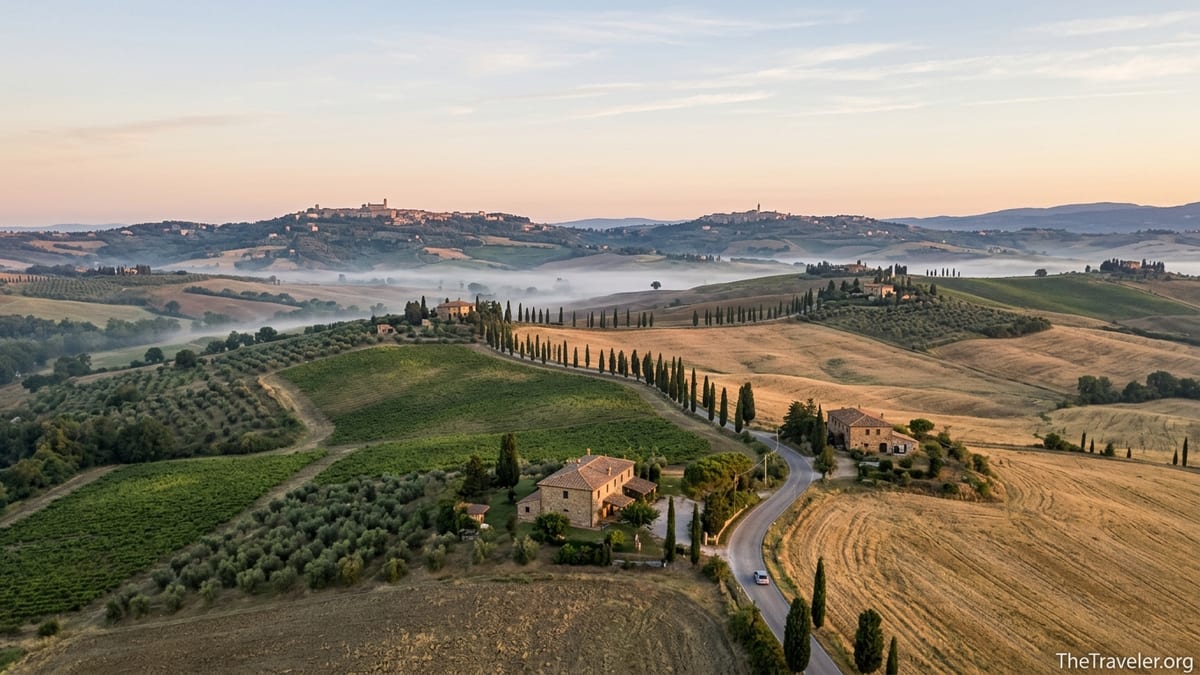
Where This Route Goes and How Much Time You Really Need
This itinerary focuses on a classic arc through central Italy: Florence and Siena in Tuscany, the UNESCO-listed landscapes of the Val d’Orcia and Montepulciano, then across the regional border into Umbria for Assisi, Perugia and Orvieto. All are close enough together that you can connect them in 5 days if you move briskly, but most travelers will be happier with 7 or 10 days so they can slow down for long lunches, wine tastings and evening strolls.
Distances are short but roads and train routes are slower than many visitors expect. Driving from Florence to Siena takes about 1 hour 15 minutes using the Firenze–Siena dual carriageway in normal traffic, while the train can take closer to 1 hour 30 minutes with connections and the walk or bus from Siena station into the historic center. Reaching the Val d’Orcia hill towns from Florence by car is around 1 hour 45 minutes to Montepulciano or Pienza, and about 2 hours to Montalcino. Public transport exists but is infrequent and often involves multiple local buses, so it rarely suits a tight schedule.
On the Umbrian side, trains between Perugia and Assisi typically take around 20 to 30 minutes, with regional tickets often priced under 10 euros each way in second class. Orvieto sits on the main north–south rail line between Florence and Rome, and direct or one-change trains from Orvieto to Florence commonly take around 2 to 2.5 hours. These practical details matter: in a 5-day trip you may want trains between the major cities and a short car rental only for the rural days, while in 10 days a full road trip becomes both feasible and rewarding.
As a rule of thumb, a 5-day trip works best for travelers who prioritize Florence and Siena with a taste of the countryside. Seven days allows two nights amid the cypress-dotted hills of Val d’Orcia. With 10 days, you can add slower mornings in Montepulciano, a full day in Assisi and evenings on the terraces of Perugia and Orvieto watching the sun drop over the Tiber and Chiana valleys.
Rental Car vs Train: Choosing How to Travel
The key decision for this route is whether to rely on Italy’s rail network, hire a car or combine both. Trains are the obvious choice between major cities. Florence, Siena, Perugia and Orvieto are all well connected by regional and intercity services, with tickets that are usually affordable if you book standard second-class seats. For example, a regional fare from Florence to Perugia can often sit in the 15 to 25 euro range per person depending on the connection, and you step off close to the historic centers rather than in an out-of-town highway zone.
But trains cannot carry you onto the tiny lanes of Val d’Orcia or up into many rural agriturismi. Montepulciano has a separate train station on the valley floor rather than up in the historic hilltop town, and places such as Pienza or the famous viewpoints along the SP146 ridge road are essentially car-only. A typical visitor wanting to drive the classic Pienza to San Quirico d’Orcia stretch, pull over for photos of cypress-lined farm tracks and then detour to a Brunello di Montalcino winery will find a rental car the only practical option.
For many travelers, the best of both worlds is a hybrid plan. You might arrive in Florence by high-speed train from Rome or Milan, enjoy the city car-free for two or three nights, then pick up a rental car at a neighborhood agency outside the historic center to avoid Florence’s ZTL restricted traffic zones. Daily rates for a compact manual car can vary widely by season, but as a planning figure it is common to see 45 to 80 euros per day in spring and autumn, excluding extra insurance and fuel. After two or three days driving around Siena and Val d’Orcia, you could drop the car in Chiusi or Orvieto and continue by train into Umbria and on to Rome.
Parking and ZTL enforcement cameras are the main car-related pitfalls. Siena, Perugia and Orvieto all have restricted zones and paid parking lots just outside their walls. Expect to pay around 2 to 3 euros per hour or a daily capped rate in the 18 to 25 euro range in many municipal garages. It is worth checking your hotel’s instructions in advance: a farmhouse hotel in Val d’Orcia usually offers free parking in a gravel courtyard, while a boutique hotel inside Siena’s walls may need to register your number plate or ask you to park in a specific garage.
A Focused 5-Day Itinerary: Highlights in a Short Week
A 5-day trip means prioritizing. The most efficient circuit for a first-time traveler is Florence, Siena, Val d’Orcia and Orvieto, with a brief taste of Umbria at the end. This can be done entirely by public transport if you accept a more urban focus, or with a short car rental for the rural middle section. One practical pattern is to spend nights 1 and 2 in Florence, night 3 in or near Siena, and nights 4 and 5 split between Val d’Orcia and Orvieto.
On day 1, arrive in Florence and keep plans simple. Walk from the Duomo to Piazza della Signoria, continue over Ponte Vecchio toward the Oltrarno side and settle into the rhythm of evening aperitivo. Many visitors opt for a simple glass of Chianti Classico and a board of crostini topped with chicken liver pate or Tuscan pecorino for around 10 to 15 euros in a neighborhood wine bar away from the busiest streets.
Day 2 can be your major Florence sightseeing day. Pre-book timed tickets for the Uffizi or Accademia to avoid long queues, then climb to Piazzale Michelangelo for a late afternoon view across the Arno. Travelers who prefer not to rent a car can take a late train to Siena and check into a hotel inside the medieval walls, such as a simple guesthouse near Piazza del Campo, often priced in the 120 to 180 euro range per night for a mid-range double room in shoulder season.
On day 3, explore Siena in the morning before heading south. You might stroll from the striped marble cathedral to the shell-shaped Piazza del Campo, then pick up a rental car near the station and drive 45 minutes to the northern edge of Val d’Orcia. Base yourself in an agriturismo near Pienza or Montepulciano, where farm stays with pools and vineyard views can start around 140 to 220 euros per night. On day 4, spend your time on the Pienza to Montalcino loop: visit a caseificio to taste pecorino di Pienza, then continue to a Brunello winery around Montalcino, where a standard tasting flight may cost 20 to 30 euros per person.
Day 5 is your transfer into Umbria. From Val d’Orcia drive about 1.5 hours to Orvieto, drop the car near the bottom funicular station, then ride up into the walled town. Spend the afternoon visiting Orvieto’s striped Duomo and underground tunnels. In the evening, sit on the terraces overlooking the surrounding countryside with a glass of local Orvieto Classico white wine before traveling onward to Rome or Florence the following day.
A Classic 7-Day Itinerary: Adding Montepulciano and Assisi
With 7 days you can slow down and add both Montepulciano and Assisi without feeling rushed. One efficient plan begins with two nights in Florence, two nights in Siena or Val d’Orcia, and three nights shared between Montepulciano and an Umbrian base such as Assisi or Perugia. This structure keeps driving stages to 2 hours or less and allows for relaxed mornings.
Days 1 and 2 follow a similar pattern to the 5-day trip: Florence without a car, mixing headline sights with less crowded corners such as the San Lorenzo market or the artisan workshops of the Oltrarno. On day 3, travel to Siena by train or bus and spend the night inside the walls so you can experience the town after the day-trippers leave. A simple dinner of ribollita soup and pici pasta with cacio e pepe in a local trattoria might come to 20 to 30 euros per person without wine, depending on where you choose.
On day 4, pick up a rental car and drive the 1.5 to 2 hours to Montepulciano, detouring via the cypress-viewpoints of Val d’Orcia. Many visitors stop in San Quirico d’Orcia for coffee, continue to Pienza for lunch on a terrace overlooking the valley, then follow the scenic SP146 road to Montepulciano. Once there, you can tour one or two underground wine cellars beneath the Renaissance palazzi around Piazza Grande, with guided tastings often priced around 15 to 25 euros per person.
Days 5 to 7 take you into Umbria. From Montepulciano it is about 1.5 hours’ drive to Assisi, depending on traffic and route, or you can drop the car at Chiusi-Chianciano Terme station and take a regional train. In Assisi, plan on one full day to walk from the Basilica of San Francesco up through the medieval lanes to the Rocca Maggiore fortress. On your final day, either continue by train to Perugia for an afternoon and evening among its student-filled piazzas, or go directly to Orvieto for a last hilltop overnight before onward trains to Rome or Florence.
The 10-Day Grand Circuit: Tuscany and Umbria in Depth
Ten days allow for the kind of central Italy journey that many travelers imagine: unhurried drives on country roads, long vineyard lunches and time to linger in the quieter corners of each town. A common pattern is to divide time roughly as three nights in Florence, three in rural Tuscany around Val d’Orcia and Montepulciano, and four in Umbria split between Assisi, Perugia and Orvieto.
On days 1 to 3, use Florence as a cultural base. In addition to the obvious highlights, consider a half-day side trip to Fiesole by city bus for a view back over Florence’s skyline, or an early morning walk in the less visited Sant’Ambrogio market where locals shop for produce and cheese. If you plan to rent a car, pick it up on the morning of day 4 from an agency on the edge of the center so you can leave town quickly along the Firenze–Siena road.
Days 4 to 6 are your Tuscan countryside phase. Drive first to Siena for lunch and a brief wander, then continue into Val d’Orcia where you base yourself for three nights in an agriturismo between Pienza and San Quirico d’Orcia. From here you can dedicate one day to the Pienza–Montalcino loop, including a soak in the thermal waters of Bagno Vignoni or Bagni San Filippo, and another to the Montepulciano area, perhaps joining a small-group vineyard tour where transport, tastings and a light lunch might cost 90 to 140 euros per person depending on the season and inclusions.
On day 7, travel across to Umbria. One pleasant route takes you via Lake Trasimeno, where you can stop in Passignano sul Trasimeno for lunch by the water. Arrive in Perugia by late afternoon, park in one of the multi-level garages connected to the historic center by escalators, and spend the evening on Corso Vannucci tasting chocolate from local pasticcerie. Overnight in Perugia or continue another 30 minutes by road or regional train to Assisi for a quieter hilltop setting.
Days 8 and 9 are for Umbria’s spiritual and civic capitals. In Assisi, visit both the upper and lower basilicas and follow walking paths among olive groves just outside the walls. In Perugia, explore the underground Etruscan and medieval passages beneath the Rocca Paolina and have aperitivo on a terrace facing the valleys below; prices for a spritz and snacks often start around 8 to 10 euros. On day 10, finish in Orvieto. Drive around 1.5 hours from Perugia or Assisi, drop the car, then devote the day to the Duomo, Etruscan sites and perhaps a guided tour of the well system such as the famous double-helix well designed for mules. Stay one last night for sunset views before boarding a direct or one-change train the next day to Florence or Rome.
Practical Planning: Seasons, Budgets and Booking
Central Italy is a year-round destination, but the feel of this itinerary changes markedly by season. Late spring and early autumn, roughly May, June, late September and early October, are usually the most comfortable for this route. In Val d’Orcia, May can bring green hills and wildflowers, while late September brings golden fields and wine harvest activity. July and August can be very hot, especially in cities like Florence and Perugia, with many Italians also on holiday, which pushes car rental and accommodation prices toward their annual peak.
From a budget perspective, this is a mid-range to high-end itinerary depending on how you travel. For a couple sharing a room, a realistic daily budget including accommodation, meals, local transport and moderate entrance fees might range from 200 to 350 euros, excluding flights. A simple lunch of panini and coffee near Siena’s Piazza del Campo might cost around 10 to 15 euros per person, while a full dinner at a good osteria with antipasti, a pasta course, dessert and a shared bottle of regional wine could come to 35 to 60 euros per person depending on location and choice of dishes.
Booking strategy also matters. High season stays in small Val d’Orcia agriturismi and centrally located boutique hotels in Florence and Orvieto often sell out months ahead, especially in June and September. Many properties now require credit card guarantees and have stricter cancellation policies than before 2020, so it is wise to check terms carefully. For train travel, you can often buy flexible regional tickets on the day of travel, while high-speed services between major cities have advance-purchase offers that can significantly lower fares if you commit to a specific departure time.
Drivers should also consider insurance and navigation. Collision damage waiver and theft protection are commonly included with a high deductible. Many travelers choose an additional policy to reduce that excess, either directly with the rental company or through a third-party provider. For route guidance, offline maps on a smartphone work well in rural Tuscany and Umbria, but always cross-check with road signs, especially for avoiding ZTL zones around historic centers where fines are enforced by cameras rather than police at the roadside.
How to Combine Car and Train Without Stress
If you prefer not to drive into or out of Florence and Rome, you can still enjoy the rural sections of this itinerary by being strategic about where you pick up and drop off the car. One popular pattern is to travel by train from Rome or Milan to Florence, stay there without a car, then take a regional train to a smaller station such as Chiusi-Chianciano Terme or Arezzo where several rental agencies operate near the station. From there it is a straightforward 45 to 60 minute drive into Val d’Orcia or Montepulciano on quieter roads.
Another option is to start or end the driving portion of the trip in Orvieto. Because Orvieto lies on the main rail line, it has both good car rental options and frequent trains north to Florence and south to Rome. For example, you might take a morning high-speed train from Rome to Orvieto in around 1 to 1.5 hours depending on the connection, pick up a car and spend several days looping through Umbria and southern Tuscany, then drop the car in Florence before taking a train onward. This pattern avoids the densest city traffic while maximizing time on scenic rural roads.
Remember that one-way rentals, such as picking up a car in Florence and dropping in Orvieto or vice versa, often incur an additional fee. For a compact car this might be 50 to 100 euros or more depending on the company and season. It is worth comparing quotes where pick-up and drop-off are the same location versus different locations, and calculating if the fee is justified by the time and stress you save by avoiding city centers.
When mixing transport modes, allow generous buffers between drop-offs and train departures. Returning a car at a small station agency typically takes 20 to 30 minutes including paperwork and vehicle inspection, and regional trains can experience delays. Building in a 60 to 90 minute gap between your planned car return and train departure reduces the risk that a minor traffic jam outside Perugia or Siena will cascade into missed connections later in the day.
The Takeaway
A journey through Tuscany and Umbria linking Florence, Siena, Val d’Orcia, Montepulciano, Assisi, Perugia and Orvieto can be shaped to fit almost any schedule. With 5 days you can hit the major highlights and enjoy at least one full day among the rolling vineyards and hill towns. In 7 days, you add depth in Montepulciano and Assisi. In 10 days, the route becomes a rich tapestry of art, food, wine and countryside where no segment feels rushed.
Deciding between car and train is less about right and wrong and more about your priorities. Trains work brilliantly between the larger towns, while a rental car unlocks the backroads and farmhouses that give this region its iconic feel. Many travelers find that a hybrid approach, using trains for the big jumps and a short car rental for the rural middle, offers the perfect balance of freedom and simplicity.
Whichever structure you choose, book key accommodations early, study ZTL maps before driving into any walled town, and give yourself time in the schedule for serendipity. Some of the most vivid memories from this part of Italy come not from ticking off famous sights but from unexpected moments: a sunset over the Val d’Orcia fields, an unplanned tasting in a family-run cantina in Montepulciano or a quiet early morning walk through the stone lanes of Assisi before the tour buses arrive.
With realistic planning and a willingness to slow down, this central Italian itinerary can feel less like a checklist and more like a lived experience of one of Europe’s most rewarding regions.
FAQ
Q1. Do I really need a rental car for this Tuscany and Umbria itinerary?
For the cities alone you could rely on trains and buses, but a rental car makes a huge difference for reaching Val d’Orcia viewpoints, agriturismi, small wineries and rural villages such as Pienza and Monticchiello. Many visitors choose a hybrid plan: trains between Florence, Siena, Perugia and Orvieto, and a car only for 2 to 4 days in the countryside.
Q2. How many days should I allocate to Val d’Orcia and Montepulciano?
If you are short on time, one full day lets you see a sample of Val d’Orcia plus Montepulciano. For a more relaxed pace, aim for 2 or 3 nights in the area so you can dedicate one day to the Pienza–Montalcino loop and another to Montepulciano and its surroundings without rushing.
Q3. Is it difficult to drive and park in Siena, Perugia and Orvieto?
Driving into the historic centers is not recommended because of ZTL restricted zones and narrow streets. Instead, follow signs to public parking garages outside the walls and walk or use escalators and funiculars into the old town. Parking is usually paid but straightforward if you follow local signs and your hotel’s instructions.
Q4. What is the best time of year for this itinerary?
Late spring and early autumn, roughly May, June, late September and early October, usually offer the best combination of pleasant temperatures, open services and scenic countryside. July and August can be very hot and crowded, while winter brings quieter towns, shorter days and a higher chance of rain, though it can still be rewarding for those who prefer fewer tourists.
Q5. Can I do this itinerary without changing hotels every night?
Yes. A common strategy is to use Florence and a countryside base as hubs. For example, you might spend 3 nights in Florence, 3 nights in an agriturismo near Pienza or Montepulciano, and 3 or 4 nights in Umbrian bases such as Assisi and Orvieto, taking day trips from each rather than moving every day.
Q6. How much should I budget per day for a mid-range trip?
For two people traveling together, a realistic mid-range daily budget including accommodation, meals, local transport and standard entrance fees often falls between 200 and 350 euros, depending on season, choice of restaurants and whether you rent a car. This excludes international flights and major shopping.
Q7. Are wine tastings easy to arrange in Montepulciano and Montalcino?
Yes. Many wineries and in-town tasting rooms offer walk-in or prebooked tastings. Short guided tastings in Montepulciano or Montalcino commonly cost around 15 to 30 euros per person, while more elaborate vineyard tours with food pairings can be higher. In peak season, booking ahead directly with wineries is advisable.
Q8. Is it better to base in Siena or directly in Val d’Orcia?
If you want evening life, museums and easy train or bus access, Siena makes a good base. If your priority is scenic drives, vineyards and quiet farm stays, staying directly in Val d’Orcia near towns such as Pienza, San Quirico d’Orcia or Monticchiello is usually more rewarding, especially if you have a car.
Q9. How do I avoid ZTL fines when driving?
Study ZTL maps for each town in advance, use a navigation app that highlights restricted zones, and follow signs carefully as you approach historic centers. In most cases you should park outside the walls and walk in. If your hotel is inside a ZTL, confirm how they handle guest access and plate registration before arrival.
Q10. Can I easily continue to Rome or other regions from this route?
Yes. Orvieto and Perugia both sit on useful rail lines with direct or one-change connections to Rome, Florence and beyond. Many travelers end the itinerary by dropping a rental car in Orvieto, spending a final night there, then taking a morning train directly to Rome Termini or on to other Italian regions.