

Central Italy is where many travelers fall in love with the country for good. From the domes and forums of Rome to the misty olive hills of Umbria, from Tuscan stone villages to the quiet coves of the Adriatic, this region is dense with places that all claim to be “unmissable.” The real challenge is not whether to go, but how to choose. This guide compares Rome, Florence, Siena, Val d’Orcia, Assisi, Perugia, Orvieto, Lucca, San Gimignano, the Marche coast and hinterland, Abruzzo, and a handful of lesser-known towns, so you can match the right slice of Central Italy to your time, budget and travel style.
How to Choose Your Central Italy Base
Central Italy is compact enough that you could, in theory, drive from Florence to the Adriatic in less than three hours, but each area offers a very different experience. Rome and Florence work best for first-time visitors who prioritize iconic art and ancient history, and who are comfortable in busy, urban settings. Hill towns such as Siena, Orvieto, Assisi and Lucca suit travelers looking for a slower rhythm, medieval streets and evenings in small piazzas, often with more affordable lodging than the major cities.
Val d’Orcia in southern Tuscany, with villages such as Pienza and Montalcino, is ideal if your mental image of Italy involves cypress-lined lanes, vineyards and thermal baths. On the eastern side of the Apennines, regions like Marche and Abruzzo add beaches, wild national parks and fewer foreign visitors; they suit hikers, families who want a calmer seaside than the Amalfi Coast, and repeat visitors seeking something less obvious. When planning, consider not only what you want to see, but how you want to spend your days: lining up for the Vatican Museums, or walking solitary farm tracks between stone farmhouses.
Budget and logistics matter too. A good midrange double room in central Florence or Rome can easily cost from 180 to 250 euros per night in high season, while in towns such as Perugia, Ascoli Piceno or Sulmona you may still find well-reviewed guesthouses between 90 and 130 euros. Car rental is almost essential for Val d’Orcia and much of Marche and Abruzzo, while it is a liability in Rome and Florence, where ZTL restricted zones mean hefty fines if you drive into historical centers. Many travelers find a hybrid plan works best: city stays without a car, then a rental for countryside and coastal legs.
Rome vs Florence: Big-Hitting Cities for Art and History Lovers
Rome is the natural entry point to Central Italy for many visitors, thanks to its major airport and near-mythic sights. It rewards travelers fascinated by ancient history, early Christianity and urban grit. In a three-day stay you might tour the Colosseum and Roman Forum, spend half a day in the Vatican Museums and St Peter’s Basilica, walk the Baroque heart from Piazza Navona to the Trevi Fountain, and have dinner in Trastevere or Testaccio. Food-obsessed travelers will appreciate Roman specialties such as cacio e pepe, carbonara and fried artichokes, most easily found in casual trattorie where a plate of pasta still often costs around 12 to 16 euros.
Florence, by contrast, is denser, quieter at night and intensely focused on Renaissance art. If your must-see list includes Michelangelo’s David, Botticelli’s Birth of Venus and Brunelleschi’s dome, this is your city. The historic center is walkable from end to end in about 20 minutes, and most major museums sit within that compact area. A typical two-day visit might combine the Uffizi Galleries, the Accademia, the Duomo complex and an afternoon across the river in the Oltrarno, where artisan workshops and smaller churches feel more lived-in than the busy streets around Piazza della Signoria.
In terms of traveler type, Rome suits those who like big-city energy, nightlife and layered history, and who do not mind navigating crowds and traffic. Florence is better for art students, couples and travelers who enjoy slower evenings and being able to walk almost everywhere. If you have a week in Central Italy and it is your first trip, splitting time between Rome and Florence, with a single-day trip to a hill town such as Siena or Lucca, makes sense. For repeat visitors, it can be more rewarding to choose just one city and spend the rest of your time in smaller centers or countryside.
Siena, San Gimignano, Lucca and the Allure of Tuscan Hill Towns
Siena is often described as Florence’s smaller, moodier cousin, and for many travelers it becomes a favorite. The fan-shaped Piazza del Campo, where the Palio horse race is held twice each summer, is one of Italy’s great urban spaces, lively with cafes but still used by locals as a meeting place. The striped marble Duomo houses important works by Donatello, Pisano and others, yet lines are generally shorter than in Florence. Many visitors stay one or two nights in Siena as a base to explore Chianti or the Crete Senesi by car, enjoying quieter evenings than in the larger cities.
San Gimignano, famous for its medieval towers, works differently. Its skyline is striking, and views from the town walls over vineyards and olive groves are spectacular. However, the daytime streets can be packed with tour groups, especially in high season, and parking just outside the walls is paid and competitive in midday. For that reason, San Gimignano suits travelers staying nearby in agriturismi who can visit early morning or late evening, when the buses are gone and the town regains its village character. It is particularly appealing to photographers and families who want a fantasy-medieval backdrop in real life.
Lucca, on the other hand, offers a more lived-in, less tour-bus feel. Its intact Renaissance walls, topped by a tree-lined promenade, form a flat, car-free ring where locals jog and families rent bikes. Inside, narrow streets lead to Romanesque churches, small squares and independent shops. Compared with Florence or Siena, Lucca has a quieter nightlife and a less pressured museum list; it is an excellent base for travelers who want to blend sightseeing with downtime, especially if you are traveling with children or working remotely. Regular trains connect Lucca to Pisa and Florence, making it logistically simple even without a car.
Val d’Orcia and the Tuscan Countryside: For Wine, Views and Slow Travel
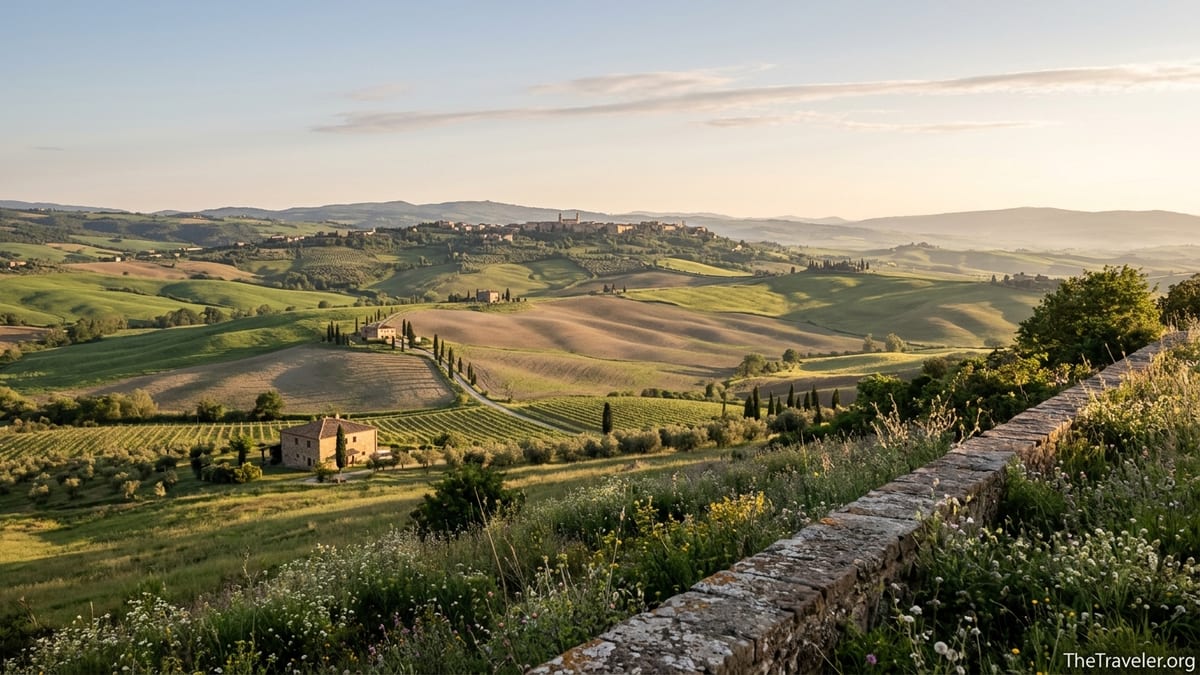
South of Siena, the Val d’Orcia is the landscape often used on postcards and film sets to represent the “ideal Tuscany.” Recognized as a UNESCO World Heritage cultural landscape, it rolls in soft, cultivated hills broken by farmhouses, cypress-lined drives and hilltop villages such as Pienza, Montalcino and San Quirico d’Orcia. Pienza itself, rebuilt in the 15th century under Pope Pius II as an “ideal Renaissance town” and later designated a separate UNESCO site, makes a good base for travelers who want a small town with real services, including wine bars, pecorino cheese shops and a handful of midrange boutique hotels.
Montalcino attracts wine lovers from around the world as the home of Brunello di Montalcino. Many estates around the town offer tastings by reservation, often costing around 20 to 35 euros per person for a guided tasting of several wines paired with small bites. Even if you are not a serious wine drinker, the drive from Montalcino down into the surrounding valleys is one of the area’s highlights, with viewpoints over patchwork vineyards and distant Monte Amiata. Nearby Bagno Vignoni, a tiny spa village where a central stone basin of thermal water fills the main square, fits travelers who are as interested in hot springs and easy hikes as in wine.
Val d’Orcia suits slower travel. Public transport is sparse, so most visitors either rent a car or join organized day tours from Florence or Siena that combine a few towns with a winery stop. If you can, consider a three- or four-night stay on an agriturismo, a working farm that rents rooms or apartments. Breakfast often features homemade jams and local cheese, and some properties serve dinner a few nights per week, which helps solve the rural dining question. This style of travel is ideal for couples, honeymooners, photographers and anyone looking for quiet evenings under Tuscan stars instead of city nightlife.
Umbria: Assisi, Perugia, Orvieto and Lesser-Known Hill Towns
Nicknamed the “green heart of Italy,” Umbria has scenery that rivals Tuscany but with fewer visitors, slightly lower prices and a stronger sense of traditional religious and village life. Assisi, perched on the western flank of Monte Subasio, is the best-known town, famous as the home of Saint Francis. The Basilica of San Francesco, with its sequence of frescoes by Giotto and others, is a major pilgrimage site. Daytime can be heavily trafficked with groups, particularly around religious holidays, but evenings feel more contemplative once buses have left and local families reclaim the main streets.
Perugia, the regional capital, has a very different feel. It is a university city with a large student population, which means more nightlife, cafes and cultural events, including a well-known jazz festival in summer and a chocolate festival in autumn. The historic center, set on a hilltop, is reached from modern parking areas and the train station via escalators and a small metro system. For many travelers, Perugia makes a convenient hub: trains and buses connect to Assisi, Spello, Gubbio and Lake Trasimeno, while lodging can be more affordable than in neighboring Tuscany. It suits younger travelers, solo visitors and anyone who likes a bit of city energy without the intensity of Rome.
Orvieto, dramatically set on a tufa plateau, works particularly well for travelers coming north from Rome. Trains from Rome Termini take around 1 to 1.5 hours, and a funicular links the lower station to the old town. Orvieto’s striped Gothic cathedral is among Italy’s most striking, and the town’s network of underground caves and wells gives it an unusual, slightly mysterious character. Many people visit as a day trip, but staying a night lets you enjoy quiet cobbled streets and dinners based on local white wines and hearty cuisine. Nearby smaller Umbrian towns such as Spello, Trevi and Montefalco reward slow road trips with their olive groves and family-run osterie.
Marche and Abruzzo: Under-the-Radar Beaches and Wild Mountains
Travelers who have already fallen for Tuscany and Umbria often look east to Marche and Abruzzo for their next trip. Along the Marche coast, the Conero Riviera stands out for its combination of cliffs, pine woods and pebble coves. Villages such as Sirolo and Numana sit above the sea, with lanes of pastel houses and viewpoints over the Adriatic. Beaches like Urbani, San Michele and the more remote Due Sorelle are typically accessed by path or boat, which helps keep them from feeling overbuilt. In summer, beach clubs rent umbrellas and loungers, while stretches of public shoreline remain free for those who prefer to bring their own towels.
Inland, Marche offers Renaissance towns such as Urbino, birthplace of Raphael, and smaller centers like Ascoli Piceno with its pale stone piazzas and cafe arcades. These destinations suit travelers who enjoy art and architecture but prefer a language environment where Italian dominates and English is less commonly heard than in Florence or Rome. Prices for coffee, gelato and house wine also tend to be a little lower; it is still common to pay around 1.30 to 1.50 euros for an espresso at the bar in non-touristy areas.
Abruzzo spreads from nearly 3,000-meter Apennine peaks to a 130-kilometer coastline along the Adriatic. Much of its interior is protected by national parks such as Gran Sasso and Monti della Laga and Maiella, where stone villages cling to slopes and well-marked trails lead to ridgelines and high plateaus. Towns like Sulmona and Santo Stefano di Sessanio appeal to hikers and photographers, with historic centers restored after past earthquakes and small alberghi diffusi, or “scattered hotels,” where rooms are spread across different old buildings under one management. On the coast, the Trabocchi shoreline south of Pescara is dotted with old wooden fishing platforms converted into restaurants, particularly attractive to food travelers seeking fresh seafood in atmospheric settings.
Marche and Abruzzo are best for travelers who like to combine beach or mountain days with small-town wandering, and who are comfortable renting a car and dealing with more limited English. Families often appreciate the largely sandy, shallow beaches around towns like Grottammare or Giulianova in Abruzzo and the fact that they are generally less crowded and less expensive than better-known western-coast resorts. Active travelers will find cycling routes, canyon walks and winter skiing in Abruzzo’s higher areas, making these regions appealing almost year-round.
Matching Destinations to Traveler Types and Seasons
The right place in Central Italy depends heavily on when you are traveling and what atmosphere you want. In July and August, cities such as Rome and Florence become very hot, with afternoon temperatures frequently over 30 degrees Celsius and queues in full sun outside major sights. At this time of year, hill towns at slightly higher elevations, such as Siena, Orvieto, Assisi and Lucca, can feel marginally cooler in the evenings, and coastal areas in Marche and Abruzzo offer sea breezes and opportunities to swim. Beach clubs typically charge daily rates per umbrella and two loungers, often starting around 20 to 30 euros in high summer, more in the most fashionable spots.
Spring and autumn are generally the best seasons for combining cities with countryside. From April to early June and from late September into October, you can hike in Val d’Orcia or around Gran Sasso, enjoy vineyard views and still spend comfortable hours in museums without the peak-season crowds. This is also a good time for food-focused travelers, as many villages host small festivals celebrating asparagus, truffles, new olive oil or local wines. Winter has its own charm in places like Perugia or Siena, with Christmas lights and quieter streets, though smaller coastal and rural businesses may close or operate on limited hours.
Solo travelers might lean toward places with clear public transport links and established hostel or small-hotel scenes, such as Rome, Florence, Perugia and Lucca. Couples and honeymooners often prioritize Val d’Orcia agriturismi, boutique hotels in Siena or Orvieto, or sea-view guesthouses along the Conero or Trabocchi coasts. Families may find that a week in a countryside apartment near a hill town, with a rental car for day trips and an on-site pool, offers the best balance of relaxation and sightseeing. In all cases, it is worth booking the most in-demand experiences, such as Vatican Museum entries, Uffizi tickets or guided Brunello winery visits, several weeks in advance during popular months.
Budget also shapes the right match. Rome and Florence, plus the most famous pockets of Tuscany, are the most expensive for lodging and dining, particularly close to main squares. Shifting your base even 15 or 20 kilometers away, for example staying in a village near Siena instead of inside the city walls, or choosing Perugia over Florence, can free up funds for private tours, better meals or an extra night’s stay. In lesser-known areas of Umbria, Marche and Abruzzo, excellent full dinners with wine at traditional trattorie can still often come to around 25 to 35 euros per person, a noticeable saving compared with tourist-heavy neighborhoods in the big cities.
The Takeaway
Central Italy is not a single destination but a mosaic of overlapping worlds: imperial ruins and Renaissance domes in the cities, stone bell towers in the hill towns, orderly vineyards in Val d’Orcia, sunflower fields and pastures in Umbria, cliffs and pebble coves in Marche, and wild highlands in Abruzzo. Each of the places in this guide rewards a different kind of traveler. Rome and Florence deliver the textbook highlights of Italian art and history; Siena, Lucca and San Gimignano refine that with more manageable scale. Val d’Orcia offers the classic countryside escape, while Umbria’s towns provide a similar feel with a little more everyday life still in the foreground.
On the eastern side of the mountains, Marche and Abruzzo add another layer for those willing to venture just a bit further. Here, Italian families fill the beaches, local accents crowd the cafes, and English menus are less common. For many repeat travelers, these regions are where Italy starts to feel less like a collection of famous sights and more like a place to simply live for a while, even if only for a week in summer or a few crisp autumn days.
When choosing among these destinations, start by being honest about what you most enjoy on a trip. If you feel alive in museums and busy streets, give most of your time to Rome or Florence and add brief forays into the hills. If you crave open views, long lunches and evenings on quiet terraces, bias your itinerary toward Val d’Orcia, Umbria, Marche or Abruzzo. There is no single best place to visit in Central Italy, but there is almost certainly a corner that aligns perfectly with how you like to travel and how you want this particular trip to feel.
FAQ
Q1. Is it better to stay in Rome or use it as a day trip from another city?
For most travelers, especially first-time visitors, Rome deserves at least two or three nights on its own. Trying to visit as a day trip from Florence or a hill town would involve long train rides and leave too little time for the Forum, Vatican Museums and simply wandering its neighborhoods in the evening.
Q2. Do I need a car to explore Tuscany and Umbria?
You do not need a car for major cities such as Florence, Siena or Perugia, which are all served by trains and buses. However, to fully enjoy Val d’Orcia, smaller Umbrian villages and rural agriturismi, a rental car is extremely helpful, and in some areas almost essential, as public transport is infrequent.
Q3. How many days should I spend in Val d’Orcia?
Two full days is the minimum to see Pienza, Montalcino and a couple of smaller villages, and perhaps fit in a winery visit. Many travelers find three to four nights ideal, allowing time for slow drives, thermal baths, relaxed lunches and a rest day by the pool if they are staying on a countryside property.
Q4. Is Assisi too crowded to be enjoyable?
Assisi can feel very busy in the middle of the day, particularly around the Basilica of San Francesco and on religious holidays. Staying one or two nights changes the experience, as mornings and evenings are quieter, and you can explore lesser-visited streets, hermitages and viewpoints when day-trippers have gone.
Q5. Are the beaches in Marche and Abruzzo suitable for families?
Yes. Many sections of the Adriatic coast in Marche and Abruzzo offer gently sloping, mostly sandy beaches with calm water and lifeguards in summer. Beach clubs provide umbrellas, loungers, bathrooms and snack bars, which is convenient for families with young children.
Q6. Which is more budget-friendly: Tuscany or Umbria?
On average, Umbria tends to be slightly more budget-friendly than the most famous parts of Tuscany. Accommodation and restaurant prices in towns like Perugia, Spello or Orvieto are often lower than in heavily visited Tuscan hotspots, though there are exceptions at the luxury end of the market.
Q7. Can I visit San Gimignano, Siena and Chianti in one day from Florence?
It is technically possible with a long, structured tour, but it makes for a rushed experience. Many travelers find it more enjoyable to combine only two of these in one day or to stay overnight in Siena or a Chianti village so they can explore at a more relaxed pace and enjoy evenings after tour buses leave.
Q8. Is Abruzzo safe and practical for independent travelers?
Abruzzo is generally considered safe and welcoming, and it is increasingly popular with independent travelers. The main challenge is logistics: public transport in rural and mountain areas is limited, so renting a car and being prepared for winding roads and small villages is important if you want to see its national parks and hill towns.
Q9. When is the best time to visit Central Italy for fewer crowds?
Late March to early May and late September to early November usually offer a good balance of pleasant weather and lighter crowds. During these periods, you are more likely to find last-minute tables at restaurants, shorter lines at major sights and more availability in small hotels and agriturismi.
Q10. Is it realistic to combine Rome, Florence and the Amalfi Coast with Central Italy’s hill towns in one trip?
It can be done on a longer itinerary of two weeks or more, but for trips of around ten days or less it is usually better to choose either a Rome–Amalfi focus or a Rome–Florence–hill-town focus. Trying to include too many distant regions often leads to rushed stays and excessive time spent on trains or highways.