


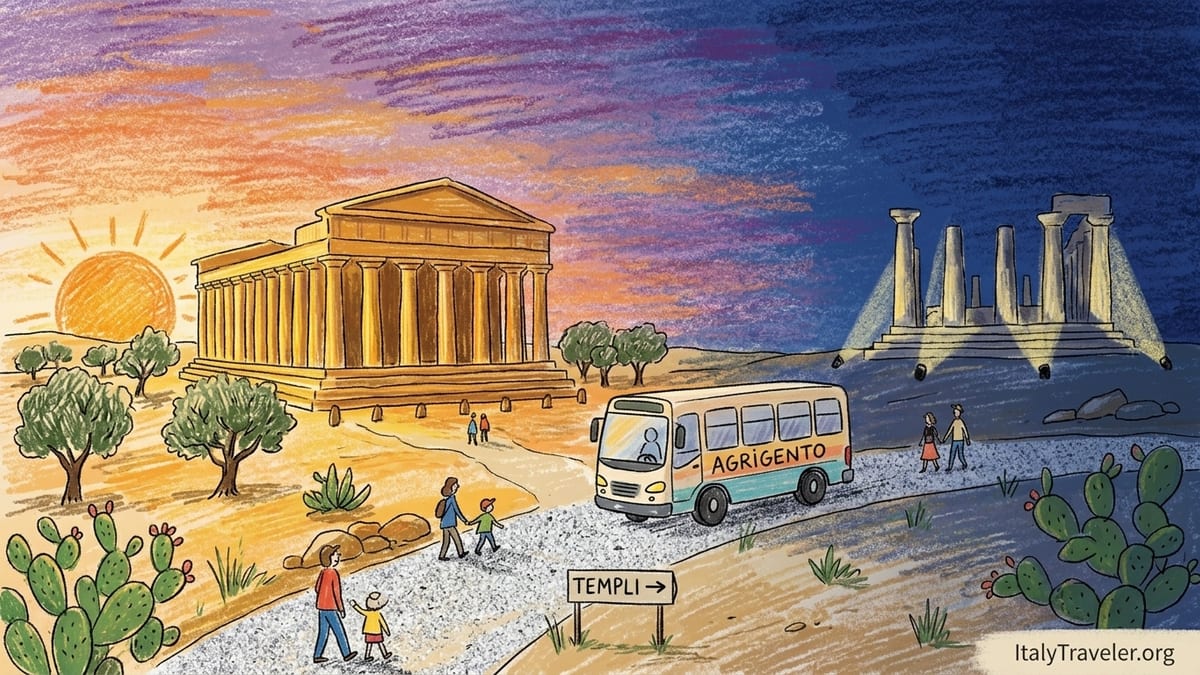
I visited Agrigento’s Valley of the Temples in late August 2026, at the height of Sicily’s long, hot summer. I bought a standard €14 afternoon ticket at the Temple of Juno entrance, skipping the combined museum option for another day, and stepped out into 32°C early evening air that felt surprisingly bearable after the daytime heat. My very first impression was of open golden light on the ridge and the sea shimmering in the distance, with the Doric columns of the Temple of Juno already catching a softer, honeyed tone that hinted at how powerful this landscape would become as the sun went down and the floodlights came on.
Getting to Agrigento and Choosing a Sunset Visit
I reached Agrigento from Palermo earlier that same day, on a morning coach that replaced part of the temporarily reduced rail service. The journey took just over three hours including a brief roadside coffee stop, and we rolled into Agrigento’s bus station late morning. The station sits just below the modern center, and from there I walked up to my small guesthouse near Via Atenea, dropped my bag and immediately felt the midday sun pressing against the shutters. It was obvious that a mid-afternoon temple march would be a test of endurance as much as sightseeing.
I had already decided to time my visit for the evening, taking advantage of the extended summer opening hours that keep the park accessible until late at night between June 20 and September 20, 2026. During those weeks, the Valley stays open to 23:00 on weekdays, with last entry usually around 22:00, and even later on some weekends. Knowing that sunset in late August would fall around 19:45 to 20:00 gave me a natural rhythm: enter in late afternoon light, watch the sky burn orange behind the columns, and then linger as the artificial lighting slowly takes over.
From the center of Agrigento I used one of the local city buses that connect the town with the archaeological park. At the bus station the board listed several lines serving “Templi – Giunone”, essentially the Temple of Juno entrance on the high eastern end of the ridge, and I boarded one of the mid-afternoon departures. Twenty minutes later, after winding past apartment blocks and a glimpse of the sea, the driver dropped a small group of us at the stop just uphill from the main eastern gate. If you prefer not to rely on bus timings, there is also a large gravel car park off Via Panoramica dei Templi, used by many self-drivers arriving from Palermo, Catania or the coastal road near San Leone.
The choice of this specific time of day was deliberate. Midday in August on this exposed ridge can push the feel of the temperature well above the official 32–34°C readings, with little natural shade on the main spine of the Via Sacra. I had briefly walked down to the Belvedere viewpoint above the modern town at lunchtime and the heat was harsh, the light flat and bleaching detail out of every stone. In contrast, an evening visit promised lower sun angles, slightly cooler air and, crucially, the chance to see the temples shift from natural to artificial light, something that daytime-only visitors simply miss.
Tickets, Evening Programs and First Moments Inside the Park
At the Temple of Juno gate I joined a small queue at the CoopCulture ticket office. For 2026, standard admission to the Valley of the Temples is €14 for adults, with a combined ticket for the archaeological area and the Pietro Griffo Archaeological Museum priced at €19.20. Because I wanted to focus entirely on the changing light in the park, I chose the simple €14 entry and decided to visit the museum on a different morning when I would appreciate the statues and pottery out of the sun.
In addition to the basic ticket, from July 23 to October 31, 2026, the park has introduced an optional €3 supplement for a special exhibition that is hosted within the archaeological area and the museum. At the window the clerk asked if I wanted to add that extra exhibition access. I declined this time, because my slot was already tight between sunset and the last bus back to town, but it is worth considering if you plan to spend the day shuttling between the park and the museum and are interested in the temporary displays.
Summer 2026 also brought back an extended program of evening openings branded locally as “Luci in Valle”. This is not just about keeping the gates open longer. It includes separately bookable small-group guided walks that start after sunset, following a set route along the illuminated temples with an archaeologist or licensed guide. These experiences must be reserved in advance and require their own ticket; they operate on specific nights and do not replace ordinary daytime or evening entry. For this visit I chose to explore independently with a regular ticket, using the extended hours to linger, but I saw several groups assembling near the Temple of Concordia later in the evening, escorted by guides carrying small torches and earpiece audio systems.
Once inside the gate, I topped up my water bottle at the fountain just past the turnstile, checked the orientation map and stepped onto the compacted gravel of the Via Sacra. The first stretch from the eastern entrance to the Temple of Juno is slightly uphill, but the path is wide and firm underfoot, easy enough for most people in basic walking shoes or sandals. The air still felt hot, but the sun had started to sink, throwing long shadows from the prickly pears and low olive trees that dot the hillside. To the south, beyond the tumbling almond groves, the sea was already a cooler, paler blue than it had been at midday.
The Temple of Juno: Golden Stone and A First Glimpse of the Sea
The Temple of Juno, sometimes referred to as the Temple of Hera, is the first major monument you meet when entering from the eastern side. Perched on a rocky spur, it dates from the 5th century BC and was probably dedicated to the goddess who protected marriage and the household. Several of its columns stand re-erected in an almost complete peristyle on the southern side, while the northern flank is more fragmentary, showing where earthquakes and later stone-robbing have bitten into the structure.
Arriving in late afternoon, I found the temple half-bathed in warm side light. The ochre limestone had turned a deep honey color that seemed to glow against the pale sky. From the upper terrace on the south side, the view stretched across the valley floor to the modern skyline of Agrigento on one side and the line of the Mediterranean on the other. It was busy but not overcrowded: families with strollers lingered near the railings, a coach group posed for a final group shot before heading west, and a few independent travelers like me sat quietly on the low stone walls, just watching the light shift.
Even at this early stage I could sense how different the atmosphere was compared to daytime. Earlier in the day I had looked across at the ridge from the town and the temples appeared flat, almost chalky, standing against a bright white sky. Now the side lighting carved shadows into each fluting on the columns. The rock-cut steps around the base were easier to read, and the site felt less like a ruin surviving in spite of the environment and more like architecture made to belong in this kind of slanting, end-of-day light. I walked slowly around the perimeter, conscious that the clock was ticking toward sunset but not wanting to rush this first encounter.
Walking the Via Sacra: Distances, Terrain and Practicalities
From the Temple of Juno, the main visitor route follows the ancient Via Sacra westward along the crest of the ridge. The entire walk from the high eastern gate down to the lower western entrance at Porta V covers roughly 2.5 kilometers, depending on which side paths you explore. It is mostly downhill or gently undulating if you start at Juno and finish near the Temple of Zeus, which is why many independent visitors aim to enter at the top and work their way down, sometimes taking a taxi or shuttle up at the start.
The path itself is compacted gravel and stone with some embedded rock and occasional shallow steps. It is not especially difficult if you are moderately mobile, but it can be jarring for anyone with knee issues or very small children. It is also not ideal for lightweight strollers, particularly in the more irregular stretches near the Temple of Heracles and the Sanctuary of the Chthonic Deities. Wheelchair access is possible in sections, especially around the Temple of Concordia where more level, paved stretches exist, but tackling the entire ridge from end to end in a wheelchair would require advance planning and likely assistance.
Shade is limited on the ridge itself. A few trees lean over the path and provide small pools of shadow, but you are essentially walking in the open. In late afternoon the angle of the sun helps a little, and in August there is usually a sea breeze that takes the edge off the heat, yet I was glad to have a full one-liter bottle of water with me. There are kiosks and small cafes near the main entrances and around the Concordia area where you can buy drinks and snacks, but there are no frequent water points along the path, so it is wise to stock up at the start.
By the time I left the Juno terrace, the crowds had thinned a little. I fell into a rhythm of walking ten or fifteen minutes along the Via Sacra, then stopping for five to take in the views. Occasional interpretive panels explained the ruins you pass that are less instantly legible than the large temples: clusters of foundations, bits of wall, and stretches of the ancient city defenses. The light remained soft and angled, making it easier to see the three-dimensional shapes of the ruins and trace how ancient Akragas once stretched from this sacred ridge back toward the plateau where the modern town now stands.
The Temple of Concordia: From Sunset Silhouette to Floodlit Icon
The Temple of Concordia sits roughly midway along the ridge and is the undeniable star of the Valley. Built in the 5th century BC, it owes its exceptional state of preservation to a long second life as a Christian basilica from the 6th century AD until the late 18th century. The conversion saved its structure from the fate of many neighboring temples, which were quarried for building material; as a result, its colonnades, entablature and pediments still stand almost complete, making it one of the best preserved Doric temples anywhere in the Greek world.
I reached Concordia about half an hour before sunset. In natural light, the temple is already striking: a near-perfect rectangle of thirty-four columns standing on a crepidoma of weathered steps, aligned east-west so that the long side faces the sea. At this hour in August, the western sun hits its southern flanks, throwing deep shadows into the fluting while leaving the north side in a more muted, cooler tone. The path diverts into a broad viewing terrace where visitors naturally slow down. Some leaned against the rope barriers simply watching the sky, while photographers jockeyed gently for positions that framed the columns against the dissolving blue.
As the sun finally slid behind a bank of distant cloud above the horizon, the last natural light flattened for a few minutes. The temple briefly became a dark silhouette, its details merging into a single mass. Then, almost imperceptibly at first, the artificial lighting system came alive. Discreet ground-level projectors around the base of the temple began to wash the stone in a soft, upward glow. It was not the harsh, theatrical illumination I had half-expected, but a warm, controlled light that respected the structure’s lines. The columns re-emerged, now with a slightly deeper, more saturated color, while the background sky shifted through purples into a navy blue.
Standing there through this transition was the highlight of my visit. In natural light, Concordia feels like architecture in dialogue with its landscape, its ochre stone answering the dry hills. Under artificial light it becomes almost sculptural. Details that were barely noticeable at midday, such as the slight swelling of the columns (entasis) and the weathered edges of the steps, suddenly stood out. Floodlighting inevitably changes our perception of ancient monuments, but here it seemed to underline the temple’s mass and rhythm instead of overwhelming it. I walked around the perimeter path, looking back from different angles, and each view felt subtly different as the mix of lingering twilight and artificial light continued to shift.
Temple of Heracles and the Fragmentary Power of Ancient Akragas
Leaving Concordia, the Via Sacra continues gently downhill toward the Temple of Heracles, which stands closer to the western end of the ridge. This temple is older, dating to the late 6th century BC, and much less complete. What you see today is mainly a row of reconstructed columns on one side, most of them re-erected in the 20th century using ancient drums and modern anastylosis techniques. Around them lie fallen blocks, column segments and scattered stones, giving a sense of the original footprint but not the full standing form.
In daylight, this contrast between intact and fragmentary can feel almost disappointing after the near-perfection of Concordia. At night, though, I found the Heracles temple unexpectedly moving. The lighting here is gentler and a little more selective. The standing columns are lit so that their verticality is accented, while the tumbled blocks around them fall partly into shadow. The result is a play of light and dark that hints at the temple’s original volume but never fully restores it. You feel aware that this is a ruin, a once great structure undone by earthquakes and centuries of reuse, and that awareness is part of its power.
This section of the park also begins to explain more of ancient Akragas itself. Panels and low walls mark stretches of the old city fortifications that once ringed the urban plateau. The Valley of the Temples is not a separate religious zone in a literal depression; it is a ridge on the southern edge of the ancient city, given over largely to sacred buildings that watched over the dwellings on higher ground. Archaeological investigations have revealed that the city followed a Hippodamian grid plan, with regular streets and insulae laid out to take advantage of the breezes and the defensive potential of the terrain. Under the evening floodlights, with modern Agrigento’s lamps flickering on in the background, it was easier to imagine that continuous line of urban life from antiquity to today.
By this time of the evening, perhaps an hour after sunset, crowd levels had dropped significantly. Day-trippers with long drives ahead had mostly gone, and what remained were overnight visitors like me and a few small groups on pre-booked Luci in Valle tours, their guides pointing out details of column capitals and ancient quarry marks in quiet, measured voices. The air had cooled into the mid-twenties Celsius, perfectly comfortable for walking in short sleeves, and the scent of wild herbs crushed underfoot began to compete with the day’s baked dust.
Sanctuary of the Chthonic Deities and the Temple of Olympian Zeus
From the Heracles area, a path curves down toward the Sanctuary of the Chthonic Deities and the Temple of Olympian Zeus on the lower ground near the western exit. This part of the site feels different, both archaeologically and emotionally. Instead of one dominating standing temple, you move through a complex of foundations, altars and partial reconstructions, with one particularly photogenic corner of re-erected columns known popularly as the Temple of the Dioscuri. It is important to remember that this postcard image is the product of 19th-century reconstruction using elements from different buildings, rather than a fully preserved temple in situ.
The sanctuary itself was dedicated to deities of the underworld, including Demeter and Persephone, whose cults were central to Greek ideas about fertility, agriculture and the cyclical nature of life and death. In the dusk, with the ground lights picking out low walls and the four standing columns of the Dioscuri corner glowing like a small beacon, the place felt quietly atmospheric. It lacks the instant legibility of Concordia, but if you pause and read the interpretive panels, you begin to piece together an image of processions, sacrifices and seasonal rites that once animated this seemingly low-key space.
A short walk beyond lies the vast, fragmented area of the Temple of Olympian Zeus. In antiquity this was one of the largest Doric temples ever started in the Greek world, measuring roughly 112 by 56 meters. Today, only its foundations, parts of the altar and huge broken architectural blocks remain scattered across the enclosure. A few massive telamon figures, once used as support sculptures, have been reconstructed horizontally so visitors can appreciate their scale. Under artificial lighting, the immensity of the footprint becomes more apparent. Pools of light fall on isolated column drums and statue fragments, while much of the platform lies in darkness, giving a sense of the volume without attempting to recreate a lost whole.
Walking around these lower sanctuaries after dark brought home how different the Valley feels once the sun has fully gone. Midday visitors encounter an impressive archaeological park, but the modern town, power lines and roads are constantly in the periphery. In the evening, with those distractions dimmed and the monuments selectively lit, it becomes easier to abstract the temples from their surroundings and imagine the sacred landscape of ancient Akragas. The trade-off, of course, is that you see less of the broader topography and some details vanish into shadow, which is why combining a daylight stroll with an evening visit can be so rewarding if time permits.
Comparing Daytime Heat to Evening Calm
Although my main visit was in the evening, I did have a minor taste of midday conditions earlier in the trip when I walked along part of the ridge under the midday sun on a different day. The difference was striking. At noon, even in early September, the stones radiated stored heat. The light was almost vertical, casting short, hard shadows that made carved details on column bases and friezes difficult to read. The sky felt relentlessly bright, and the pale gravel paths bounced glare back into your eyes. Even with a hat and sunglasses, it was tiring to be out in the open for more than an hour or two.
By contrast, during my late August evening visit the atmosphere was calmer and kinder. The temperature in the first hour after entry still hovered around 30–32°C, but the sun’s lower angle made it far easier to handle. As the sun dipped toward the horizon, a steady, cool breeze came up from the sea, carrying the smell of dry grass and a hint of salt. Once the sun had fully set and the floodlights took over, the air settled into a very pleasant low-to-mid twenties. It became comfortable enough that I barely noticed the heat anymore, even walking uphill in places, which allowed me to focus my attention on the monuments instead of my own discomfort.
Crowds also followed this daily curve. Daytime, especially mid-morning to mid-afternoon, can see steady lines of coach groups moving between Juno and Concordia, with guides unfurling colored flags and compact clusters of people bunching up around the best view points. In the evening, those mass groups thin out sharply after sunset. What remained were couples strolling hand in hand, small families whose children ran in circles around the safer, open terraces, and a few passionate history enthusiasts hanging on their guide’s every word during the Luci in Valle walks. There was space between people, silence enough to hear cicadas and the crunch of your own footsteps, and no rush to get everything seen before an early closing time.
From a photographic standpoint, the difference was just as marked. My daytime shots from earlier in the week look flat and washed out, with pale columns against a bleached sky. The evening photos, taken from almost the same angles, show strong contrasts, deep blue skies and richly colored stone, without any filter tricks. Travelers sensitive to heat, light and crowds may find that an evening visit transforms what could feel like a box-ticking ordeal into a genuinely memorable experience.
Costs, Time on Site and Was Sunset Worth the Extra Planning?
By the time I reached the western exit near the Zeus temple it was close to 22:00, and I had been inside the park for roughly four hours. That included generous stops at each major monument, time spent simply sitting near Concordia as the light shifted, and a slow final loop through the Sanctuary of the Chthonic Deities. For this visit I kept my spending modest. The €14 entrance ticket was my main cost, plus about €3.50 for a cold drink and small snack from a kiosk near the Concordia area, and around €2 each way for the city bus from Agrigento. Had I opted for the combined €19.20 ticket with the Pietro Griffo Museum and the €3 exhibition supplement, my cultural outlay for the day would still have remained under €25.
I did look into joining a Luci in Valle guided tour, which typically carries a higher per-person cost than basic entry and must be reserved online in advance. In the end I chose not to, partly because I wanted the freedom to linger or move on as I wished, and partly because I had already spent a significant part of my Sicily budget on specialized tours elsewhere. For travelers who enjoy structured interpretation, though, these after-dark guided walks can be a compelling way to get deeper historical context while still benefiting from the evening atmosphere. It is essential to remember that they are tied to the 2026 summer program and may not run on identical dates or terms in future years, so always check the most recent schedule before planning around them.
In practical terms, the extra planning required for a sunset or night visit mainly involved reversing the usual day-trip pattern. Instead of arriving mid-morning and leaving by late afternoon, I scheduled my transport so that I had a relaxed lunch in town, a short rest during the worst heat, and then headed to the park around 17:30–18:00. I carried a light jacket in my bag in case the breeze turned cooler after dark, and I made sure to know the time of the last bus back toward the center. Taxis waited outside the lower parking area near the western exit, offering a fallback option if I missed the bus or wanted a quicker ride.
Looking back, the timing felt exactly right. I entered in bright, angled daylight, experienced golden hour at Juno, reached Concordia in time for sunset and the first phase of artificial light, and finished among the fragmentary ruins of Zeus in darkness. The sequence suited the character of each monument: complete form in shifting light at Concordia, reconstructed yet dignified columns at Heracles, and evocative foundations and colossal blocks under the stars at Zeus.
The Takeaway
Of all the temples I visited that evening, the Temple of Concordia remains my clear favorite. Its preservation, proportions and alignment make it beautiful at any hour, but seeing it transition from natural to artificial light brought the architecture alive in a way that photographs cannot fully capture. The subtle shift from honeyed stone against a fading sky to a floodlit silhouette against deep blue felt like watching the temple move through time, from classical Akragas through its Christian chapter and into the present, where it continues to anchor the identity of Agrigento.
In total I spent just under €25 connected to the visit itself, including transport, ticket and a simple snack, not counting accommodation in town. For that price I gained several hours of unhurried exploration in one of the most important archaeological landscapes in the Mediterranean, experienced both as a sunlit ridge and as an illuminated sacred corridor. The extended summer hours and targeted lighting of 2026 turned what could have been a rushed daytime check-list stop into an experience that felt almost contemplative.
Was sunset or evening access worth the extra planning? For me, absolutely. The cooler temperatures, reduced crowds and layered lighting conditions made it easier to appreciate both the famous showpieces like Concordia and the more fragmentary but equally important sites such as the Chthonic Sanctuary and the Olympian Zeus complex. It is still valuable to see parts of the valley in full daylight if you can, especially to understand the broader landscape setting, but if you have to choose, an August or early September evening in the Valley of the Temples offers a balance of comfort and drama that midday simply cannot match.
If you are considering Agrigento in a future summer, my advice is simple. Check the latest evening opening dates and any Luci in Valle-style programs, buy your ticket in good time, carry more water than you think you will need, and plan to enter from the Temple of Juno side in the late afternoon. Then give yourself the luxury of time as you walk west along the Via Sacra, letting the day slip into night among the columns. There are few places in the Mediterranean where ancient Greek architecture feels as alive after dark as it does in Agrigento.
FAQ
Q1. How much did it cost to visit the Valley of the Temples in 2026?
During my August 2026 visit, a standard adult ticket to the Valley of the Temples cost €14, with an optional combined ticket including the Pietro Griffo Archaeological Museum priced at €19.20, plus an additional €3 supplement if you wanted access to a special exhibition running between July 23 and October 31, 2026.
Q2. How long should I plan to spend inside the Valley of the Temples?
I spent about four hours walking from the Temple of Juno entrance down to the western exit, including generous time at each major temple and pauses for sunset and photos. Many travelers report that three to four hours is a comfortable window if you follow the same east-to-west route without rushing.
Q3. Is an evening visit better than going during the day?
In high summer I found the evening visit clearly more enjoyable than midday because of cooler temperatures, softer light and smaller crowds. You lose some landscape visibility after dark, but the trade-off is seeing key temples like Concordia and Heracles beautifully illuminated, which I felt more than justified planning around the evening opening hours.
Q4. How difficult is the walk along the Via Sacra?
The main route from the eastern entrance near the Temple of Juno to the western exit by the Temple of Olympian Zeus is roughly 2.5 kilometers, mostly downhill or gently sloping if you walk east to west. The surface is compacted gravel and stone, fine for most people in sturdy shoes, but it is not ideal for lightweight strollers and can present challenges for visitors with limited mobility over longer stretches.
Q5. How do you get from Agrigento town to the Valley of the Temples?
I used a local city bus from the Agrigento bus station that serves stops labeled for “Templi” and “Giunone”, which dropped me near the Temple of Juno entrance in about twenty minutes. Many visitors with rental cars instead use the main car parks along Via Panoramica dei Templi and either walk or take a short taxi ride up to the higher eastern gate.
Q6. What should I bring for an evening visit in summer?
For my late August visit I brought at least one liter of water, a hat and sunscreen for the first sunny hour, comfortable walking shoes, and a light layer in case the sea breeze felt cool after dark. I also found a small torch or reliable phone flashlight helpful in the darkest stretches near closing time, even though the main paths are generally lit.
Q7. Can I visit both the Valley of the Temples and the Pietro Griffo Museum in one day?
It is possible to do both in a single day using the €19.20 combined ticket, for example by spending a late morning or early afternoon at the museum and then heading to the archaeological park for sunset and evening. I personally chose to separate them, visiting the museum on a different morning, so that I did not feel rushed in either place.
Q8. How crowded is the Valley of the Temples in the evening?
When I visited on a typical late August evening, there were still plenty of visitors around sunset, especially at the Temple of Concordia, but overall crowd levels were noticeably lower than during the middle of the day. After dark the atmosphere became even calmer, with mainly overnight guests and small guided groups remaining on the ridge.
Q9. Is the Luci in Valle guided experience necessary to enjoy the site at night?
I enjoyed my independent visit with a regular ticket and did not feel I missed out, but the Luci in Valle guided walks provide added historical context and a structured route under the lights for those who prefer it. They are a separately ticketed summer 2026 program, so you should check current offerings in future years rather than assuming they will run on the same schedule.
Q10. Which temple should I prioritize if I am short on time?
If you have limited time, I would prioritize the Temple of Concordia, which is both the best preserved and the most atmospheric at sunset and under illumination. If possible, also allow a brief stop at the Temple of Juno for the views and the Temple of Heracles to see the contrast between reconstructed standing columns and more fragmentary remains.