


Sicily is larger and more varied than many first-time visitors expect. Driving from Palermo to Syracuse takes about three hours without stops, and it is simply not realistic to “see it all” in one week. This guide is written for travelers who want a smart, flexible plan: three distinct itineraries of 7, 10 and 14 days that prioritize depth over box-ticking. It blends up-to-date transport changes, including the September 14, 2026 restoration of Palermo–Catania rail services and the October reopening of the Palermo–Agrigento line, with practical driving times, suggested food stops and realistic budgets.
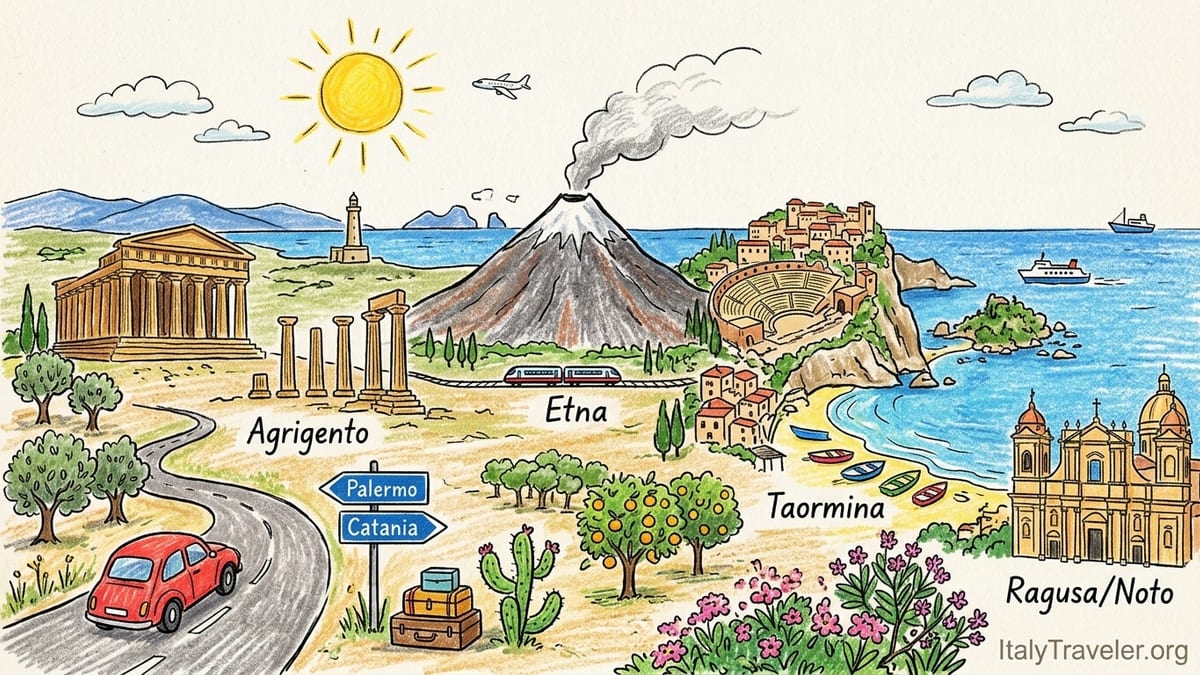
How Long Do You Really Need in Sicily?
Sicily is roughly 300 kilometers across and combines big cities, mountain villages, Greek temples, Baroque towns, volcano landscapes and multiple coastlines. Distances that look short on a map can stretch into long days once you add traffic, winding inland roads and time spent circling for parking near historic centers. For context, Palermo to Catania on the A19 motorway is close to 200 kilometers and usually takes about three hours by car or train in normal conditions, not counting breaks or congestion near the cities.
For this reason, trying to cover Palermo, Cefalù, Taormina, Mount Etna, Syracuse, the Baroque southeast, Agrigento, the west coast and the Aeolian Islands in a single week is likely to feel rushed and frustrating. A more satisfying approach is to focus on one half of the island for a seven-day trip, link both coasts in ten days, and reserve a full two weeks if you want to add slower detours such as the Egadi Islands, Segesta and the Villa Romana del Casale.
Flight patterns also affect planning. Many travelers arrive on direct seasonal services from Europe into either Palermo or Catania, and transatlantic connections usually require a change in Rome or Milan. Using an open-jaw ticket that arrives in Palermo and departs from Catania, or vice versa, can save you half a day of backtracking at the end of your trip when compared with a circular route that begins and ends in the same airport.
The three itineraries below are designed as complete routes rather than a single 14-day plan that is simply shortened. The seven-day option offers an eastern and a western version, the ten-day route links both coasts without racing every day, and the fourteen-day route adds secondary highlights and more relaxed pacing. At each step you will find suggested overnight bases, realistic driving distances, transport alternatives, food ideas and approximate daily spending.
Driving, Trains and Buses in Sicily After 2026 Rail Changes
As of September 14, 2026, the main rail artery between Palermo and Catania has fully reopened after infrastructure upgrades between Termini Imerese and Caltanissetta Xirbi. Regional and Intercity trains now again run across the island without long replacement-bus sections, cutting travel times and giving a reliable alternative to the A19 motorway. The Palermo–Agrigento line, which had summer disruptions in 2026 during works near Roccapalumba and further south, has also been restored to regular service from early October, meaning you can once more reach Agrigento’s Valley of the Temples by direct train from Palermo.
For long cross-island hops such as Palermo to Catania or Palermo to Agrigento, Trenitalia’s regional trains usually cost in the region of 12 to 20 euros per person in second class, depending on distance and promotions. Advance-purchase Intercity tickets on some longer routes can be similar or slightly higher. For a couple who only want to drive short coastal stretches, these train fares can be competitive with the combined cost of car hire, fuel and tolls, especially when you factor in city parking and the risk of fines in restricted traffic zones known as ZTL.
If you do rent a car, note that most Sicilian motorways are free of tolls. The A19 between Palermo and Catania, the A29 toward Trapani and Mazara del Vallo, and the Catania–Siracusa and Siracusa–Rosolini routes do not charge tolls. Tolls are currently applied on the A20 between Messina and Palermo and on the A18 between Messina and Catania, where you take a ticket at a booth and pay in cash or card at your exit. Typical tolls are on the order of 4 euros for Messina–Catania and around 10 to 11 euros for the full Messina–Palermo run, with small annual adjustments.
Speed limits on Sicilian motorways are usually 130 kilometers per hour for cars where indicated, but in practice many sections have lower temporary limits because of viaducts, tunnels or ongoing maintenance. Provincial roads (SS or SP) have lower limits, often 90 or 70 kilometers per hour, and can be slow through villages. Foreign drivers should carry their license plus an International Driving Permit where required, keep rental documents in the car and take extra care with ZTL zones, which are camera-enforced restricted areas in historic centers such as Palermo, Catania, Syracuse and Taormina. Fines are typically mailed to your rental company months later and then passed on along with an administrative fee.
7-Day Itinerary: East & Southeast Sicily (Plus a Western Alternative)
This seven-day plan is ideal if you fly into Catania and want a mix of classic views, Greek heritage, Baroque architecture and beach time. Distances are manageable, but there is still a lot to see, so think of it as a “taste of the east” rather than the definitive Sicily tour. Driving distances assume direct routing; actual days will run longer once you add sightseeing.
Day 1 to 2: Catania or Taormina and Mount Etna. Land in Catania and either base yourself in the city center or transfer directly to Taormina, about one hour away by car or train. A taxi transfer from Catania Airport to Taormina often costs around 100 to 120 euros, while the Interbus coach is usually under 15 euros per person. Spend your first afternoon exploring Catania’s Piazza del Duomo and fish market, or, in Taormina, the Greek Theatre and the viewpoint over Isola Bella. On Day 2, take a guided 4x4 or hiking excursion on the slopes of Mount Etna from Catania or Taormina, budget roughly 70 to 120 euros per person depending on how far up you go and whether cable cars or off-road vehicles are included. Overnight base: Catania or Taormina both nights. Daily spending for a couple with a mid-range hotel, meals out and an Etna tour can easily reach 220 to 300 euros.
Day 3 to 4: Syracuse and Ortigia. Drive or take a regional train or Interbus coach from Catania to Syracuse, around one hour and 70 kilometers by road. Trains are often priced around 8 to 12 euros per person. Base yourself on Ortigia island for two nights if your budget allows, as this puts you within walking distance of the Duomo square, the waterfront and evening restaurants. Allocate at least half a day for the Neapolis Archaeological Park, which includes the Greek Theatre, Roman Amphitheatre and the Ear of Dionysius cave; entry fees are usually under 20 euros per adult, with reductions for young people. Food-wise, Ortigia’s daily market is perfect for a simple lunch of arancini, panelle, grilled fish or a cutting board of cheeses, generally 5 to 15 euros per person depending on how much you order.
Day 5 to 6: Noto and Southeast Beaches. From Syracuse, drive around 45 minutes to Noto, a compact Baroque town ideal for slow evening walks and gelato under the golden facades of Corso Vittorio Emanuele. Many travelers choose to stay either one night in Noto itself or in nearby seaside villages such as Lido di Noto or Marzamemi. Use your days for a mix of Noto sightseeing and beach time at places like the Vendicari Nature Reserve, where car parks near popular coves such as Calamosche charge modest daily fees. Driving distances stay under 80 kilometers per day if you keep to this corner. A couple in a mid-range guesthouse can expect to spend about 180 to 250 euros per day here, including meals of seafood pasta or couscous and local wine.
Day 7: Return to Catania. Drive from Noto or Syracuse back to Catania Airport in around one to one-and-a-half hours. If your flight leaves late, you may fit in a short visit to Catania’s historic center or a last coffee at the Pescheria market. To avoid stress, reach the airport at least two hours before departure, more if you are returning a rental car at high season when queues at the counters can be long.
Western 7-day alternative from Palermo. If you fly into Palermo instead, focus your week on the northwest and Agrigento rather than racing to the east. Spend two nights in Palermo’s historic center exploring the Norman Palace, Palermo Cathedral and the Ballarò and Vucciria markets, then add a day trip to Monreale by city bus or taxi to see its famous mosaics. Drive or take the train to Cefalù for two nights, about one hour east; this small coastal town combines a broad beach with a medieval center below a dramatic headland. Finish with two nights near Trapani, using your full day there for a cable car or bus ride up to the hilltop town of Erice and an excursion to the salt pans between Trapani and Marsala, or, if you prefer archaeology, drive south to Agrigento for the Valley of the Temples and stay overnight before looping back to Palermo. Distances between Palermo, Cefalù, Trapani and Agrigento are generally between 90 and 200 kilometers, which translates into one and a half to three hours of driving.
10-Day Itinerary Linking Palermo, Cefalù, Taormina, Etna, Syracuse, Ragusa and Agrigento
Ten days gives you just enough time to connect Sicily’s north and east coasts plus a loop through the southeast and Agrigento. This route works especially well as an open-jaw trip flying into Palermo and out of Catania, which avoids duplicating the Palermo–Catania leg. With ten days, it is important to assign overnights where evening atmosphere matters most and to avoid daily hotel changes.
Day 1 to 2: Palermo (overnight Palermo). Arrive in Palermo and do not pick up a car on day one. Stay inside or near the historic center, move around on foot and by bus, and give yourself two nights. A central three-star hotel or guesthouse often starts around 100 to 160 euros per night in high season for a double room. Spend one full day visiting the Norman Palace and Palatine Chapel, the Cathedral, the Quattro Canti crossroads and at least one street market such as Ballarò, where a panelle and crocché sandwich or a slice of sfincione pizza can cost only a few euros.
Day 3: Cefalù (overnight Cefalù). Pick up your rental car on the morning of day three, either from Palermo city or at the airport, and drive roughly one hour east to Cefalù on the A20 motorway. Allow extra time to collect the car, check the vehicle, and get used to Italian road signs before reaching the more complex ZTL and parking situation in Cefalù’s old town. Afternoon is for the cathedral, the lungomare promenade and perhaps the panoramic hike up La Rocca. Budget around 50 euros for secure overnight parking and restaurant meals for a couple in addition to accommodation.
Day 4 to 5: Taormina with Mount Etna day trip (overnight Taormina or Giardini-Naxos). From Cefalù, continue along the A20 and A18 toward Taormina, a drive of about three hours and 220 kilometers, plus tolls. Plan to arrive in mid-afternoon to avoid the most congested times. Park in one of the multilevel car parks outside the historic center and use the shuttle or elevator system up to town. Spend two nights so that you have one full day for an Etna excursion or for a mix of the ancient theatre and beach time at Isola Bella and Mazzarò. Many Etna group tours from Taormina are priced from around 80 to 110 euros per person, not including lunch.
Day 6 to 7: Syracuse and Ortigia (overnight Syracuse / Ortigia). Drive about one and a half to two hours south from Taormina to Syracuse, skirting Catania. Some travelers prefer to drop the car in Taormina and take a train or coach to Syracuse to avoid city driving; others keep the car to use later in the southeast. Allow two nights in Syracuse so you can spend one full day between the Neapolis Archaeological Park and the narrow lanes of Ortigia, including a sunset aperitivo on the seafront. Daily budget for a couple here is usually in the 200 to 280 euro range with hotel, meals and site tickets.
Day 8: Ragusa and Scicli (overnight Ragusa Ibla or countryside agriturismo). From Syracuse drive about one and a half hours inland to Ragusa. Many visitors choose to stay in Ragusa Ibla, the lower old town, or in a rural agriturismo between Ragusa and Modica. On the way or as a short half-day trip, you might visit Scicli, a small Baroque town with quiet lanes familiar from Italian television series such as Inspector Montalbano. Ragusa’s charm shows in the evening when buildings light up and local restaurants serve dishes based on local ricotta, pork and vegetables. Parking is usually paid in marked bays around the historic center.
Day 9: Agrigento (overnight Agrigento). From Ragusa to Agrigento by car, allow around two and a half to three hours on inland roads. Alternatively, return the car and travel by bus or train via Caltanissetta or Gela, although connections can lengthen the journey. Plan to arrive by early afternoon so you can explore the Valley of the Temples in late daylight and stay through sunset, when the columns are illuminated. Combined tickets for the archaeological park and regional museum are usually under 20 euros per adult. Overnight in Agrigento town or in a coastal hotel at San Leone, about 15 minutes away by car.
Day 10: Palermo departure. On your final morning, drive or take the train from Agrigento back to Palermo in about two hours. With the Palermo–Agrigento railway back in full service after October 2026, direct trains again make this leg practical without a car, though frequencies vary by day. For a late afternoon or evening flight, you can fit a short stop at the beach in Mondello or a quick stroll in Palermo if you have already dropped off your car and stored luggage.
14-Day Grand Route Including Egadi, Segesta and Villa Romana del Casale
With fourteen days, you can slow the pace, add western highlights and include more interior sites. This itinerary suits drivers who are comfortable with longer days behind the wheel and a mix of city, coast and countryside. It is still wise to use an open-jaw flight if possible, for example arriving in Palermo and leaving from Catania, though a well-planned loop is also possible.
Days 1 to 3: Palermo, Monreale and Segesta (overnight Palermo). Spend your first three nights in Palermo, using public transport or organized tours for nearby sites. Dedicate one day each to Palermo’s core monuments and markets, a half-day trip to Monreale by bus or taxi, and a half or full day to Segesta to see its solitary Doric temple on a hill and the theatre with views across the countryside. Reaching Segesta without a car involves a coach toward Trapani with a stop near the park entrance, or a day tour from Palermo that may cost from 60 to 90 euros per person.
Days 4 to 5: Trapani, Marsala salt pans and Egadi Islands (overnight Trapani). Collect a rental car when leaving Palermo, then drive about two hours west along the A29 to Trapani. Use Trapani town as a base for two nights. One full day can be devoted to the salt pans and windmills between Trapani and Marsala, where small museums and boat operators offer short trips along the lagoon. Another option is a day trip to the Egadi Islands, especially Favignana, where frequent ferries from Trapani’s port run in less than an hour. It is better to dedicate a full day to Favignana rather than try to combine multiple islands quickly; you can rent a bicycle on arrival and circle to Cala Rossa or other coves, budgeting 20 to 30 euros for rentals and simple seaside meals.
Day 6: Erice and move to Agrigento (overnight Agrigento). Before leaving the west, take the cable car or drive the winding road up to Erice, a medieval hill town with stone lanes and views across the coast on clear days. Later, continue your drive toward Agrigento, which typically takes around three hours. Check into your accommodation and, if time allows, preview the Valley of the Temples from viewpoints such as the Temple of Juno before a full visit on day seven.
Day 7: Agrigento and Scala dei Turchi (overnight Agrigento). Devote this day to the Valley of the Temples plus a short excursion to the white cliffs of Scala dei Turchi, about 15 minutes’ drive west of Agrigento along the coast. There have been periodic access restrictions in recent years at Scala dei Turchi because of erosion and safety concerns, so verify on the ground whether you can descend to the beach or only view from above. This is also a good evening to enjoy a longer dinner before the inland drive planned for the next stage.
Day 8: Villa Romana del Casale and Enna area (overnight Piazza Armerina or Enna). Drive inland toward Piazza Armerina, approximately two hours from Agrigento, to visit the Villa Romana del Casale, a UNESCO-listed late Roman villa known for its huge mosaic floors, including the famous “bikini girls” and hunting scenes. Tickets are moderate in price and the site is mostly covered, which offers some shade or shelter in changeable weather. Stay either nearby in Piazza Armerina or in Enna, a hilltop town around 40 minutes away that offers wide views over central Sicily.
Days 9 to 10: Baroque southeast, including Ragusa, Modica and Noto (overnight Ragusa or Modica). Over two days you can trace a loose triangle between Ragusa, Modica and Noto, choosing one town as your base. Ragusa Ibla is romantic and compact, Modica is known for its historic chocolate shops, and Noto offers a linear main street of honey-colored palaces and churches. Daily drives between these towns are short, often under one hour, which helps rebalance the longer inland legs earlier in the trip. Plan your main meals around local specialties such as Modica chocolate bars, caciocavallo cheese and seafood on the coast near Noto.
Days 11 to 12: Syracuse and Ortigia (overnight Syracuse). Move north to Syracuse for two nights. With extra time compared with shorter itineraries, you can add boat trips around Ortigia’s sea caves, a visit to the catacombs of San Giovanni, or a relaxed half day at a nearby beach such as Arenella. Some travelers choose to drop their rental car upon arrival in Syracuse and complete the trip by train and bus to reduce stress around parking and ZTL enforcement in the final cities.
Days 13 to 14: Taormina, Etna and departure via Catania (overnight Taormina or Catania). Finish with two nights in Taormina or the nearby coastal town of Giardini-Naxos. Use one full day for Mount Etna, choosing between a guided hike in one of the nature park zones or a combined cable car and 4x4 trip toward the higher craters, if conditions allow. Your final day can be a calmer mix of Taormina’s Teatro Antico, last-minute shopping and a leisurely lunch before a short transfer, generally around one hour, to Catania Airport. For early flights, consider staying the last night in Catania itself and returning your rental car the previous evening.
Should You Add the Aeolian Islands?
The Aeolian Islands are a highlight of Sicily for many travelers, but they are best treated as a dedicated extension rather than an add-on squeezed into an already busy seven or ten-day itinerary. Reaching Lipari or Salina typically involves at least half a day each way: a drive or train to Milazzo or Messina, then a hydrofoil crossing that can take around one to two hours depending on the island and sea conditions. For islands such as Stromboli, journey times can be even longer. Once there, slow ferry timetables and limited inter-island connections make hopping between several islands time-consuming.
If you only have seven days in Sicily, trying to include the Aeolian Islands usually means sacrificing key mainland highlights such as Syracuse, Noto or Agrigento or reducing each stop to a single rushed night. Even with ten days, adding the Aeolians sensibly would require dropping parts of the circuit, for example focusing on Palermo, Cefalù and the Aeolian Islands, or on Catania, Taormina and the Aeolian Islands only. Two weeks gives more scope, but it is often wiser to plan the Aeolians as a separate future trip, or to make them the main focus with only a short pre- or post-stay on Sicily itself.
Another consideration is weather and sea conditions. Ferry services can be affected by strong winds or winter schedules, which may cut crossings or reduce frequency. In high summer, accommodation on islands like Panarea or Salina can also be expensive, easily surpassing 200 to 300 euros per night for mid-range places. For a first-time trip where you want to understand the character of Sicily’s cities, interior and coasts, concentrating your limited days on the main island usually delivers better value and fewer logistical surprises.
Open-Jaw vs Circular Routes, Costs and Practicalities
Choosing between an open-jaw itinerary and a circular route has a direct impact on driving distances and overall stress. An open-jaw route, such as flying into Palermo, traveling across the island, then departing from Catania, allows you to avoid duplicating the Palermo–Catania section by road or rail. Although open-jaw airfares can sometimes be slightly higher than simple round-trips, the savings in car rental days, fuel, tolls and time often compensate, especially for couples or families. For example, skipping a four-hour drive back to your original airport on the last day may save one or two nights of car hire at 40 to 70 euros per day plus fuel.
Circular routes that start and end in the same city can still work, particularly if flight options or rental car conditions favor a single-airport plan. In that case, design your loop to minimize zigzags. From Palermo, one effective circle for ten or fourteen days is Palermo, Cefalù, Taormina, Etna, Syracuse, Ragusa, Agrigento and back to Palermo. From Catania, a circle could run Catania, Syracuse, Noto, Ragusa, Agrigento, Palermo, Trapani and back to Catania via Cefalù and Taormina. Use the reopened Palermo–Catania and Palermo–Agrigento rail lines where convenient if you want to break the loop and avoid driving some segments.
Approximate daily spending varies widely, but for planning purposes a mid-range couple traveling in 2026 might expect a budget from about 180 to 260 euros per day outside the peak of August, including a double room in a three-star hotel or quality guesthouse, restaurant meals and local transport. Car rental can range from roughly 30 to over 70 euros per day depending on season, vehicle category and insurance. Fuel prices move with global markets, but filling a compact car’s tank in Sicily typically costs around 70 to 90 euros at recent price levels. Train tickets for intercity hops often fall between 10 and 25 euros per person, while long-distance buses such as those run by SAIS could be similar or slightly less.
Families should budget higher daily totals because of larger rooms, attraction tickets and food. A family of four in a single family room or small apartment might spend 250 to 360 euros per day for accommodation and meals in high season, plus transport. Apartment rentals can soften the blow by allowing some self-catering, especially in places like Syracuse, Ragusa or Cefalù where markets and bakeries make it easy to assemble breakfasts and simple dinners at home.
Rainy-Day Alternatives and Map-Ready Planning Tips
Even in Sicily, not every day is beach weather. Winter and spring can bring showers and, at higher elevations, cooler temperatures. Including indoor or mostly covered sights in your plan makes your itinerary more resilient. In Palermo, the Palatine Chapel, the Regional Archaeological Museum and several historic palazzi provide rich indoor time. In Syracuse, the archaeological museum complements the open-air ruins and helps fill wet hours. Villa Romana del Casale near Piazza Armerina is largely covered by modern roofing and walkways, making it an excellent rainy-day anchor in central Sicily.
On the east coast, Catania’s churches and the Benedictine Monastery of San Nicolò l’Arena offer shelter and context, while in Taormina you can shift from beach plans to leisurely lunches and shopping in Corso Umberto if clouds roll in. The Baroque towns of Ragusa, Modica and Noto remain atmospheric in light rain; their churches and cafes make it easy to dip in and out between showers. Having at least one such indoor-rich base every few days means the overall trip does not stall because of a passing weather front.
For mapping your routes, use realistic drive times rather than the most optimistic estimates on navigation apps. It often helps to think in terms of one major move every two or three days rather than daily relocations. A practical pattern is three nights in Palermo, two in Taormina, two in Syracuse, two in Ragusa and two in Agrigento for a ten or twelve-day trip, always planning to arrive in each new town by mid-afternoon. This leaves mornings for unhurried check-outs and scenic detours, and evenings for walking and dinner rather than highway driving.
Finally, keep an eye on transport news in the weeks before you travel. While the key Palermo–Catania and Palermo–Agrigento rail services have resumed after their respective 2026 works, Italy occasionally schedules new maintenance windows that introduce replacement buses or temporary timetables. Regional strikes can also affect trains and sometimes buses. Checking the latest notices from Trenitalia, local bus companies and news outlets shortly before each move will help you avoid surprises and adjust departure times if necessary.
FAQ
Q1. Is one week enough to see all of Sicily?
For a first visit, one week is enough to explore either the east and southeast or the west and Agrigento, but not the entire island comfortably. Trying to include Palermo, Taormina, Syracuse, Ragusa, Agrigento and the islands in seven days leads to constant packing and long driving days.
Q2. Do I need a rental car for these itineraries?
A car gives the most flexibility, especially for rural sights like the Baroque hill towns and Villa Romana del Casale, but it is not strictly essential. You can combine trains and buses for major legs such as Palermo–Catania or Palermo–Agrigento and then book local tours or taxis for shorter hops. Travelers nervous about ZTL zones and parking may prefer this mixed approach.
Q3. How much should a couple budget per day in Sicily in 2026?
A realistic mid-range budget for two adults is around 180 to 260 euros per day outside peak August, including accommodation in a three-star hotel or guesthouse, meals, local transport and modest sightseeing. Adding a rental car, fuel and tolls can increase that by 40 to 100 euros per day depending on car class, insurance and how far you drive.
Q4. Are driving and parking difficult in Sicilian cities?
Driving is straightforward on motorways but can be stressful in city centers because of narrow streets, scooters and ZTL zones monitored by cameras. Parking near historic centers is often in paid blue-line bays or in multilevel car parks outside the core, such as in Taormina or Cefalù. Many visitors choose to park once and walk or use public transport while in Palermo, Catania or Syracuse.
Q5. What are typical train and bus costs between major cities?
Regional train tickets for routes like Palermo–Catania or Catania–Syracuse usually fall around 10 to 20 euros per person, while intercity buses such as SAIS can be in a similar range. Prices vary slightly with distance and promotions, so checking your specific date and time is still important, but these figures help for broad budgeting.
Q6. When is the best time of year to follow these itineraries?
Late spring from May to June and early autumn from September to mid-October balance warm weather with more manageable crowds and prices. July and August are hotter and busier, especially on the coast, while winter months bring cooler temperatures, shorter days and more limited ferry schedules to islands like the Aeolians and the Egadi.
Q7. Can I visit Mount Etna without a guided tour?
You can drive or take a bus to the Rifugio Sapienza area on Etna’s southern slope and walk the lower craters on your own. However, access to higher-altitude zones is tightly regulated for safety, and most visitors opt for guided hikes or organized 4x4 and cable-car combinations that provide equipment, local knowledge and clear information on current volcanic conditions.
Q8. How should I handle tolls on Sicilian motorways?
Tolls apply mainly on the A18 between Messina and Catania and the A20 between Messina and Palermo. You collect a ticket when entering the toll section and pay at your exit with cash or card. Other principal routes, including Palermo–Catania and Palermo–Trapani, are toll-free. Keep some small euro notes or coins in the car to make paying easier and avoid delays.
Q9. Are the Aeolian Islands realistic for a first-time week in Sicily?
Including the Aeolian Islands in a seven-day mainland itinerary is usually too rushed. Reaching islands like Lipari or Salina involves a combination of train or bus to ports such as Milazzo plus a hydrofoil, which already uses much of a day. For a relaxed experience, plan them as a separate trip or dedicate at least three or four days of a longer Sicily stay specifically to the Aeolians.
Q10. What are good rainy-day activities in Sicily?
On wet or cool days, focus on indoor-rich sights such as the Palatine Chapel and museums in Palermo, the archaeological museum in Syracuse, the mosaic-covered Villa Romana del Casale near Piazza Armerina, and the many churches and cafes in Baroque towns like Ragusa and Noto. These places allow you to stay mostly under cover while still experiencing Sicilian culture and history.